The story
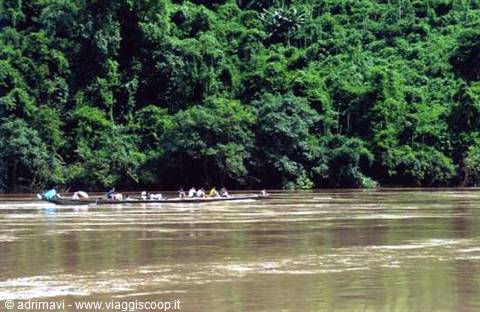
The Mekong, literally "mother of all waters", stretches for 4,500 km and ranks twelfth among the longest rivers in the world. It is a hugely important river route, the true "motorway of Laos". Navigating it means taking a journey from another age. We limited ourselves to travelling about 300 kilometres up it, from Luang Prabang to Huay Xai, just enough to slip into this world quilted with out-of-the-way villages.
Luang Prabang is the starting city. The day before we had negotiated the rental of a speed-boat for the first day, as far as Pakbeng (about 160 km, in a little over 3 h 30') and of a slow boat for the second day, from Pakbeng to Huay Xai (about 140 km, in 7 hours). From the moment we board, the air is full of adventure. The small shack that serves at once as ticket office and trattoria spreads through the air, which smells heavily of river, the sound of an endlessly repeated chant. From here we set off in search of isolated places far from the civilised world. For a good 25 kilometres, that is until the first stop, at the Pak Ou caves, the fear does not lift. On the very colourful speed boat the seats are uncomfortable, the muscles tense — not because of the position, but out of anxiety about capsizing or crashing into some boulder sticking out of the water.
The noise of the engine is proportionate to the speed. The more deafening it is, the faster we race across the surface of the water.
The Pak Ou caves, where in the 16th century King Setthatirath brought all his Buddha statues to keep them from the Burmese invader, today house more than 4,000 representations of the Enlightened One. We set off again. Little by little we grow confident with the vessel, the river and the speed, enough to urge the pilot into a race with another speed-boat heading up the river on the opposite bank. Once we have overcome our initial worry about the safety of the transport, we can now look around. The river has an oceanic vastness and is surrounded by a spectacle of forests and cliffs that fill the horizon and are dotted with tiny villages. As the day wears on, the heat grows, and with it the smell of silt rising from the river. Whenever we stop, the mosquitoes attack us from all sides, but when we set off again the speed drives everything away: mosquitoes, heat and the smell of mud.
The second stop is in a village a little bigger than those we have seen so far from a distance. We don't immediately understand the reason for the stop until a boy with a "pump" emerges from a little floating house. The young man puts the hose in his mouth, sucks hard and — as soon as the petrol comes out — starts to fill up. The process is slower than the ones we are used to, so we get off to stretch our legs. The inside of the ramshackle hut displays every kind of tin and chocolate. We have, to all intents, ended up in a "Mekong service station". We reach Pakbeng in the late afternoon. I spend a sleepless night, tortured by the humid heat, by the mosquitoes that seem to pierce the mesh of the net with no trouble, on constant alert because of the many giant geckos moving about the walls of the room.
Presiding over the scene at dawn is the market, with the noise of the sellers getting ready to set up their stalls on makeshift counters, lopsided crates or directly on the ground, on simple sheets. The traders strike us. They carry sacks of rice, vegetables and produce on their curved backs, supported by a strap that passes across their foreheads, walking along uneven paths with only flip-flops on their feet. Pakbeng is by now a "touristy" place in the sense that there are two guest houses, a hotel, a few small restaurants and some globe-trotting travellers with packs on their backs. Pakbeng is the base for visiting the surrounding Hmong villages, where opium poppies are grown. We can't find anyone to accompany us, so the excursion falls through. We then immerse ourselves in the calm confusion of the market.
Alongside the traditional traders, and those selling not-very-identifiable insects, alive, shut inside small plastic bags of which people buy up quantities, there are some dealing illegally in opium, bought in precisely the inland villages we wanted to visit. The butcher's area is gruesome because of the pieces of bleeding meat on display. Boys with Kalashnikovs slung over their shoulders move about the market.
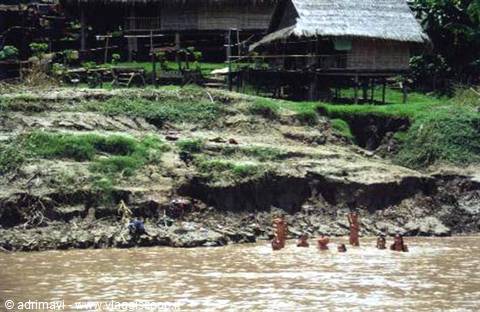
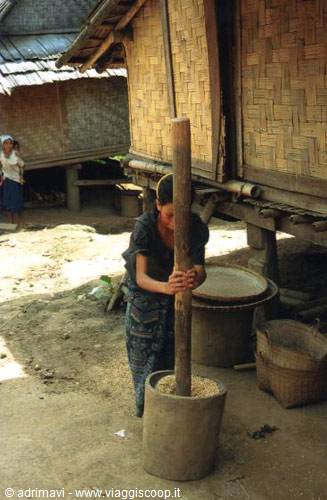
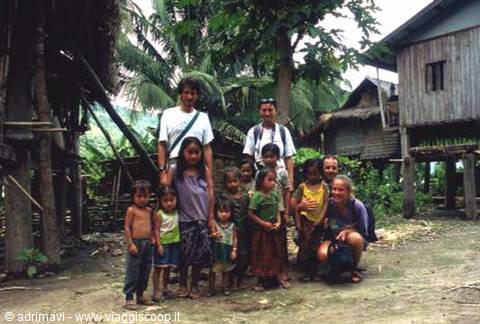
We resume navigation on the Mekong, setting sail on a slow-boat, a long, slow barge. From here we witness and discover the unfolding of life on the Mekong. We watch the tangled monsoon forest climbing steep, sheer peaks, and the different kinds of plantation. We stop at a few small villages that rise on the bank, which perhaps do not even have a name. They can be reached only by river; the houses are wooden stilt dwellings with roofs of straw and palm leaves. We notice with astonishment deadly cluster bombs used, in the Vietnam War, recycled as supports for the houses and to channel water into the rice fields. There is nothing modern: no roads, no cars, no televisions, let alone satellite dishes, no radio, no electricity. Fishing is the main activity along with growing rice. Vegetable plots crowd the banks. The hospitality is the same in all of them.
The forced stillness of the boat left to the placid calm of the river waters, over which it struggles along, makes us from time to time miss the speed boat. We finally penetrate, after 300 km of broad valleys and narrow gorges, into the heart of the notorious "Golden Triangle", the region sadly famous for opium growing, whose trade across the borders of three states became particularly lucrative between the sixties and seventies, when the Americans meddled in this profitable market, expanding its outlets worldwide. Opium became for the CIA the means to finance war operations in Indochina. Huay Xai is a city racing towards the whirlpool of opulence that television screens project. There is no set not tuned to channels or radio waves from neighbouring Thailand.
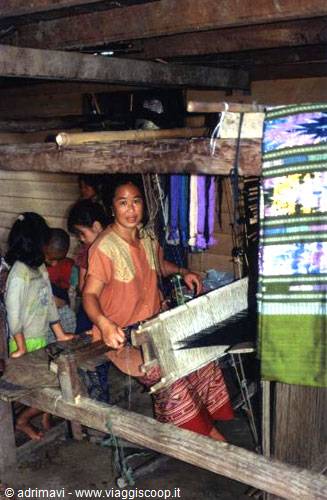
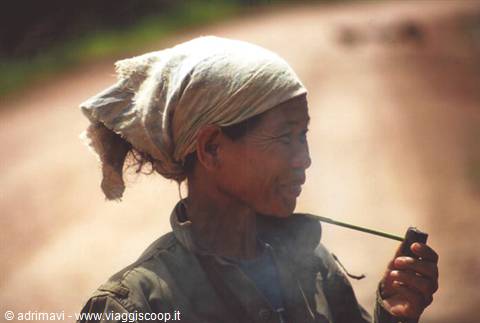
Progress will not be long in coming, as the fake Rolexes and the first mobile phones on the stalls, along the Mekong, next to the fish and fruit, show. The next day we visit the surrounding villages. They are huddled one against another, and the different ethnic groups live together so peacefully that it is hard to tell them apart. In one of Thai Lu ethnicity we find women busy working on rudimentary looms; in another, some people, with broad, convincing gestures, invite us to follow them. Puzzled, we find ourselves in a small Catholic church built by a French priest. In an Akha village we catch sight of an elderly woman smoking an opium pipe, confirming that it is traditionally the elderly who find support in it. The opium market is today so restricted that, officially, two-thirds of the production does not leave the provinces where it was grown.
The old lady signals us to follow her and takes us to an opium house, one of those places where men gather to smoke it. This time we decline the invitation to go in! Finally we visit a village of Lao Huay, curious because the inhabitants all dress in dark blue and the women are distinguished by the characteristic coin (an Indochinese piastre) hanging from their long straight hair.
The journey's photographs
11 photographs · click to open them full screen

0 reader comments