Our trip was planned from south to north, following the normal course of the cherry blossom, so going from the Chugoku region to that of Kanto, reserving Tokyo for the final days... a shame, though, that this year the weather was crazy and the cherries blossomed first in Tokyo and then in the south! It wasn't a great loss because we still saw millions of sakura in bloom, but in Tokyo they had already faded and let's say that keeping Tokyo as the last stop can be a little disappointing after all the wonders seen... but let's take things in order!
Day 127 Mar 2007
Let's just say the trip didn't exactly get off on the right foot, because we land in Rome on time, but then our Rome-Tokyo flight gets cheerfully cancelled due to engine problems! Alitalia keeps us waiting for a couple of hours standing next to the baggage carousel, saying they don't know whether they'll rebook us on other flights (yeah right… there were like 250 of us!), or whether they'll repair the plane, or whether they'll dump us in a hotel to find a solution the next day… At a certain point it becomes clear that the plane is in no condition to fly, neither that day nor the next, the other planes don't have room for 250 people, and they park us all in the freezing cold in the airport lot waiting for a bus to take us to a hotel, without knowing whether we'd be leaving the next day.
The whole thing was just wonderful because there were businessmen who had to be in Tokyo for business appointments and even a group of musicians who had a concert on the 28th! So I don't need to tell you the level of hysteria. Among other things, in Tokyo we had a flying appointment at 10 in the morning with our friend Masaki, who was supposed to hand us a borrowed cell phone to use during the vacation (the Japanese phone system isn't GSM, so even our tri-band or quad-band phones are useless there) and he was going to leave for Osaka at 11, so the appointment had clearly gone up in smoke. Meanwhile we meet a really sweet Japanese girl named Erika, and we start chatting with her.
Luckily my Michelino is a crafty travel agent, so he immediately calls his brother at the agency and has us book two seats on the Japan Airlines flight (which is an Alitalia partner) leaving at 9 in the evening, even though the hostesses tell us that if we don't have a ticket there's nothing that can be done… well, long story short, in the end we manage to talk to someone more important and more competent who verifies that our reservation shows up with the Japanese airline and changes our ticket into a JAL ticket! So the businessmen and musicians stay on the ground, while the two of us are the only ones who leave! So my advice is to have a well-prepared, trusted travel agent who can help you in these situations, because if it had been up to Alitalia we would have left the next day flying with Lufthansa to Frankfurt and then from there to Tokyo, practically losing two days of vacation! Unf
ortunately the same trick doesn't work for Erika, because since we met her during this situation, by then JAL had already closed bookings, and she also stays on the ground, and on top of that, since her visa had expired, she can't transit through any airport, so she has to wait for the next direct flight two days later, poor thing, what a shame we didn't meet her earlier!
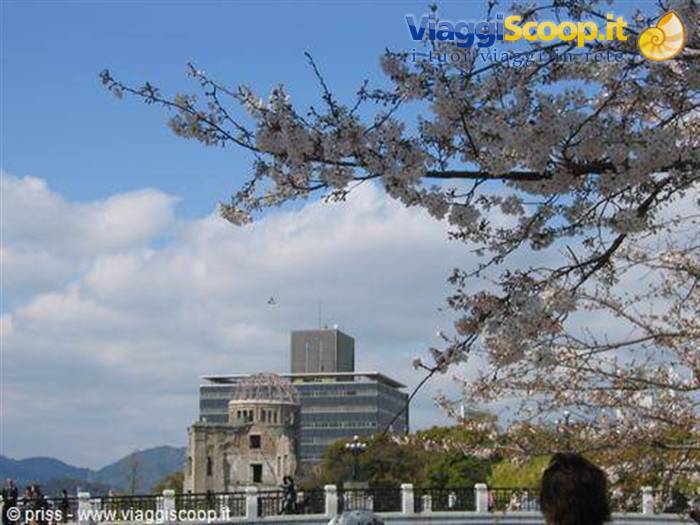
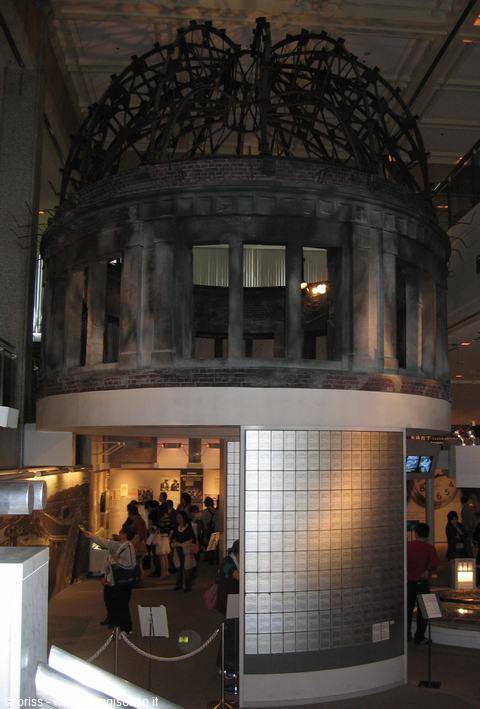
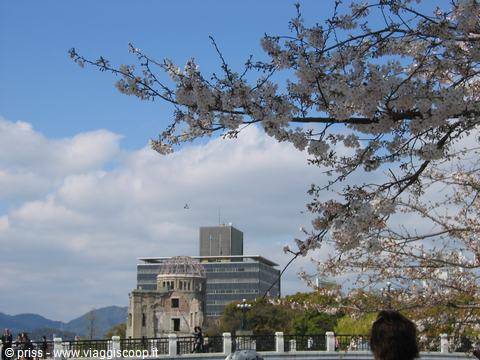
Genbaku dome
Day 228 Mar 2007
Given the delay in departure and the hands moving forward 7 hours once we arrive in Tokyo (during this period it's 7 hours because they don't have daylight saving time there), we land at 4:30 local time. Still on the plane we hear our names called over the loudspeaker: Masaki had left the phone for us with the ground crew and we saw it handed to us as soon as we set foot on Japanese soil! We pick up our luggage, change some money at the airport, pick up our Japan Rail Pass and already it's six in the evening.
On that note, even though by now it's extremely well known, let me suggest to anyone who wants to take a trip to Japan to buy the Japan Rail Pass because even though it doesn't include the super-fast Nozomi train, it lets you take any other JR line train (including the Hikari and Kodama Shinkansen); in two weeks we only bought a couple of bus tickets in Kyoto and one subway ticket in Tokyo, for the rest we were able to visit every corner of the city by train! Be careful, the pass must be bought in Italy, it can't be purchased once you're in Japan; a voucher will be sent to you along with instructions on where to go at Narita airport to pick up the actual pass.
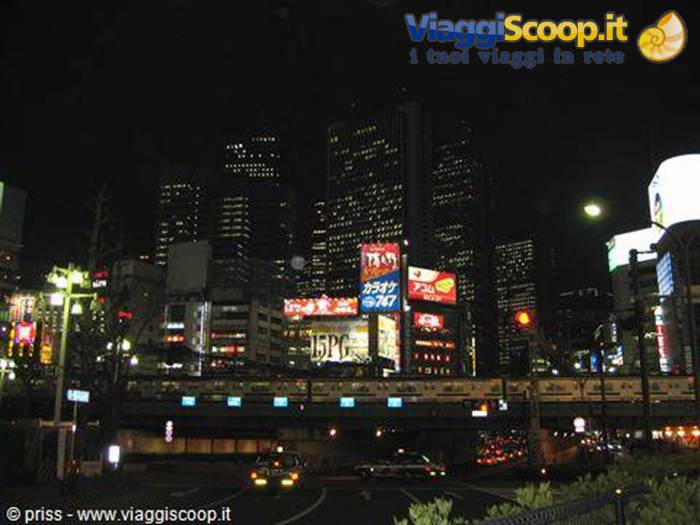
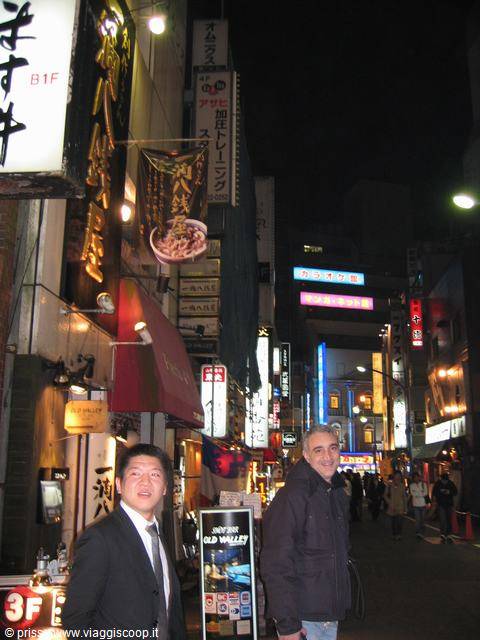
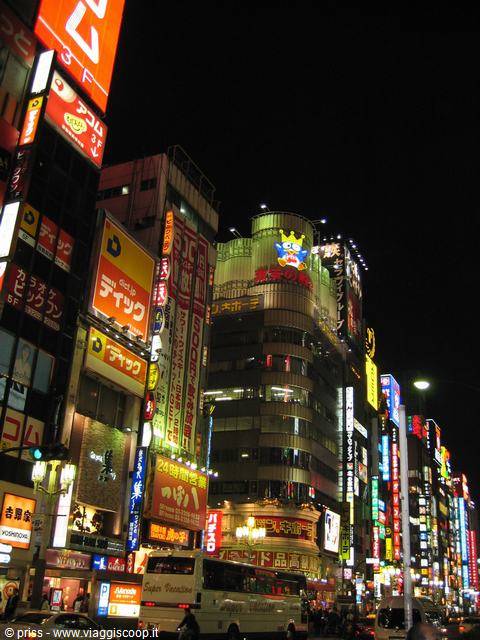
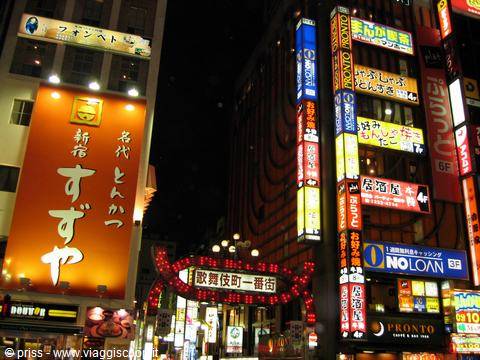
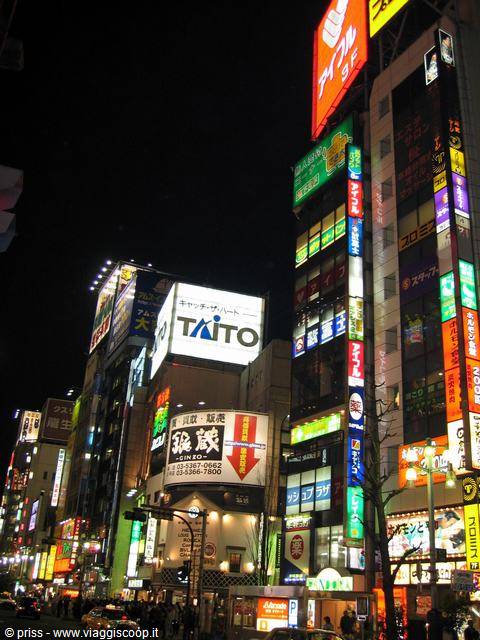
Going back to the trip, initially we had planned to immediately take the train from Tokyo to go to the Okada family's house, other friends of ours who live in a village an hour from Himeji, but once we arrived at Narita, after 12 hours spent at Fiumicino and another 12 on the plane, we were decidedly tired, so we didn't feel up to doing an hour by train to Tokyo, then 3 and a half hours to Himeji and another hour to Kamigori, so we take a night at the same hotel we booked for the end of the trip. After a nice shower and a bit of restoration, it's nine in the evening and here we are among the incredibly colorful streets of Shinjuku. We stroll a bit among groups of "salarymen" in jackets and ties, visibly tipsy, restaurants with plastic food displayed like 3D menus, and we look at every shop window, every illuminated sign, we follow the aromas in search of a place to eat.
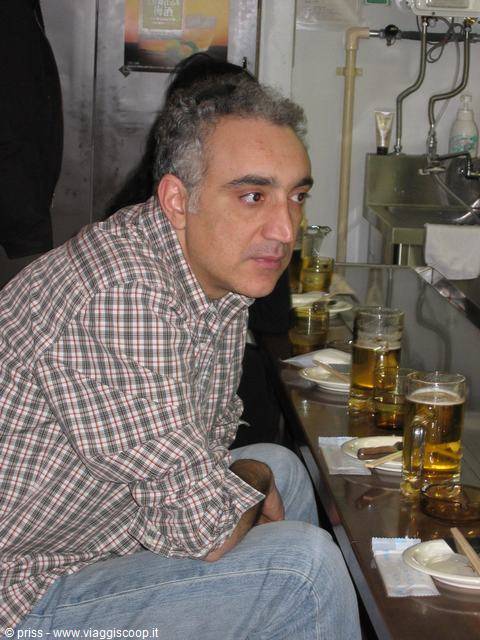
Mistaking it for a restaurant, we end up in a bar (izakaya) and order snacks and beer that we devour in an instant; we would have liked to order more, but even in a neighborhood like Shinjuku, bars accept orders only until 10! A truly strange thing for us Sicilians! Well, for today we go to bed with our little bellies a bit empty!
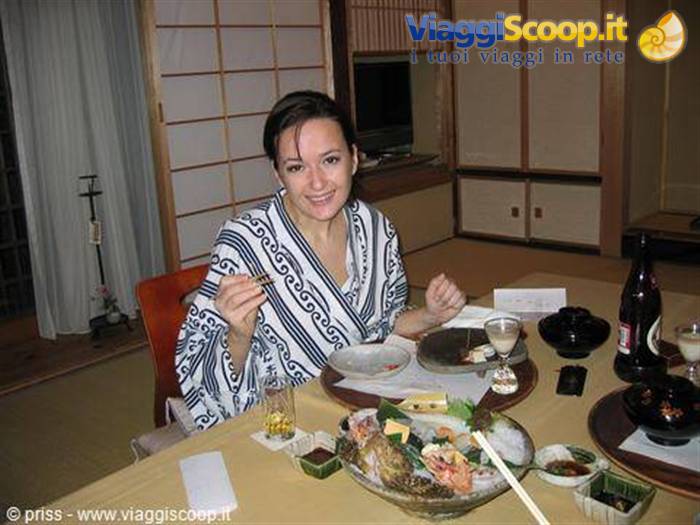
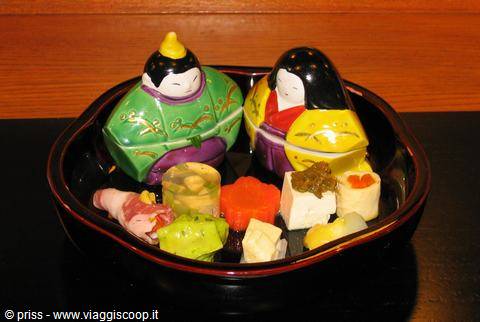
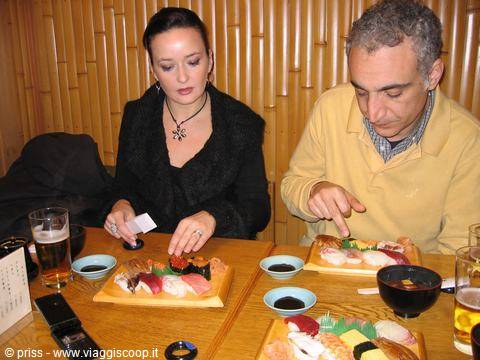
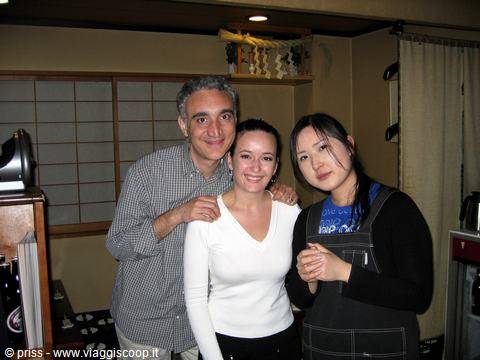
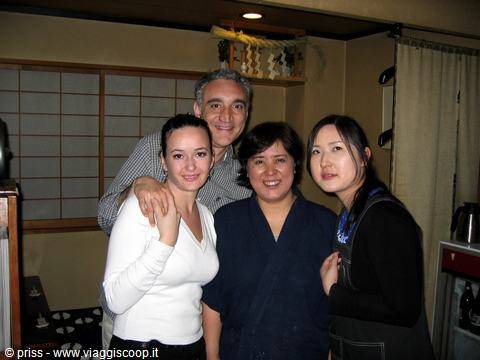
what a fairytale dinner!
Day 329 Mar 2007
Struck by the curse of jet lag, even though we'd gone to bed at midnight and were destroyed by the trip, we wake up at 4 in the morning! We fall back asleep at 7 and wake up for good at nine thirty. Since on the Shinkansen leaving for Himeji in the morning there were only smoking seats available (the Japanese smoke a lot! And even in public places like bars and restaurants, something I never stop being amazed by!), we book the 2:00 PM one and have a bit of time to spend in Tokyo.
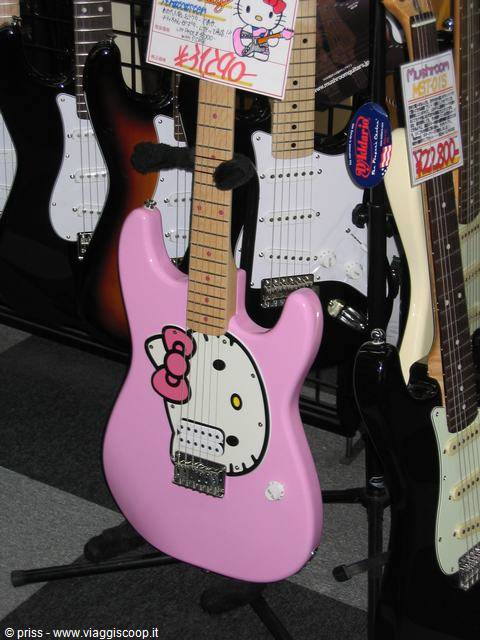
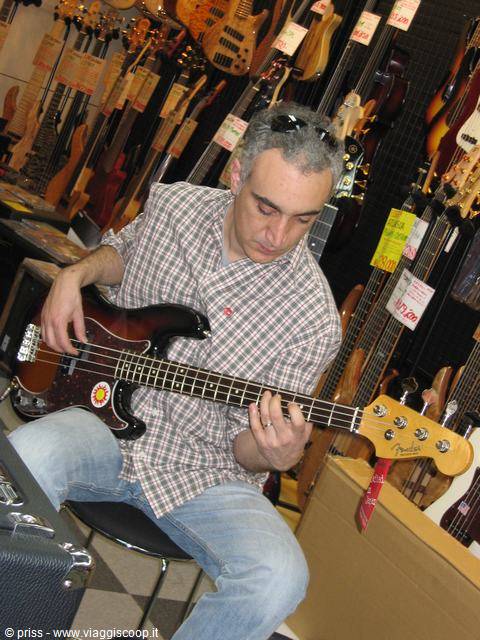
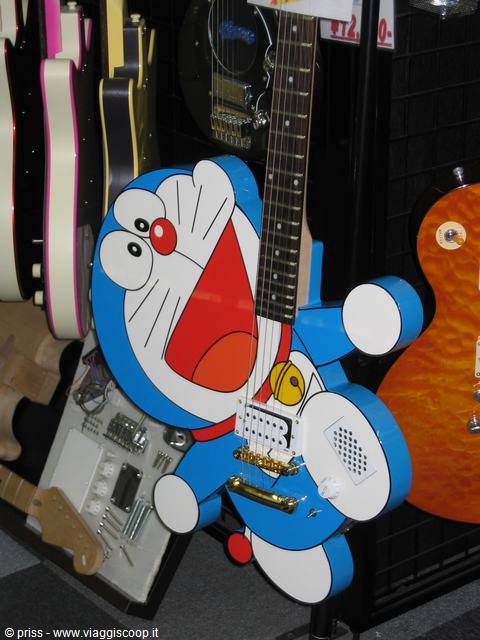
At this point Michele immediately wants to go see some bass guitars in a musical instrument store in Shibuya; unlike the serious music stores we visited in the United States, in Tokyo it's fun: there are tiny multicolored electric guitars (for dwarves or children?), normal-sized guitars but shaped like stars, Hello Kitty or even Doraemon… an incredible thing, and clearly Michele buys a new bass, though strangely he chooses a very ordinary white Fender with a tortoiseshell pickguard… I could totally see him with the Hello Kitty guitar! But obviously we'll pick it up when we return to Tokyo at the end of the trip. Then we set off for Himeji after buying an ekiben (a ready-made meal sold in wooden boxes complete with disposable chopsticks that you buy at the station; it can contain just about anything!) to eat on the train.
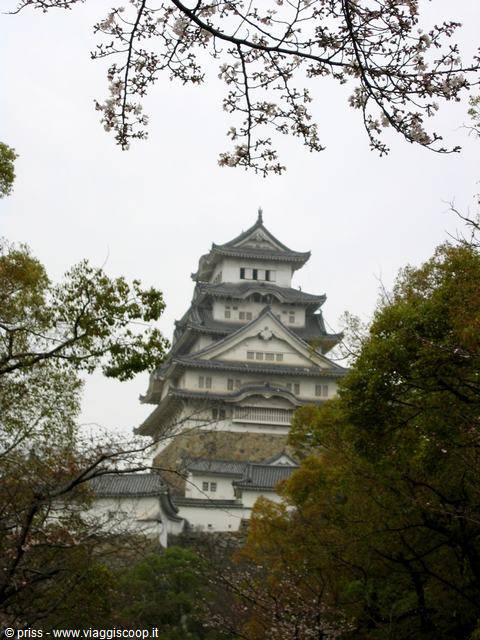
Once we arrive in Himeji we already see the marvelous castle lit up in white in the twilight; Yuji and Yukimi Okada (whom I met 18 years ago when I was little more than a child on the beach in Taormina) are waiting for us and take us to their splendid house in Kamigori, where we have a real mini-apartment to ourselves: a little entrance, a room with tatami and futon, a bathroom and a small kitchen with a minibar stocked with every kind of drink.
Before sitting down to eat the excellent dinner Yukimi prepared for us, we give the Okadas the gifts we brought: a necklace for her and a wooden case with sommelier "tools" for Yuji, silver and Swarovski earrings for their daughter Mioto, and a spider-shaped computer screen cleaner for their son Yuri, plus some gifts from my sister… clearly we brought gifts for all the Japanese friends we would meet, given their hospitality; we thought that once delivered we'd find ourselves with a bit more space in our luggage… instead each of them reciprocates with equally beautiful gifts! Between what they give us and what we buy, our luggage will gradually take on absurd dimensions! One more clarification about gifts in Japan: they're a serious matter, they're given with two hands and a small bow, and then the Japanese don't open them right away, but once you've parted ways.
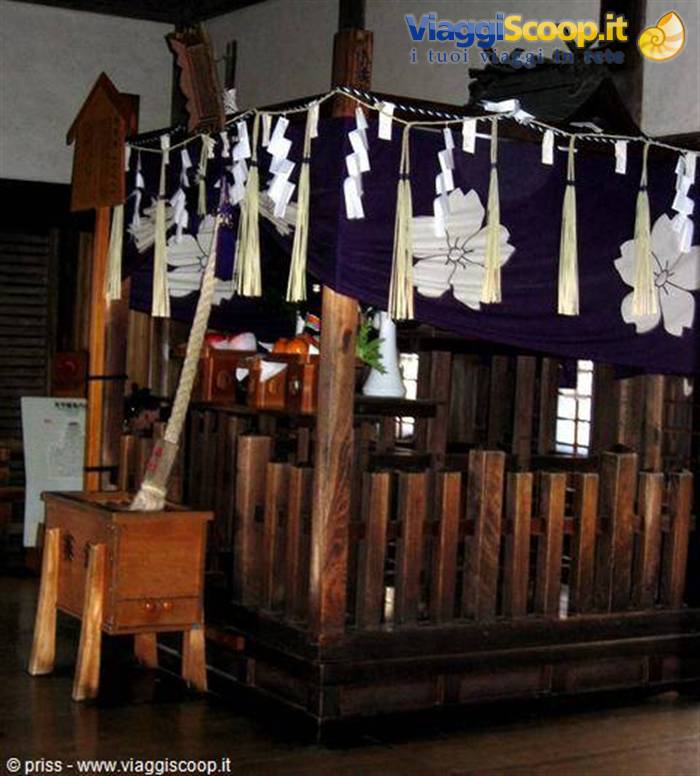
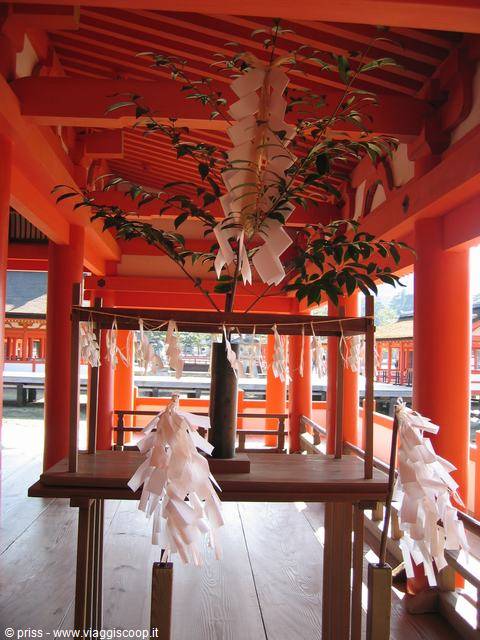
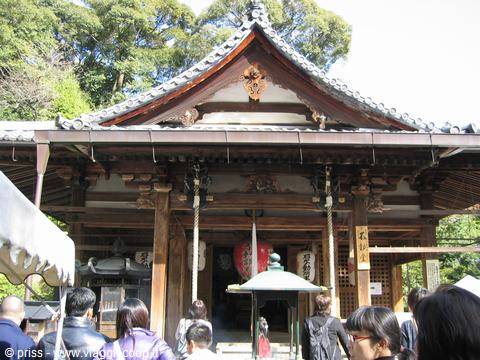
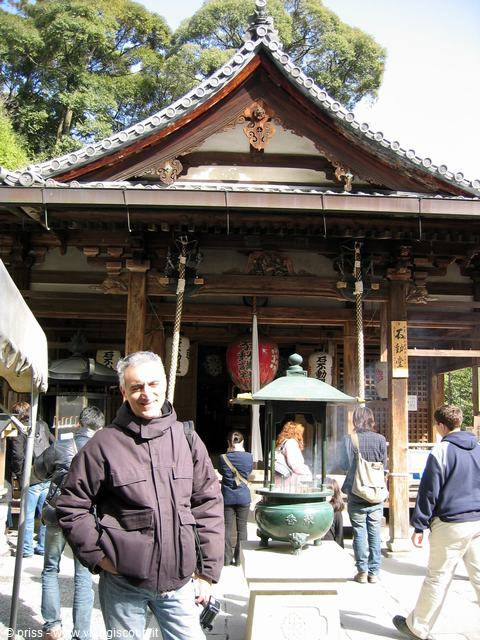
Altare in legno con corde shimenawa e bandiere viola, santuario interno
Day 430 Mar 2007
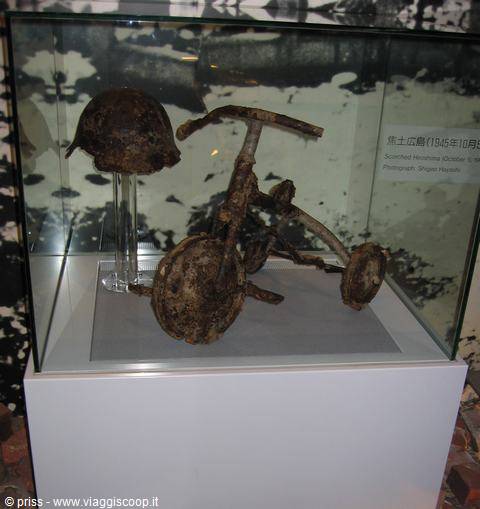
Wake-up (traumatic) at 8:30, we have to take the Shinkansen to Hiroshima! Once we arrive, Yukimi, Michele and I, just to start the day off on a cheerful note, go visit the Peace Park with its cenotaph and the Peace Memorial Museum: Yukimi, who until a few years ago lived right in Hiroshima, doesn't come inside with us. Once inside, we immediately realize how for her this museum represents an all too harrowing memory. I've often read that this museum is reproached for lingering too much on the suffering of the people of Hiroshima, neglecting the wartime cruelties committed by the Japanese and describing the atomic bomb as if it had fallen from the sky without placing it in a historical context.
Well, honestly I think anyone making these criticisms should be ashamed, because it's quite clear that the museum's intent isn't useless pity or whining, but rather to depict a chapter of human madness by telling the story from the point of view of children, of those who only suffered the war. After all, that's also understandable. It does so in a harrowing, merciless way, sparing the visitor nothing, so the incredibly long procession of horrifying photos, of sandals, uniforms, tricycles, lunch boxes and a thousand other objects belonging to children and young people who were wiped out in an instant, the minute descriptions of wounds and agonies are brutal and terrible, but necessary.
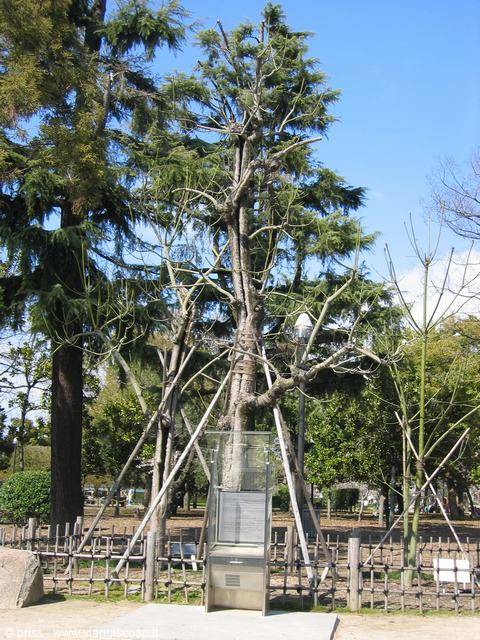
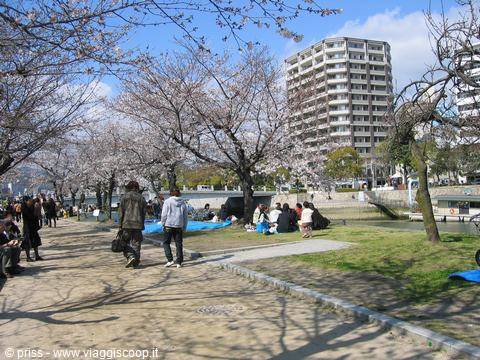
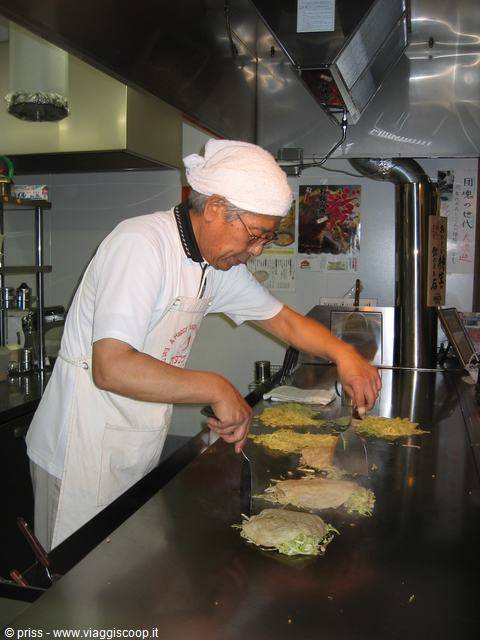
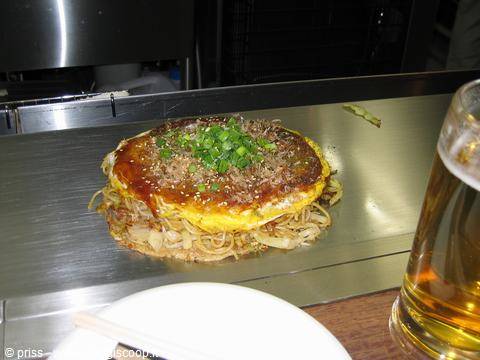
Having left the horror behind, we stroll in the calm Peace Park, dotted with commemorative monuments including the one to little Sadako Sasaki, whose story I read when I was a child too, and where children still bring long strings of paper cranes in remembrance. The day is splendid, we linger among the cherry trees in bloom and the citizens having picnics on their usual blue tarps, and we make it all the way to the Genbaku, what was once the Prefecture's Industrial Promotion Hall and is today the Peace Dome, recognized a few years ago as a UNESCO World Heritage Site. Forgive me for switching from serious to lighthearted, but I'd like to recommend to anyone going to Hiroshima not to miss the experience of tasting Okonomiyaki, a truly inimitable local dish.
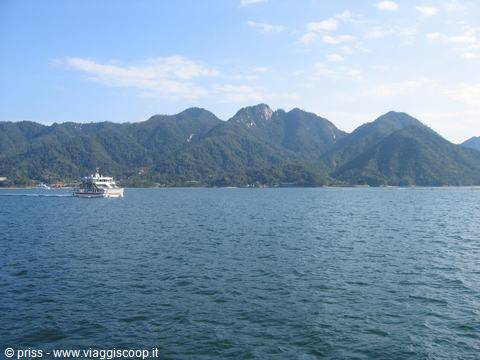
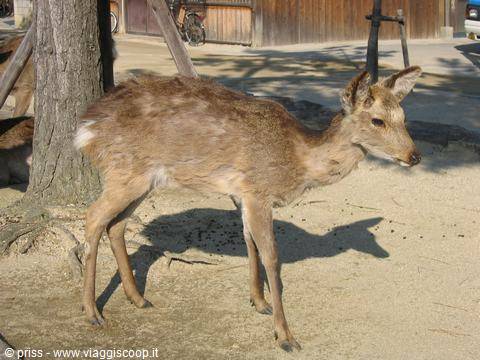
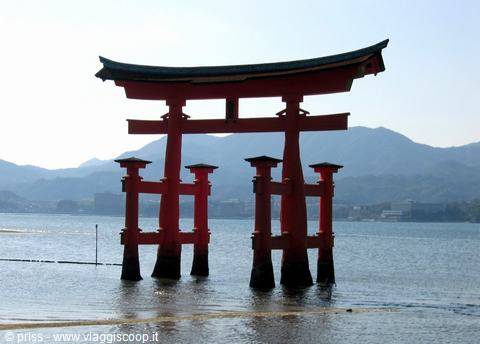
We then take a little train and go catch the hydrofoil that takes us to Miyajima. No place could have cheered our hearts more than this. Miyajima is a small island mostly covered by untouched, uninhabited forest, home to only a tiny village, a pagoda and a shrine, but at the same time it's a splendid place with absolute peace (there are no cars on the island), full of deer with sweet little eyes, and from which you can admire one of the most famous "postcard" views in all of Japan: the Torii of Itsukushima Shrine. Placed at the mouth of the bay, this torii really seems to float on the water, as does the shrine itself at high tide, since Itsukushima-jinga is built on stilts; in any case, even when the tide is low the bottom is not at all muddy or smelly as you might expect, and it's a truly splendid place.
To enjoy the view of the island, you go up by cable car to Mount Misen, where there are mischievous monkeys living freely and having fun snatching things from tourists!
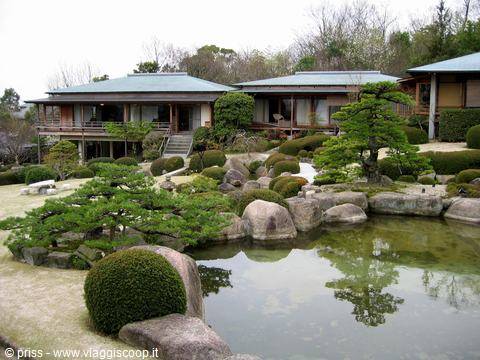
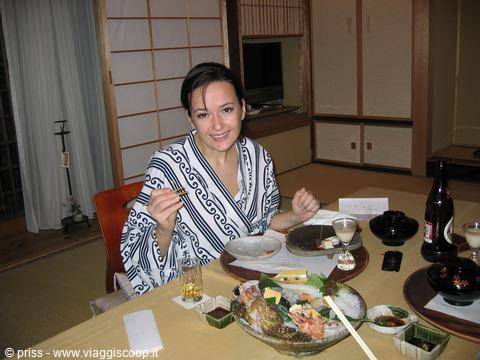
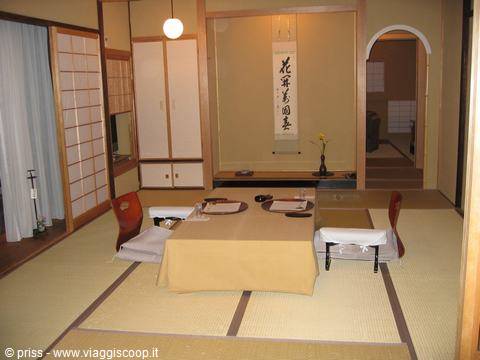
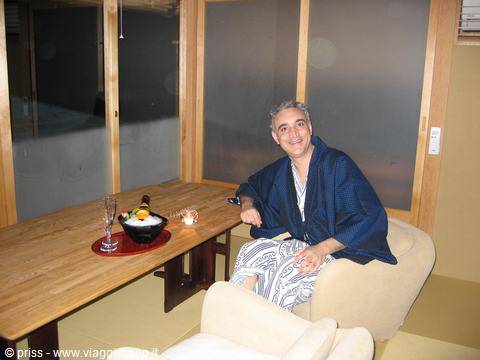
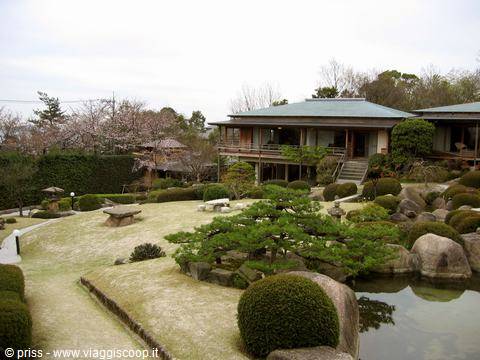
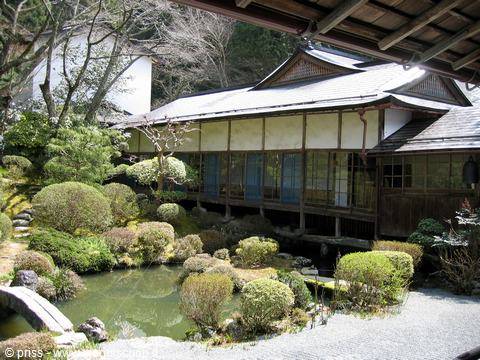
Having left the island, we go to the splendid Ryokan Sekitei that the Okadas wanted to give us. It's no small gift, because this ryokan is ranked second among the most beautiful in all of Japan! It's built entirely of cedar wood and smells wonderful; we leave our shoes at reception and go to our room (there are 10 in all, but it would be better to call them lodgings, since each one includes a dining room, bedroom, a little veranda with chairs from which to admire the zen garden, a bathroom with sink, a bathroom with shower, an upper floor with a wooden bathtub with a panoramic view, and a romantic sitting room where at the end of dinner they served us champagne by candlelight); on the floor tatami is mandatory, and to keep your little feet from getting cold it's clearly heated!
Before dinner we stroll in the marvelous garden with a pond complete with carp, and then, having put on our yukata, we head to the onsen (hot springs). The tubs are separated between men and women because you go in completely naked; before entering the tub you must wash yourself well with soap and hot water, both because the tubs are communal and therefore must not be dirtied, but also to accustom your body to the decidedly high temperature, because if you went straight into the hot water the temperature difference could cause a rise in blood pressure. For the same reason you enter the tub little by little and only after a while do you immerse yourself up to your shoulders. When we went before dinner there was no one there, and I found myself in a beautiful garden with two large stone tubs, enjoying the hot bath under the tree fronds. An almost mystical experience!
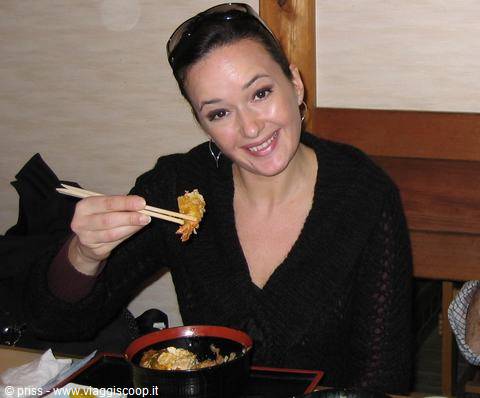
Back in our room they serve us dinner… an endless series of elaborate and exquisite courses, but since it was all written in Japanese, don't ask me to tell you what it was! I only know that my Japanese friends to whom I showed the menu all told me "this is a veeery special menu"; I certainly recognized monkfish sashimi, shrimp, then there was a crab broth, grilled oysters, lobster, grouper, all cooked and presented in a way that was a joy for the eyes as well as the palate. We ate uninterruptedly for two hours! And then a good sleep in our futons with silk blankets. Oyasuminasai!
Kyoto!
Day 531 Mar 2007
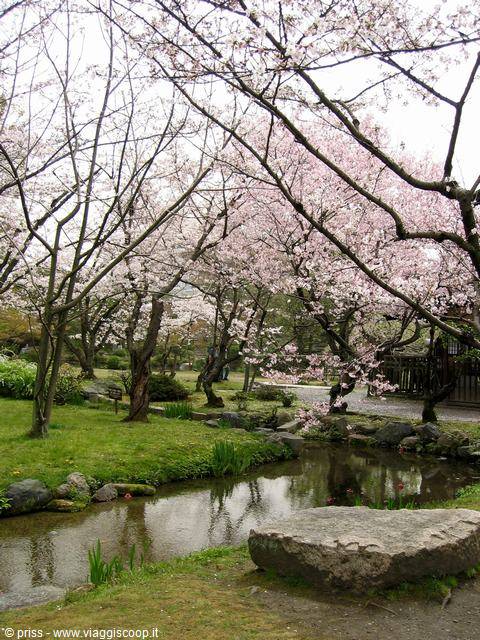
At eight they serve us our splendid breakfast; after one last stroll in the zen garden we leave Sekitei… an experience we won't forget! We go to Okayama, where one of the 3 most beautiful gardens in Japan is located: Korakuen, from which you can glimpse Okayama Castle, also known as the crow castle because of its black color. It's a truly splendid garden created at the end of the 1600s and designed to be beautiful throughout the year: in summer you admire the iris garden, in autumn the flaming maples, in winter the snow-covered conifers, and we got the cherry trees in bloom!
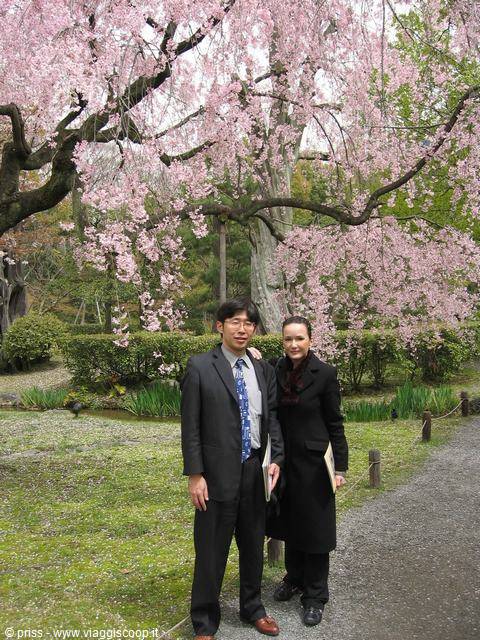
The day is a bit gray, but despite that it's really beautiful to stroll among the rice and tea fields. Yukimi has me take part in a small tea ceremony in one of the park's special little houses; she teaches me how to bow, how to sit, and above all how to turn the cup before and after drinking the very bitter matcha green tea accompanied by mochi, typical glutinous rice sweets (sweets so to speak, since they're tasteless and gummy!). In the garden there are also no fewer than three couples of newlyweds having their photos taken under the sakura, so we get to admire their splendid kimonos. We meet the rest of the Okada family, that is Yuri and Mioto, Yuji and Yukimi's children, who are now 23 and 20… when I last saw Yuri he was 5! Just think!
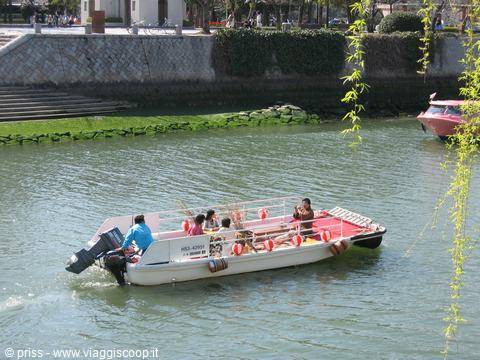
We all go together to Kurashiki. This little town doesn't have any particular standout attraction, but it's absolutely delightful to stroll along its canal lined with craft shops, small museums, sake bars, and watch the carp darting about from the bridge. An enchanting little town! Here we buy Bizen-yaki ceramic glasses specifically for beer; these glasses, with their almost rough appearance in terracotta-colored ceramic with metallic reflections, are wonderful for drinking beer, because they have the property of making the foam full-bodied, and they're truly exceptional. For dinner Yuji takes us to an incredible little restaurant: only ten seats and delightful dishes presented masterfully by its Taisho.
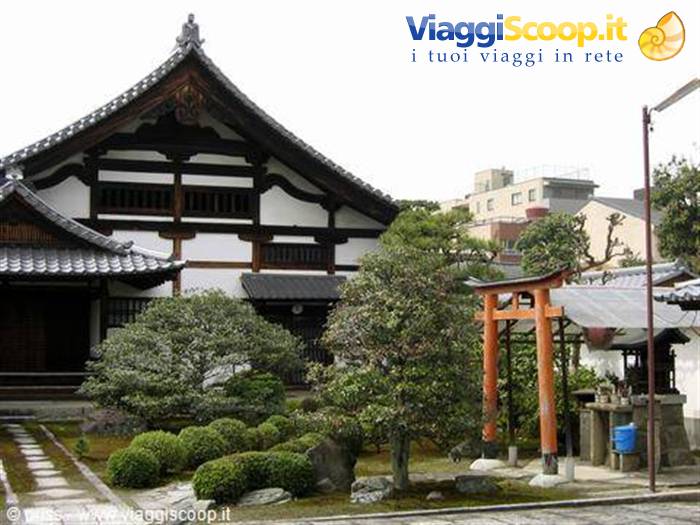
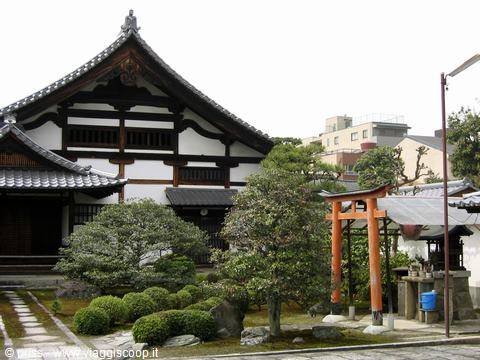
Tempio in legno e piccolo torii vermiglio nel giardino di Kyoto
Day 61 Apr 2007
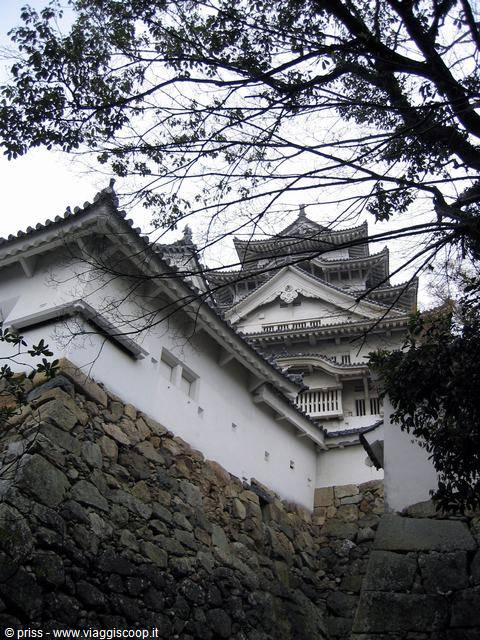
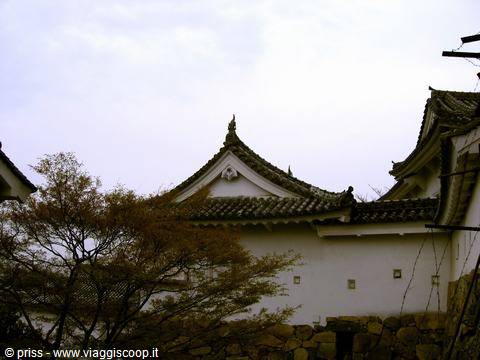
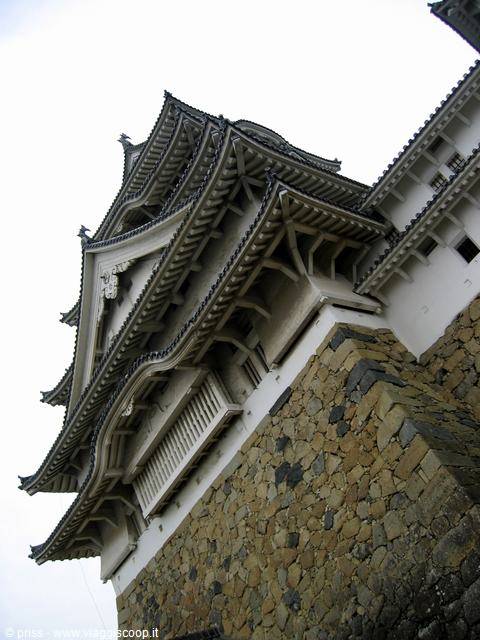
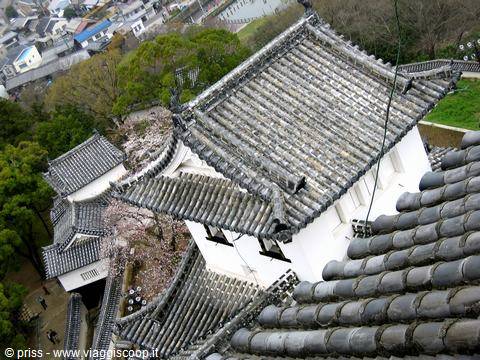
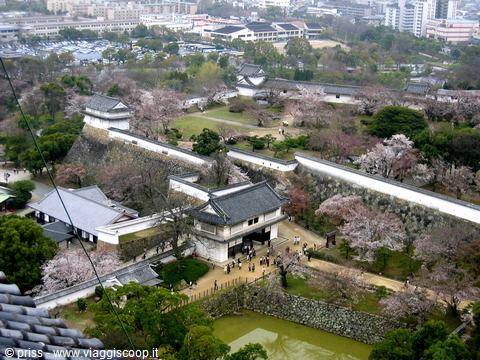
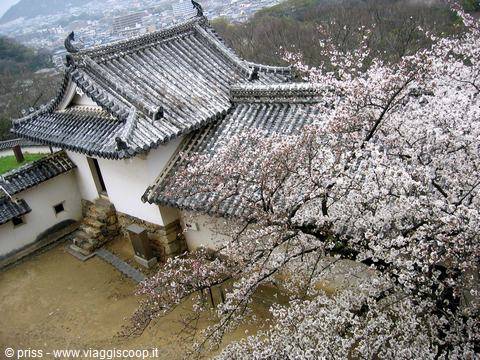
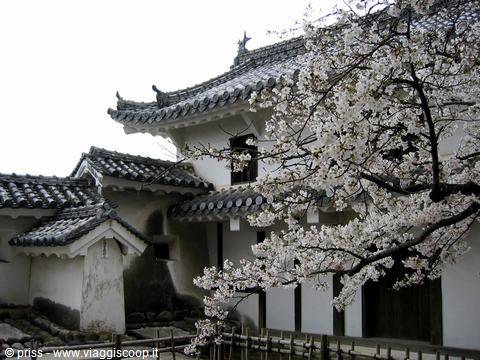
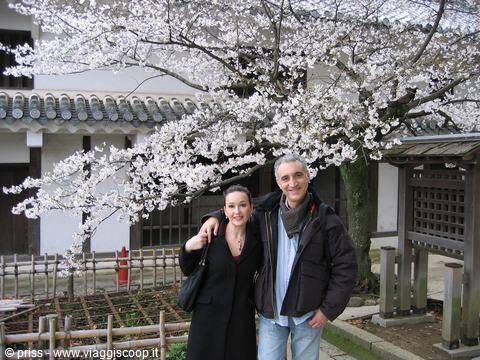
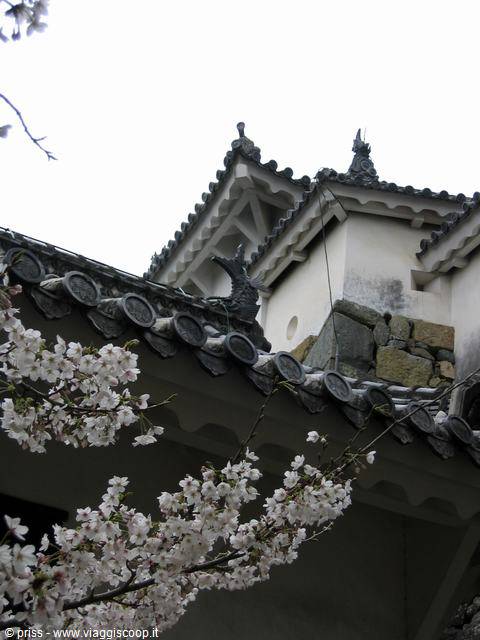
We go to Himeji to visit the spectacular castle. It's the most beautiful castle in Japan, the only original one, never rebuilt from the Middle Ages to today. It's a castle whose purpose was to serve as a fortification, not to be a noble residence, although several Shoguns lived there, and it contains the tower that was the happy residence of Princess Sen. It's a five-story fortress with 3 smaller structures around it (dojon), and all around the entire structure there are moats and dry-stone defensive walls. Even under the leaden sky of this Sunday, with the splendid cherry trees in bloom at every corner, every corridor, every opening once used to shoot at the enemy is a marvelous sight, even the Harakiri maru, that is, the place designated for harakiri and seppuku, the ritual suicides of the samurai, seems like a corner of paradise.
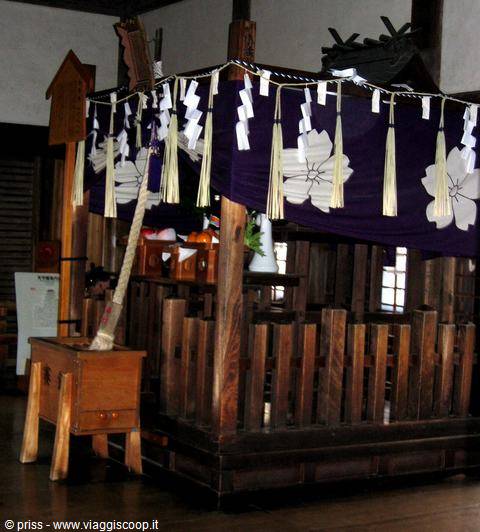
We climb with no small effort all the way to the top, five floors in the dark belly of the castle, squeezed together with hordes of local tourists, and then enjoy the splendid view from the top floor. Here you also find the Osakabe altar; in fact, at the site chosen for the castle's construction there was this small altar, which was moved elsewhere, but after some time, for superstitious reasons, it was rebuilt inside the castle's upper hall. A truly strange combination: an altar with offerings on top of a fortress!
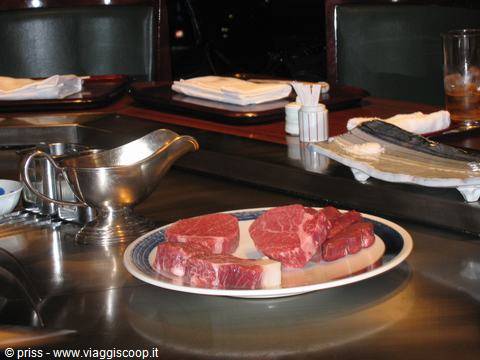
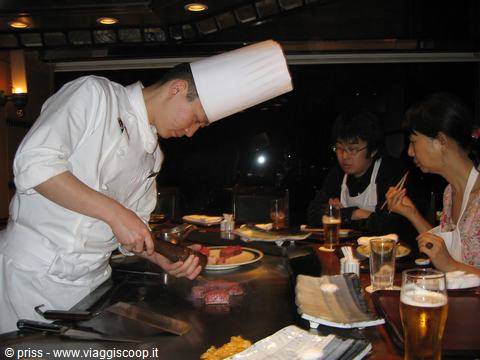
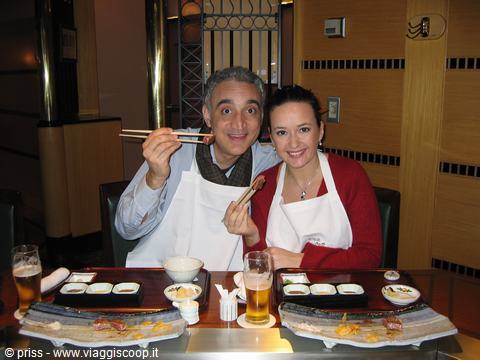
Since the Okadas spoil us in every way and this is our last evening together, they take us to Kobe, to the panoramic restaurant of the New Otani; here we sit around a steel counter for at most 10 people and have a chef with a big hat who cooks for us the delicious Kobe beef (Kobe gyu), the emperor's meat; practically, before being butchered these steers are massaged by hand so that the fat is distributed through the meat, the result is such marbling that the fat melts completely during cooking and makes this meat 10 times more tender than the best meat I've ever eaten (including American or Argentine meat).
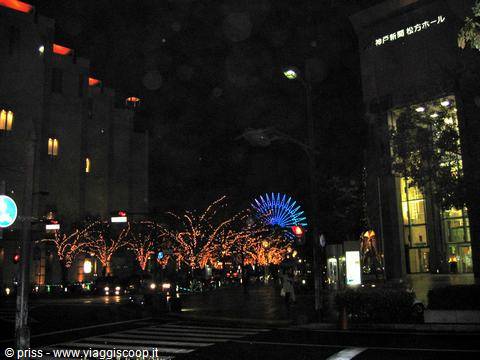
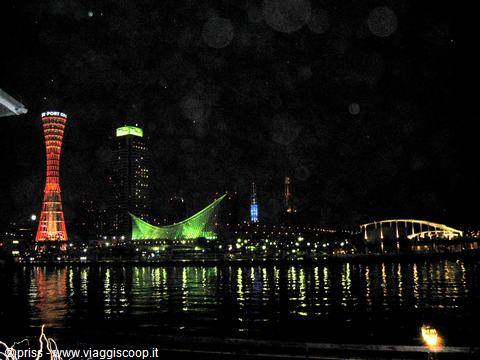
After dinner we take a stroll among the shops of Kobe and reach a terrace with a beautiful view of the illuminated harbor; it's truly incredible to think that just 12 years ago this pleasant, vibrant city was devastated by a terrible earthquake that, together with the fires it sparked, caused the destruction of vast areas. We say goodbye to the Okadas and take the train to Osaka, where Masaki is waiting for us, another friend first met virtually and then hosted for a few days in Sicily. It's already 11:30 PM and he takes us to our lodging and sets an appointment for the next morning in Kyoto.
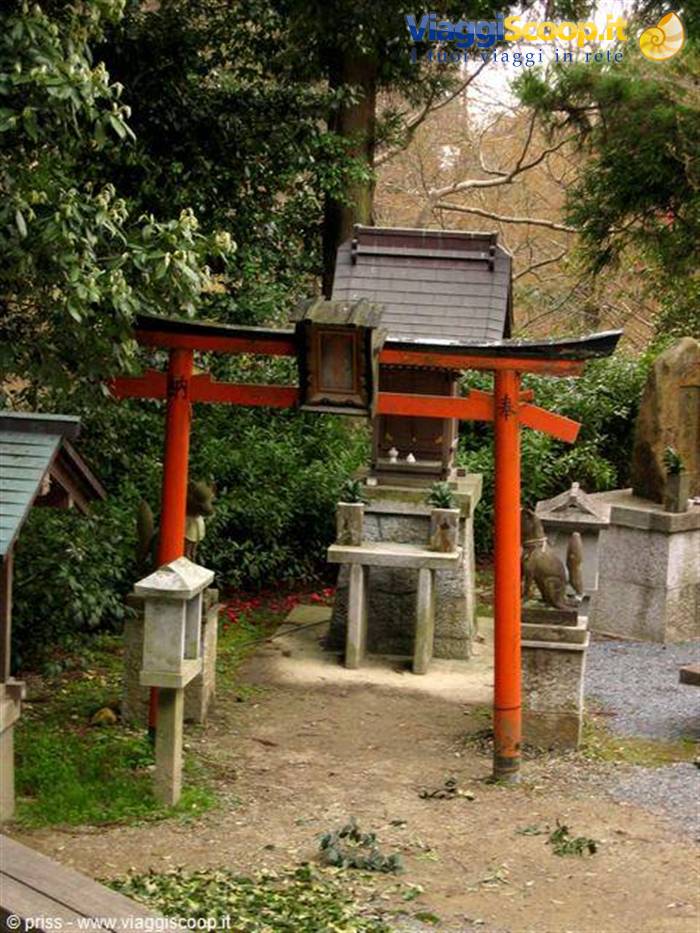
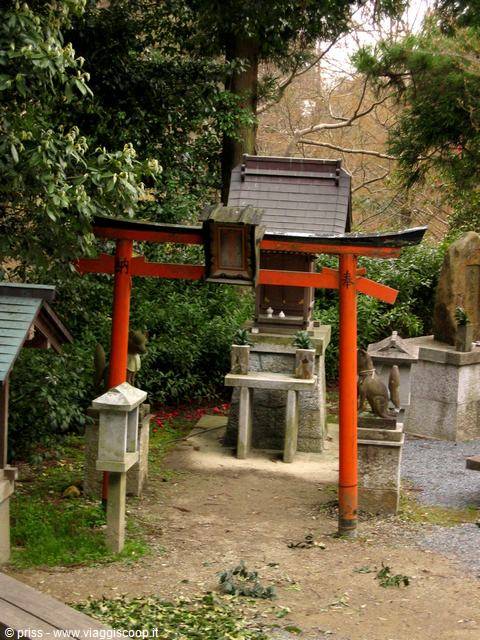
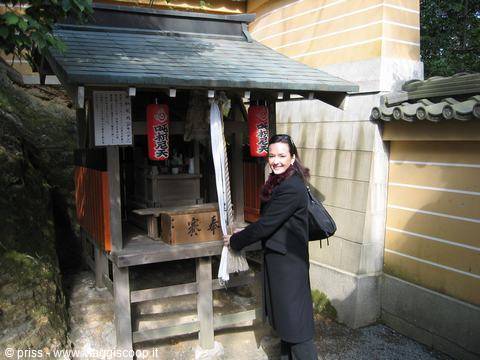
Red torii gates and small stone shrine surrounded by green trees
Day 72 Apr 2007
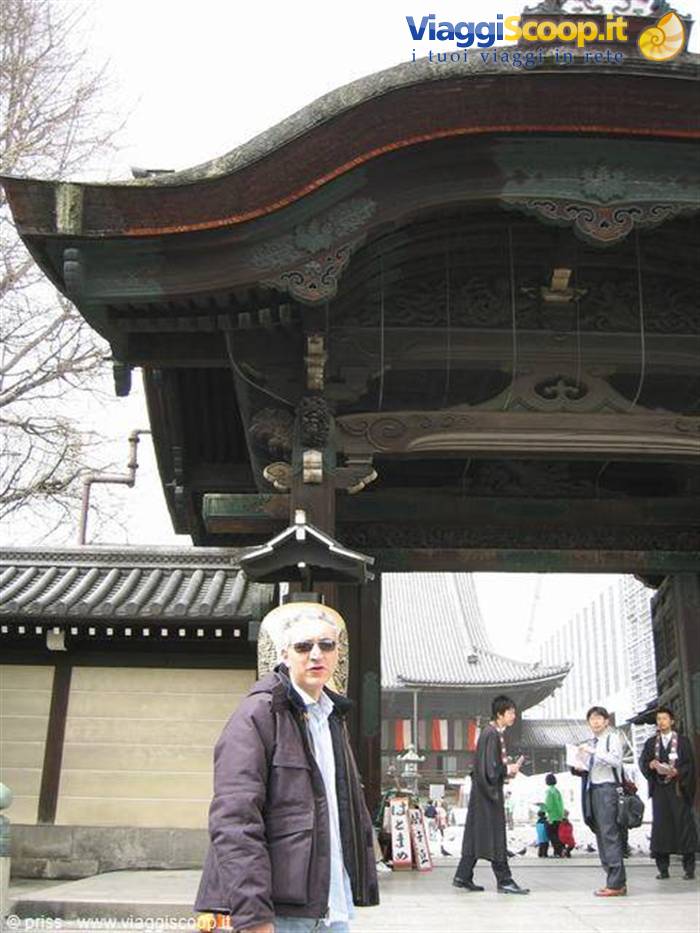
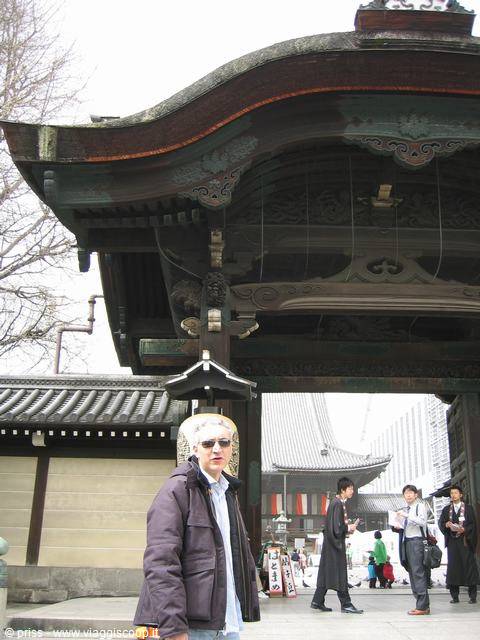
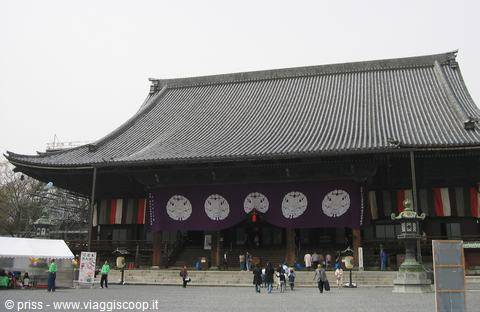
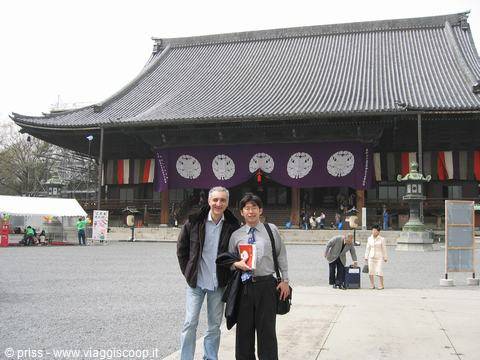
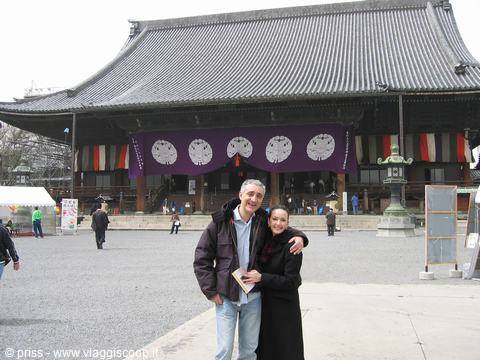
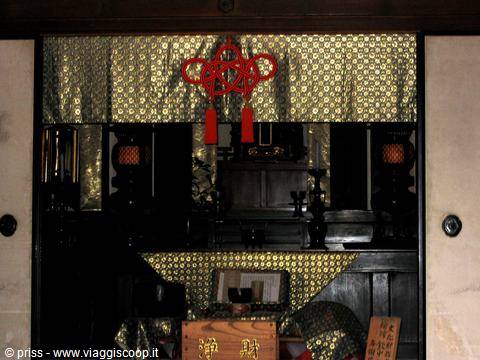
Our lodging in Osaka is near the station, but to take the rapid train that gets us to Kyoto in just 20 minutes we have to go to Shin-Osaka station (that is, the one served by the JR Shinkansen); at nine thirty we're in Kyoto, where we indeed meet Masaki. The first place he takes us to see is Higashi Honganji, which we reach on foot from the station; it's the mausoleum of Shinran Shonin, the founder of Shin Buddhism, or at least that's what I read in the pamphlet they gave us… I'm not exactly a particularly religious person and in general my knowledge of Buddhism is really limited. In any case, we pass through the immense Goei-do mon gate and admire the immense Goei-do hall. Inside there's a religious service and we stay kneeling a while to admire the hall's decorations and listen to the melody of the chanting prayers.
A curiosity: in the passage between the two halls there's an enormous rope that was used at the time of the temple's reconstruction after a fire, since traditional ropes couldn't transport the heavy materials needed, thus delaying the reconstruction… so they resorted to this special rope made from the hair of devotees! 53 of them were made, the largest measuring 110 meters, with a circumference of 40 cm and weighing 1000 kilos… all in human hair… brrr!
We then go see Nishi Hongan-ji, which is made up of 5 buildings, the seat of the Jodo Shin-shu Buddhist school. It's a truly very beautiful complex, a shame that several buildings are under restoration, so wrapped in scaffolding.
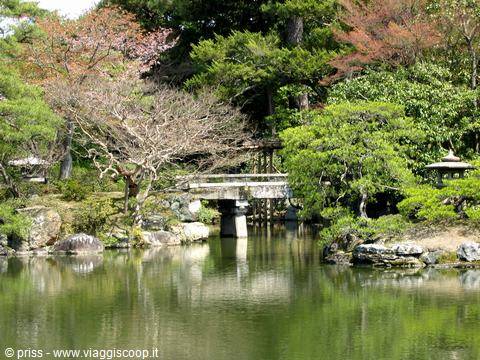
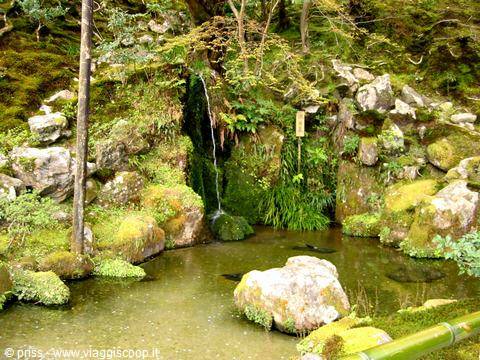
A few blocks further on we reach the Shosei-en garden; this too is a traditional Japanese-style garden, with its wooden bridges, the little houses where you drink tea, its scenic little waterfall, and a thousand flowers… they even give you a little calendar illustrating which flowers to admire during the year. It's truly an oasis of serenity in the middle of the city; there are also many picnic tables in front of the pond… if you have leftover bread you can give it to the carp; as soon as you get near the lake shore, they come rushing in great numbers!!!
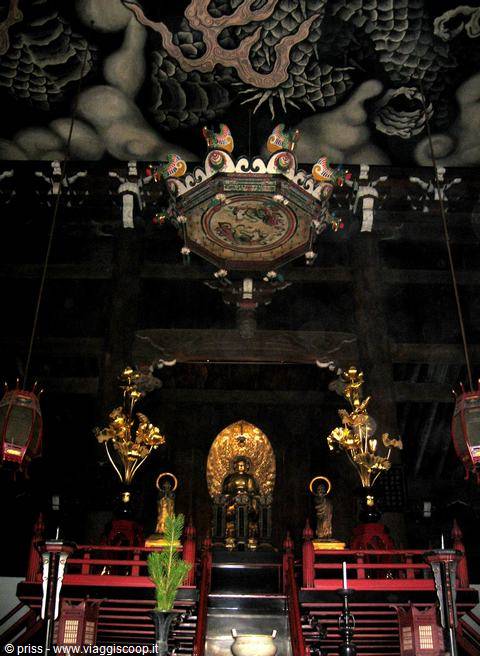
We continue and head north; the streets we walk aren't particularly scenic, we're near the Miyagawacho Kaburenjo Theater, then we enter a garden containing many practically deserted temples with free admission. In one, the ceiling is decorated with an immense painting in shades of gray depicting two splendid dragons. Then we reach the entrance of a temple that from the outside says absolutely nothing and is paid… well, I highly recommend leaving your shoes at the entrance, paying the ticket and going in, because this is Kenninji temple, that is, the oldest zen temple in Kyoto; although the Lonely Planet guide doesn't spend even a word on this oasis of serenity, we're won over by the beauty of the panels painted with the allegory of the gods of wind and thunder and by its silent zen gardens.
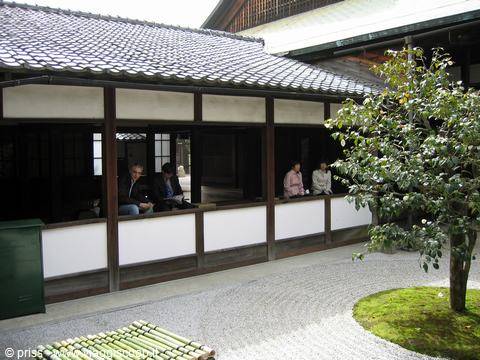
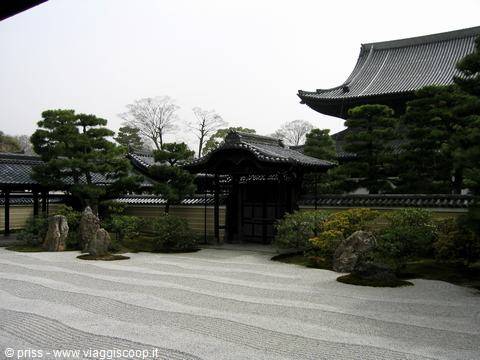
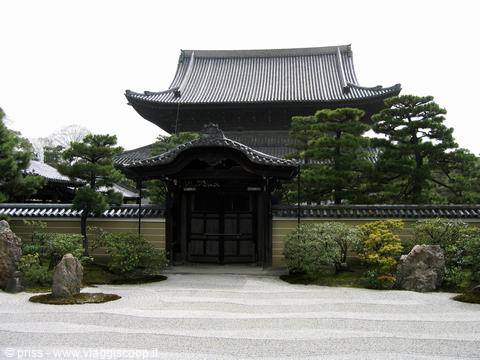
There are 3, one that uses a sort of "borrowed scenery" with gravel raked in concentric circles to simulate the waves of the sea, an island created by a circle of earth covered in moss with a tree in the center and a rock representing a mountain, then there's a garden of moss and stones, and another that represents the rock garden just as we've always imagined it: boulders on raked gravel. It's truly evocative and beautiful, there are no hordes of noisy tourists and you can sit comfortably in its little rooms and contemplate its peace.
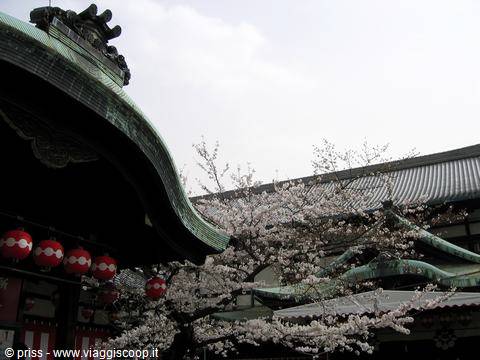
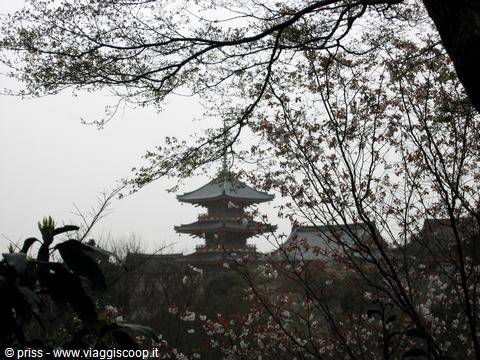
We stroll through the streets of Gion and then stop by Kodaji temple and its gardens designed by a landscape architect who was a master of the tea ceremony. We admire the colorful Yasaka pagoda and reach Kiyomizu temple. This temple is, for some reason that frankly escapes me, one of the most famous in Kyoto. Mind you… it's not that it's ugly, in fact it's quite pretty, being on a platform supported by wooden columns overlooking a steep hill full of cherry trees in bloom, but today the weather is really awful, it's cloudy, the sky is to say the least leaden and honestly I don't understand what pleasure this immense crowd of Japanese gets from looking out to admire this grayish panorama. To take a photo you practically need a queue-cutting pass… I definitely prefer the less touristy corners!
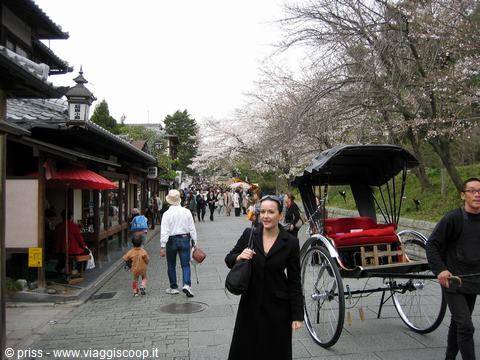
Through the beautiful Maruyama Park (Maruyama koen), strewn with blue tarps on which festive locals drink and sing under the cherry blossoms, we reach Chion-in temple… oh guys, we're practically destroyed… it's 6 in the evening and since nine thirty in the morning we've been walking nonstop (the only break to eat a sandwich!) but Masaki doesn't give up and keeps walking, driven by the desire to show us as many things as possible.
We walk some more through the streets of Gion and for example the beautiful Shinmonzen-dori, then we continue toward the characteristic Ponto-cho street; here Masaki starts walking quickly because early in the morning Michele had told him he'd like to visit the Nishiki food market and so he, kind as always, wanted to take us there too… too bad though that we're literally destroyed, Michele also has a terrible cold and can't take any more, so in the end we manage to make him understand that we'll go another day and we head back to the station.
It must be said that our accommodation isn't exactly the height of convenience for visiting Kyoto: between changing trains, the station and the journey, at least 45 minutes if not an hour goes by, so Michele and I think it over and decide that maybe we should get a room in Kyoto for a couple of nights, also so we can go out in the evening in the alleys of Gion.
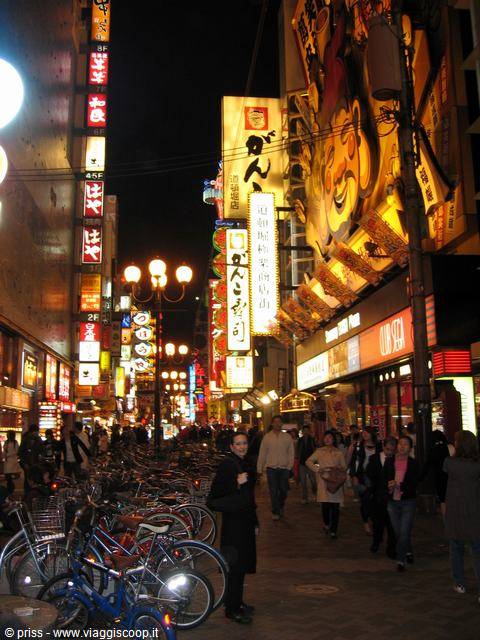
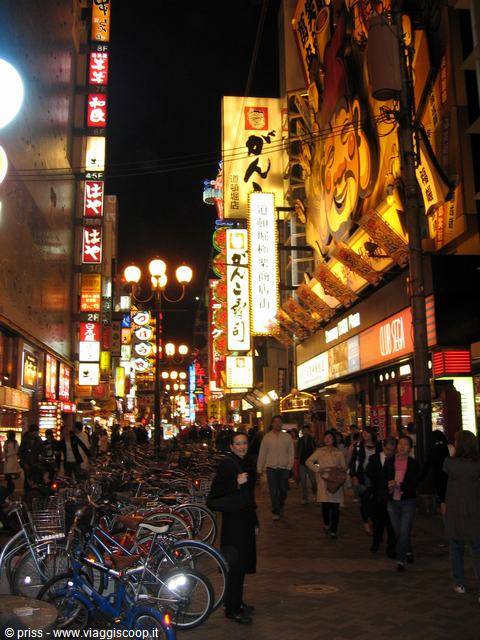
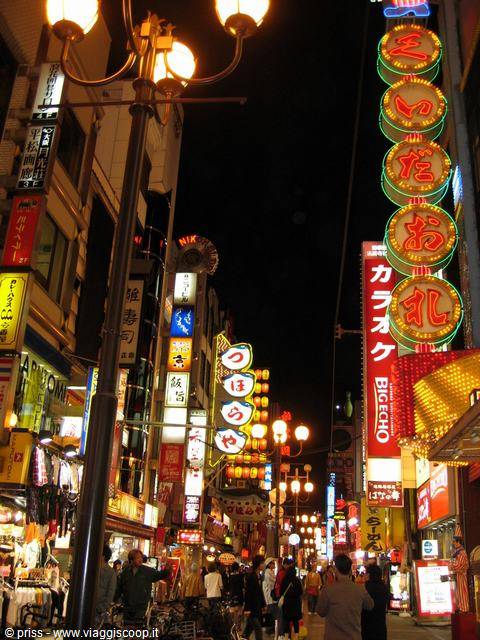
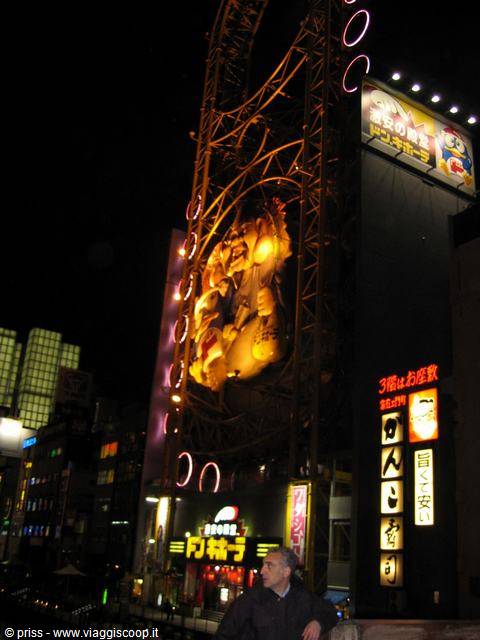
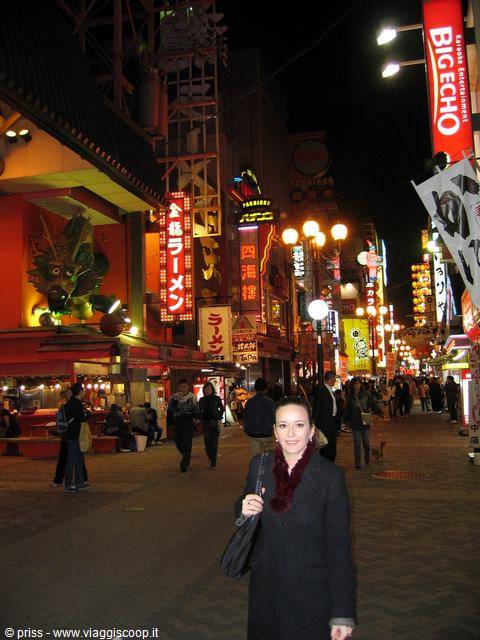
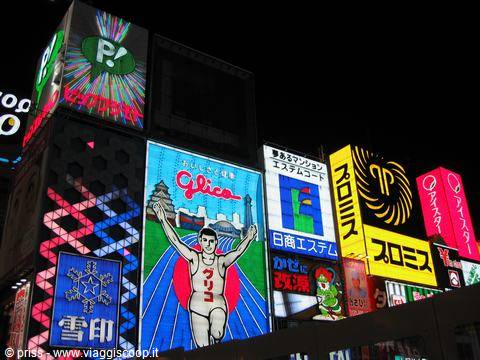
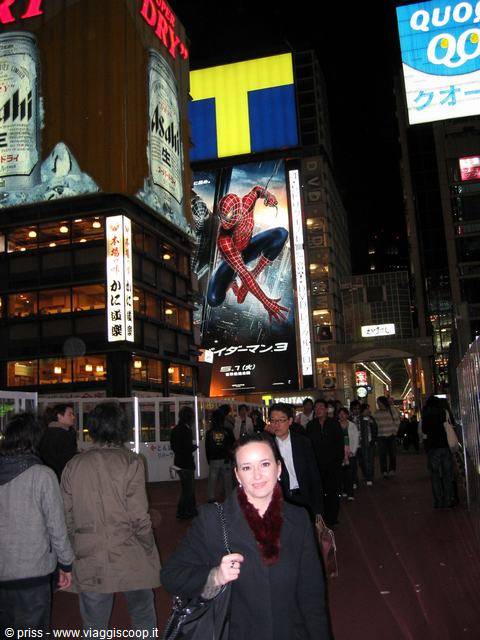
During our wanderings we ask a couple of ryokans and hotels if they have rooms available, but everything is full (except for one ryokan that has a room for just 30,000 yen per person for a single night, and honestly it doesn't seem worth spending about 375 euros a night for a ryokan that wasn't worth even a tenth of the beautiful Sekitei in Miyajima) and in the end for 100.00 euros we take a double room at the Apa Hotel next to the station starting the following evening, and now off to catch the train to Osaka! After a nice shower and a bit of relaxation we take the JR loop line and go to dinner in the incredibly colorful Dotombori district; we wander through the crowded little streets and admire the signs of Ebitsu Bashi… it feels like walking on the set of Blade Runner! An unmissable experience for pris(s)!
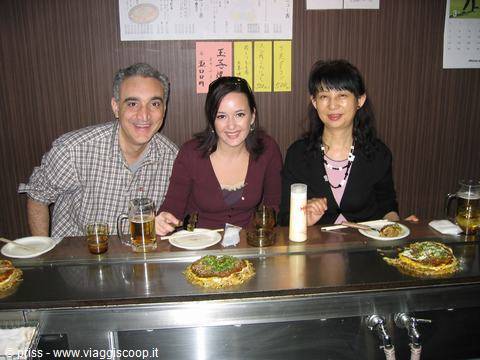
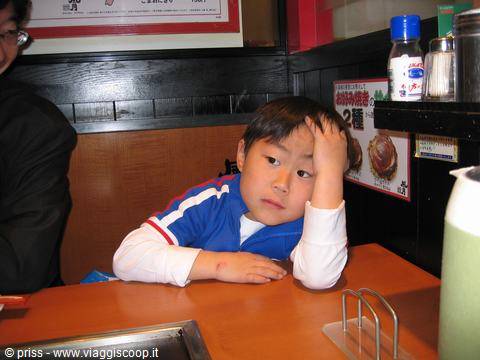
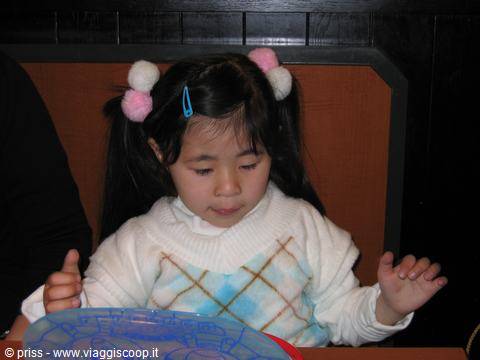
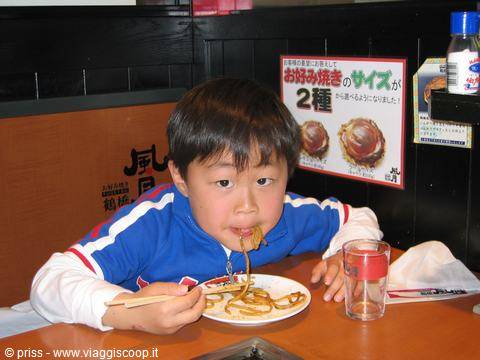
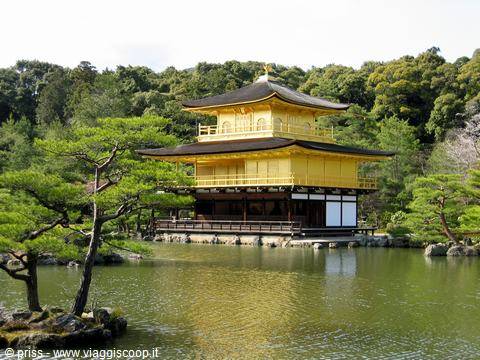
We stay in Osaka for the morning and meet Masaki's family to have lunch together around 11:30. So we meet his wife Yuko and his splendid children Luca and Ryo; they're both adorable: Ryo happily plays with his books and pays no attention to us (he's just 3) and Luca is a sight with his Catania cap! he entertains us counting in Italian and with a whole series of phrases Masaki and our mutual friend Andrea taught him; we eat Yakisoba and Okonomiyaki and exchange the inevitable gifts! Then together with Masaki we take the train to Kyoto, but he has to go to work. We check in at the hotel and then in the square in front of the station (for about two euros) we buy two-day passes for buses and the subway; also in the square we get an excellent free little map of the city, and so we take the bus to go to Kinkakuji, that is, the Golden Pavilion.
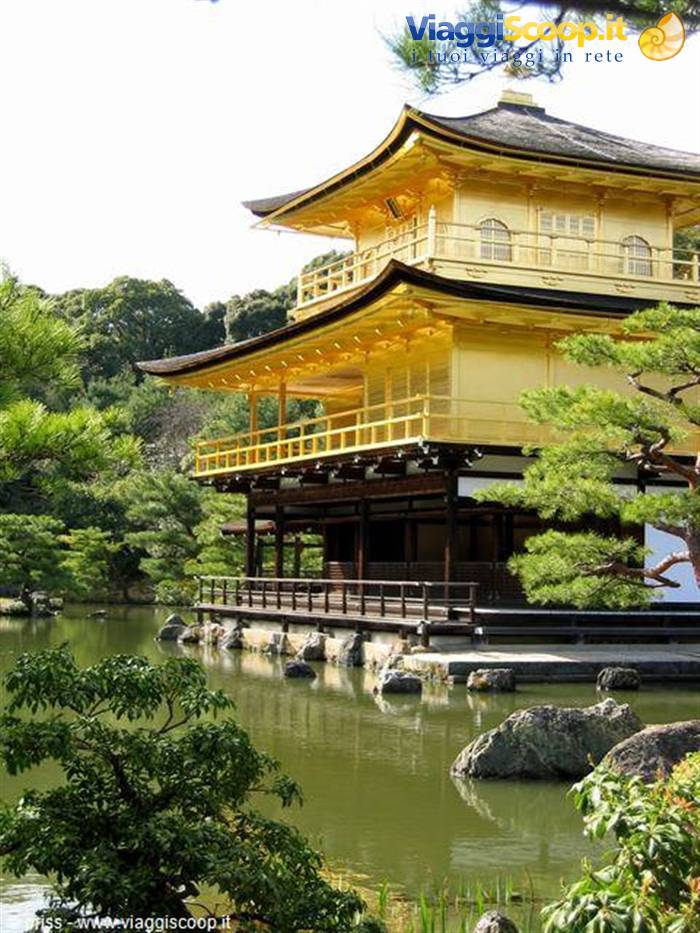
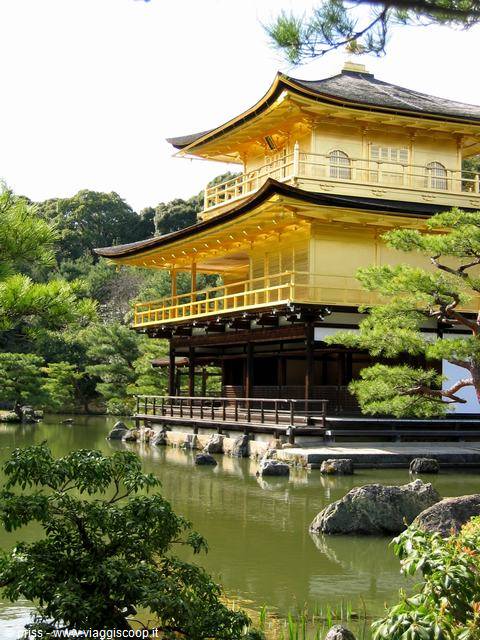
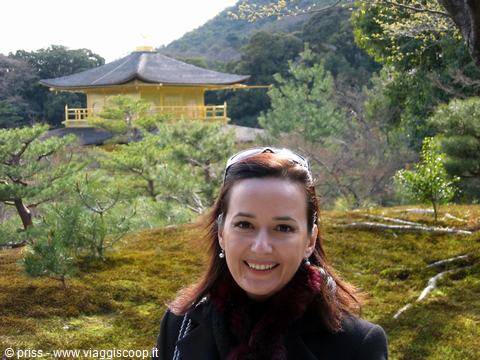
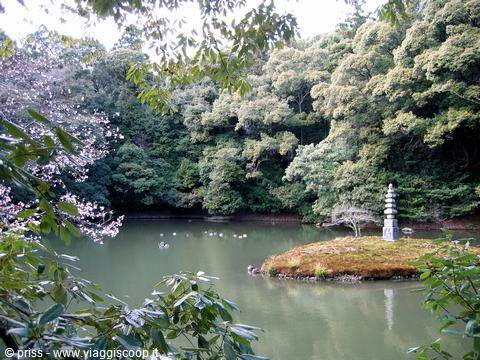
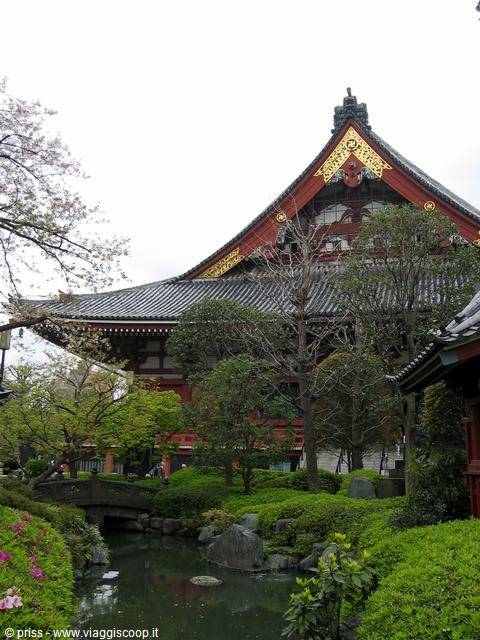
Originally in 1220 there was a complex of temples called Rokuon, set in a splendid garden; at the end of the 1300s the golden pavilion was built as a shogun's residence and transformed into a zen temple after his death; the rest of the temples have fallen into ruin, but the garden is still a marvel. As for Kinkakuji, it must be said that it's truly breathtakingly beautiful: its three floors are built in three different styles, the first in that of imperial palaces, the second in that of samurai houses, and the third in the style of zen temples; the last two floors are entirely covered in gold leaf and the whole structure is reflected in the splendid lake; it's impossible to describe how it lights up in the sun.
It's truly marvelous! The incredible thing is that in any case what we admire is not the original pavilion, since it was destroyed in 1950 by a young monk who set fire to it because he was obsessed with its beauty and convinced that his aesthetic sense would approach perfection only after destroying what had bewitched him! As described by Mishima in his book "Kinkakuji". We stroll through the garden around it, admiring the little waterfalls and the enchanting views created well 700 years ago.
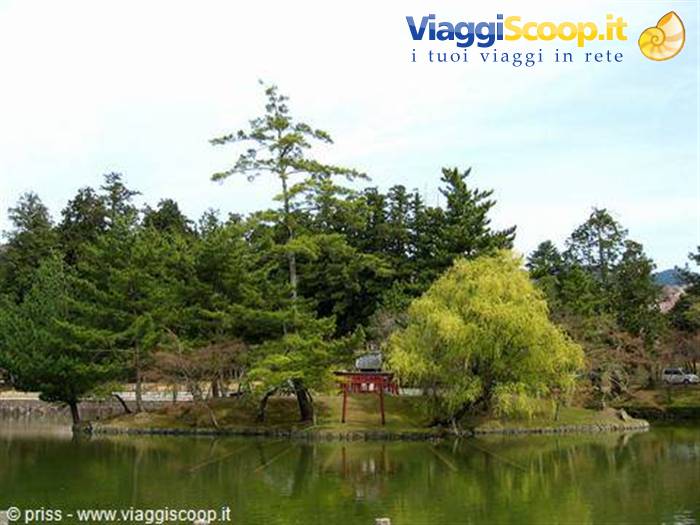
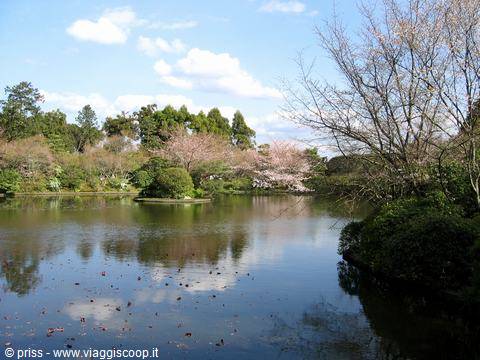
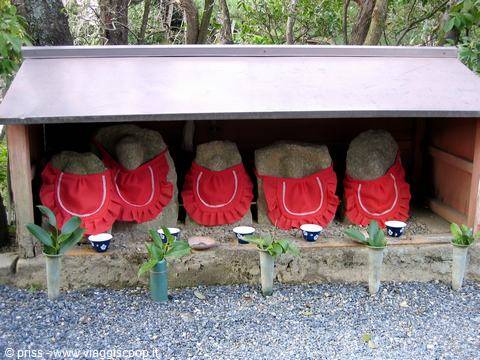
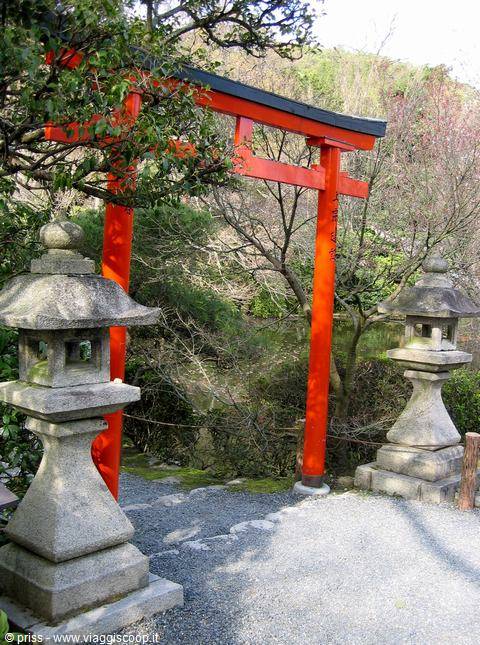
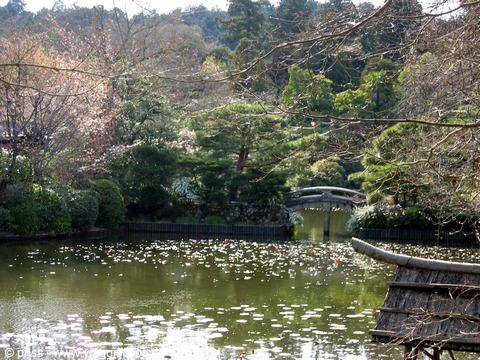
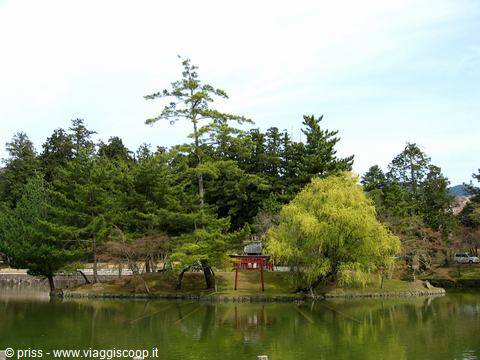
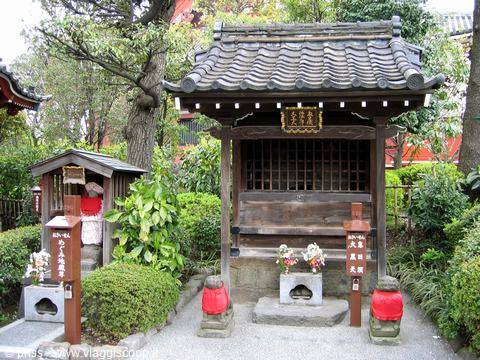
Following the map and asking for directions here and there, we reach Ryoan-ji, or the temple of the peaceful dragon, which actually makes us realize how big Kyoto is: based on the map we thought the two temples were very close, but there's at least half an hour of walking between them. We immediately find ourselves in an enormous garden with a pond lined with trees in bloom; there's also a little peninsula with a torii and a small row of "Mizu jizo" statuettes, that is, literally "water children," guardian deities of unborn children, all with a little bowl in front and their characteristic bib so they don't get dirty with the offered food; then we head toward the temple with its famous zen garden.
It's a true painting made of stone and sand; there are 15 rocks arranged so that from whatever perspective you look at them, one always escapes your view, and their arrangement was conceived by the gardener and painter Soami in the 1500s, a splendid arcane and mysterious harmony, with its bare shadows and the gravel raked in soft swirls. I highly recommend arriving here early: visiting this place with the crowds risks compromising its zen pleasure! Well… the sun has been covered by some big clouds and there's an icy wind, so for now we head back to the hotel!
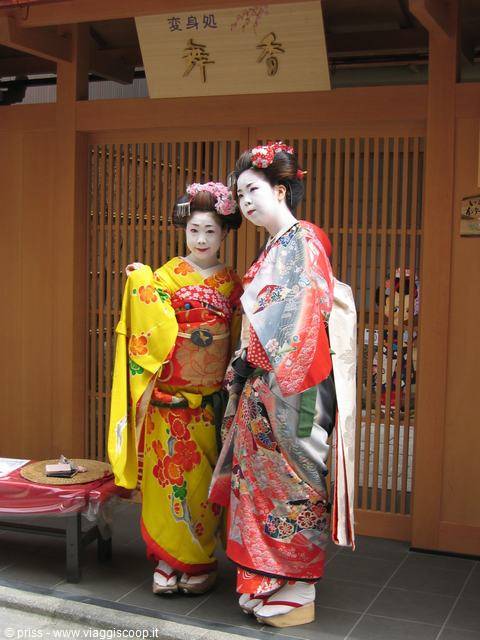
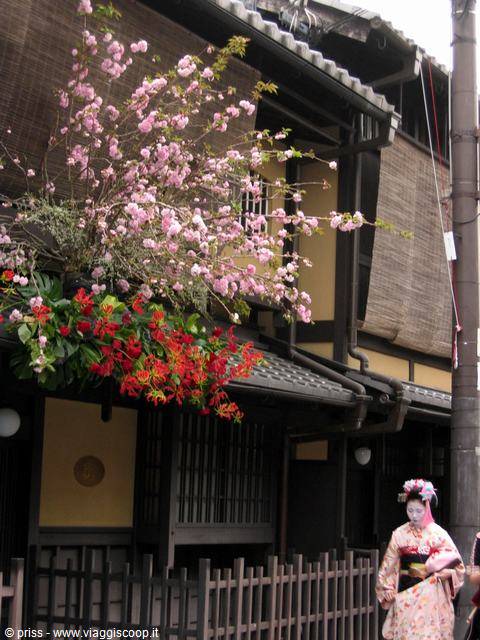
After resting and freshening up a bit, we go to Gion for a stroll and for dinner; here people eat early, so by eight we're already looking for a restaurant; actually it's not very easy to understand when you're in front of a restaurant, or a bar, or a ryokan, because from the outside they all look the same: wooden buildings with lanterns! In the end we opt for a little restaurant displaying photographs of wonderfully prepared dishes; in fact, it's fine kaiseki ryori cuisine.
We take off our shoes and sit upstairs, crouching on the tatami; dinner consists of sashimi, soup, flower-shaped vegetables, salad, and many other delicious but indecipherable things; a series of cups, bowls and little trays of different shapes, colors and materials follow one another on our table, in a truly elegant and refined atmosphere that justifies the not exactly cheap price (but not even expensive like OUR restaurants); the only thing that seems absurd to me is that even in such a sophisticated place smoking is allowed! We thank them and pay, and when we appear at the door to leave, the owner of the restaurant follows us, continuing to thank us, complimenting Michele, saying he's gorgeous, and urging us to come back… see what food connoisseurs these old Japanese women are?!
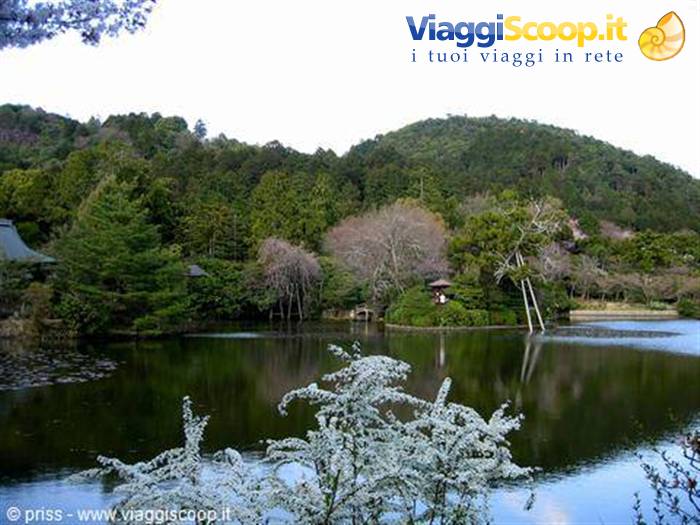
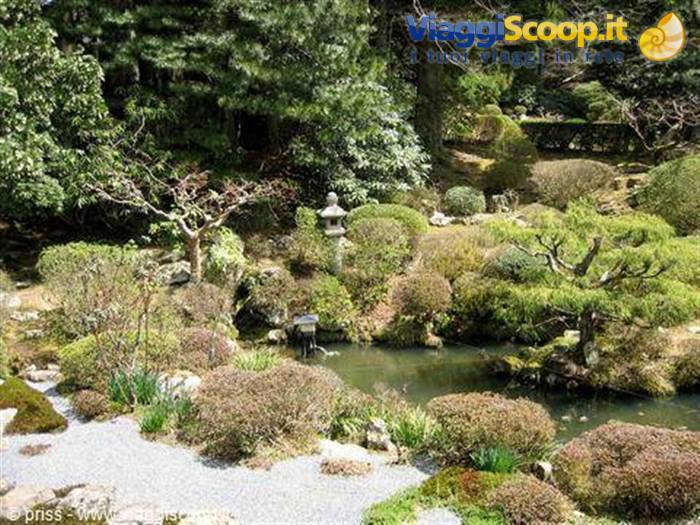
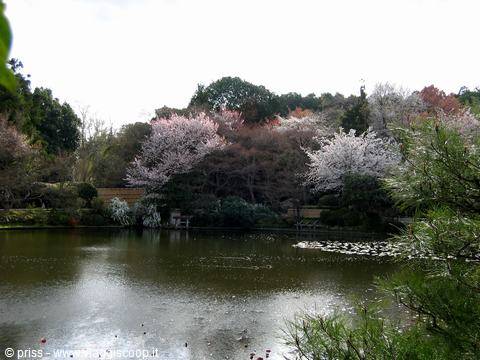
Pond reflecting trees and green hill, wooden pavilions, white blossoms, Kyoto
Day 94 Apr 2007
first part
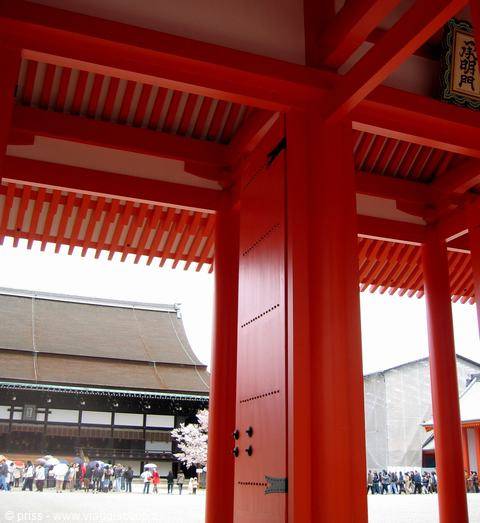
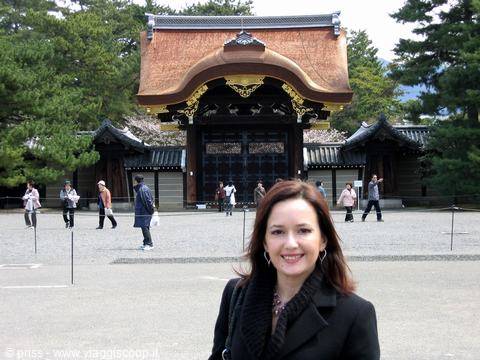
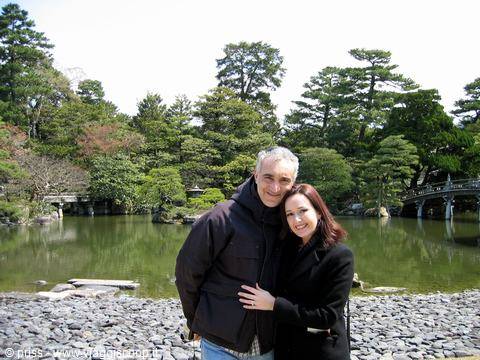
Today too poor Masaki is working; it's not a big problem for us, here things work so well and you manage with such ease that we get around without any difficulty. To go visit the Kyoto Imperial Palace we take the subway and get off at Imadegawa, and we immediately go to the Imperial Household Agency to request permission to visit it, but when we get there they tell us that today is a special day and admission is free for everyone. Lucky as we are to be able to visit it directly without booking and waiting for entry, we're still a bit unlucky because the free admission means there are hordes of Japanese tourists with us, and as I said, I don't particularly love having to make my way through the crowd to look at something.
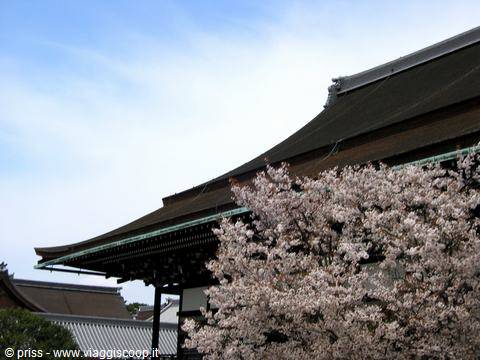
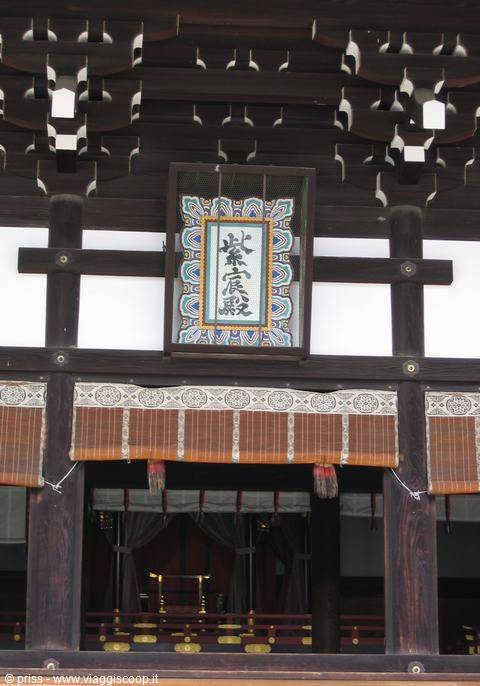
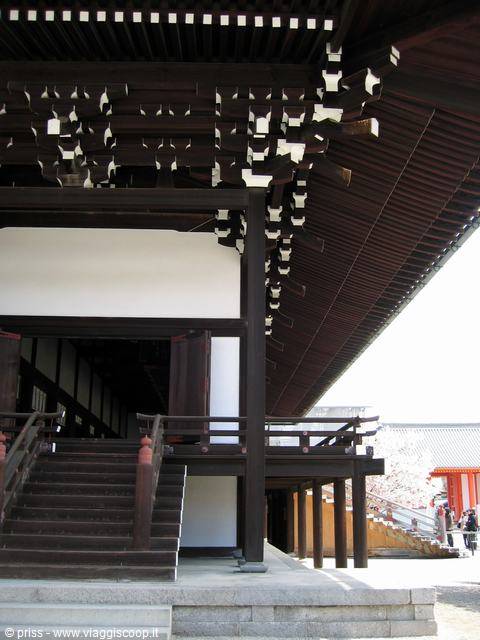
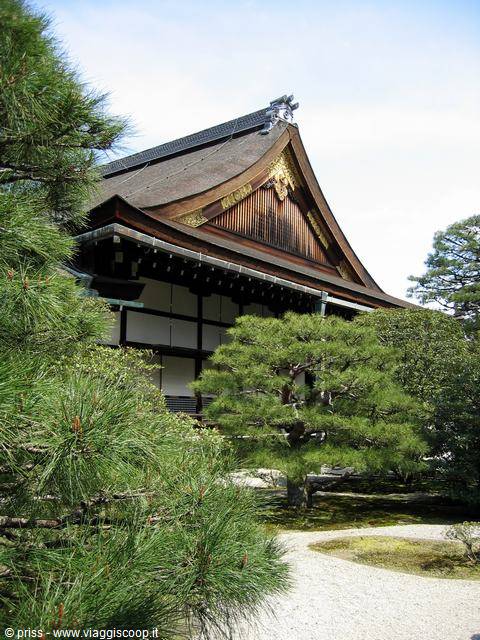
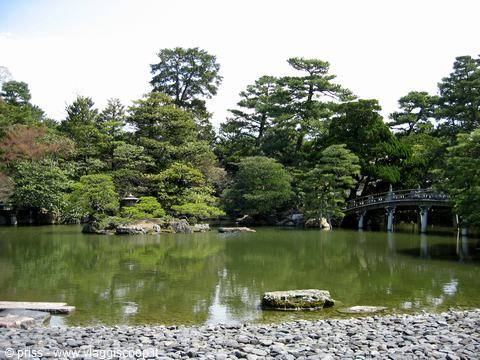
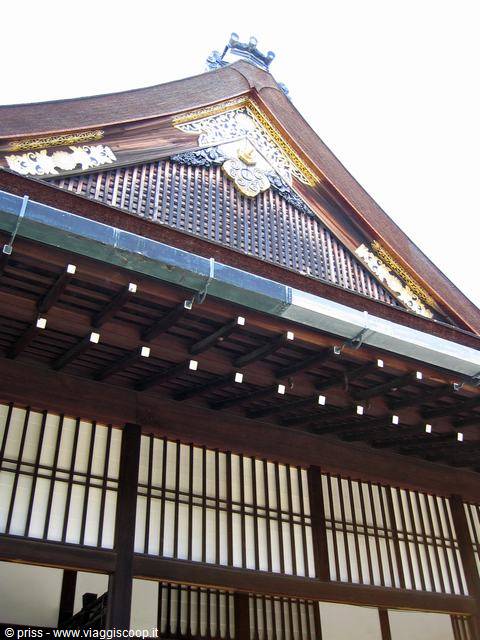
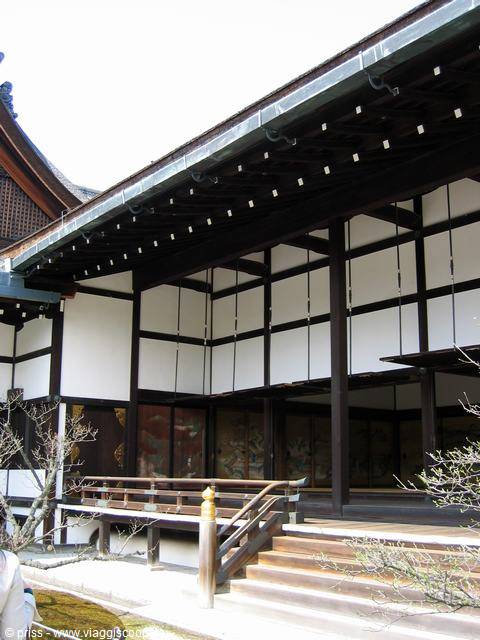
Anyway, it must be said that the Kyoto Gosho is made up of various buildings, among which stand out the Shishinden, which is the main palace and with its square in front was used for official ceremonies, the Kogosho, used for ceremonies on the occasion of the coming of age of the heir to the throne, and the Otsunegoten, built later (in 1590), which was the emperor's residence until 1869, the year the capital was moved to Tokyo. It must be said that the architecture of these buildings is not in itself particularly impressive or majestic, it's very simple; what fascinates me, however, is its essential harmony and its exterior walls that literally vanish, leaving whoever stayed there an absolutely clean view; the great roof is supported by columns and this means the walls are no longer walls; the rooms are then divided by screens decorated with a golden background.
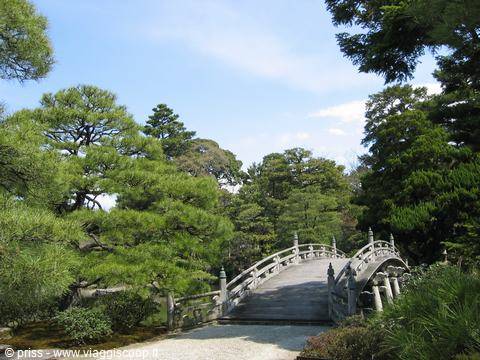
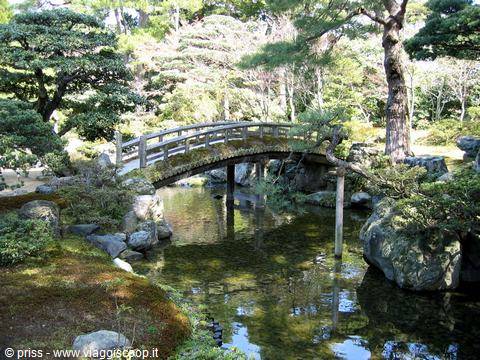
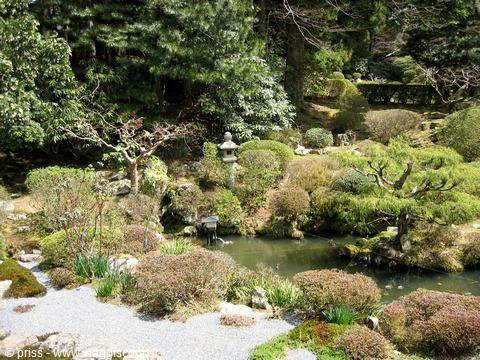
I really like this sense of continuity with the outside, also because what we once again find marvelous is above all the gardens. All the gardens we visited in Japan have a characteristic that makes them extremely different from any other natural space ever visited before: all the elements that make up the landscape have been placed together with sensitivity and great compositional harmony. Certainly we're in front of a less "natural" nature than you see elsewhere, in the sense that it's a nature manipulated for purely aesthetic purposes; sometimes, as in the case of rock gardens, we're in front of totally artificial landscapes, but their grace is such as to make the heart of whoever contemplates these pruned and miniaturized trees grateful, the little ponds topped by wooden bridges, the carpet of moss and the bare rocks that dot it.
Having left the imperial palace and the Kyoto Gyoen national garden, we ask for directions to reach Ginkakuji Temple; a boy tells us to go on foot because it's straight all the way from Imadegawa-dori… careful, if they give you this advice too, DON'T FOLLOW IT, there's more than an hour of walking! Kyoto is big; even what looks fairly close on the map, due to the schematic division of its streets, actually isn't at all. So I recommend taking the bus; among other things they're frequent and it's very easy to tell when you're at the right stop because at the front of the bus there's always a display showing the current stop and which one will be next.
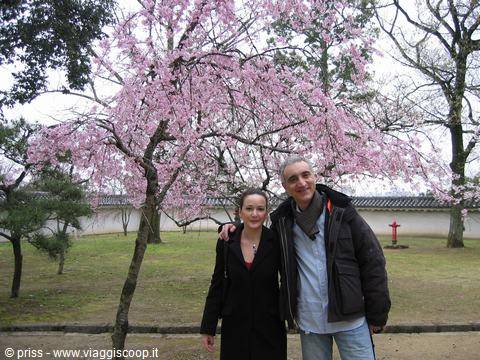
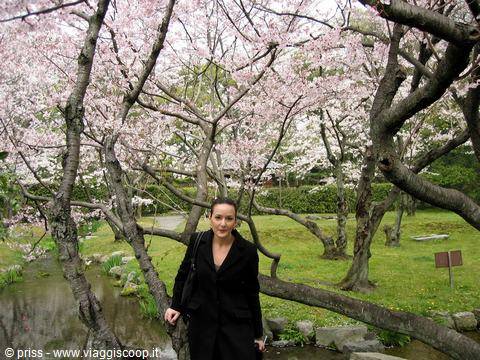
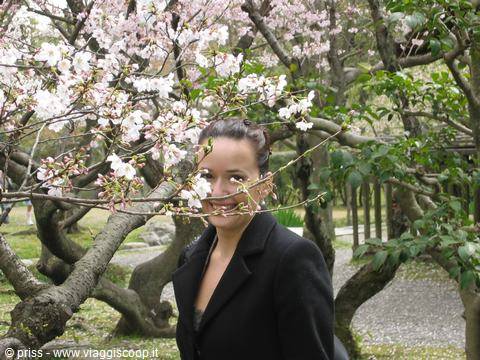
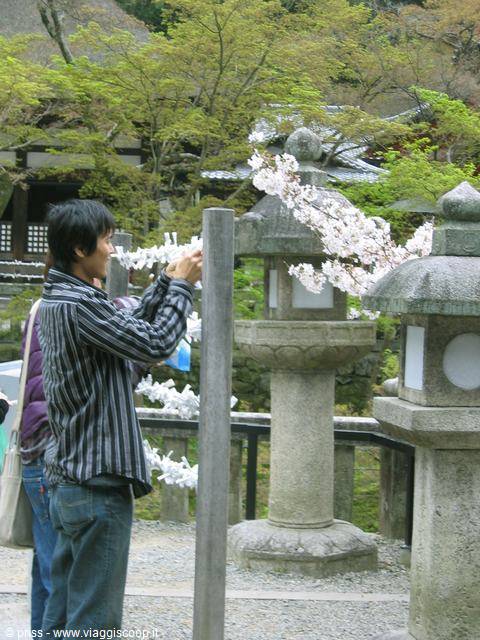
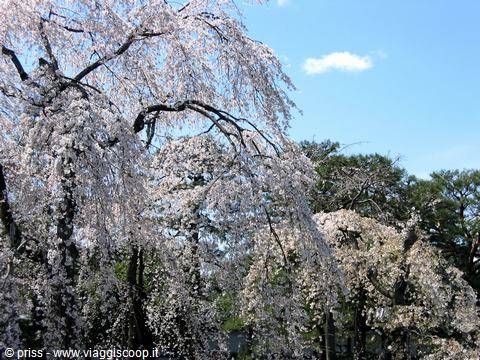
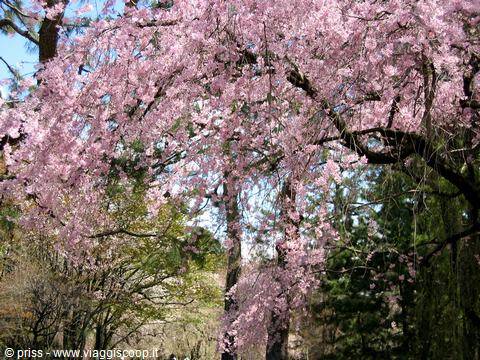
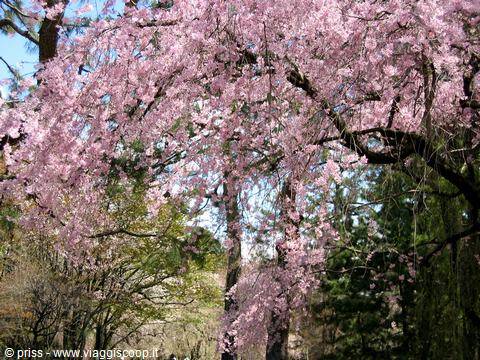
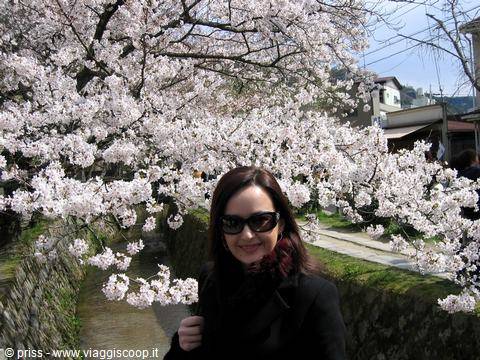
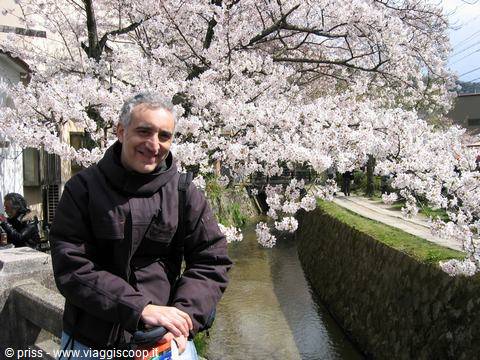
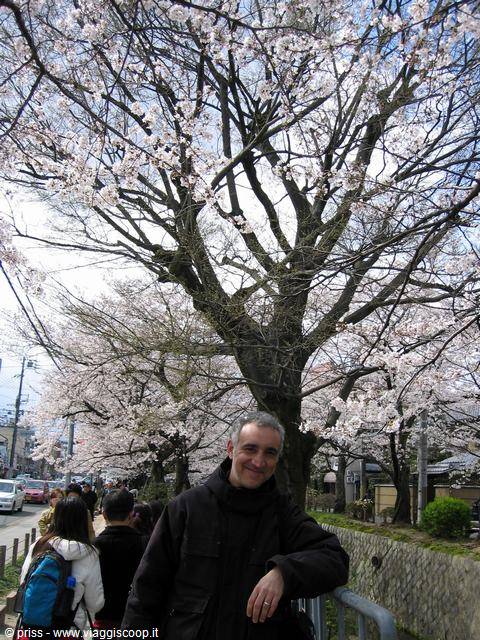
To reach the temple we pass along a tree-lined avenue completely loaded with cherry trees in bloom; it's a real spectacle! Maybe you're wondering what this fixation with cherry trees is; in fact, even I, before coming here, wondered why the Japanese go crazy to such an extent over blossoming trees. But I must say that once I arrived here my doubts were dispelled in an instant: there are in fact many varieties of cherry trees, most of which are purely ornamental (and there I was thinking that in summer they'd end up with wagonloads of cherries!!) some have weeping branches and pink flowers, others (among which the someyoshino variety is certainly the most delicate and spectacular) have pale pink buds and very white flowers that stand out against the black trunk, and yet others, besides the flowers, have delicate reddish leaves.
In any case they're all very tall and imposing trees, and when you walk along an avenue lined with sakura it feels like being under a sky of snow-colored flowers. I assure you that at that point the urge to start photographing every single bud comes over you!
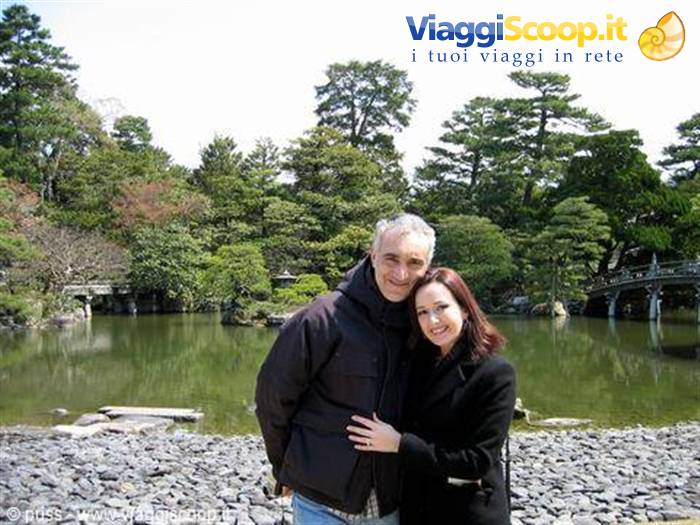
Coppia accanto allo stagno del giardino Koraku-en, Okayama
Day 104 Apr 2007
second part
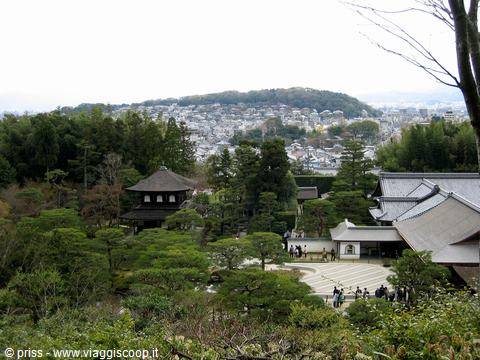
Having arrived at Ginkakuji temple, or the Silver Pavilion, given the name we were expecting the silver counterpart of the golden pavilion, so once we entered the garden we looked around in search of a structure covered in silver leaf… but there's only one made of brown wood… uhm… reading the guide carefully we learn that shogun Yoshimasa Ashikaga's plan to cover his villa in silver was never carried out.
Who knows, maybe the construction company went over budget! The fact is we feel vaguely cheated, because why don't they call it "brown wooden pavilion, never lined with silver, but still pretty"? Oh well… let's console ourselves by admiring its particular architecture (first floor in palace style and second floor in Chinese temple style) and the zen garden with its white sand mountain representing Fuji, and we stroll among the tall pines, the little ponds, and climb the path that leads us to admire a beautiful panorama of the garden, the palace and the whole city. A shame that in the meantime the sun has hidden.
A little curiosity: in the garden at a certain point you find yourself in front of a counter with lots of little pots on it containing all the types of moss present in the park, arranged according to their importance: from "plebeian" moss to "VIP" moss (or maybe I should say VIM, as in very important moss?).
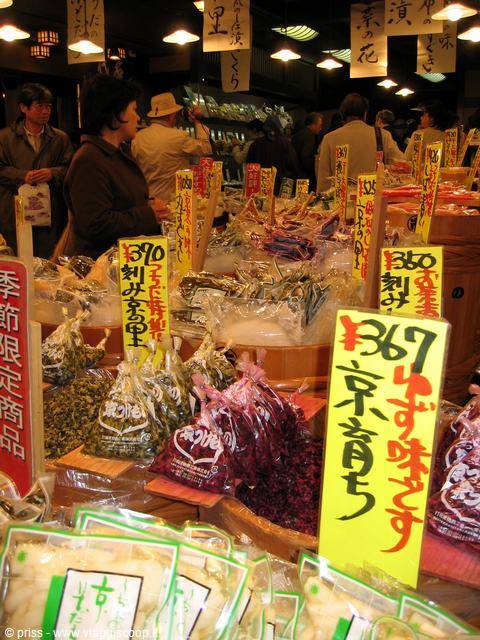
Well, enough temples for now! Let's go buy sushi knives! And so here we are at the Nishiki food market; it's truly incredible to look at the enormous quantity of fish, crustaceans and vegetables, completely unknown, on the stalls! The most striking thing is the absolute lack of smell, even though we're in a narrow (and crowded) covered gallery lined with food shops of every kind.
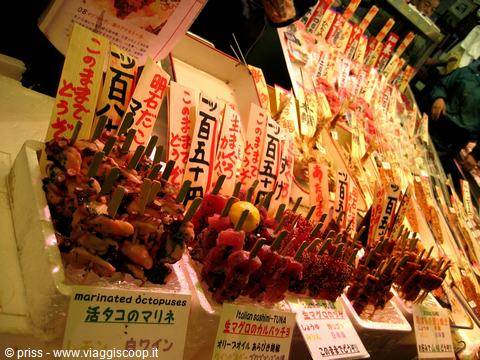
One of the most fun things, besides the nice and recurring riddle "but what is this thing?" (constantly unsolved), is looking at the stalls with ready-to-eat snacks: tempura of every kind, but above all skewers with marinated octopus tentacles impaled on them like lollipops, Italian tuna sashimi and every kind of raw delicacy… a child looks at them the way we look at ice cream! It's a wonderful thing, and if we hadn't just eaten a sandwich I would have bought myself a nice sashimi lollipop! Along the gallery we reach Aritsugu, which according to a Japanese magazine is the knife supplier to the cooks of the imperial household. This shop is now 400 years old and its knives are all handmade from tempered soft steel; there are all kinds and all sizes, and the prices aren't as high as you might expect.
We have the characteristics of the knives specifically for cutting sashimi explained to us and I give two as a gift to my sweetie; we also buy the whetstone to sharpen them and a couple of molds to cut vegetables into flower shapes. The incredible thing is that in this shop, where between one thing and another we end up paying about 250 euros, you can only pay in cash! So I have to run to the post office to withdraw more money; meanwhile they engrave our names on the knives!
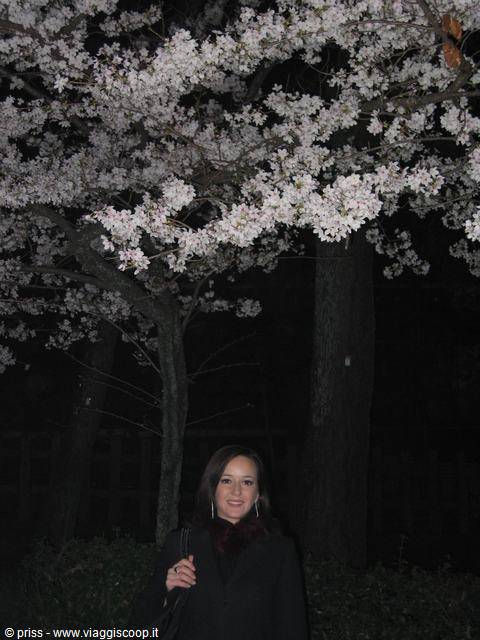
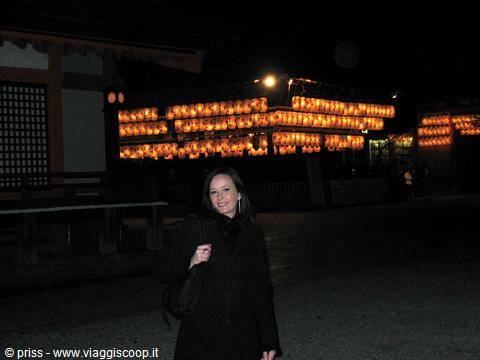
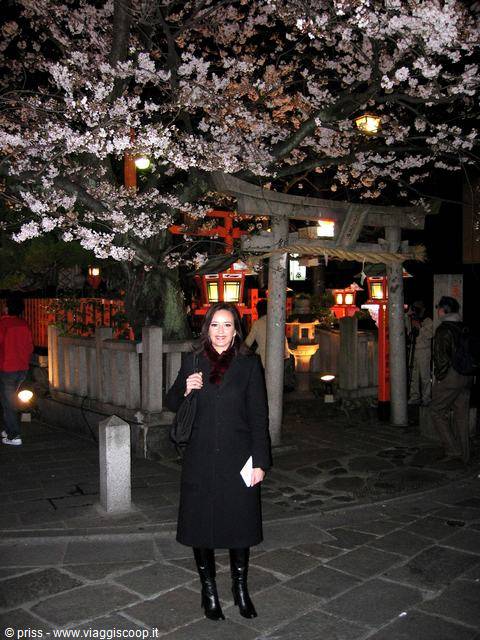
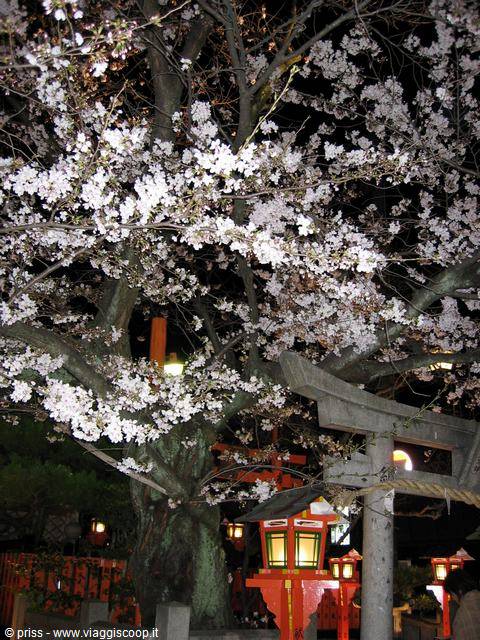
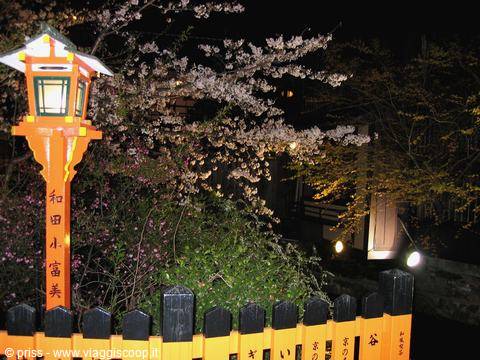
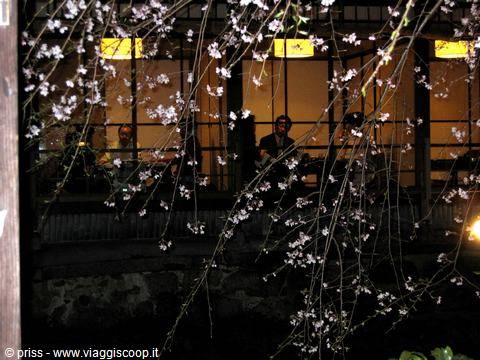
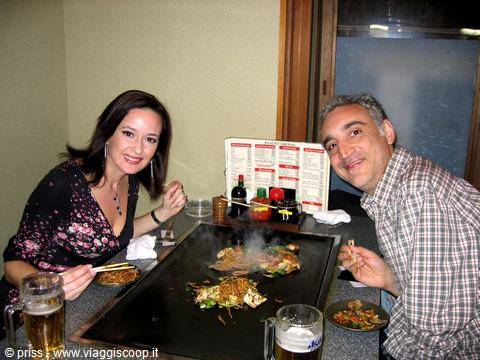
We go back to the hotel, rest a bit and then return to stroll along the beautiful Shimonsen dori; I must say that this street with its beautiful cherry trees in bloom is one of my favorites. In addition to what I've already said about the beauty of the sakura, I'd like to add that at night too they have something magical about them, so much so that the Japanese call them "yozakura," that is, "night cherries," almost as if they were another tree. In the light of the lanterns they seem to float in the dark, what a marvel! We go eat yaki soba and yaki udon in a little restaurant whose dining room overlooks the river lined with cherry trees. How hot it is with these tables with a built-in hot plate!
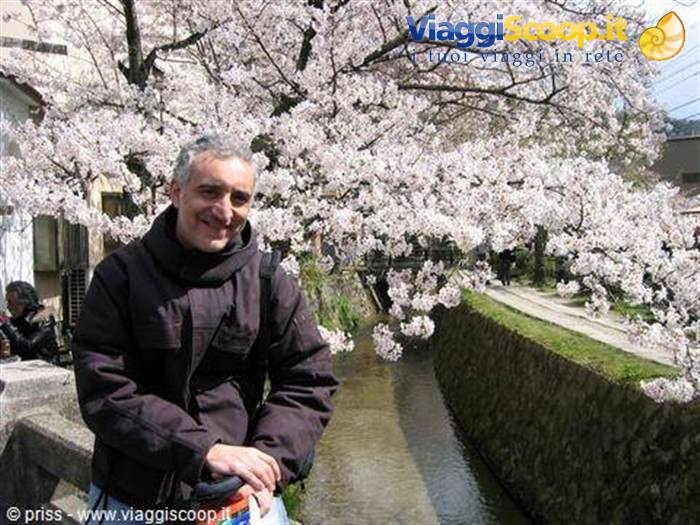
Passeggiata lungo il canale dei ciliegi in fiore, Sentiero del Filosofo, Kyoto
Day 115 Apr 2007
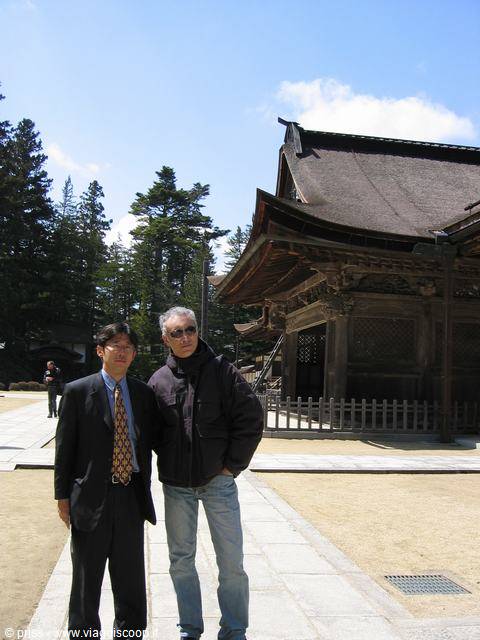
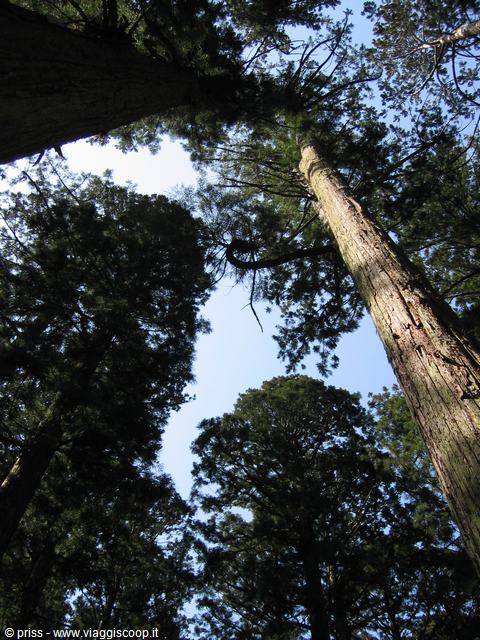
Masaki takes us to the sacred mountain of Koya. At ten past eight we're already here; he tells us there's a lot of road to cover to reach Koya-san even though the kilometres separating it from Kyoto are only 110! Indeed it takes us 3 hours to get there and the route isn't the easiest: on the last stretch we climb up the hairpin bends of a little mountain road, among rivers and enormous trees; the beauty of it is that this absurd road is two-way traffic and even though they're in front of a blind curve the Japanese don't use the horn... so at a certain point we were about to have a nice head-on collision with a truck! Once we arrive, Masaki would have wanted us to meet a Buddhist monk of Swiss origin who could have explained everything to us in Italian, so he buys 5 kilos of rice to offer to the monastery, on which he also has our name written.
Unfortunately, though, today the Swiss monk has gone to Osaka! In his place a female monk welcomes us, but she only speaks Japanese with Masaki and when she says something to us in English it's only to give us a sort of quiz about Buddhism... and clearly we're two dunces on the subject and know nothing about esoteric Shingon Buddhism (as indeed of any other Buddhism!) of Kobo Daishi or Kukai, and we come across as two beasts who came there to do goodness knows what. Whatever, let's drop it!
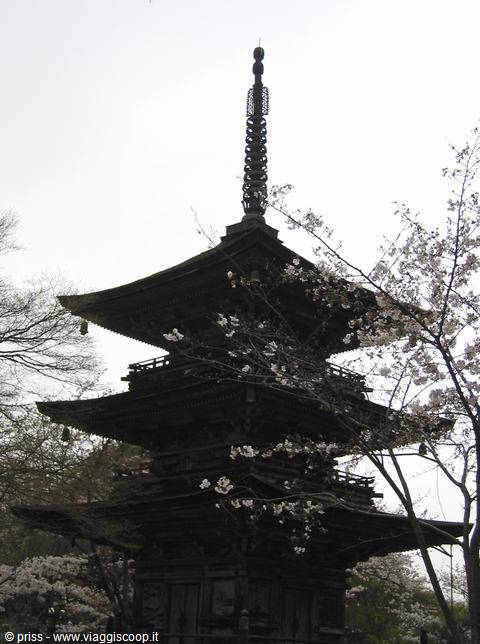
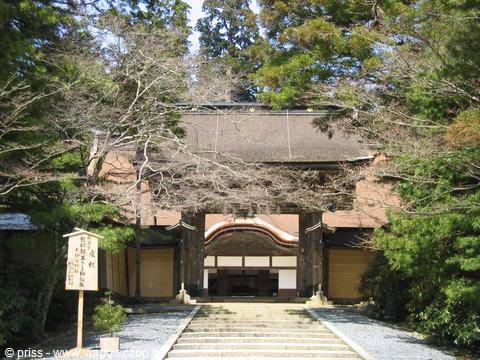
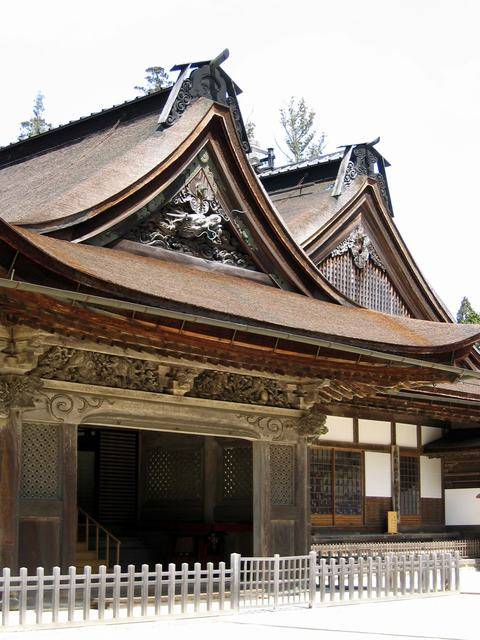
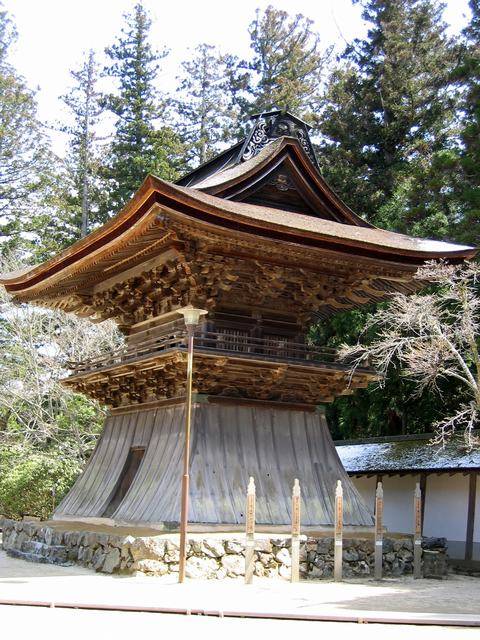
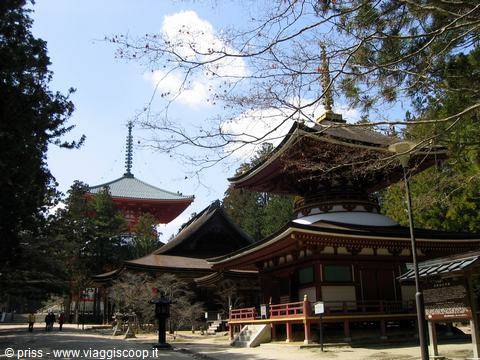
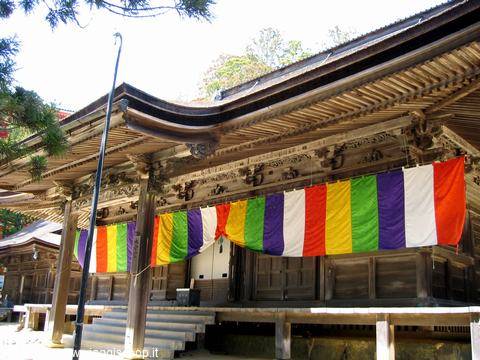
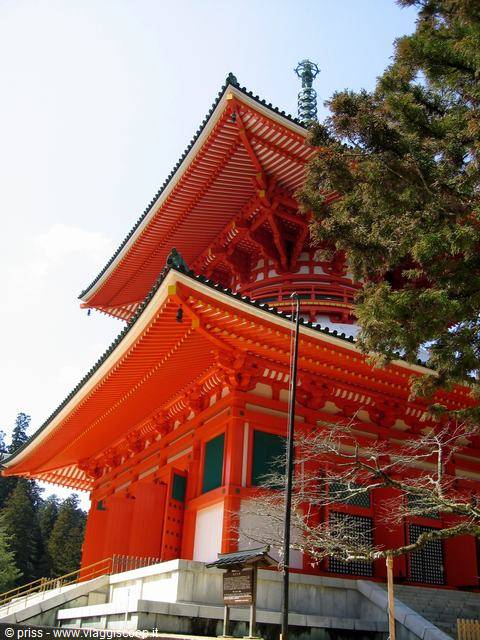
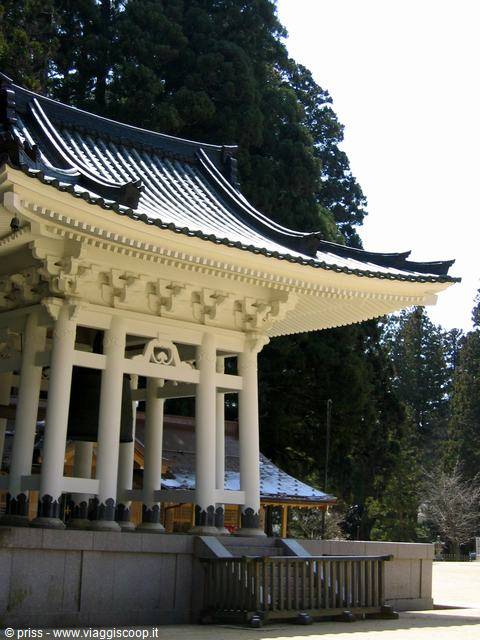
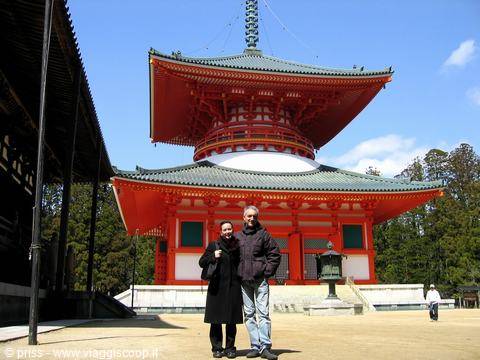
We go to see the temple complex of Garan; although the sun is out, Koyasan is quite high up and it's monstrously cold, so much so that although it's almost midday there's ice on the ground and on the most shaded roofs there's some nice snow... on top of all that Michele still has a bad cold and has even got a cold sore up one nostril, I can't tell you how happy he is every time we have to take off our shoes to enter a temple or monastery! The largest structure is the Dai-to, an enormous two-storey pagoda painted a brilliant orange, and the Kondo, that is the main hall. We admire the statue of the cosmic Buddha and his four guardians, but photos are not allowed.
There's also the western pagoda; I must say the whole complex makes for a pleasant walk, shame it's so cold; I really think that if we'd come here in bad weather we'd have frozen to death! To warm up we eat tempura soba in hot broth and tendon.
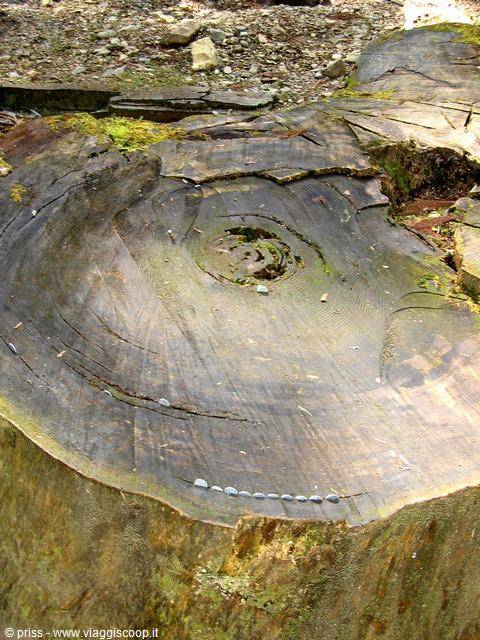
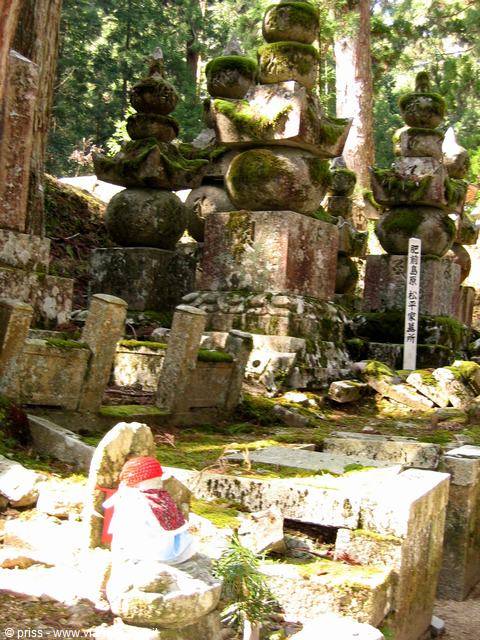
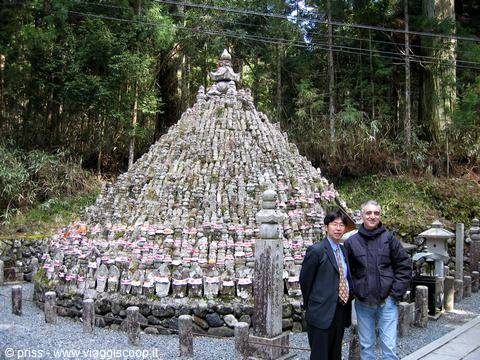
After lunch we go to visit the Okuno-in cemetery; Masaki explains that many people have even just a bone or a lock of hair of their loved ones buried here in order to bring them close to those of important monks and guarantee them a privileged position with the coming of the Buddha. The cemetery is enormous and submerged in the shade of centuries-old trees; we pass through crowds of statues with their little red woolly hats and bibs; there's also a cut trunk with coins stuck into its cracks...
there are many things that escape me, but not even Masaki is very well prepared on the subject, so if any of you reading this could explain their function to me I'd be really grateful! Very beautiful is the Toro-do, that is the hall of lanterns, two of which have been burning for more than 900 years; here there's a small crowd in prayer, and a row of statues onto which the faithful pour river water as an offering (but here too Masaki isn't quite sure). A little curiosity: in this cemetery there's also a "monument to termites" requested by a pesticide company, perhaps in a fit of repentance or as simple compensation!
I must say one thing in all honesty: perhaps Masaki's and our friend Andrea's enthusiastic accounts had led me to have who knows what expectations about this place; I must say it's beautiful, especially for its natural setting, but perhaps since we're not Buddhist and can't fully understand its mysticism I didn't find it an unmissable destination, especially because it's so hard to get to. Perhaps I would have preferred to be able to continue exploring Kyoto.
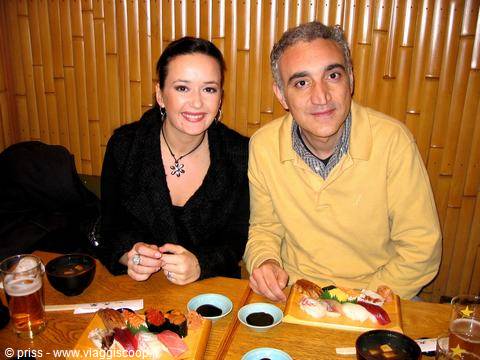
We return to Kyoto and invite Masaki to dinner: tonight sushi, lots of excellent assorted nigiri!
Koyasan
Day 126 Apr 2007
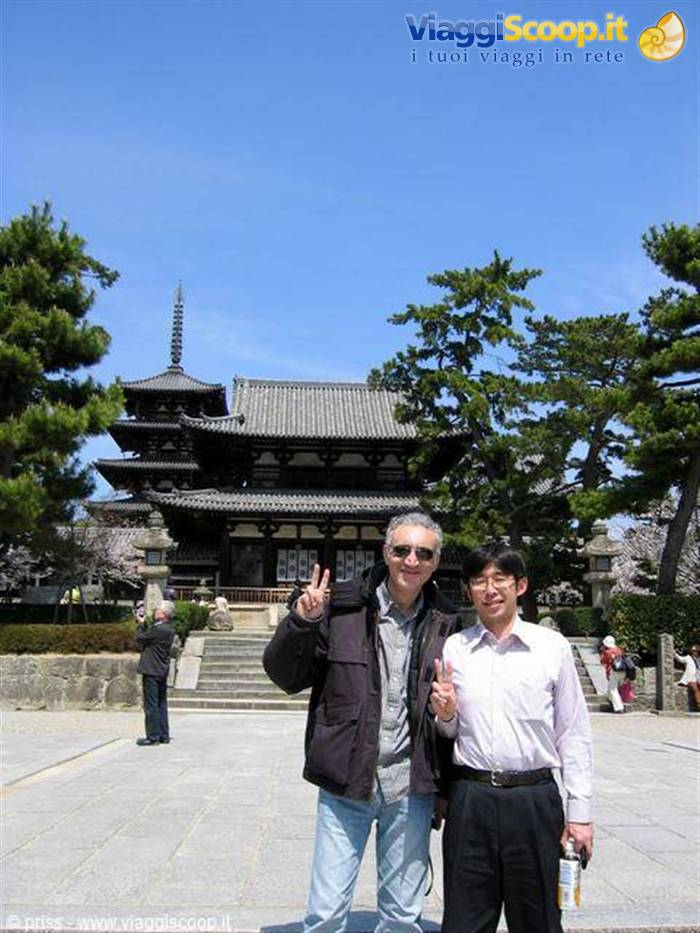
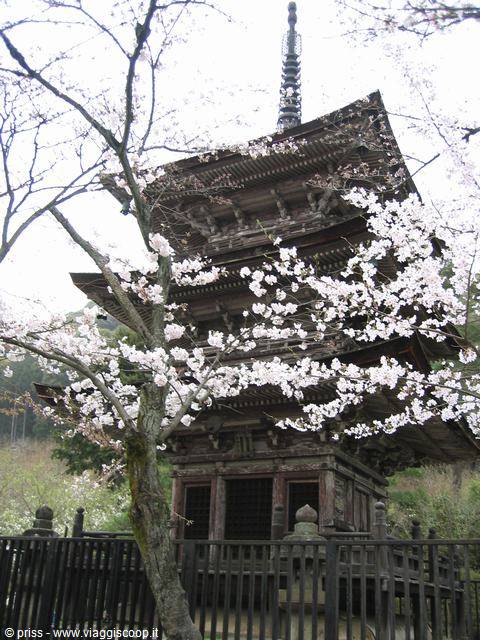
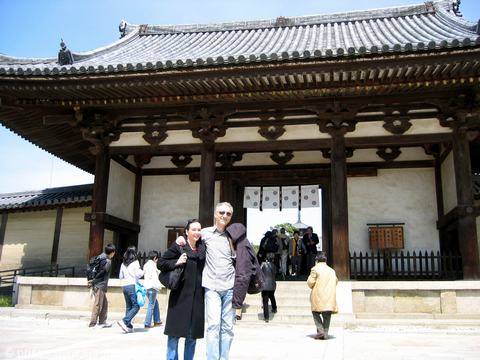
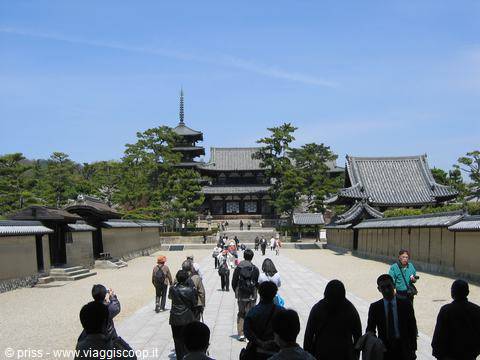
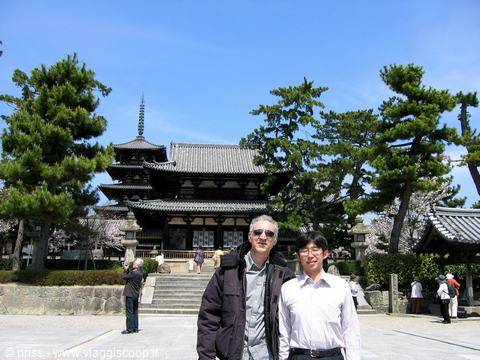
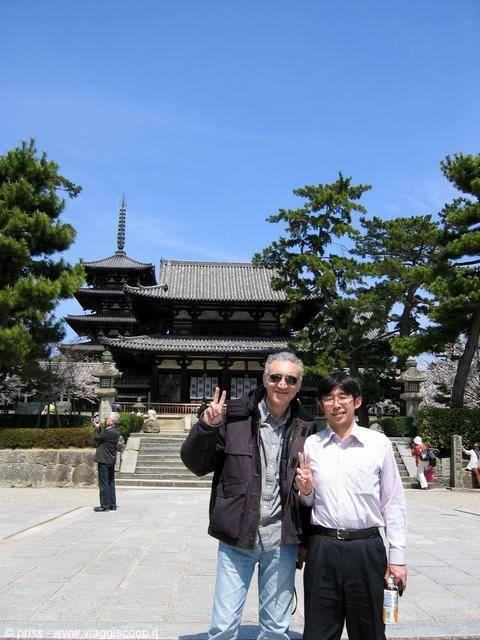
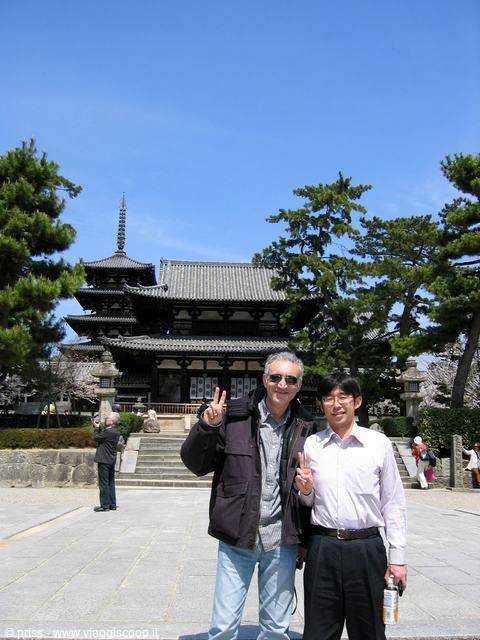
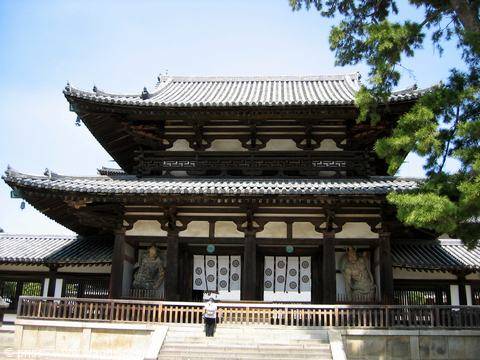
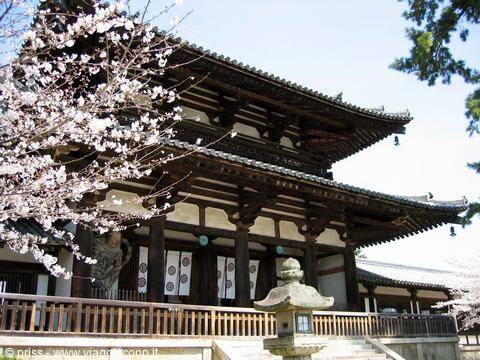
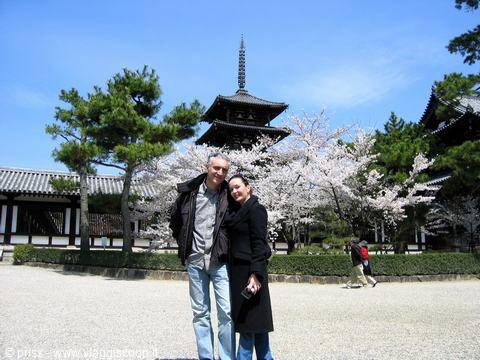
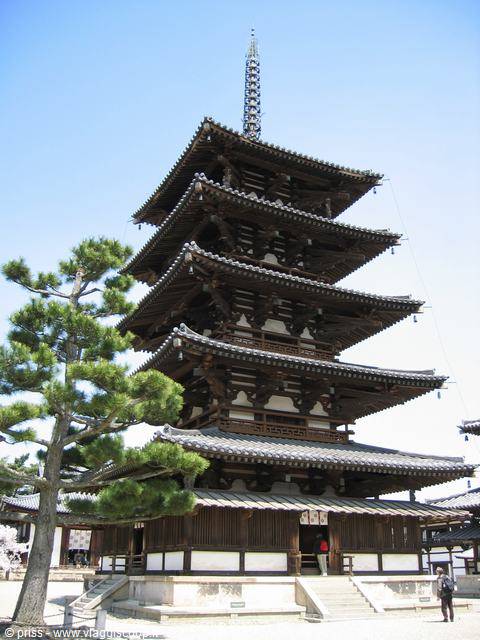
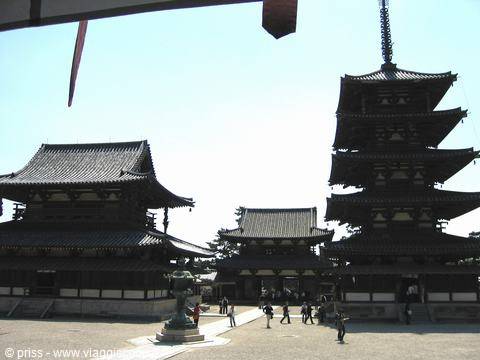
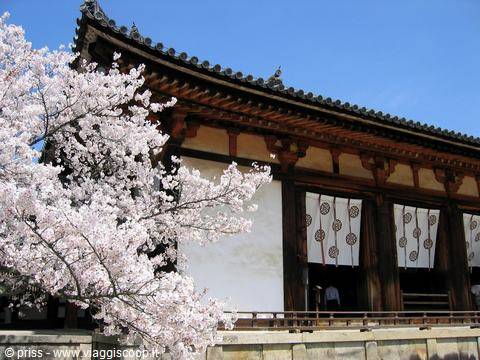
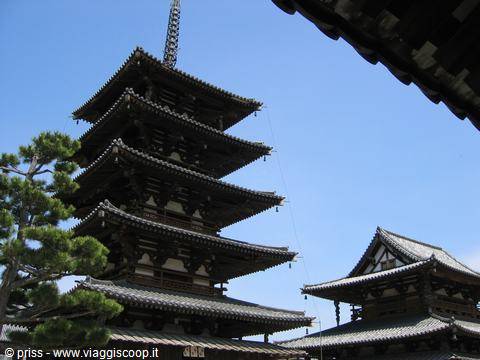
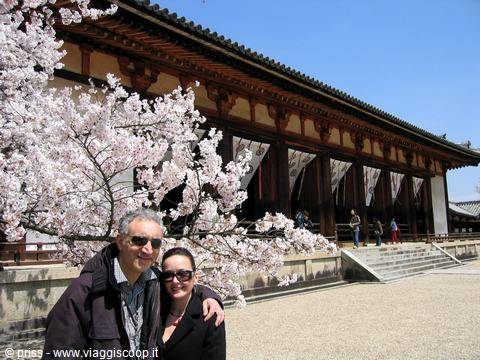
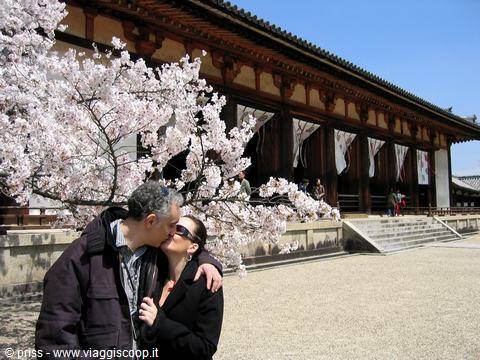
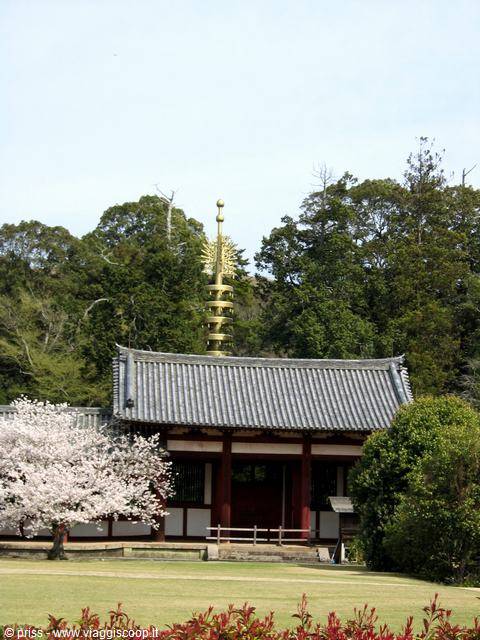
We meet Masaki at Nara station and by car we go straight to visit the Horyu-ji complex. Here stands the oldest wooden building in the world; in fact it dates back to 607. In the west cloister are the pagoda and the Kondo with, inside, a bronze group of the Shaka triad which apparently has the characteristic archaic smile, abstract lines, draped garments and a flaming mandorla, though unfortunately they're practically in the dark, and even though there's nice sunshine today you can't really make out such details. One of the pleasures of Horyu-ji, instead, is strolling in the cloister, an example of art that influenced the construction of temples throughout East Asia.
Before leaving the cloister, look along the walls of the little wooden hut on the right: there's a specimen of Tamemushi, a beetle with wings of an iridescent green like petroleum; inside the Daihozod-en (great treasure hall) at the end of the avenue there is in fact a mini shrine decorated with its wings, although the original colour is now faded. Inside the treasure hall there are also beautiful statues of Kannon; shame that here too perhaps it would have been better to bring a pair of infrared glasses to see these works properly!
But now let's move on to Nara; this lovely little town was Japan's first permanent capital. Previously, to preserve Shinto ritual purity, the imperial court moved to a new seat upon the accession of each new Emperor. At the time of Nara's founding, Japanese culture was strongly influenced by Chinese culture, with the introduction of Chinese characters and a great spread of Buddhism. There was therefore a cultural renaissance both artistic and religious, and this led to the construction of numerous temples, some of which have come down to us intact. In 784 Japan's capital moved to Kyoto and Nara became, from an imperial city, a quiet little town. This "oblivion" actually turned out to be a great advantage for the city, since it saved it from the devastation of the civil wars that damaged the artistic heritage of the major Japanese cities.
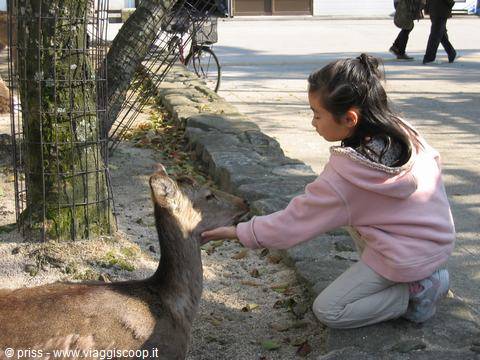
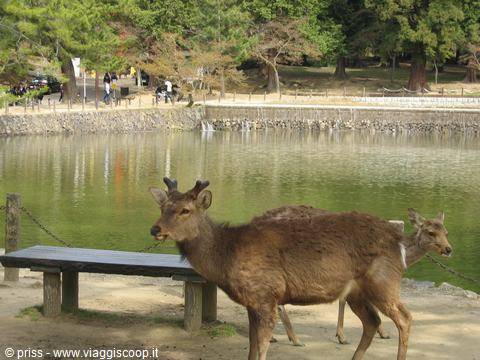
Nara today is a small town rich in historic buildings located at walkable distances; besides, getting around the city is very simple since it's a sort of chessboard. One of the city's main attractions is the famous Nara-Koen Park, inhabited by about a thousand deer whose antlers are filed down; these sacred deer are clearly... and it's possible to stroke them without problems...
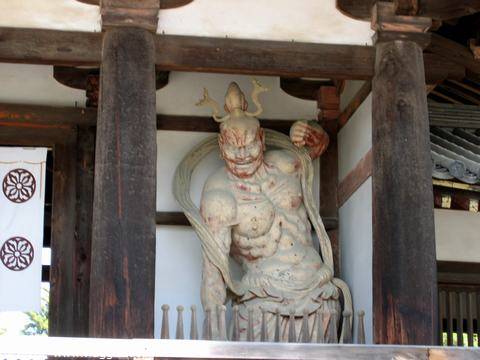
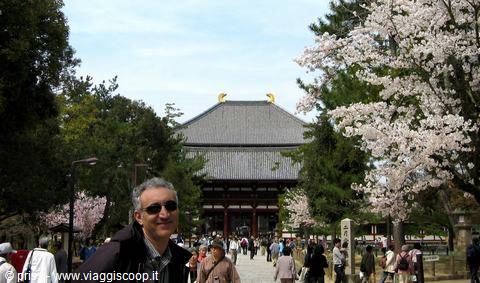
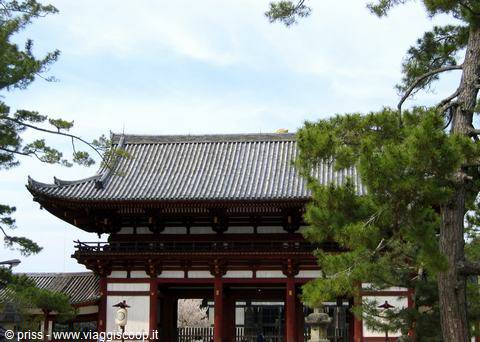
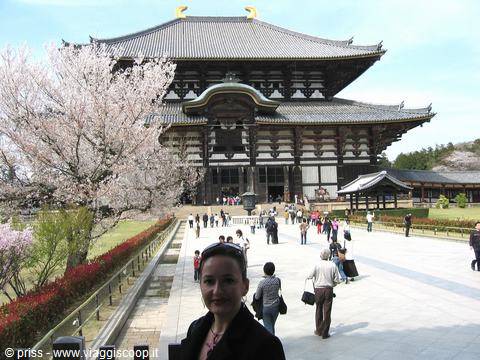
indeed in a certain sense stroking them is inevitable since along the road biscuits to offer them are on sale, so the deer take it for granted that you have something for them and to look for it they stick their wet noses on you! In Nara-Koen Park the great temple complex of Todaiji is perhaps the most important historic monument; you enter it after passing under an enormous portal flanked by two huge wooden statues depicting two types (demons?) absolutely furious and with fluttering garments, very beautiful, but since they were caged behind a grate I didn't photograph them.
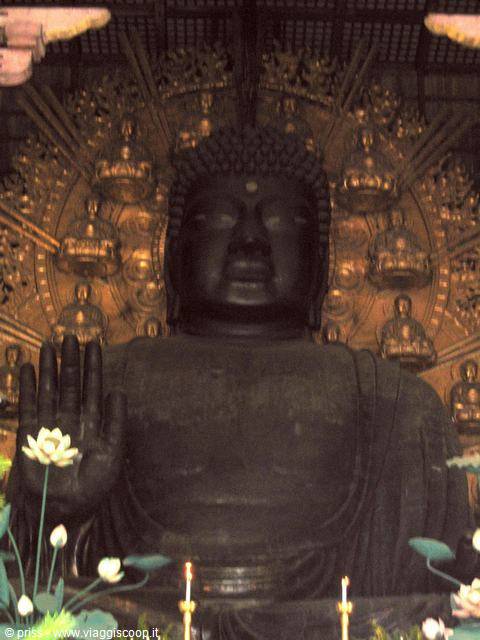
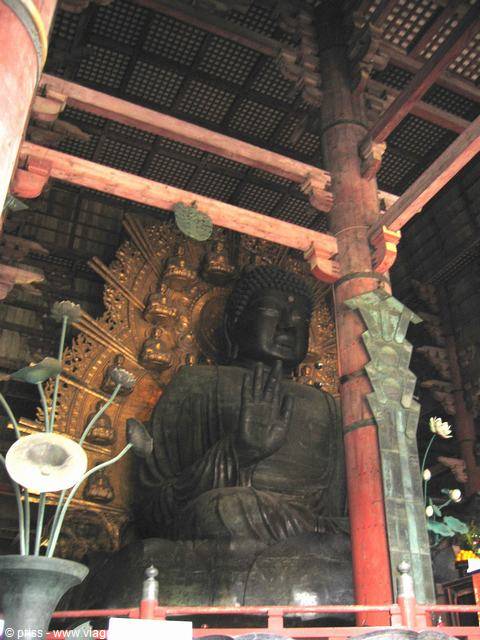
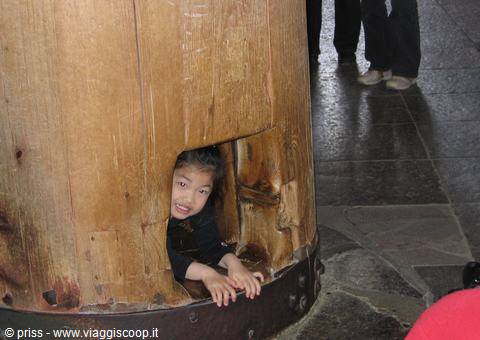
The Daibutsuden temple is very famous because it is the largest wooden structure in the world, although it's only a reproduction of the original temple which was even larger (it's said the current construction is about two thirds) and it houses a great statue of the Buddha dating back to the 8th century; clearly it's the largest statue in the world and is something like 20 metres tall, with 437 tonnes of bronze and 130 kg of gold. To get an idea of how big it is, look at the photo of the hole a little girl is popping out of: it's a passage at the base of a column that has the dimensions of one of the Buddha's nostrils. All children squeeze into it because whoever manages to pass through it is assured of enlightenment.
The statue is seated on a lotus flower, symbol of Nirvana, and has its right hand raised showing the palm, meaning "Don't worry", and the one resting on its knees "Come to me, I will save you". There's also the Kofukuji Temple, whose museum holds a collection of ancient Japanese statues. Shame we can't spend more time in Nara, it really is a beautiful city, but we have to go back to Kyoto, pick up our suitcases and go to Tokyo. So we say goodbye to Masaki, with whom we hope to meet again... in Sicily or in Japan... who knows!
We arrive in Tokyo and go to the Keio Plaza in Shinjuku. When we had slept here the first night of the trip we had booked at the last moment and were assigned a "comfort" room in the south tower; I must say it wasn't bad as a room, the furnishings modern, clearly recently renovated, of good size, so since the room I had booked from Italy was much cheaper we were afraid we'd end up with a room with decidedly dated furnishings, like some of those you see on their website. Instead, perhaps because we had signed up for the "Executive international" programme, or perhaps because we had returned so soon after our arrival, we were spontaneously given an upgrade and assigned a WONDERFUL room on the 31st floor of the main tower (one of the already renovated floors).
The room was gigantic (it corresponds to the plaza premier on their website), furnished with extreme taste, an enormous and super comfortable big bed, absolutely silent, with a very complete courtesy service and a breathtaking view. Not to mention that it's a hotel with a truly convenient location, being reachable in a few minutes through a covered gallery directly from Shinjuku station. If I were to return to Tokyo I wouldn't want to stay anywhere else!
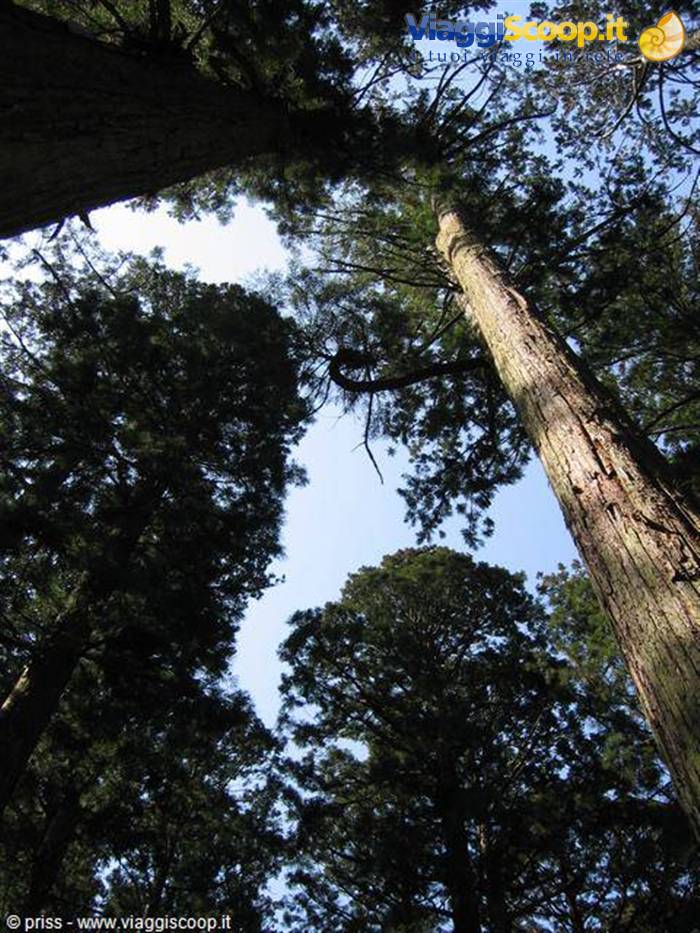
giant big trees
Day 137 Apr 2007
After all these days of frantic traveling by train and car, today we rest! Among other things, Michele is eager to go pick up his bass... I clearly a little less so, so I go shopping at Takashimaya and we arrange to meet there at 12:30. These department stores comprise 12 floors of chic shops and 3 of restaurants, and even though my dear husband told me "in my absence see if you can find something you like" with obvious gift-giving intentions, I must say that many of the shops here are absolutely of no interest to me... both because I have no intention of buying a pair of Ferragamo shoes or a Chanel bag in Tokyo, and because Japanese fashion is truly a bit unsettling: impossible giant bows, affected little flowers and balloon-like lines...
nothing that suits prisstyle! But don't think that all this managed to make me give up, so in the end I manage to find a very cool sweater even if not exactly cheap! Who cares!
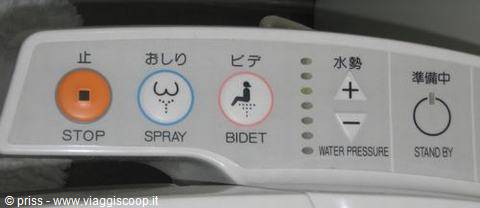
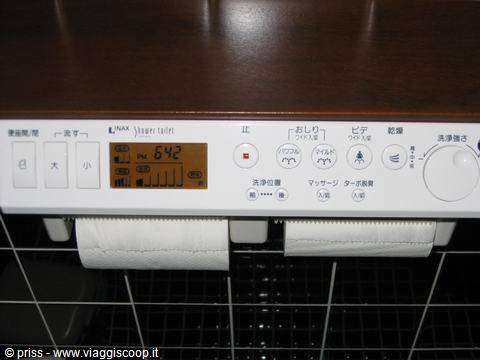
In addition to Takashimaya, you can find lots of nice little gifts in the Tokyu Hands store, where you can find practically everything: from carnival costumes to washi paper (improperly called rice paper), to my beloved computerized toilet seat! Finally Michele arrived with his new bass but before going to leave it at the hotel, we go to the 11th floor of Takashimaya where there is a demonstrator of Nespresso system coffee machines and finally we drink a good coffee like back home! Today is precisely a day dedicated to shopping, also because we have to buy a camera to bring as a graduation gift for Michele's brother, so we go around several electronics stores in search of the brand-new Pentax K10, in Shinjuku there are two very well-stocked ones, but Masaki told us to also go to the Akihabara district (also known as "electric town") before buying it, so that's exactly where we head for th
e afternoon.
I must say that this electronics district is quite picturesque: there are some huge stores, and then lots of small shops specializing in certain types of products, along with manga and video game stores. It's not an elegant district, in fact it's rather run-down and the prices from one store to another don't change much and the Pentax we're looking for turns out to be more expensive than in the other places where we've seen it. However, our afternoon is not fruitless because only in this district can you find electronic devices already set up for abroad and so we can buy ourselves an authentic Zojirushi rice cooker made in Japan with buttons also in English and 220 v current.
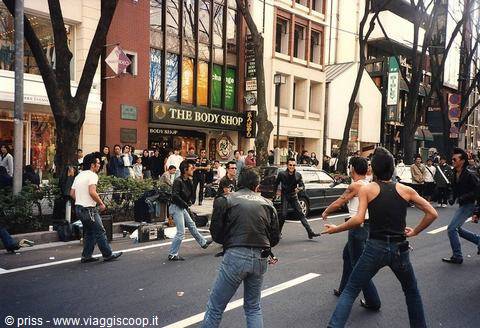
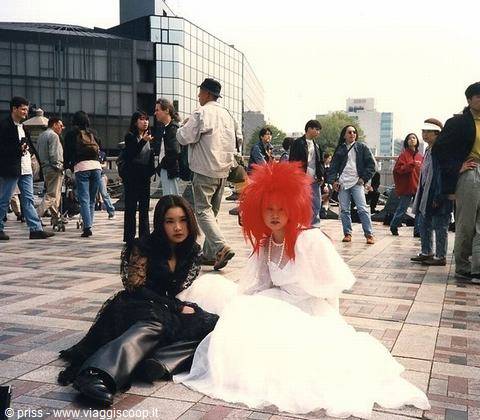
Needless to say that for the camera, on the other hand, the most convenient price is that of the store two steps from the hotel! Now we would like to go see the Cosplay phenomenon in Harajuku, that is, the kids who on weekends go out wearing the clothes of their favorite characters, complete with scenic gothic-style makeup... but unfortunately after a cloudless day it starts raining violently so our walk fades away. What a shame, it was something that intrigued me a lot!
After getting properly soaked going from one Shinjuku restaurant to another, not finding even a little hole to have dinner, we decide to go back to the hotel and have dinner there. But even though it's only 8:30 pm all the Japanese restaurants of the hotel (there are at least 5 different ones) tell us they are about to close, since we don't feel like having dinner at the Italian restaurant, nor at the French one, nor even less at the Chinese one, we opt for Korean cuisine. The Korean restaurant of the Keio is very nice and luxurious, they ask us if we want to eat something grilled and upon our positive answer they accompany us to a table with the barbecue stove in the center. We eat soft pancakes with shrimp, eggplant salad and grilled chicken and prawns cooked directly at our table by a chef! Really delicious and not even particularly expensive since we paid less than 30 euros each...
I don't dare think how they would have fleeced us in Italy for such a dinner in a restaurant of equal level! Only warning with Korean dinners: some dishes are very spicy, in any case they were clearly indicated in the menu.
Two men making peace signs before wooden temple hall and pagoda under blue sky
Day 148 Apr 2007
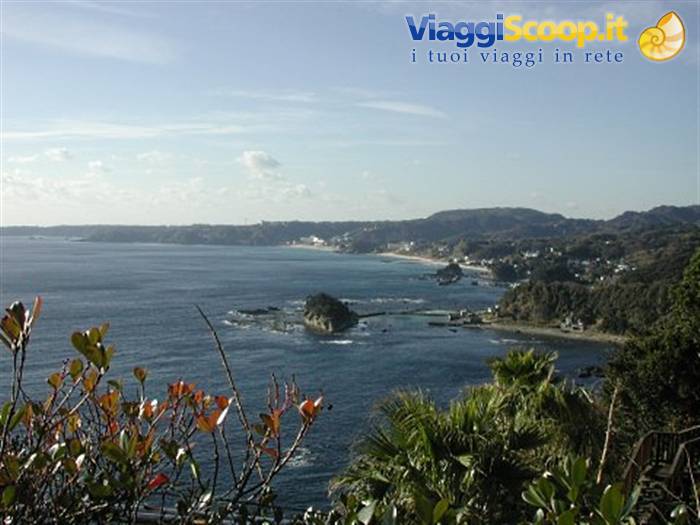
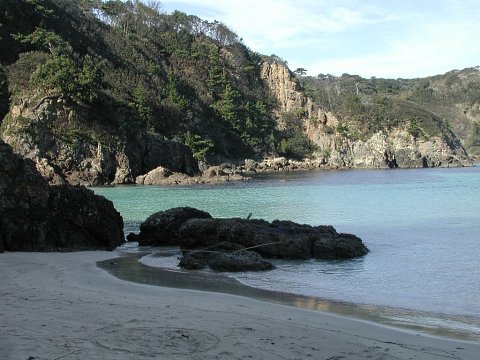
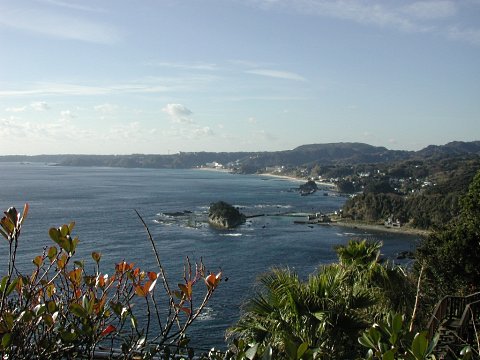
You must know that when I was 16 I studied a bit of Japanese and today we go visit Taeko, my Japanese teacher! We haven't seen each other for 16 years... wow! We got in touch by phone thanks to the cell phone lent to us by Masaki, and she gave us all the directions to reach her in the Izu peninsula, just south of Tokyo. So we take the train to Atami and there Taeko comes to pick us up with her husband Mario... what an emotion guys! She is always the same, it doesn't seem a single day has passed since the last time we saw each other, it's truly incredible (as well as a bit moving) to have found each other after so long! Mario and Taeko live and work as English, Italian and Japanese translators and interpreters in Ito, a small town in the beautiful Izu peninsula.
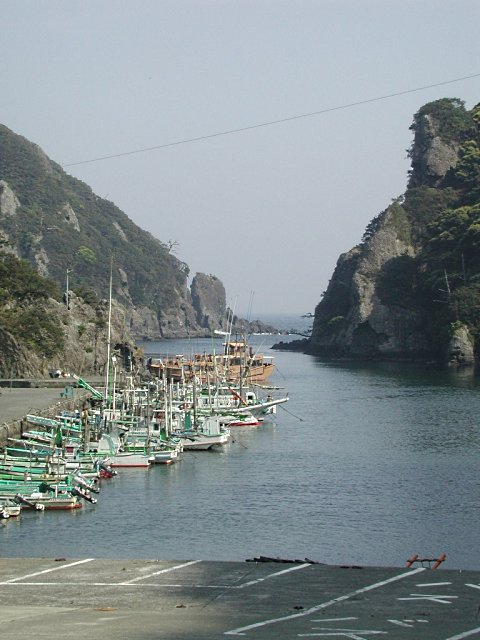
They got married in Italy (after all he, as you will have deduced from the name, is Italian, from Bergamo to be precise) and moved to Japan 10 years ago now. To reach their house we travel a beautiful road along the coast. To anyone who has the chance I strongly recommend visiting this peninsula overlooking the sea, its dark rocks and shining waters recall certain views of Liguria, or even the north coast of my city. The sun shines and this coast, along which you can also admire some small medieval castle, is truly wonderful! Once we arrived at Taeko and Mario's house they give us a wonderful antique obi, it's incredible to think that it is more than 3 and a half meters long...
who knows how difficult it must be to wear it with the kimono! Then they prepare a magnificent Barbecue in their beautiful garden and it's truly wonderful to chat together enjoying the delicacies they prepared! The nice thing is that thinking they were dealing with two Italian gluttons they prepared a truly Pantagruelian quantity of food! It's a real banquet with sashimi, Hokkaido crab, some unknown large shells grilled with a bit of sake inside and then yakitori and sausages... in short a mountain of delicious food! After this feast, since we talked so much about food they take us to the supermarket and help us buy some sauces and dips: the raw material for our future Japanese dinners made at home.
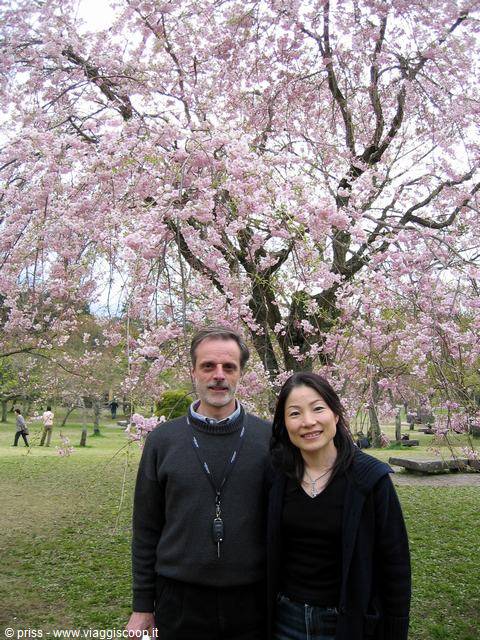
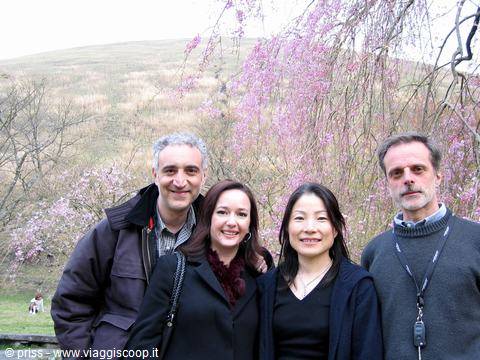
Then we take a walk and go to a very beautiful park on the slopes of a small volcano, too bad the sakura are already fading because here there are many and it must be a real spectacle when they are at their maximum splendor. In any case it's a beautiful park, too bad that at the time of the photos with Taeko and Mario the sun hides! Then they take us back to Atami to catch the train via a scenic road among the wooded hills, from here normally you enjoy a spectacular view of Mount Fuji... but not today because some clouds arrived to cover it. Even with this haze the landscape is truly suggestive. It was a wonderful day!
Nara koen
Day 159 Apr 2007
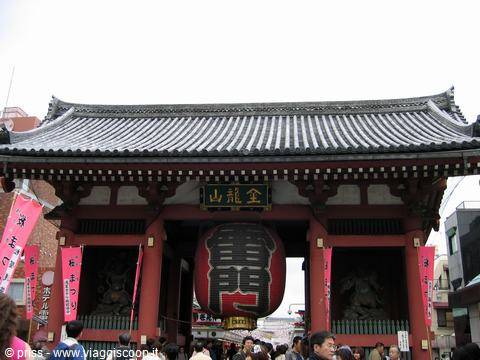
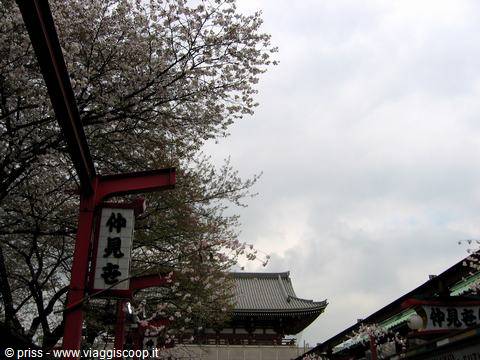
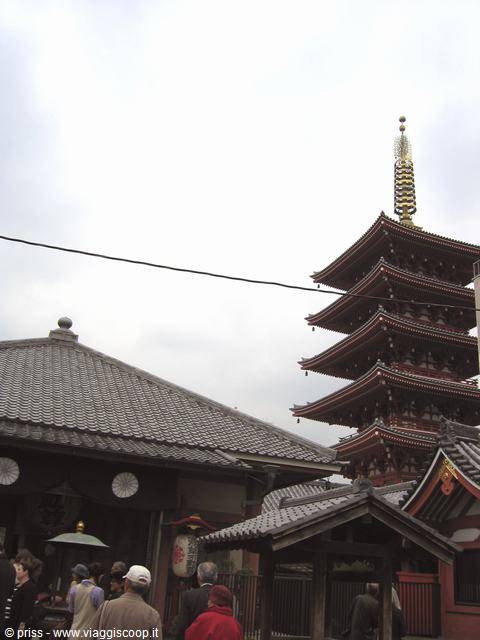
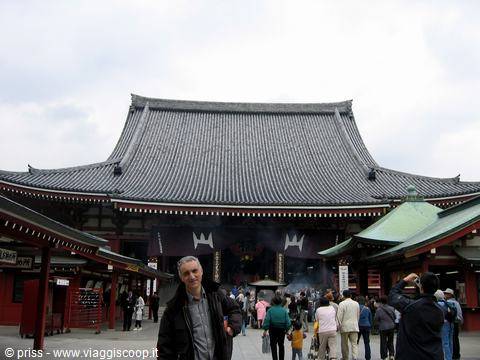
We go in search of the most ancient Tokyo (even though yesterday when we said that Mario corrected us saying "the OLDEST Tokyo), and here we are in Asakusa to visit the Senso-ji, since I have a sore throat I join the people crowding around the incense burner placed in front of the temple: it is said in fact that its smoke brings good health and so we are all there letting it fan over us, trying to make it penetrate our clothes... uhm I already feel better, will it be the incense or maybe the lozenges I bought this morning? Near the temple there is a small pagoda, a cemetery and many little lanterns. After leaving the temple we dedicate ourselves to the many stalls along the street: the time has come to buy the geta that Gianni asked us for, that is, the clogs in light wood with the two raised straps underneath like those that I don't know which cartoon character had...
oh but couldn't our dear ones have less bulky wishes? By now we have accumulated so many gifts (both received and to bring to relatives and friends) that we had to mail our dirty clothes home!
While we buy the geta, we get a phone call from Taeko who recommends an excellent area for shopping, it's exactly the street where I would have wanted to go on Saturday: between Harajuku and Omotesando, too bad that today there's not a shadow of Cosplay! Indeed it is truly a very fashionable area, there are small Italian cafes and boulangeries, we buy some beautiful prints according to the ukiyoe technique and then little bowls and other little gifts. A truly excellent store for this kind of purchase is the Oriental Bazar. It's almost five and we have walked a lot, we go to rest a little at the hotel and in the meantime we make arrangements with Erika (the girl we met at Fiumicino airport) to go visit her.
Erika's mother in fact has a small restaurant where only chicken skewers are eaten, but in many variations! It's not exactly in Tokyo, but in Kawasaki, we take the train and Erika comes to pick us up at the station. The restaurant is right nearby and it's a nice little place, with the classic counter from which you can follow the various preparation phases, but also a traditional little room with two low tables on the tatami.
We sit at the counter so we can chat with Erika who has to work to give her mother a hand and we eat one skewer after another, truly delicious! Erika tells us some of her troubles with the immigration office in Italy, it seems incredible to me that they make such a fuss about granting a residence permit to this very polite Japanese girl! Erika in fact has been studying fine arts at the Bologna academy for two years now, she also tells us about some scams she was a victim of in the early days when she had little familiarity with the language...
what a shame! I really wonder how one can take advantage of such a sweet and good girl, even though despite everything she still likes Italy, I really hope that on her return our country can regain some points! During dinner Erika's mother and some of her friends who are customers go out of their way with kindness, they give us a strange card game with 4 drawings for each month (it's a rather complicated thing and they themselves have to consult friends by phone to be able to assign the right cards to each month!) and a cast iron pot with a little stove. They are all very kind despite the language barriers and at the end of the evening one of them even offers us a taxi to go to the station! This too was truly a beautiful evening in excellent company!
Shirahama bay in Shimoda, dark rocks among palms and blue sea under daytime sky
Day 1610 Apr 2007
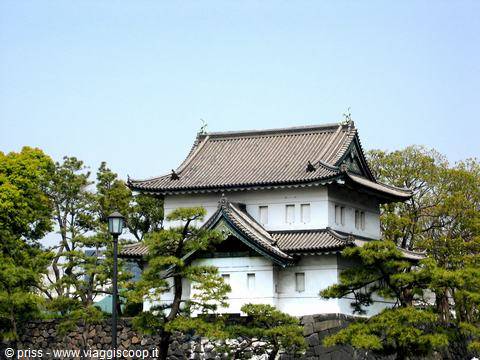
Today is practically our last day in Tokyo and we should have taken an excursion to Nikko, but my cold has gotten worse and since we know it's in the mountains and it's cold like in Koyasan I don't want to risk facing a 12-hour flight with a fever. So... it will be for next time! So we go see the imperial palace of Tokyo, the emperor still lives here and obviously it's not visitable, we admire it from afar and then we go visit the eastern gardens of the palace, actually they are quite ordinary gardens that have nothing to do with the splendid Japanese gardens seen up to now. So we go to Ginza, the famous high-class shopping district, our first destination is the Sony Building where according to the guide you can reach floors and floors of cutting-edge technological marvels. Actually you could admire them if only one knew how to read Japanese...
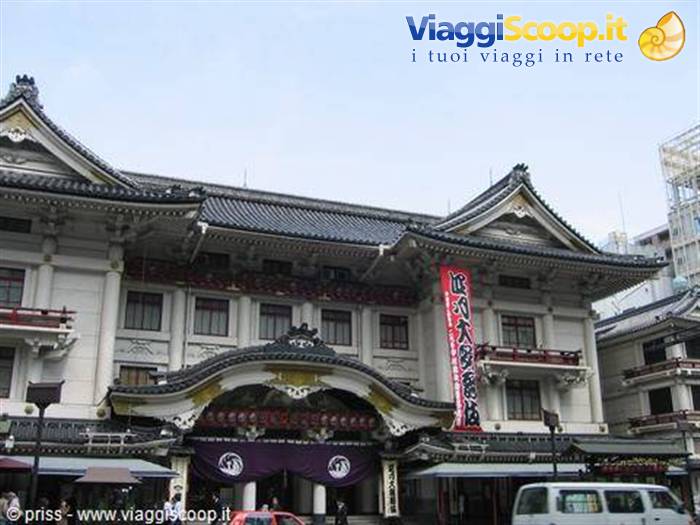
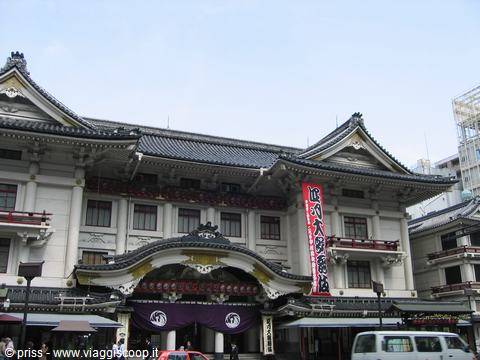
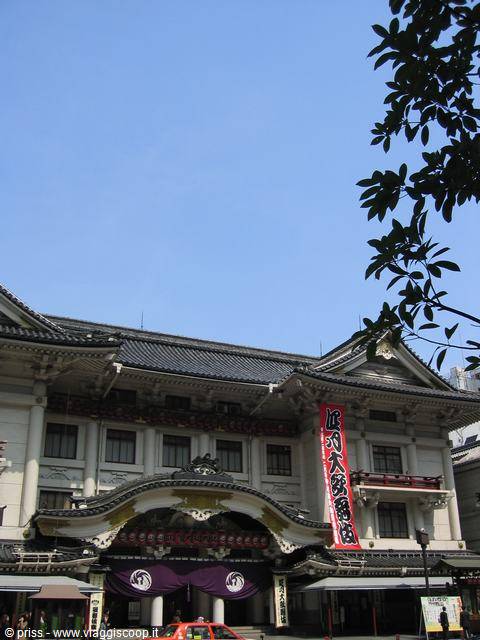
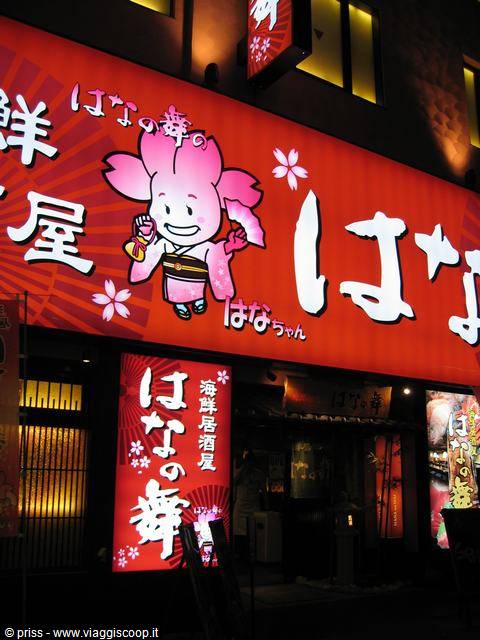
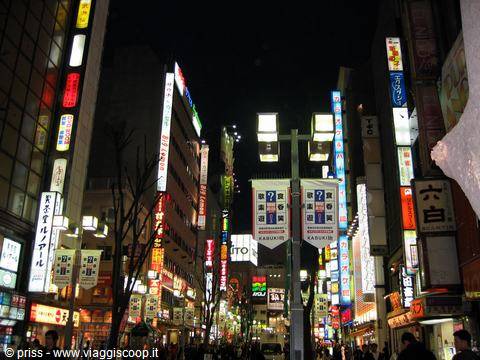
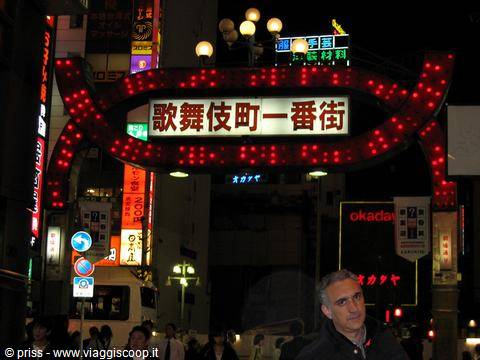
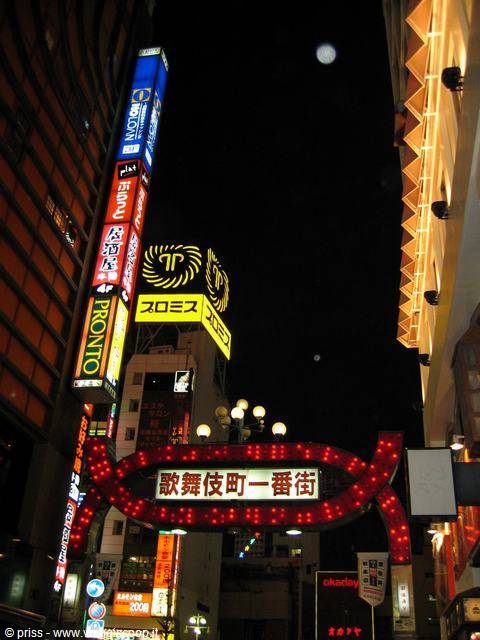
but that's not our case and since in most cases we can't even understand what the devices in front of us are, after 2 floors we get annoyed and leave... an English sign at Sony? No huh? We continue walking around Ginza until we reach the Kabuki theater, but I must say that in general I find it a rather disappointing district. So we go back to Shinjuku and walk among the heterogeneous crowd of the Kabuki-cho area, the district of Tokyo's "questionable" venues... the nice thing is that it's a very colorful place where you can walk in complete tranquility, very different from the red-light districts of certain European capitals. Bho...
maybe in the end I'm not cut out for upscale districts, but I prefer Shinjuku a thousand times over Ginza! Actually Tokyo is absolutely not a destination to leave for the end of the trip, I think that maybe Asakusa, or the more "old" districts to use Mario's definition could have thrilled us if we had seen them before everything else, but after the magnificent temples of Kyoto or Nara, the comparison is truly merciless! But even from the point of view of the modern metropolis Tokyo is not up to par: being built on reclaimed land, in a highly unstable alluvial plain and often subject to earthquakes its buildings are certainly not skyscrapers worthy of the name.
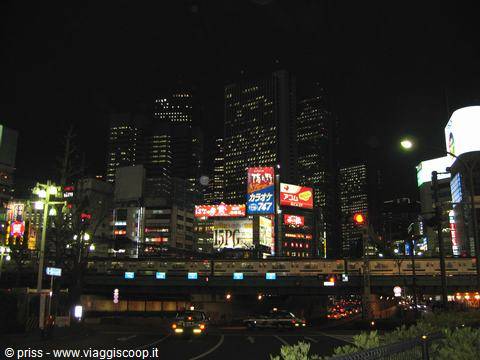
The tallest buildings are right in Shinjuku, after all even the Keio Plaza where we are staying is among them and even though they don't exceed about 50 floors they are a fine sight in the night lights and this is our last "postcard" of this splendid trip.
Ginza kabuki theatre
Day 1711 Apr 2007
the suitcases close and off we go! In conclusion I would like to say that although I have written so much I have told you only a minimal part of the thousand oddities noticed in Japan. It is a land of strong contrasts, incredible landscapes, profound culture. I had never seen such order in very crowded stations and such care for every aspect of common life. I would also like to add that it's not a trip as expensive as one might expect, for the rail pass for two weeks we spent 250 euros and we moved EVERYWHERE, the hotels where we stayed were beautiful and the most expensive is on sale at 150 euros per night on the major Italian portals (if I think about how much we spent at the Hilton or the Sheraton in New York... the Keio is much nicer and costs less than half!) and among other things there were also many other lower-priced alternatives.
The same goes for restaurants: hygiene prevails everywhere in Japan, we ate divinely both in luxury restaurants and in simple places. Don't buy the nice ready-made tours, set off on your own and you'll see it will cost you as much as going to a European capital because between hotels and restaurants you'll greatly amortize the cost of the plane ticket. Another thing: the worse you speak English the better! The Japanese speak very badly, but they work in every way to help you, after the first days I either asked for information in Japanese, or Michele in English... for them my English with conjugated verbs and correct terms was too difficult, so if your vocabulary is reduced to "I go" or "I want eat" so much the better! Well then... now I have really written a novel so good trip to everyone!
Sia il diario del viaggio che le foto sono meravigliosi! Dev'essere stato veramente un viaggio molto emozionante:avete fatto venire voglia anche a noi di andare in Giappone!!!
priss · 28/04/2007
grazie ragazzi! alle foto devo dare un po' una sistemata, ad ogni modo io vi consiglio caldamente di andarci, è davvero un viaggio "diverso" dal solito!
MasalaKate · 29/07/2007
Brava! Le tue foto mi piacciono molto, spontanee e piene di personalità.
Tama · 03/09/2007
Spettacolare!!!!
Il giappone è la meta del mio viaggio di nozze e l'itinerario è simile, solo che noi faremo da nord a sud...
Mi piace molto il vostro diario!!!
E naturalmente anche le foto
memeonline · 17/02/2008
FANTASTICO QUESTO VIAGGIO
SPERO DI RIUSCIRE AD ANDARCI ANCHE IO PRIMA O POI !!!
MEME
memeonline · 17/02/2008
FANTASTICO QUESTO VIAGGIO
SPERO DI RIUSCIRE AD ANDARCI ANCHE IO PRIMA O POI !!!
MEME
ventoenuvole · 09/09/2008
complimenti Laura mi è piaciuto sia il tuo modo di raccontare che il tuo modo di vedere e donare ricordi.
Io ci ho provato con il mio viaggio in bicicletta in solitaria tra Corsica e sardegna, che ho intitolato RAPPORTO MOLTIPLICANTE, dove ho cercato di attraversare sia i luoghi del cammino che i luoghi del mio pensare.
comunque non nego che il Giappone è sempre stato per me un luogo irraggiungibile per quanto abbia cercato di avvicinarmi, nforse un auto mi ha dato la sensazione che può avere un occidentale nei confronti del Giappone ed è Philippe Forest, con il suo "Sarinagara" tre volte un unica storia.
un augurio e buoniviaggiancora.
Ventoenuvole







































7 reader comments
Sia il diario del viaggio che le foto sono meravigliosi! Dev'essere stato veramente un viaggio molto emozionante:avete fatto venire voglia anche a noi di andare in Giappone!!!
grazie ragazzi! alle foto devo dare un po' una sistemata, ad ogni modo io vi consiglio caldamente di andarci, è davvero un viaggio "diverso" dal solito!
Brava! Le tue foto mi piacciono molto, spontanee e piene di personalità.
Spettacolare!!!! Il giappone è la meta del mio viaggio di nozze e l'itinerario è simile, solo che noi faremo da nord a sud... Mi piace molto il vostro diario!!! E naturalmente anche le foto
FANTASTICO QUESTO VIAGGIO SPERO DI RIUSCIRE AD ANDARCI ANCHE IO PRIMA O POI !!! MEME
FANTASTICO QUESTO VIAGGIO SPERO DI RIUSCIRE AD ANDARCI ANCHE IO PRIMA O POI !!! MEME
complimenti Laura mi è piaciuto sia il tuo modo di raccontare che il tuo modo di vedere e donare ricordi. Io ci ho provato con il mio viaggio in bicicletta in solitaria tra Corsica e sardegna, che ho intitolato RAPPORTO MOLTIPLICANTE, dove ho cercato di attraversare sia i luoghi del cammino che i luoghi del mio pensare. comunque non nego che il Giappone è sempre stato per me un luogo irraggiungibile per quanto abbia cercato di avvicinarmi, nforse un auto mi ha dato la sensazione che può avere un occidentale nei confronti del Giappone ed è Philippe Forest, con il suo "Sarinagara" tre volte un unica storia. un augurio e buoniviaggiancora. Ventoenuvole