The story
In India all roads lead to Varanasi, the holy city par excellence of Hinduism. Varanasi is one of the oldest cities in the world, but above all the spiritual soul of India. A trip to this country cannot and must not, in our opinion, fail to include a visit to the city. Ancient Hindu scriptures call it the Eternal City, as the home of the god Shiva. The same scriptures hold that the city stands on the holiest ground there is on Earth. For this reason, and for so much more, Varanasi is the holiest of India's holy cities; it is the place of the ablutions in the Ganges, of the ghats, of the funeral pyres, where it is impossible to remain an impassive observer because of the atmosphere steeped in spirituality that only this holy city conveys and radiates.
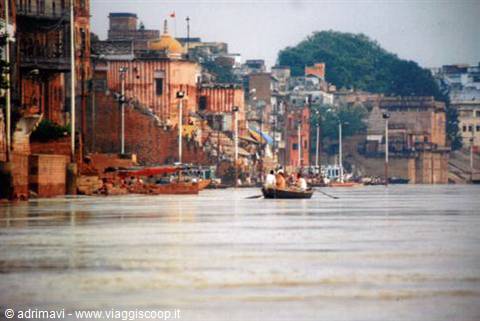
We see Varanasi and the Ganges, the most sacred things in India, for the first time and at the same moment. For an instant I believe I feel the very sensations that must assail pilgrims on their arrival in the city: faith, grace, mercy and eternity. The city stretches along the western bank of the Ganges; the eastern one, in fact, is considered impure. This is easily sensed from the contrast of the great palaces and temples, from the myriad spires rising here and there, and from the many ghats, the stairways on which a constant coming and going of people descends to the river for the ablutions. A swarm of life, then, animates the western bank at every hour of the day, in contrast to the desolate opposite bank. It is raining, but people seem not to pay it much mind.
It is the usual afternoon monsoon downpour, more or less violent, that has been pursuing us since our arrival on the subcontinent; after all, we are in the height of the rainy season. The Ganges is in flood because of the season, so much so that the ghats are partly submerged by its putrid, brown, dirty and muddy waters. Our visit begins at the Bharat Mata Temple, dedicated to Mother India and known for its relief map of India. From here, by tuk-tuk, we continue to the New Vishwanath Temple, which houses the revered lingam of Shiva. It is dark by now, but we find the time to visit the last of the temples whose entrance is not forbidden to us, the Tulsi Manas Mandir, in the Sikhara style. The temple is famous for its walls, on which the Hindi version of the Ramayana is reproduced, the epic poem that tells the story of Rama, one of the many reincarnations of Vishnu.
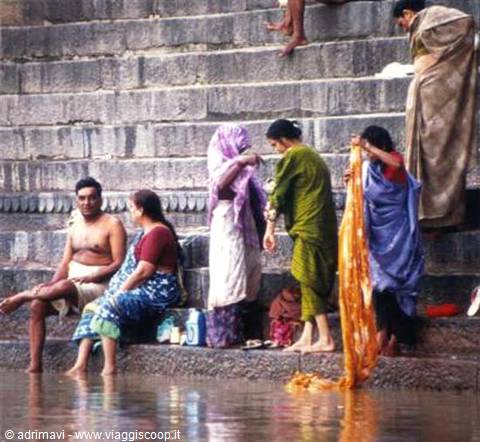
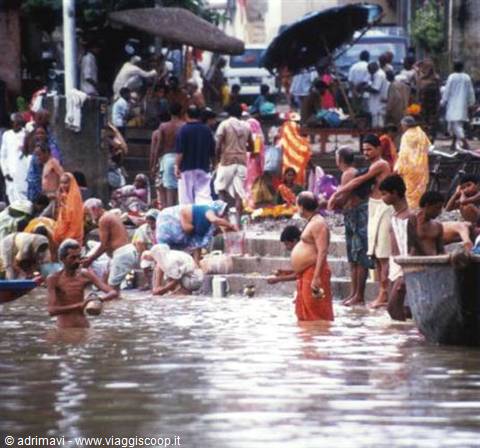
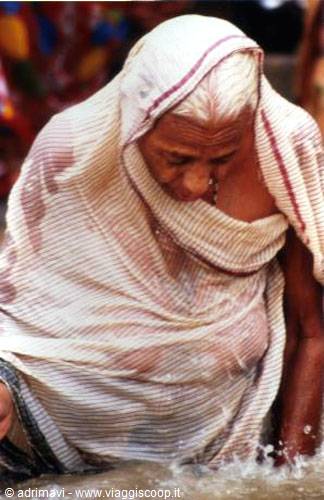
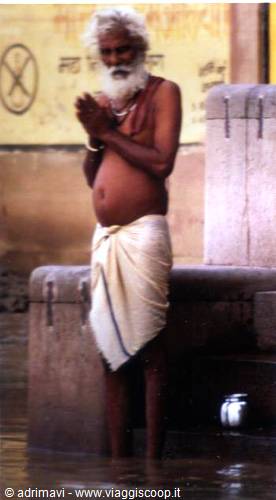
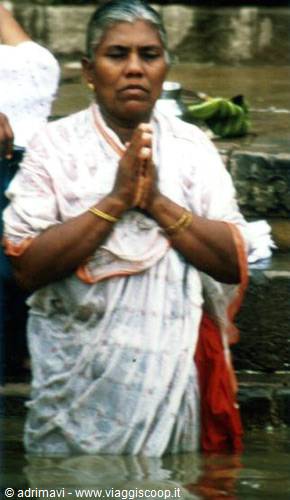
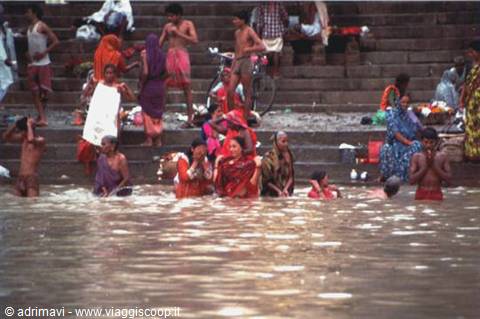
The next day at dawn we have an appointment with a boatman who will take us to witness the extraordinary spectacle that is repeated every morning at sunrise: the ablutions of the faithful in the Ganges. At the first rays of the sun we are already on board, ready for the boat ride. Along the three kilometres of ghats we take part in a touching spectacle and savour mystical atmospheres. During the two-hour tour we witness a continuous flow of the faithful descending to pray in the holy waters of the Ganges: men, children and women, the latter wrapped in phantasmagorical, colourful saris, purifying themselves of the sins they have committed. Now and then one sees young people intent on yoga exercises or sadhus in meditation. Going up and down the river in the water we see everything, even the carcass of an animal following the docile flow of the river.
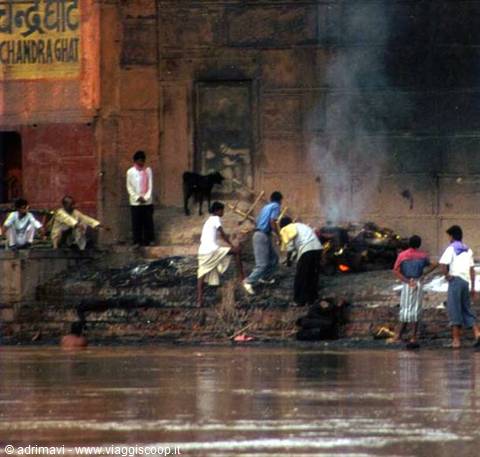
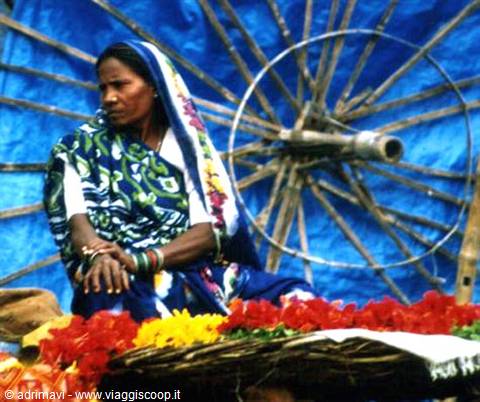
More than anything else we see many garlands of flower petals floating by, the offerings made to the Great Mother Ganga. At every ghat there is a vendor of these garlands. The Manikarnika and Harischandra Ghats are the most evocative, places where more than anywhere else one feels the spirituality of the Indian religion. Here the rite of cremation is performed. The bodies of the deceased are carried on a bamboo litter, wrapped simply in a sheet, and laid on the funeral pyres, stacks of wood suitably prepared, burned, and finally their ashes thrown into the Ganges. We stop in the middle of a cremation and are at once completely enveloped by gusts of smoke mixed with ash. Add to that the unbearable heat, the bothersome humidity and the acrid smell of burnt human flesh, and you will understand why it felt like suffocating.
Deafening bursts follow one another inside the pyre along with the sound of the untouchables' sticks, the workers who tend the blaze and revive the fire by beating the burning embers with large sticks. The guide explains that the three hours of cremation needed to incinerate a body cost 2,500 rupees, that is 120,000 lire, a sum only wealthy Indians have. The poor cannot afford to buy the wood and pay for all the work needed to prepare the funeral pyre, so for them there are electric crematoriums, far cheaper though less sacred and ritual. The body, in fact, is incinerated in just 15 minutes. The funeral in this case costs just 250 rupees, that is 12,000 lire. After the life of the river, we immerse ourselves for the rest of the day in that of the city. Close to the Ganges, Varanasi is a tangle of alleys where tuk-tuks can barely pass.
We observe human figures hard to describe and define: they are the terminally ill, the hopeless, brought here by their relatives from every part of India to die, since the holy ground on which the city stands is propitious for leaving earthly life. Whoever passes away in Varanasi gains access to paradise. That is why so many old people, the dying, the sick, the maimed crowd here right by the bank, waiting to die! The labyrinth of alleys looks like an open sewer, yet, indifferent, people buy and sell vegetables at improvised stalls, children play chasing one another, cows graze indifferently as if on a lawn. We reach the Golden Temple, whose entrance is reserved for Hindus only. A shrewd and kind Indian knows this well; his house stands right next door.
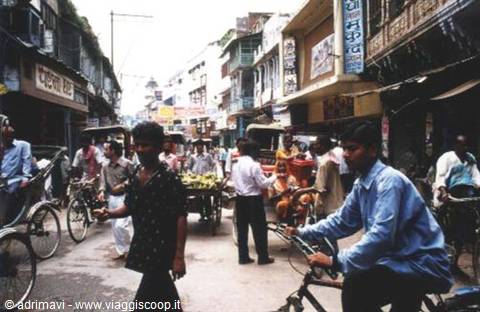
If you linger in front of the entrance, the man in question will spot you and, for a small fee, will come and offer to let you up onto his balcony, from which you can see the interior of the temple courtyard very well. So we watch the faithful pray on the shiny marble floor, strewn with coins and flowers, some wilted, others in full bloom. From here we get a good view of the temple's dome, famous for having been covered in a tonne of gold - hence the name Golden Temple - at the wish of Maharajah Ranjit Singh. We go to the Chawk district, where the city's most characteristic market is held. Impossible to describe the chaos of pedestrians, bicycles, cows, tuk-tuks and cars circulating with no rule of priority or stop, amid the deafening, continuous blare of horns.
We even see a human traffic light! We find some quiet in one of the many silk-weaving workshops for which Varanasi is famous the world over. A Varanasi silk scarf must absolutely be bought, and right here, among the precious silks of one of these factories, at whose looms mostly children work. We each take one as a memento of our visit, but what is a scarf, however beautiful, compared with the many memories this holy and eternal city leaves behind. Every Hindu who professes to be one must, at least once in life, make a pilgrimage to Varanasi, but the same, I would add, must do every traveller who chooses India as their destination. Here more than anywhere else, in the kaleidoscopic Indian subcontinent, what Pasolini said comes true: "a Westerner who goes to INDIA has everything but in reality gives nothing. INDIA, instead, which has nothing, gives everything".
The journey's photographs
11 photographs · click to open them full screen

0 reader comments