I arrived in India on a Qatar Airways flight Rome-Doha-Delhi. To get here the plane flew over Pakistan. I made the trip with a friend. We booked the tour with an agency in Jaipur, which put a car with a driver at our disposal for most of the journey. The trip through India is the largest part of an itinerary that also included the Kathmandu Valley in Nepal. Unfortunately this journey was marked by my bout of flu with a high fever.
Day 122 Feb 1992
Arrival in Delhi and Mandawa
Having arrived at Delhi Airport at 3 in the morning, already in possession of the visa obtained from the Indian Embassy in Rome not without difficulty, after collecting our luggage we made our way to the exit, where numerous drivers were waiting for their clients with signs in their hands on which they had written the tourists' names. And so I see the sign with my name and I pick out the driver, a distinguished gentleman with a nice pair of moustaches curled a la Cecco Beppe. The air is spring-like despite it being the middle of the night; we reach our vehicle in the car park and begin the tour. We take advantage of the night to leave the urban sprawl of the capital. Despite the hour the traffic is heavy and I can only imagine what it would have been like in broad daylight. This is the first contact with Indian driving, hard to understand by our standards.
In practice it seems that there is no highway code and that anarchy is the rule; the law of the strongest prevails, or if you prefer, of whoever makes himself heard the most with the horn. It is one long honking, a continuous jam with road users grazing dangerously past one another. The roadway is not in good condition, the presence of cows and other animals on the carriageway and the variety of traffic made up of cars, tuk tuks (they are motorised three-wheelers, mostly Piaggio, used as taxis), camel-drawn carts, motorbikes overloaded with goods and people and trucks loaded beyond belief complete the picture. After a first traumatic introduction we both prefer to take the back seats because sitting in front you risk a heart attack, seeing as the vehicles point themselves at each other head-on and only at the last moment does each one swerve onto its own side of the carriageway.
In any case, by around 9 we are at our accommodation, the Desert Resort in Mandawa, a place in the style of a caravanserai but decidedly dignified. The room is spacious and cool, closed by a large wooden door secured by a bolt held by an enormous padlock. I am feverish; despite the heat I have cold shivers and my eyes are clouded. After a short rest we go to lunch in a truly spartan little restaurant with whitewashed walls. Not knowing how to read the menu, we choose at random and they bring us some tasteless meat, but still edible. We then take a stroll with a young local through the streets of Mandawa, a town of 20,000 inhabitants rich in Havelis, the stately homes of times past, which, not having been recognised as a UNESCO world heritage site as in other places, lie in a state of semi-abandonment. Even those still inhabited show a decided state of neglect.
The streets are dusty and dirty, the shops dilapidated, also because I don't think many tourists come here. The frescoes on the facades, much deteriorated, faded by time and neglect, let you glimpse the glorious past of these dwellings. The main street features an entrance arch to the town. After changing the equivalent of 300 Euros into Rupees we return to the Resort to rest, then in the evening we go to dinner in the same place as at lunch. Since, despite not having a good taste, we had managed to eat it, we order the same meat again. Back at the Resort we lie down for the night. To the tiredness of the flight, to the disruption of the time zone change, I add the weakness from the fever, which I feel is so high that I am cold even under the thick blankets.
Agra, the Taj Mahal
Day 223 Feb 1992
Deshnok and Bikaner
I spent the night tossing and turning in bed with a raging fever that I cannot verify for lack of a thermometer. Fortunately I have some Tachipirina with me, which I swallow in the hope of containing the problem. Very weak, I make an effort to get up and go to the Resort restaurant for the buffet breakfast. It is our first breakfast, but I already sense that, as happened yesterday for lunch and dinner, it will be very difficult for me to eat anything pleasant. The buffet is sufficiently stocked, but the savoury dishes are too spicy; I take refuge in an omelette, which they cook for me instantaneously.
I realise that with my health problems I have enjoyed nothing of this Resort, which is nevertheless very unusual; the dried-earth bungalow where we slept had beautiful geometric decorations, the entrance gate of the complex was guarded by staff dressed in traditional clothing who welcomed us by painting the third eye typical of Hindus on our foreheads. We leave Mandawa and with a long transfer of almost six hours we go to Bikaner. The kilometres to cover would not justify all this time, but we are in India, where we travel on very busy state roads, and travelling for six hours a day will be almost a constant of the tour.
The driver, who has an unpronounceable name and whom we have nicknamed Omar because of his slight resemblance to the actor Omar Sharif, is already waiting for us at the exit of the Resort, where I distribute the tip to the man wearing the turban and a fine pair of big moustaches framed by a sun-baked face, who yesterday washed and ironed the clothes I had put out to dry in the garden. During the transfer we stop a couple of times in places where it is possible to do our business and sip a cup of hot tea. Given the not particularly clean surroundings, I prefer not to eat their spicy concoctions, but since I have to take medicines on a full stomach I have them bring me some freshly cooked naan, a tasteless but nutritious flatbread. Shortly before arriving in Bikaner we make a detour to Deshnok, a place famous for the so-called Temple of Rats.
Hindus, as is well known, believe in reincarnations and worship certain animals as deities; here rats are venerated because they are believed to be the reincarnation of the dying who escaped the wrath of the god of death. Hundreds of rats roam undisturbed among the marbles of the Temple; the faithful pour milk for them into the bowls. These rats are so accustomed to loving contact with people that they do not flee in the presence of humans. After all, rats are considered in India to be domestic animals as well as the transport of the god Ganesh, one of the most loved and depicted, as protector of the home. After this short stop we reach nearby Bikaner, one of the largest cities in Rajasthan. We take accommodation in the luxurious Lallgarh Palace, a maharaja's palace converted into a Hotel, as often happens in these parts.
When India abolished noble titles after independence, it left the maharajas their huge fortunes. Unable to maintain their assets, since the taxation of their subjects had ceased, they found themselves forced to reinvent themselves as entrepreneurs by converting their luxurious residences into hotels or museums. The room we take possession of is as big as an apartment: bedroom, small sitting room, hallway and bathroom. We visit Jungarh Fort, mighty on the outside, delicate on the inside, where it has pristine white courtyards and walls of finely perforated stone. The technique of perforating the walls had a dual purpose: the circulation of air in the rooms and the possibility of seeing outside without being seen. This latter possibility was mainly the prerogative of women, for whom the perforated wall was like a large veil behind which they hid.
The interiors still preserve some furnished rooms, such as the throne room and the Maharaja's bedroom. In the basement there is a museum display with weapons, jewellery, elephant saddles and even an old aeroplane. After this pleasant visit we come down from the Fort via a grand staircase that leads us to the courtyard converted into a car park for tourist cars like ours and in turn protected by a perimeter wall. Once outside the walls we park nearby and continue by tuk tuk through the intricate traffic of central Bikaner. We move at a walking pace among vehicles and animals, grazing past vehicles coming in the opposite direction. The narrow streets are lined with spartan shops of every kind, which we try to peer into.
As on the road, disorder and dirt reign; the shopkeepers do not seem very interested in tidying up, for the most part they laze about sitting on their goods piled one on top of another; someone is intent on detaching himself from the world with exercises of meditation and yoga. The strong aromas of spices mingle with those of vehicle exhaust pipes and the excrement of the sacred cows that calmly move along the road, heedless of the traffic. We see a few old Havelis with decorated facades, but we refuse the tea offered to us by a truly uninviting stall. We also visit a Jain Temple, climbing right up to the roof, where you get a nice panoramic view of the city. The tuk tuk takes us back to the car park, where, having picked up the car again, our driver accompanies us to the hotel. In the evening Omar takes us to a restaurant where I manage to eat very little, as it is extremely spicy.
My friend fares better: back at the Hotel, we see that there is a big party in the garden where they offer buffet food, and he wolfs down a little pizza. I limit myself to observing the setup and the musical show put on on a big stage. Only Indians are present at the event, wearing festive attire, which here is not a jacket and tie or a fashionable women's garment, but a sari. The women show off their abundant jewellery and have a veil on their heads. You get here by passing under an arch where a couple of girls in saris throw flower petals at us. It is a sign of hospitality; this afternoon too, when we arrived at the hotel reception, they put a garland of flowers on us and offered us a fruit juice, which I did not drink. The evening breeze certainly did me no good, and in the evening the fever tends to rise, and so here I am in bed with cold shivers.
In central Bikaner I bought a mercury thermometer that registers a temperature of 38 degrees; I take another Tachipirina tablet and sleep.
Agra, the Taj Mahal
Day 324 Feb 1992
Ramdeora and Jaisalmer
Again last night I tossed and turned in bed for a long time because of the fever. This morning the thermometer reads 37.5; the Tachipirina is taking effect. We have breakfast in the Hotel Restaurant in a sumptuous room where a rich buffet of heavily spiced food is laid out, which I carefully avoid, taking refuge in the usual omelette with a little toasted bread and a hard-boiled egg. We then begin yet another long transfer, this time towards Jaisalmer. We make a few stops: the first in a wildlife oasis that is absolutely forgettable, basically a pond on which there are two cranes. Then we stop at a roadside place where the driver has lunch and we drink a tea and eat a naan.
Then we stop at Ramdeora, a pilgrimage site where the driver has us buy some sweets at one of the many confectionery stalls, then, after washing our hands at a small fountain and taking off our shoes, we enter a Hindu temple, hand the treats to a minister of worship, who puts them in a big bowl together with others, mixes them and gives us back a portion. For us all this is incomprehensible, like many things that happen in India, but it seems that the place where we find ourselves is so important for Hindus that they come on foot from very far away on pilgrimage. We then reach Jaisalmer, where Omar, to our displeasure, takes us to an Ayurvedic masseuse. The copious fever I feel prevents me from having the session, which my travel companion does instead, as usual. While I wait for him in the waiting room I am offered the usual tea.
While waiting I also take my temperature, arousing the curiosity of Omar and the couple who run the Massage Centre; it seems they have never seen a thermometer, and they take turns insisting on measuring their temperature. When he comes out of the massage room my friend says he feels regenerated; to me he just looks greasy, ready to be fried in a pan. Our driver finally takes us to the hotel, another stately Palace converted into a luxury Resort, whose owner is the Maharaja of Udaipur, one of the richest men in India, head of a hotel chain. The room is very beautiful; there is a large plasma television which, among its many channels, also has the one owned by the aforementioned maharaja, a single-topic TV that talks only about him and his family. The hotel is very beautiful; it has a pool, a large hall, a computer room where you can browse for free.
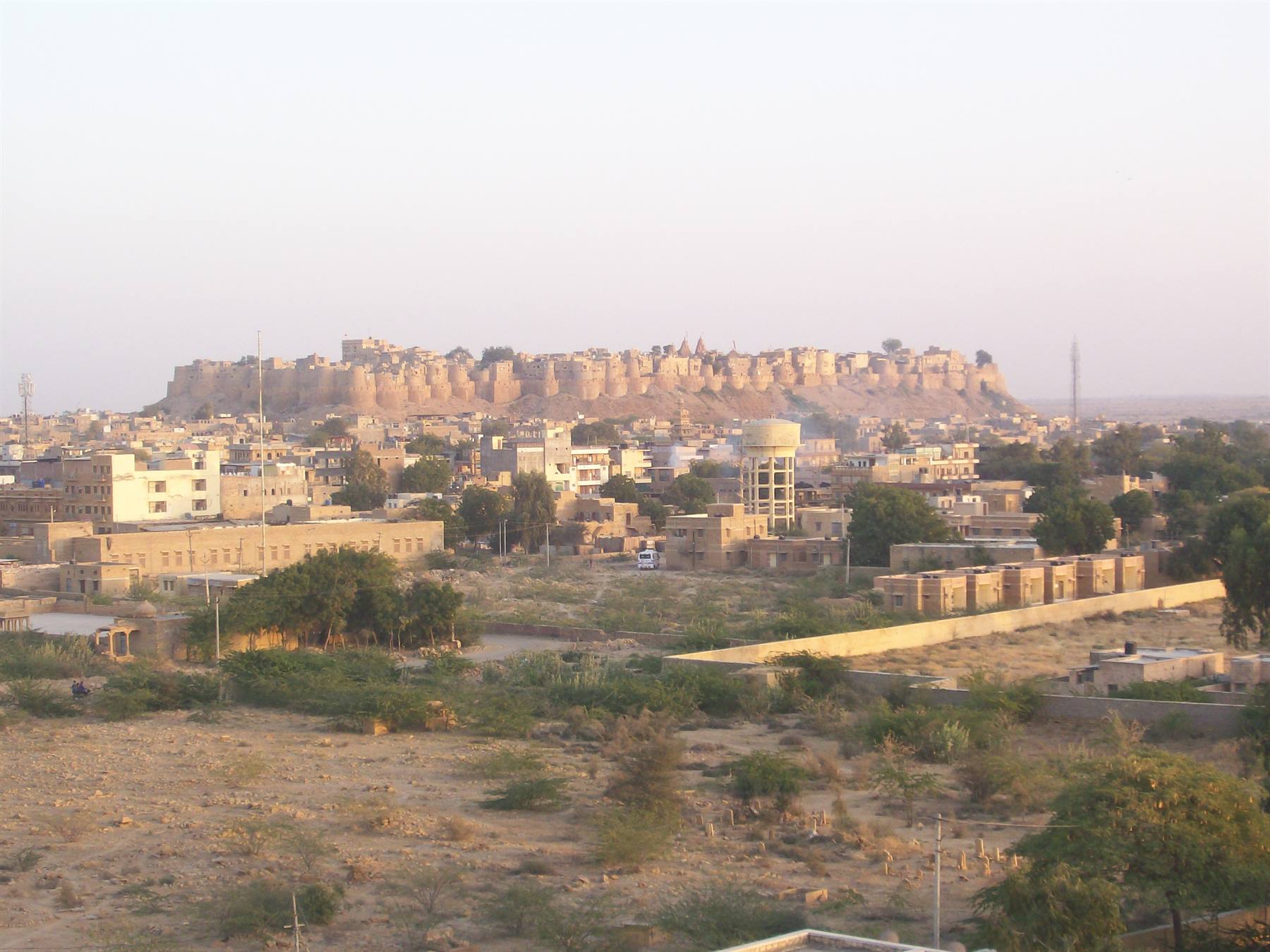
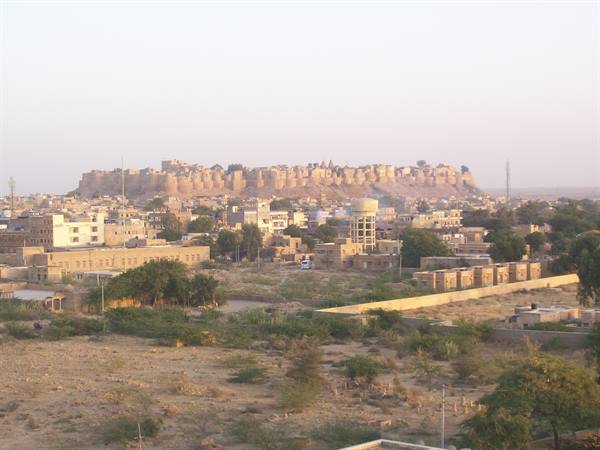
In the late afternoon we go out to go up a hill to see the sunset over Jaisalmer. The city is set on a fortified hill, entirely surrounded by walls and towers, with steppe desert all around. When the sun sets the whole city takes on a golden colouring. At nightfall we move to a little restaurant full of flies where we try to eat something, very little to tell the truth, given the usual seasonings based on masala, the local spice blend. We return to the Hotel where, after watching a little show of music and dance, we browse the internet until late. We then retire to bed.
Varanasi
Day 425 Feb 1992
Jaisalmer and Khuri
This morning the usual buffet breakfast at the Hotel and transfer to Jaisalmer Fort. The driver who came to pick us up with a guide leaves us in front of the Gate that breaches the mighty walls. The guide is a young Brahmin, and he will turn out to be the best of the trip in terms of cultural preparation, knowledge of Italian and passion in telling us about his city and the religious aspects of India. First of all we see from the outside the Maharaja's Palace with the nearby platform equipped with a stone throne used for public audiences. We then go inside two Jain Temples, with finely decorated interiors. The followers of this religion are vegetarian; some go so far as to wear a veil in front of their mouths to avoid accidentally ingesting insects and microbes.
The sculptures that cover the walls are beautiful; the places of worship appear sumptuous, in contrast with the life of the Jains, who after a life of wealth (they are excellent merchants) end their existence by shedding their possessions. Jainism, like Buddhism, is one of the many faiths born from Hinduism, which represents the majority religion in India. We do not fail to visit a small Hindu Temple among the many scattered along the narrow, irregularly laid-out little streets, sometimes located in the strangest places. A ceremony is under way that lasts about ten minutes, with a Brahmin performing ritual gestures with a lamp and the faithful gathered around him singing. There is a drum that our guide, who belongs to the Brahmin caste, starts beating, accompanying the singing.
We stop at a Bar whose terrace allows an excellent view of the walls, and where we sip a tea while the guide explains the complicated caste system to us. In practice one belongs to a caste by birth; one can grow rich or make a political career, but this does not entail moving to a better caste, so much so that one of the last Indian Presidents was an untouchable, the lowest class. One marries within the same caste, and marriages are rigorously imposed by the families, after hearing the opinion of astrologers. The husband cannot speak with his wife in front of his own mother and grandmother. Furthermore, spouses cannot go out publicly together, and even if they happen to meet in public places they avoid speaking to each other. Hindus have behavioural codes that are truly difficult to understand, and they themselves define this religion as a philosophy of life.
We go down into the valley, outside the walls, where the city has expanded since the 1700s. Here too, as on the hill, there are beautiful Havelis with finely decorated facades. In one of these, in a state of semi-abandonment, numerous bats are guests of the coffered ceiling. As happens on every guided tour, the inevitable visit to a shop; there is no obligation to buy, but finding ourselves uncomfortable we are always forced to buy something we would gladly have done without. Here in particular they would like to get us to buy pashminas, scarves made from the most delicate Himalayan goat wool, the kind found under the chin. My travel companion ends up buying a tablecloth and a sari. Satisfied with the visit, we reach our car and return to the Hotel, saying goodbye to the excellent guide. Shortly afterwards we set off again for the village of Khuri in the heart of the Thar desert.
It should be said that the Thar has nothing to do with what a desert is in the collective imagination. The Thar is mostly rocky and dusty with a few sporadic bushes; it resembles a scruffy savannah or a very sparse bush rather than the Sahara. Near Khuri they have a couple of sand dunes which they exploit to the full with organised dromedary tours. My friend and I get on two different animals, accompanied by their respective guides. Halfway along, the dromedary my companion is riding becomes restive; probably ill, it discharges copious thick saliva from its mouth. My friend gets down, but the animal begins to show signs of impatience, so much so that they have difficulty tying it to a shrub. The guides order us to flee, and they flee in turn among the dunes; we run away too, at a less hurried pace, since the fever prevents me from running.
Fortunately we are not in the Sahara, and after climbing over a few dunes we find ourselves up high together with numerous tourists waiting for the sunset with their dromedaries. We too wait for the setting of the sun; I am sweaty from the run and the wind is blowing, which worries me, since today I feel better. After the sunset, pretty but nothing transcendental, we get on two dromedaries that have been brought for us and reach a house in the village. Here they seat us in the courtyard where dinner is served with typical desert dishes, the usual rubbish. The gathering is enlivened by music and dances. As in Jaisalmer there is a young woman who dances around a fire balancing vessels on her head, then she starts walking on broken glass, demonstrating that she is a dancer-fakir.
We are not the only tourists; there is a group of middle-aged French people who invite us to dance around the fire. I have more fun playing with a little girl, the dancer's daughter. The notes of the small musical ensemble, made up of drums and a strange instrument halfway between an accordion and a keyboard, continue to accompany us. We return to the Hotel in Jaisalmer, where after browsing a bit on the computer we move to the room for the night.
Varanasi
Day 526 Feb 1992
Osian and Jodhpur
I thought I had left the fever behind me, but yesterday's sweating followed by the desert wind pushed my body temperature back above 38 degrees. After breakfast at the hotel, we continue the tour towards Jodhpur. During the transfer, we stop for a tea at the usual place where we had been two days earlier coming from Bikaner, then at Osian to see the Sachiya Mata Temple, which, with its pyramidal turrets and numerous bas-reliefs, vaguely resembles the more famous Khajuraho. When I get out at Osian, I feel a thumping fever, my vision is blurry and I'm short of breath. In this condition, I have to face a steep and long staircase leading up to the Temple. I'm in such a bad state that I have to stop frequently to rest. On the staircase, there's a constant coming and going of people ascending and descending; the women strictly wear the sari with the veil.
Because of my condition, I can't appreciate the Temple and I also avoid visiting a second one. Among other things, I had to take off my shoes and even with socks on, my feet feel cold. We retrieve the car and driver at the parking lot, where dozens of beggars surround us and we dodge them. Often it's children asking for alms, but one must resist because otherwise we encourage them to do this instead of going to school. It's no coincidence that Rajasthan has one of the highest illiteracy rates in India. In the early afternoon, we're in Jodhpur to visit the imposing Mehrangarh Fort, which dominates the city from the top of a hill.
Given how it's situated and built, the Fort was certainly unassailable; you access it via a steep climb, passing through a majestic arch and a monumental gate on whose sides are the handprints of the Maharaja's wives who immolated themselves on their husband's funeral pyre, as was the custom at the time. Moreover, Sati, as this collective suicide is called, was practiced in India until not long ago. The architecture of the Palaces is a cocktail of styles ranging from French to Mughal to British. The decorations range from stuccoes to Louvre-style windows, to the finely decorated Mughal walls, to British Christmas balls hanging from the ceiling, to Italian glass. There are courtyards that open between one wing of the Fort and another, some used for court life, others exclusively for the women, and still others dedicated to the Maharaja's public audiences.
On the bastions overlooking the city, cannons are placed, while from the terraces of the apartments, you enjoy beautiful panoramas of Jodhpur: on one side, the neighborhood with houses plastered in blue that earned it the nickname Blue City; on the other side, the market with the Clock Tower; on another side, the Maharaja's New Palace, partly used as a luxury hotel. Among the interiors of particular interest are the armory with pikes, helmets, bayonets, but also firearms, and the finely decorated throne room. During the visit, I call a doctor friend to get advice on a treatment while waiting to return to Italy. After coming down from the Fort, we see the Jaswant Thada Mausoleum from the outside, preceded by a small lake. We should have visited it inside, but it's gotten late and it's already closed.
From here, we reach the market area near the Clock Tower because the driver wants to take us into a spice shop. Even though such strong spices are the cause of my loss of appetite, we are practically forced into this obligatory visit, from which we emerge buying some tea (fortunately they have that too). We also try to stroll through the market, but the traffic of tuk-tuks, scooters, and cars makes us give up. We reach the Hotel Ranbanka, another noble Palace converted for tourism, where I decide to lie down while my friend goes to a restaurant not far away for dinner. The driver brings me hot naan at the hotel, with which I'll take the medicines prescribed over the phone by my doctor friend: the antibiotic I had brought with me from Italy. Before I fall asleep, my travel companion comes back into the room.
Varanasi
Day 627 Feb 1992
Jaipur
Last night we arrived at the Hotel when it was dark, and I preferred to retreat to my room, stuffed with fever and antibiotics; this didn't allow me to see its exterior. Since we have to reach a Dependence for breakfast, we cross the beautiful flowered garden dominated by a swimming pool. After eating something, we resume our tour towards Jaipur, where we arrive after the now canonical roughly 6 hours of driving. If they equipped India with highways like ours, these transfers would take a couple of hours. We make the usual tea stop, then upon reaching the outskirts of Jaipur, we stop at a tire repair shop to check the car's tires. I've seen dozens of tire repair shops along the roads, also because with the Indian asphalt surface full of potholes and hazards, it's quite easy to get a flat.
Generally, tires are repaired in dilapidated little rooms covered in dust; here, however, where Omar took us, it's an elegant and clean place, better than many of our tire shops. They even offer us tea, which we sip comfortably seated on a sofa while our car undergoes its check-in. We set off again to reach the Royal Orchid, a hotel housed in a tall building and not the usual converted Maharaja's Palace. The accommodations are still nice, there's paid internet near the reception, and the room is comfortable. Yesterday, in the phone call to my doctor friend, I was told to rest for an entire day, so today I take the opportunity to laze in bed between television and reading. Besides, no visits are planned because the driver lives in this city and it's his day off to spend with family.
In the evening, lacking a car and the will, we dine in the hotel's elegant restaurant with spaghetti and pizza topped, alas, with ketchup instead of ragù. An old man in traditional attire invites us to the rooftop terrace, where, as the only spectators, he shows us a brief puppet show. We thank him by buying a couple. We then retire to sleep after a fairly relaxing day, from which I hope my fragile health has benefited.
Jaipur,Palace of the Winds
Day 728 Feb 1992
Amber and Jaipur
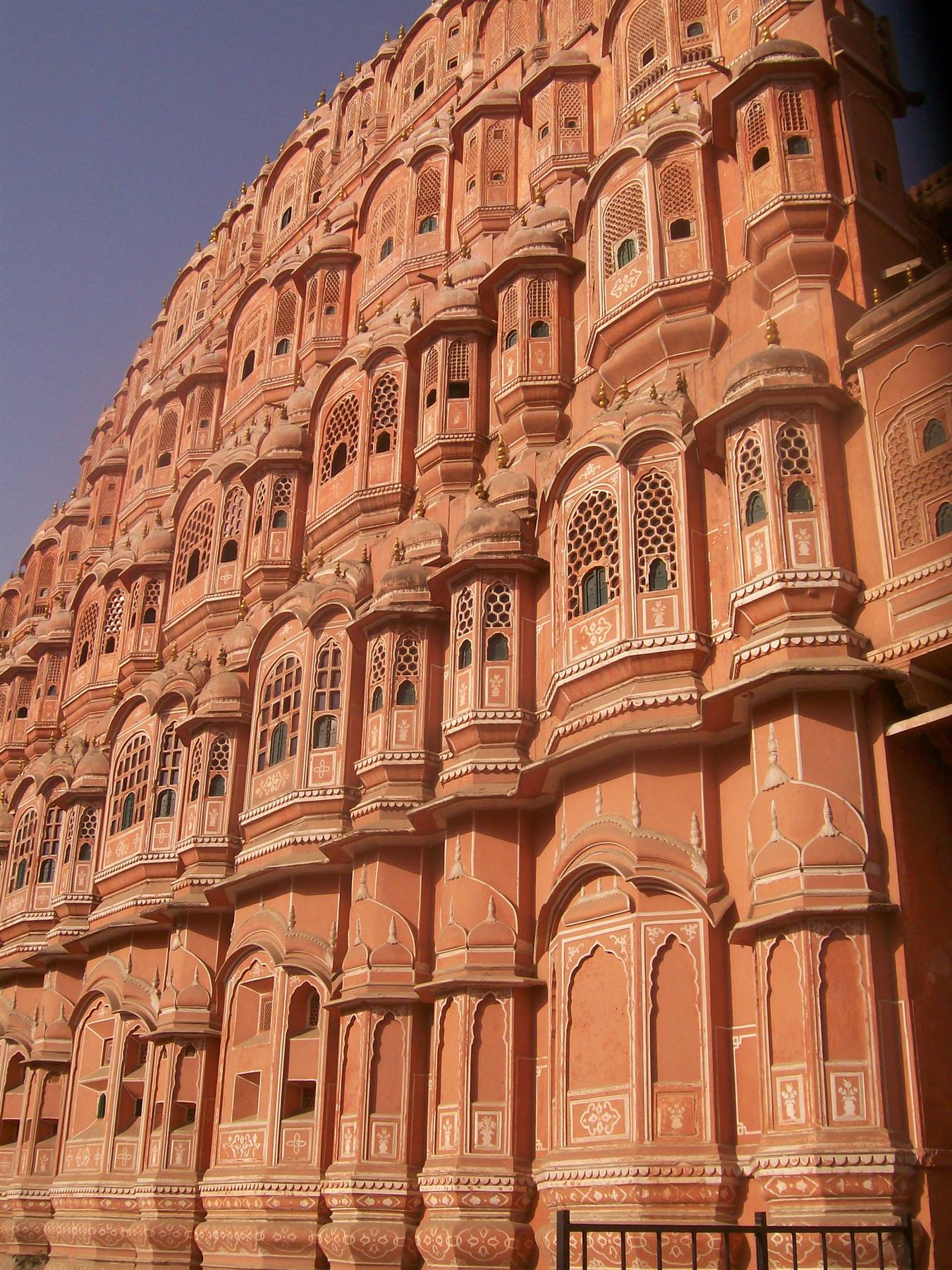
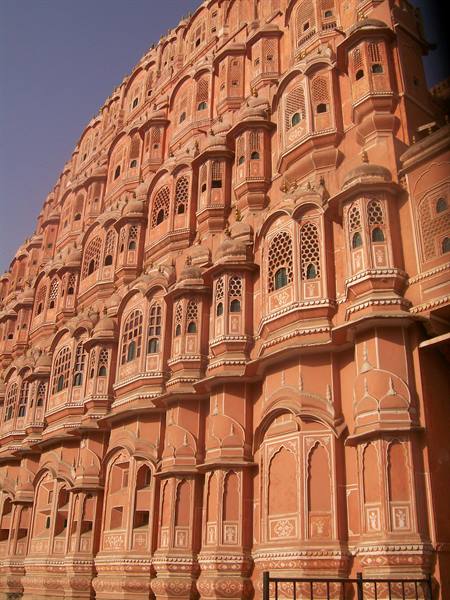
This morning, after breakfast, our driver comes to pick us up with a guide whom we could also have done without. We make a brief stop on the main street of the historic center to take a photo of the famous Palace of the Winds, the symbol of Jaipur. Like the vast majority of the buildings in the city, it's pink. The Palace has a particular facade composed of wavy lines on which open numerous windows closed by finely carved stone grilles that allowed noblewomen to see outside without being seen. Near the Palace we have a small traffic accident, probably due to our driver, who scrapes the front on another vehicle. Inexplicably no one stops or protests and everyone keeps their own damage. The driver, however, is worried that the Tour Operator to whom the vehicle belongs will find out and through the guide asks us not to tell him.
We reach Amber Fort, once the capital of Rajasthan, located on a hill. The Fort is protected by a stretch of wall that follows the lines of the surrounding hills and vaguely recalls the Great Wall of China. Furthermore, on a mountain that overlooks the actual Fort, another Fortress is located. Judging by the condition Amber Fort is in, it would seem impregnable, but the local Maharaja preferred to abandon it at the beginning of the 1700s to build Jaipur. After a long queue we're assigned an elephant whose face is painted with symbolic designs; we climb up thanks to a platform onto the howdah placed on the pachyderm's back, uncomfortable to tell the truth. The steep road on which we're carried with various jolts is traveled by numerous elephants loaded with tourists. We cross the entrance portal to the Fort, entering the parade ground where we get down from the animal.
With the guide we visit some areas of the Fortress, including rooms finely decorated with inlays, stuccoes and mirrors. Back at the car, we head for Jaipur, near which we stop to see a Palace set in the middle of a small lake and to visit, against our will, a jeweler's and a fabric shop. Jaipur, the capital of Rajasthan, welcomes us with its colorful confusion seasoned with dirt and disorder. It's incredible how in India within a few dozen meters you go from total chaos to rigorous order, from extreme poverty to ostentatious luxury. We visit the Astronomical Observatory of Jai Singh II, the Maharaja to whom the founding of the city in 1728 is owed. The astronomical instruments, mostly large sundials and similar devices, are distributed inside a garden. We then enter the nearby City Palace, where the Maharaja moved his court from Amber.
Like the houses of Jaipur, this Palace too is dominated by the pink coloring. Among other things, the beautiful Peacock Gate and the large silver vessels that were filled with Ganges water during a diplomatic trip to London by the Maharaja are worth highlighting. Here too the guide tries to get us to buy some drawings but we decline. We're taken back to the Hotel where we rest until evening, when Omar comes back to pick us up. Strangely, the car no longer shows any sign of this morning's accident; in Italy it would have taken much longer to repair it. We go to the house of our Tour Operator, which is also the office of the Agency, we settle the bill and he invites us to dinner. At the table with us there's a couple of Italians from Mantova, father and son, also traveling with the same Agent.
The Tour Operator's wife will probably have done her best in the kitchen, but the food continues to be heavily spiced. If in restaurants we avoid eating the dishes they bring to the table, here out of a sense of hospitality we're forced to make an effort and swallow. After dinner we have Omar take us to a Hotel on the outskirts of the city (it takes an hour and a half there and back) where a couple of Sicilian tourists we met in Amber give me some Tachipirina since mine are running out. The Hotel is modern and luxurious even though it has Rajput-style touches. Our driver was a bit annoyed about this unexpected trip because we're in his city and he would have preferred to spend this time with his family. We return to our Hotel, chat a bit at the computer in the lobby, then retire to our room for the night.
Jaipur,Palace of the Winds
Day 829 Feb 1992
Fatekpur Sikri and Agra
The last two days have been fairly relaxing; I'm convalescing so I prefer to rest in the Hotel when no visits are scheduled. Today, though, there's yet another transfer of about six hours. After breakfast we leave Rajasthan, entering Uttar Pradesh. The landscape becomes less arid until it turns green. The climate is typically late spring, similar to our June. First stop at Fatekpur Sikri, the monumental city built by the Mughal Akbar to move the court there from Agra but inhabited for only 15 years due to the scarce water supply. What remains are the imposing ruins of this useless architectural effort: pishtak Gates, large squares surrounded by buildings, the Royal Palace and the Mosque. To reach the ghost city it's necessary to park the car and make the last stretch by tuk tuk accompanied by a guide who speaks very poor Italian.
On the Square of Fatekpur Sikri stands the white marble Mausoleum of a Sufi who had predicted the birth of three sons to Akbar, an episode that is at the basis of the founding of this walled city. Even today women seeking a child come here to pray to the Sufi. Leaving the ancient city we reach the car by tuk tuk. From Fatekpur Sikri we transfer to Agra, staying at the Hotel Utkarsh Vilas which, although decent, is by comparison the worst of the Tour. We then go to visit the Red Fort, so called because of the color of its walls. Unfortunately our Driver has taken a liking to it and provides us again with a useless guide. We enter through a monumental gate into a large area overlooking the Yamuna River, characterized by Royal Palaces and well-kept gardens. Only part of it can be visited because much of the Fort houses a military garrison.
Here the builder of the Taj Mahal, Shah Jahan, was imprisoned by the son who dethroned him. Until his death the old Sultan was forced to see from his prison the Mausoleum of his beloved wife beyond the banks of the river. The Fort was for years the seat of the British Headquarters in the city. Back at the Hotel, we go out in the evening to a restaurant where, despite our efforts to make ourselves understood, they foist on us a very spicy dish which I send back, only to see the same thing brought back to me but rinsed. I avoid dinner, taking refuge in the usual nan. Back at the Hotel we take a little stroll around the area where there's a McDonald's that, had I seen it earlier, I would have preferred to the aforementioned restaurant, then we retire to our room. Tomorrow morning we have to wake up early to see the Taj Mahal at the first light of dawn.
Jaipur,Palace of the Winds
Day 91 Mar 1992
The Taj Mahal
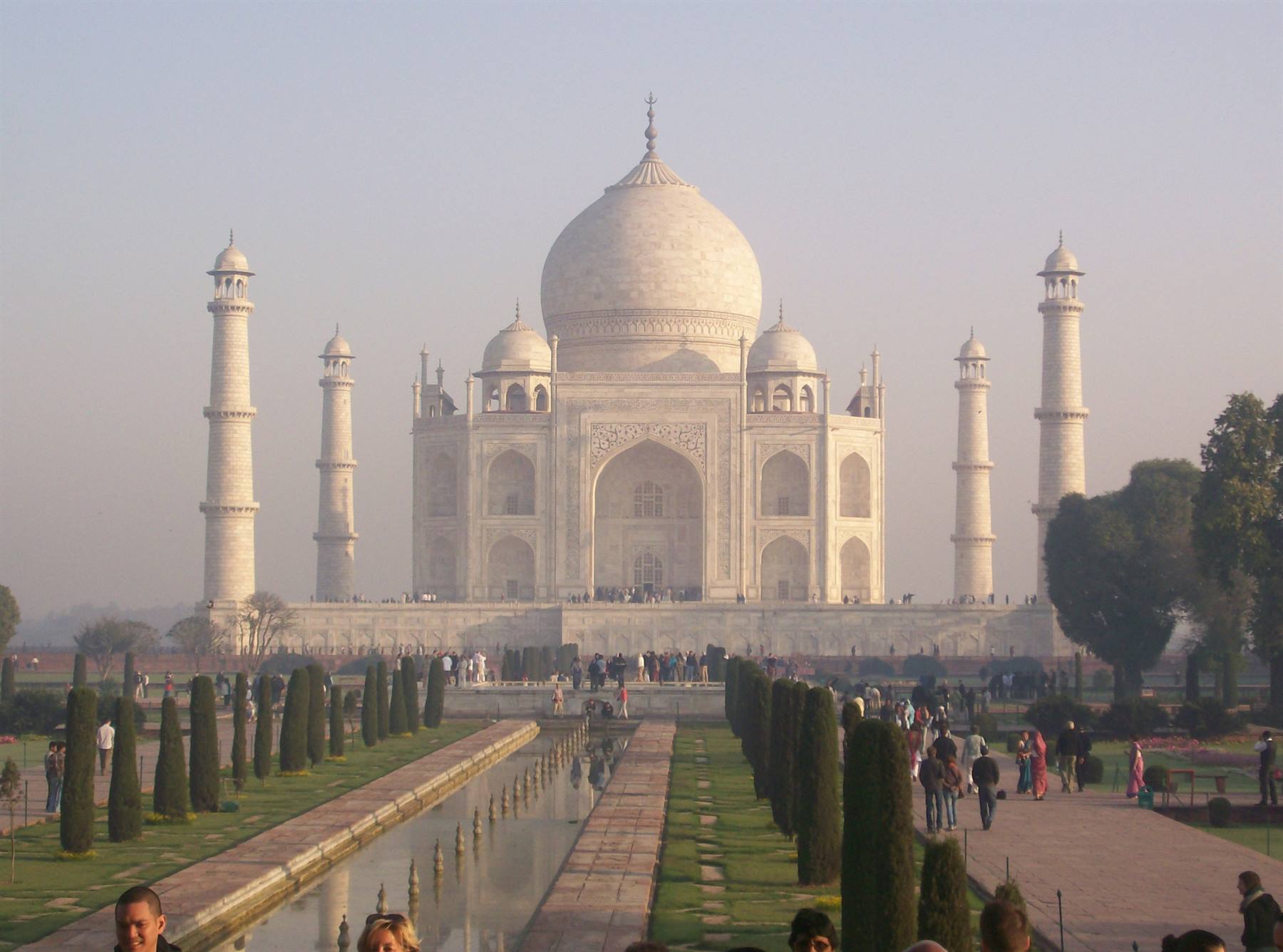
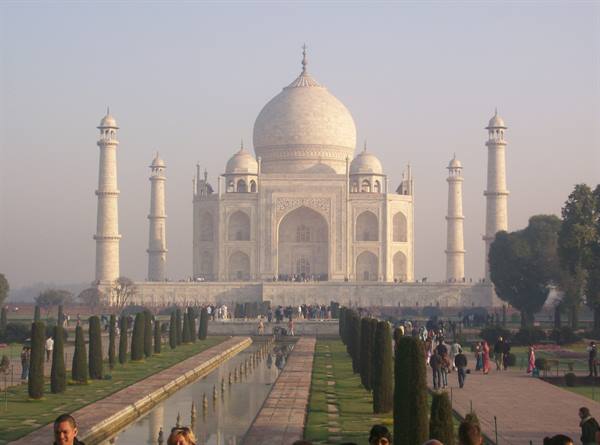
We wake up first thing in the morning; our driver takes us near the Taj Mahal, from where, accompanied by a guide, we reach the mausoleum by shuttle bus. The Taj Mahal is the most famous monument in India and is counted among the first seven wonders of the world. The visit lives up to our expectations; a pishtaq gate frames the elegant Moghul architecture with its delicate, slender lines. To reach it you have to take a long walk through the "paradise" gardens, symmetrical and well tended. The pool at the centre reflects the soft colours of the Taj Mahal, still wrapped in the morning mist, while a pale sun tries to light up its dome. As millions of tourists do, we sit on the marble bench used by Lady Diana for a famous photo.
We enter the Mausoleum, where the tomb of Mumtaz is located, the wife of the Moghul sultan who wanted the Taj Mahal for her, an everlasting sign of love, a poem in marble on the banks of the Yamuna river and a stone's throw from Agra Fort. On the opposite bank the Sultan wanted to build his own mausoleum, but was forced to stop at the foundations because, dethroned by his son, he was imprisoned in the Red Fort. Once the visit was over we returned by shuttle to the car park, from where our driver took us back to the hotel for breakfast. We spent the rest of the morning between the room and the lobby, then towards lunchtime the driver came back to pick us up to take us to the same restaurant as yesterday. Here, after yesterday evening's negative culinary experience, I preferred to fast, limiting myself to a tea.
We were then taken to the railway station, where the driver, who had been with us since our arrival at Delhi airport, left us to return to Jaipur. We thanked him with a good tip and waited for our train. The large waiting room presented the usual picture that India has accustomed us to in these days: dirt, a lack of the most basic hygienic requirements, people wrapped in their gaudy, dusty costumes and beggars. Fortunately the train to Varanasi was decent, indeed I would even venture to say better than some of our regional trains. The spacious compartments and berths larger than the European ones allowed us a pleasant journey. The heat was mitigated by fans with large blades. In our compartment we were all tourists, and this allowed me to sleep peacefully.
Jaisalmer
Day 102 Mar 1992
Sarnath and Varanasi
We arrive in the morning at Varanasi Station, where our Tour Operator's correspondent is waiting for us with a driver and the relevant car. We are taken to the hotel, where we settle the suitcases in the room. In the afternoon we are taken to Sarnath, a place near Varanasi where Buddha preached for the first time. Here stands the oldest Stupa in the world, venerated by Buddhists who consider this a holy place. A fundamental stop in Buddha's life, it has become an important pilgrimage destination. Devotees and monks are gathered in prayer around the Stupa or scattered across the large surrounding lawn. We limit ourselves to observing without disturbing the monks wrapped in their long colorful robes, who meditate on the future of humanity. Overall the place is beautiful, there is an air of mysticism, though in fact the Stupa, deteriorated by the centuries, looks like just a big thimble.
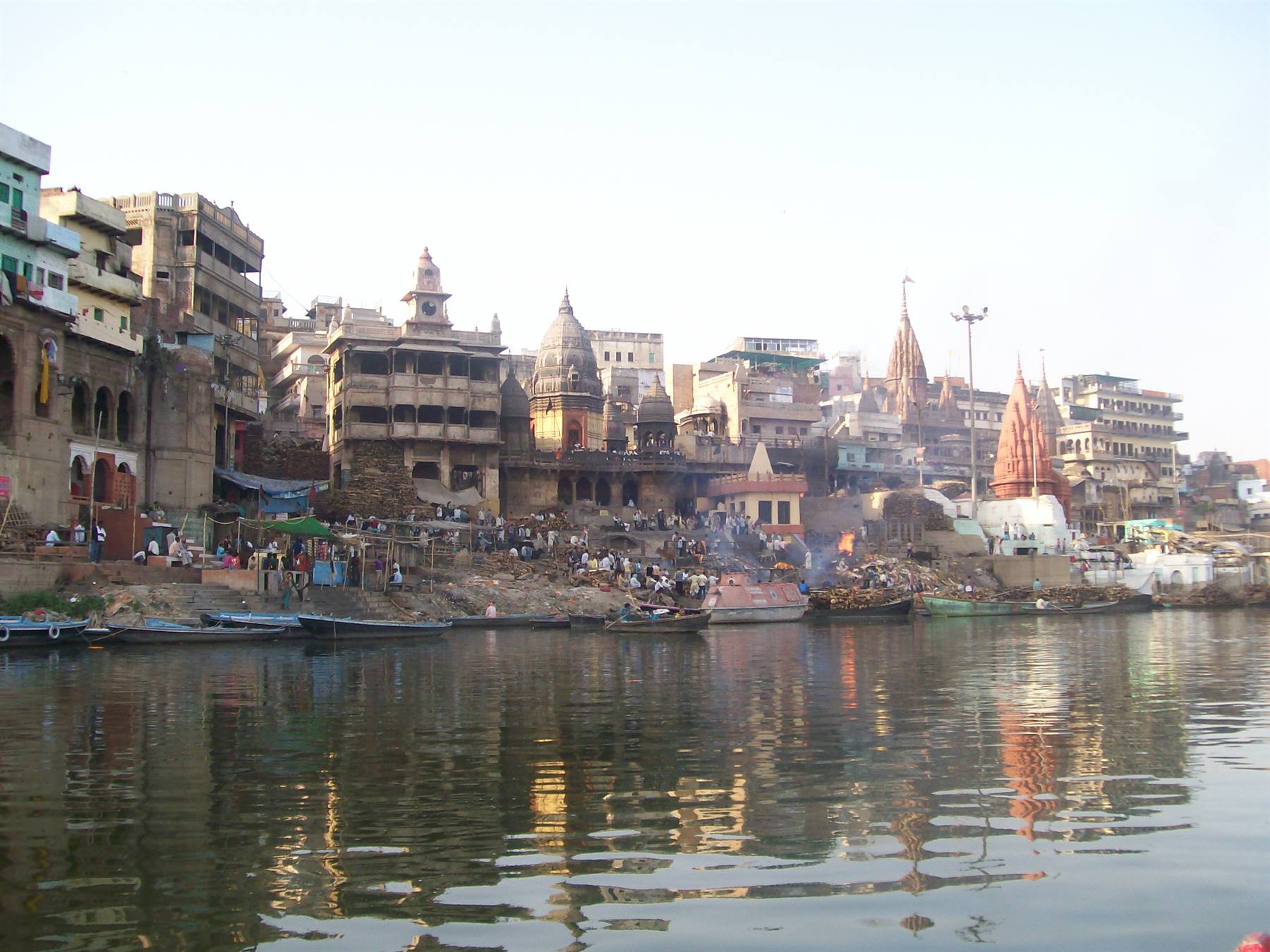
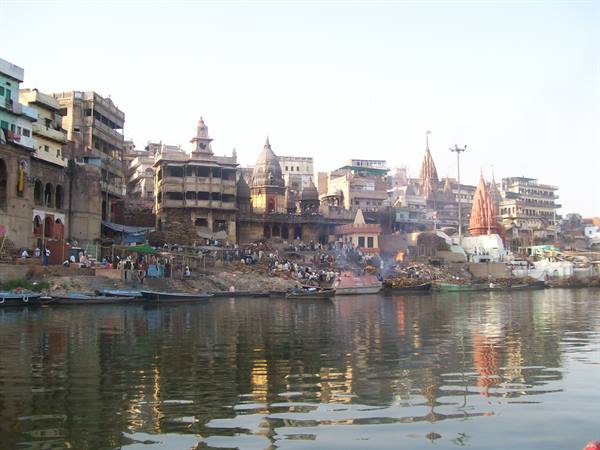
After leaving here we go to the nearby Temple, then return to the city. Here we visit a Hindu Temple inside which India in miniature has been reproduced in marble, complete with reliefs and rivers. In the evening we reach the banks of the Ganges, the sacred river of the Hindus. Here we are assigned to another guide, a mustachioed little man who takes us in a small boat to see the sunset over the river. There are many boats cutting through the waters of the Ganges; some faithful, but also tourists, place small lit lamps there that float on leaves. The riverside is lined with stairways called Ghats that allow the faithful contact with the sacred waters. A couple of Ghats are reserved for cremations. Hindus come here to die from everywhere, because scattering one's ashes in the Ganges ensures the end of the cycle of reincarnations.
Eternal life justifies a long journey to be cremated on improvised pyres at the river's edge. Along the banks there are also some palaces of the maharajas from the distant lands of Rajasthan. When we return to the mooring, a big festival is underway that blends religion and folklore with songs, sounds and ritual gestures made with fire. To reach our vehicle we have to cross part of the very crowded, dirty and disorderly city center. We are then taken to the hotel for dinner (quite pleasant by Indian standards) and the overnight stay.
Jaisalmer
Day 113 Mar 1992
Varanasi
The last day in India begins before dawn when with our driver we reach again the banks of the Ganges where the same person who was our guide yesterday awaits us. With him as rower we get on a small boat to sail the waters of the sacred river. We see again the gats for cremations, the holy men with long beards intent on meditating, the faithful immersing themselves in the waters and the men busy washing clothes. The latter violently beat the water-soaked garments on the bank. Meanwhile the sun slowly illuminates the Ganges spreading its still weak rays on the liquid surface of the river. Back at the gat from which we had started the guide leads us into the intricate historic center of Varanasi where we visit one of the many temples and the house of an artisan who produces carpets. The intent is obviously to make us buy but we limit ourselves to observing.
Through the labyrinthine street fabric of the city we return to our car which takes us back to the Hotel. We take the opportunity to rest a couple of hours then our driver takes us to the airport for the direct flight to Kathmandu in Nepal.
0 reader comments