I arrived in Shanghai from Guilin in Guangxi Province as a stop on a Tour in China that began in Beijing, made together with nine travelling companions, four of whom are old friends. With us from the capital is the young Chinese guide whom we'll conventionally call Franco. For the earlier stops of the Tour in China I refer you to the related itineraries.
Day 18 Mar 1983
Arrival in Shanghai
In Shanghai there are two airports, we land at the old one dedicated to domestic flights. Already from above we observed the immensity of this city which although having more than 30 million inhabitants is not even the largest in China. Surely, however, it is the most modern, the most industrialized and the fulcrum of the Chinese economy. In practice, if Beijing is the bureaucratic capital of the Country, Shanghai is the financial one, second in terms of business volume only to Hong Kong which it also closely resembles. From the airport we reach an elegant but serious restaurant where we have lunch. In the afternoon we visit one of the few historical monuments of the city, the Jade Buddha Temple which preserves some large statues coming from Burma. The Temple, as is customary in Buddhist culture, is preceded by a square where the faithful pray feeding the fire of the braziers.
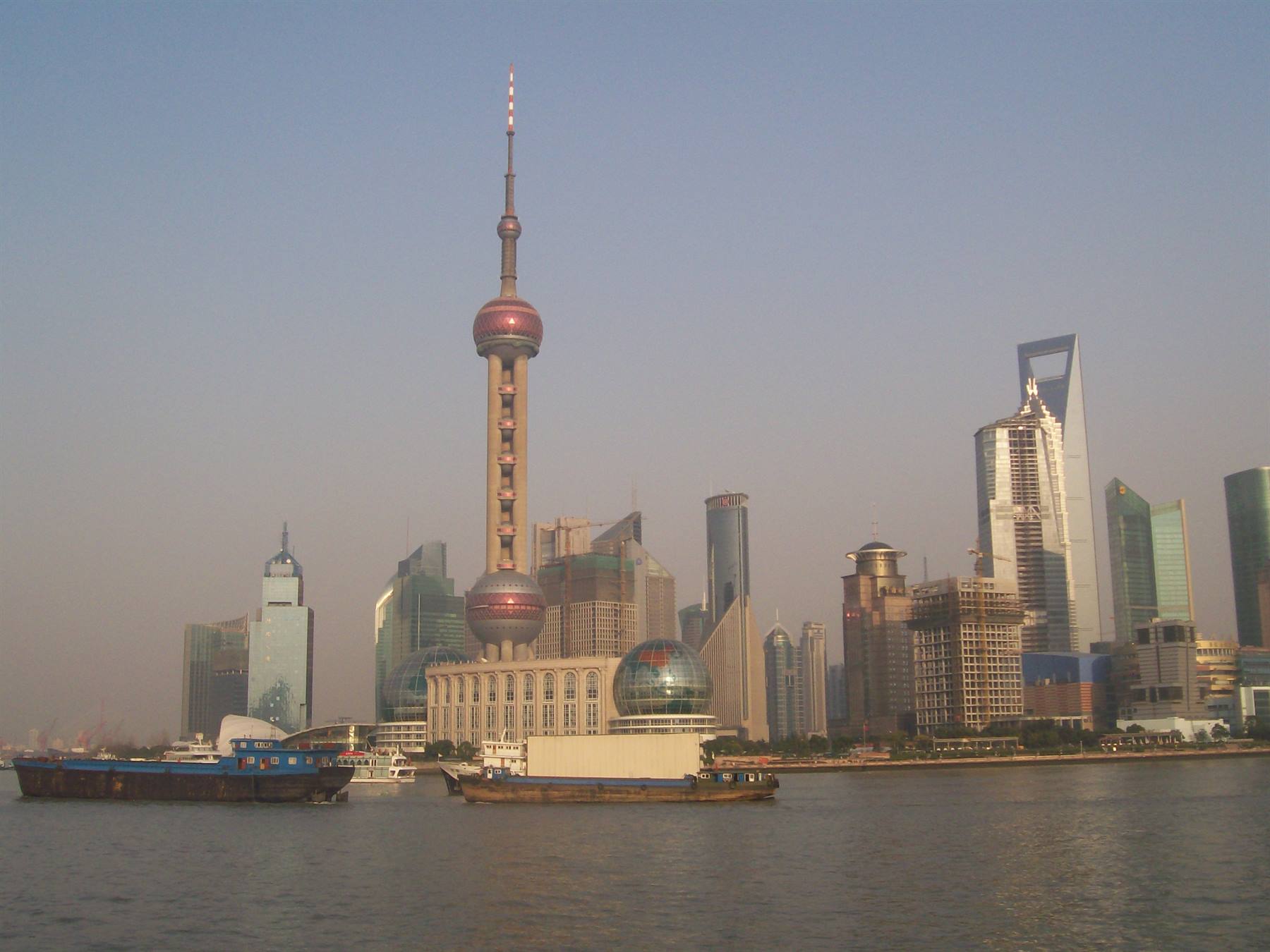
The smell of incense and the smoke envelop the environment making it mystical. We are also lucky enough to witness a ceremony with the monks who, arranged in two groups, one in front of the other, are intent on praying accompanied by the rhythm of a strange percussion instrument. From here we go to our hotel housed in a skyscraper, externally it doesn't look like much but the interiors are very elegant. The cuisine of the restaurant where we dine is unfortunately not up to the standard of the hotel. In the evening with the minibus placed at our disposal and with the help of the girl who acts as our guide in Shanghai, we take a tour of the center to admire the colossal and futuristic buildings of the Pudong district. Once this was an agricultural area but over the past thirty years the Chinese Manhattan has arisen there.
The skyline is embellished by the Oriental Pearl Tower surrounded by numerous very tall skyscrapers. The most spectacular view is from the opposite side of the river that bathes the city, in the colonial-style Bund district, but we go to the other bank through a modern underpass. Close to the skyscrapers it is difficult to frame them completely and one is almost oppressed by the immensity, a psychological subservience toward them. In the evening then everything is enhanced by a skillful illumination. The Chinese, inventors of fireworks since antiquity, have become masters of lighting design and transform urban centers into spectacular scenarios of lights and colors.
Someone might think of an energy waste and that perhaps the construction of the largest dam in the world on the Yangtze River could have been avoided but China is the land of Feng Shui, a discipline in which even the positioning of a window has a purpose and which disregards our Western logic. For them it is fundamental to give harmony to these masses of reinforced concrete and glass even if it requires a first-rate energy effort. And then in any case the Chinese are farsighted, they illuminate a lot for a few hours then everything goes dark for the rest of the night to save. We go up to the eighty-eighth floor of a skyscraper with a very fast elevator that takes a couple of minutes. From up there there is a panoramic view of the city and the river but also of a skyscraper much taller than ours complete with a panoramic restaurant with a glass floor suspended between two towers.
From where we are you can look out over the Hall of the building located eighty-eight floors below and it is a dizzying sight. With the same speed with which it went up the elevator brings us back to the entrance from where with the bus we go to visit the French quarter. Shanghai from the Opium War until after the Second World War was a colony divided among various Western powers. The French gave their concession a typically transalpine appearance with low houses, little squares and bistros. We then go to Nanjing Road, the main street of Shanghai, largely pedestrian. If often during this trip we asked ourselves where the 1.3 billion Chinese are, now we realize that quite a few are here doing the "promenade" on this wide avenue. The street is surrounded by heavily illuminated buildings and stalls that sell everything. With difficulty we make our way through the crowd.
From here we return to the hotel for the overnight stay.
Pudong
Day 29 Mar 1983
Shanghai
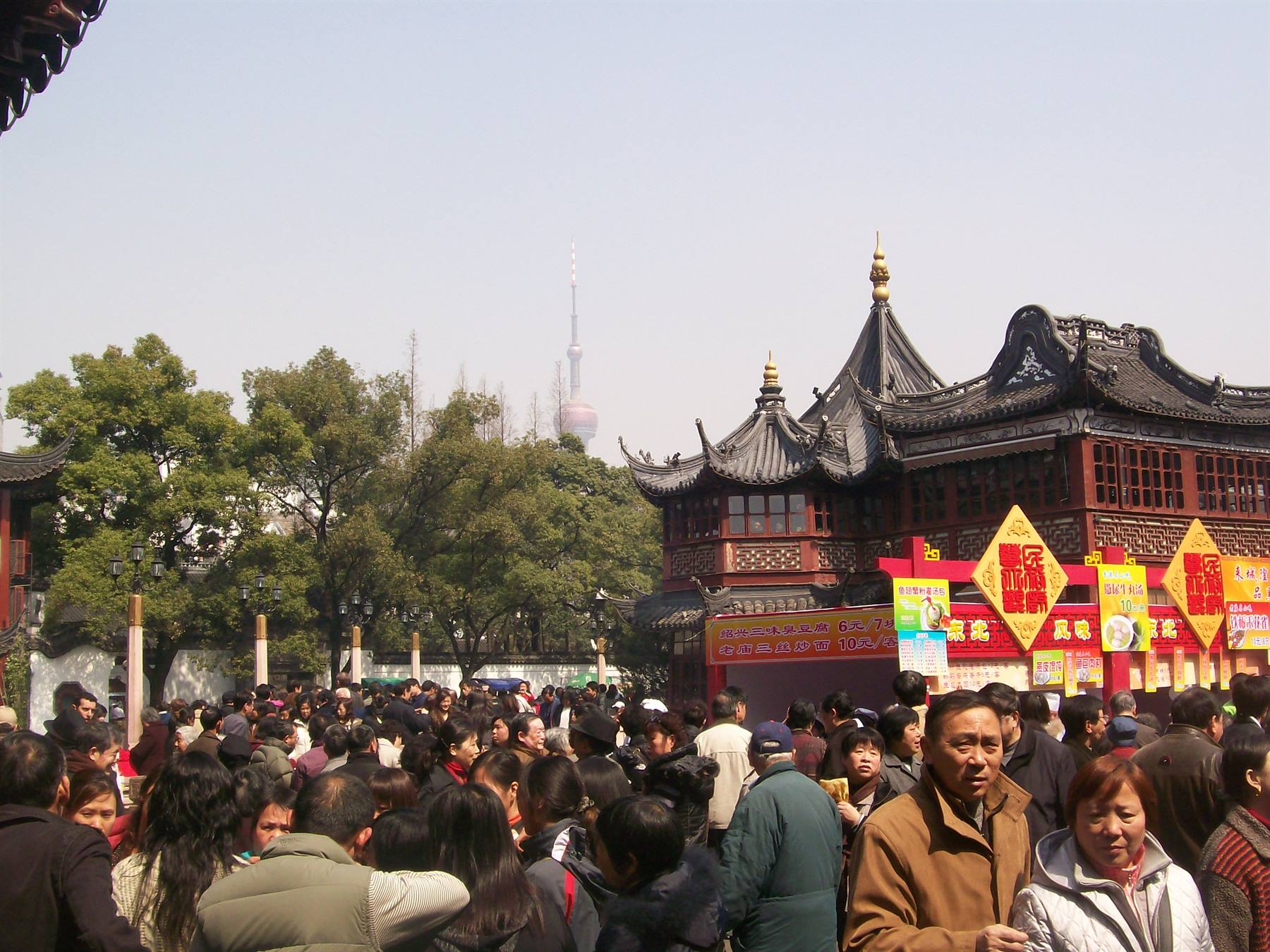
After an abundant breakfast at the hotel the minibus takes us to the historic center of the city. We immerse ourselves in the narrow alleys surrounded by houses of ancient Chinese style but not dated because rebuilt after the war. There is a crowd strolling, peeking among merchants of knick-knacks, food stalls and characteristic little shops. We cross this area to go to the Yu Mandarin Garden, a scenic aristocratic villa with pagodas, bonsai, fake rocks and little lakes, all in perfect Chinese style. The Villa and its garden are right in the heart of old Shanghai near the little lake on which the Tea House is located, connected to the shores by a zigzag bridge. After the visit we continue to stroll in this heavily touristy neighborhood in search of some souvenir to buy after long negotiation.
It is interesting to see the contrast between different architectural styles, the pagoda buildings that surround us and, looking up, the skyscrapers of Pudong in the background. We have lunch then visit the city museum, one of the most important in China, located in a large building in the center. The Museum is well kept, we are provided with audio guides in Italian and it is divided into various sections. Particular prominence is given to sculpture and applied arts but there are also sections dedicated to numismatics, furniture and calligraphy. I linger in particular on the Buddhist statues, the meticulous workings of the jade jewelry, the ancient metal vessels. I also make a fleeting visit to the Ming-era furniture and the calligraphy section since beautiful writing in China has equal dignity with painting, being considered an art form.
The flagship of the Museum is however the ceramics section where in the display cases numerous works of art are located, finely decorated pottery, refined workings that start from very distant eras and go up to the Ming Dynasty covering a long time span. Impossible to see everything, I limit myself to those that the audio guide points out as the most significant. Having left the Museum we go to the Bund, the British quarter at the time of the concessions, in practice a walk along the river on which large buildings of European style overlook, reminiscent somewhat of the banks of the Thames near the City of London. Before us, on the other bank, the new district of skyscrapers of Pudong that last night we saw in the dark and now we see in full daylight but whichever way you see it, it is fascinating.
Between the Bund and Pudong there is only the river but in reality they seem light years away from each other for history and architectural style, the colonial past and the future toward which China is projected, a Country in full economic evolution as demonstrated by the numerous cargo ships that ply the waters between the two districts. In common the Bund and Pudong have the emotional drive that created them, the desire to demonstrate, Great Britain first and then communist China, the economic strength of a Nation. After the ritual photos the minibus took us at our request to a shop of counterfeit goods, in practice an apartment used as an illegal commercial establishment.
The interior of the building that houses it is rather squalid, the apartment consisting of three rooms is packed with clothing and accessories, watches, fountain pens decidedly identical to those that the big brands offer on the market. Here in China you can find counterfeit goods everywhere, at street corners Rolexes are offered for 5 euros but in reality they are often shoddy things, here instead quality is also guaranteed but the nonetheless interesting price is not so low. We then go to Nanjing Road but not in the pedestrian area where we were last night. We stroll on this street full of high fashion shops and big international brands, this time the real ones. The traffic is heavy and you have to be careful crossing intersections because here the highway code never gives priority to pedestrians and the crosswalks indicate only the one place where it is possible to cross.
Tonight we will attend the Acrobatic Circus inside the Theater of a large luxury hotel. The Circus is one of the cornerstones of Chinese culture, many children are sent to acrobatic school and the artists who come out of it are among the best in the world. The theater is modern and elegant, the acts offered are first-rate. On the stage tightrope walkers, contortionists, jugglers and acrobats alternate. We spend a couple of truly exciting hours. Once the show is over we return by minibus to the hotel for dinner and the overnight stay.
Old Shanghai
Day 310 Mar 1983
Shanghai
After the abundant breakfast at the hotel we leave Shanghai and its Province by minibus to head to the nearby Province of Jiangsu. We will return to the Province of Shanghai only in the evening to reach the new international airport where the flight for our return home awaits us. The airport is very large, it has ample and modern architecture and it could not be otherwise as a business card and first contact for many travelers with an ambitious city projected toward the future. Late in the evening our plane lifts off Chinese soil to take us back to Europe. (For the itinerary in the Province of Jiangsu see the relevant travel diary)

0 reader comments