We arrived in Guilin on a flight from Xi'an for this stop of about three days in the South West as part of a Tour in China together with 4 tried-and-tested travelling companions, to whom 5 more have been added. As China is not only a country but also a subcontinent, I've divided the tour into several travel diaries. In this one I'll talk about the South West.
Day 16 Mar 1983
Arrivo a Guilin
We land at Guilin airport right around lunchtime. The city is almost an hour away, so we have lunch at the airport restaurant. After the bad culinary experience at Xi'an airport, we feared that the food here might also be of poor quality, but despite the snack during the flight we're still hungry, so we sit down at the table with confidence. The restaurant is large and empty; as in Xi'an, we are the only customers. The food isn't the best but it's acceptable. We get acquainted with the guide who will work alongside young Franco, our manager who has been following us since the first day in Beijing. The Guilin guide is a gentleman of about fifty; he will turn out to be culturally well-prepared and very cordial. We cross a countryside area for about an hour. From the airplane window we had already seen from above a expanse of the famous pinnacles of the region.
Before reaching the hotel we cross Guilin and reach the Reed Flute Cave. We are just a stone's throw from the city, but the surroundings are like open countryside; along a path that climbs among limestone rocks we arrive at the entrance of the Cave. Once inside, a spectacle of stalactites, stalagmites, and columns opens up before us; all very beautiful, but nothing that couldn't be seen in caves of this kind in Italy as well. In fact, here the formations are almost all dead and therefore monochromatic; perhaps for this reason there isn't even a prohibition against touching them, something that is strictly forbidden back home. To make up for the lack of color here in China, they've used artificial lighting that gives the stalactites and stalagmites various shades. Here too, as in Italy, popular imagination has run wild, giving the strangest shapes fanciful names.
The widest part of the cave has a small body of water and periodically presents a show of lights and sounds complete with laser beams, smoke machine, and soap bubbles!! Honestly, it feels more like being at Disneyland than in a natural cave. Overall, though, the destination is pleasant; the short itinerary is within everyone's reach because the route is easy to follow. Once in the city we visit a large shop specializing in tea leaves, some of which have undergone an aging process of decades. The ancient leaves are pressed into circular cakes that resemble a large coin. We sit around a table where a girl in charge of pouring lets us taste various infusions. Honestly, I don't find these teas very pleasant, and for me, who is a layman, it's also difficult to distinguish between the varieties. From here we reach the hotel, where our suitcases have arrived before us.
The hotel is located in a splendid position on the shore of one of the lakes that bathe Guilin. We are welcomed in the lobby with a welcome cocktail. The room is comfortable, and from the window overlooking the lake you can enjoy a lovely view. After a short stroll around the hotel, we return for dinner. For the first time since we've been in China, a Western-style meal is planned, but unfortunately no Mediterranean dishes will be served. There are many German guests and the food is Nordic. Still, after days away from the table we see bread reappear, and it's very good for buttering, too. In the evening we go out with the bus placed at our disposal for a panoramic tour of Guilin. First of all, we board a barge and travel a short stretch of the Li River to see the famous cormorant fishing.
Even though the fishing expedition is only for the tourists' benefit, it's interesting to see this type of catch, which I've often heard about in documentaries. On rudimentary bamboo boats, the fishermen stand and move by pushing off the riverbed with a long pole. With them are the cormorants and a large wicker basket. Once released, the cormorants hunt their prey, which are attracted to the surface by the light of the lamps. Having spotted a fish, they catch it with their beaks but can't swallow it because their throats have been tightened with a band; at that point the fisherman empties their beaks, letting the fish fall into the basket. After getting off the barge, we continue our visit along the small lakes of the city.
Guilin is considered by the Chinese to be a small city; indeed, compared to the great metropolises it might even be, but by our standards it's absurd to call it a small town, seeing as it has fully 800,000 inhabitants!! It's a place that hasn't played a decisive role in the country's history, but thanks to the fantastic landscapes of the surroundings it's one of the most visited places by tourists. For this reason, in recent years the Government has invested heavily in Guilin, turning it into a pleasant city full of romantic views. To this end, stage sets recalling ancient imperial architecture have been built from scratch, pagodas and teahouses have been created, artificial islands have been placed in the small lakes, and bridges borrowed from other cultures have been built, such as the reduced copy of San Francisco's Golden Gate.
We manage to peek through the plants along the road at Elephant Trunk Hill, then we stop on the lake shore to take a few photos of the illuminated pagodas. The colored lights make the surroundings pleasantly surreal, with the reconstruction of a district of imperial China in the background. This Guilin really is beautiful; it may well be very artificial for the tourists' benefit, but it's fascinating. On the way back we get off at a characteristic market of local foods and trinkets, but a heavy downpour catches us by surprise, so we hurriedly reach the hotel for the night. Tomorrow the cruise on the Li River awaits us, and all we can do is hope that Jupiter Pluvius lets it all out during the night.
Around Yangshuo
Day 27 Mar 1983
Li River cruise
We get up early for breakfast, also abundant here. The hotel is perhaps the most elegant of the whole trip to China and there is a coming and going of people, not only foreigners but also locals who celebrate weddings here. We hoped to see the elderly engaged in Tai Chi on the lakeside but the weather is gloomy and the shores are still deserted. With the bus placed at our disposal we reach Cooping where the boat pier is located. Once upon a time the cruise departed directly from the city but for some years they prefer to start it from here since the most beautiful things to see begin in this area. The vessel is a large barge with rather spartan interiors from which you can observe the landscape from the windows sitting comfortably. However, we don't fail to make a few forays onto the terraces where the view spans 360 degrees.
Before us opens a fairy-tale landscape of green peaks that take on particular shapes from time to time. We pass in front of small fishing villages and grazing fields. Unfortunately there is more traffic here than on the Milan ring road, boats of all sizes ply the tranquil waters of the Li River. We don't know what the cuisine is like on our boat but we see those of the other vessels and considering that we will have lunch shortly we are rightly worried. On these cruise boats the dishes are prepared on the small stern terrace, the water for cooking and washing the dishes is pumped directly from the river and the large cylindrical pots where the food is cooked are not the height of hygiene. The spectacle of nature that presents itself to our eyes distracts us from the bad thoughts while the boat gently continues its navigation.
Before reaching the final destination of the cruise we are served lunch, one of the worst of our trip to China. Even the shrimp that I paid for as an extra are a disappointment. Among other things, only beer is provided to drink, so since I don't drink alcohol I remain dry. We arrive in the town of Yangshuo, an ancient cluster of houses overlooking the river. It is all very characteristic but too touristy. We take advantage of the free hour at our disposal to walk through the crowded alleys of the town, a long sequence of shops and stalls offering everything, from silk to food, from musical instruments to phallic prostheses!! Near the pier there is the usual little market of knick-knacks where it is interesting to engage in long negotiations to get a good price. With a rubber-wheeled little train we reach the outskirts of Yangshuo where our bus awaits us.
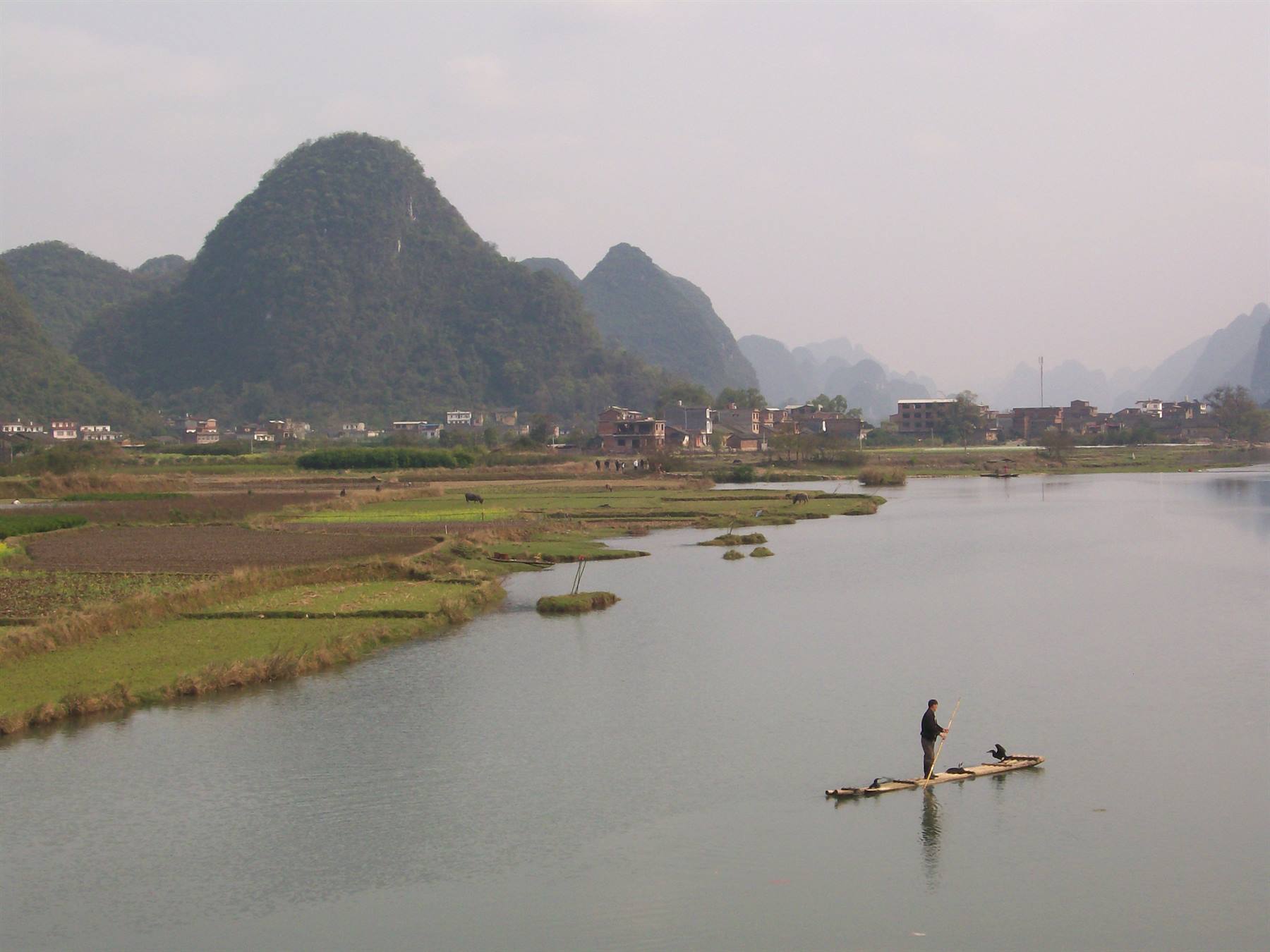
Having left the town we insist with the guide to stop on a bridge from which you enjoy one of the best perspectives on the Li River and its "sea stacks". We are not the only ones who think the place is enchanting, there are newlyweds who come here to have their photos taken. This bridge is an unexpected window onto a marvelous corner of rural China: ploughed fields, peaks, a cormorant fisherman plying the river on a small bamboo boat and even a farmer with a cow grazing. The life of the locals flows on the river but also above, on that apparently insignificant bridge motorcycles loaded to an unbelievable degree pass by, improbable vehicles, tractors, farmers and brides. We leave this place enthusiastic and continue to Guilin crossing an area of rice paddies surrounded by the inevitable pinnacles.
This region is truly beautiful and it is no coincidence that the Chinese consider it the highest natural expression of their immense Country, the stereotype to follow for their works of art. Even for me who have visited other extraordinary landscapes around the world the emotion is great. If the American canyons are beautiful for their majesty, Guilin fascinates because it is enchanting. During the journey Yan, our Guilin guide, surprises us further, he is not only available to satisfy our needs and culturally prepared but also a great singer. Apart from a few missing R's he performs his repertoire of Italian and Chinese songs involving us all. Bravo Yan!!! Before reaching Guilin we visit, as is customary on this trip, a factory of pearl jewelry. Compared to those seen in Beijing which were freshwater, these pearls are from the sea and therefore more precious.
I don't buy anything but I happily attend a fashion show of beautiful Chinese girls who display the jewels to encourage their purchase. Once in the city we visit Fubo Hill climbing up to the first panoramic terrace. Guilin seen by day is not as fascinating as by night but it is interesting to observe how the limestone peaks surround the city extending their offshoots right into the center. A crevice leads into the heart of the hill where a rock temple is set up complete with Buddhist statues carved into the rock. We return to the hotel for dinner, this time there are some Italian dishes, it is not really cooked like ours but it is still good. In the evening we go out for a walk to the food stalls where dishes unknown to us are cooked. In the afternoon the guide told us that here they eat dogs and rats but fortunately we don't see them.
From here we reach the lakeside crossing romantic little bridges and enter the characteristic pagoda that houses the tea house. We settle on the terrace overlooking the lake illuminated by colored lights that make it fairy-tale. In China the culture they have of tea is similar to what we have in Italy for wine, the tea houses are like our wine bars and the leaves are aged. There are various qualities of tea and the price is more or less high based on the quality. It should be kept in mind that often a good tea costs more than a dinner at a restaurant. For us laypeople it is difficult to distinguish the various qualities and we often end up mistaking highly refined infusions for hot water.
Here too we are unable to appreciate the taste of what we drink, I end up throwing it into the lake and who knows what the young waitress must have thought who like one of our sommeliers had served it to us with so much care, warming the cups and blending together various infusions. We are surprised that the bill is rather steep but we do not regret having immersed ourselves in this important aspect of Chinese custom. We return to the hotel happy with an intense day in this splendid corner of the world.
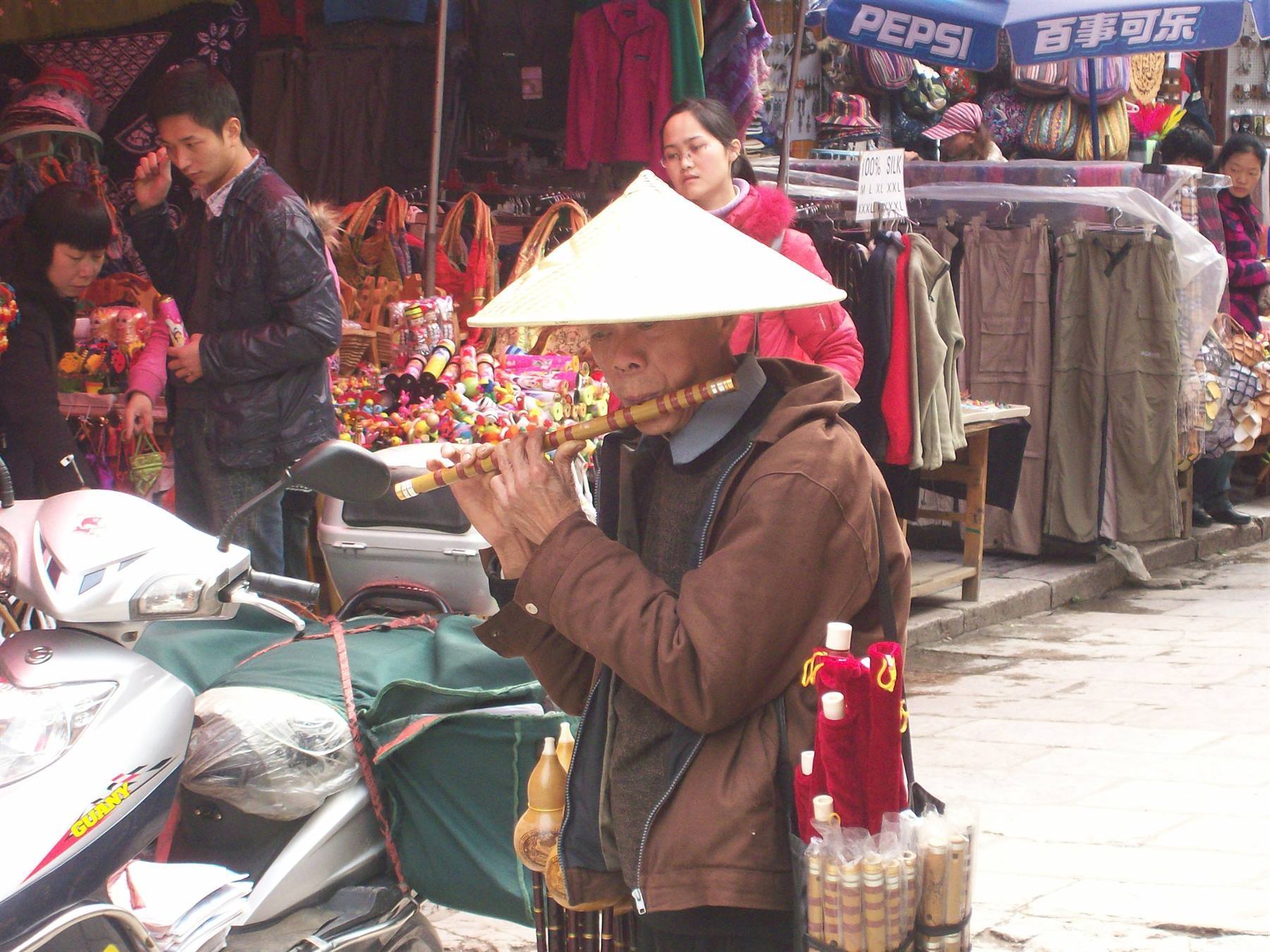
Flute seller in Yangshuo
Day 38 Mar 1983
Departure from Guilin
This morning the weather is uncertain and after an abundant breakfast at the hotel the bus takes us to the airport which is about an hour from the city. Also today, due to the not exactly optimal weather conditions, no sprightly elderly people are seen engaging in Tai Chi on the shores of the lake. We leave this enchanting corner of the world, pleasant to look at even under a blanket of haze, and board the plane headed to Shanghai. The Guangxi Province has truly satisfied us.

0 reader comments