I arrived in this Province of China on a flight from Beijing as part of a broader Tour made with a group of 4 friends. During the journey we got to know 5 other companions of the adventure. As China is not only a country but a subcontinent, I've divided the itinerary into several travel diaries.
Day 14 Mar 1983
Arrivo a X'Ian
The airport of Xi'an, where we arrive in the early afternoon with a flight from Beijing, is rather far from the city. We have lunch in the airport restaurant, but it will be the worst meal of the whole tour in China; the only justification is the rather late hour. We manage to eat almost nothing; fortunately something to put under our teeth had been served to us on the plane. Crossing a rural area we reach Xi'an to visit the local Archaeological Museum. Xi'an is the cradle of Chinese civilisation; it has been capital several times; from here numerous emperors governed, among them those of
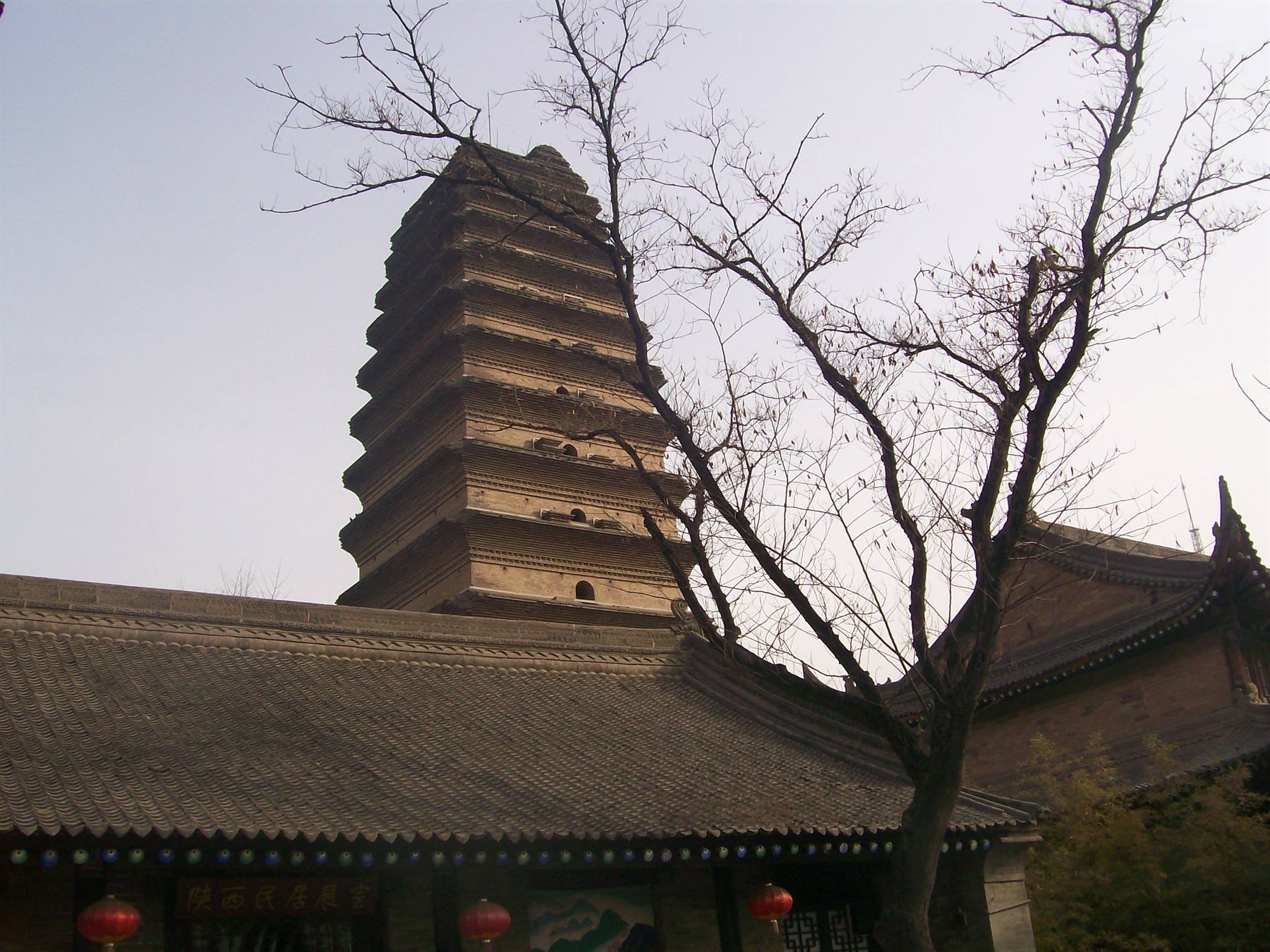
Small Wild Goose Pagoda
Day 25 Mar 1983
I Guerrieri di Terracotta, la Moschea, gli spettacoli
We start the day with an abundant breakfast at the hotel. As usual in China, the staff outnumbers the actual needs, and so you notice that to cook a couple of scrambled eggs there are no fewer than two cooks, one who cracks the shells and the other who cooks them. It's nothing new around these parts, I've seen shops with a couple of people whose only job is to open and close the door, but in this country there are more than a billion people and they all have to work somehow!! Xi'an has contributed so much to Chinese history, but not many would come here if, while digging a well, a farmer hadn't accidentally discovered the famous terracotta warriors. We had a preview yesterday by looking at those exhibited in the museum, but today the entire army awaits us. Before reaching it, we stop at a State factory that mass-produces terracotta soldiers and lacquer furniture.
They show us the molds used to produce them and let us watch a crafting process. We then cross a countryside area where a few pyramid-shaped mounds emerge, the tombs of emperors from ancient dynasties. Near one of these mounds, the one belonging to the emperor of the Qin who began the construction of the Great Wall, lies his great army buried together with him to defend the valley that housed his tomb. The thousands of statues, each different from the other, are kept in some large hangars; the excavations have not yet been completed, and even during our visit we see a group of experts busy examining the finds. There are parts of the army not yet restored, while others show the soldiers lined up in battle formation, complete with horses in tow.
Missing, however, are the weapons, which were stolen by a General some years after the emperor's death, and the wooden chariots, worn away by time. After visiting the army hangars, we enter the Museum, which keeps the emperor's bronze chariots and some armor inside large display cases. At the exit of the archaeological area we also meet the famous farmer who accidentally discovered the warriors, sparking the tourist development of Xi'an and the surrounding area; he is here to sign autographs and have his photo taken, but everything is strictly for a fee. His authenticity is confirmed by the displayed images showing him with the Chinese President and with Bill Clinton. Once the visit is over, we head back into the city; after lunch we visit the Great Wild Goose Pagoda, a tall multi-story structure built to house the sacred texts that a Buddhist monk brought from India.
The pagoda is part of a Monastery where there are some recent buildings that tell the story of the monk-traveler through graffiti on metal. The Buddhist complex overlooks two large squares, one of which has a scenic fountain in the center and is crowded with people on the occasion of a festival. From here we return to the historic center after traveling for a stretch along the road that runs around the walls enclosing it. The heart of the city passes through the Drum and Bell Towers, near which lies the Islamic quarter with the Great Mosque. Islam reached this far with the merchants who traveled the long Silk Road that, from the Mediterranean, after thousands of kilometers across Central Asia, arrived at Xi'an. The Great Mosque features a strictly Buddhist architecture, with a pagoda in place of the minaret.
The temple is surrounded by a very orderly Suk, quite different from those found in other Islamic cities; the only similarity is that here too you have to haggle. At the various stalls, I and two of my travel companions prefer the Chinese shadow puppet theater, which puts on a short performance to the sound of traditional instruments. We don't understand anything of what the shadows say, but it's pleasant to watch these figures move from behind an illuminated screen. The little theater is inside an old noble house, complete with furnishings and a garden. We leave the center of Xi'an by minibus to reach a large Theater that, instead of an orchestra section, has an elegant restaurant with tables arranged on two levels.
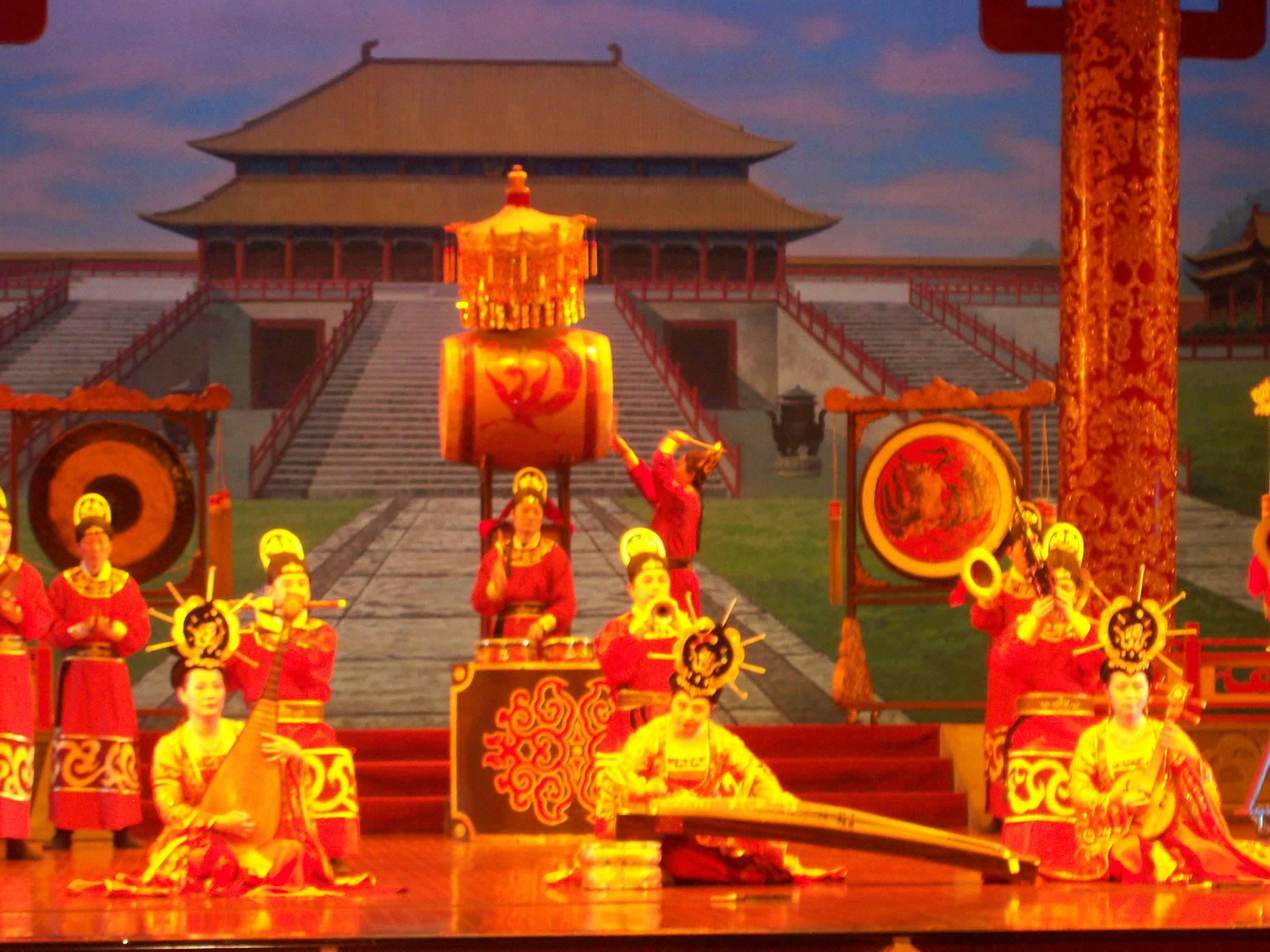
We are seated on the upper floor; the service is refined, there's a rose on the table, and while we dine we are entertained by the melodious sound of a Chinese stringed instrument. At the end of the meal, one of the best of the entire tour, the curtain opens and a wonderful show dedicated to the Tang dynasty begins. If the early Qin made Xi'an famous with their terracotta warriors, the Tang represent the golden age of the city over the course of its millennial history. The Tang represented in China what the Renaissance was for Europe. Throughout the performance we appreciate the meticulously crafted stage sets, the graceful dances of the dancers, the melody of the music performed with traditional Chinese instruments, distinguished by the sweetness of the sounds punctuated by the beat of drums.
Emperors, empresses, concubines, eunuchs, and dignitaries parade by in a triumph of grace and harmony, a show that will remain in our memory forever. After these two very intense hours, we return to the hotel completely satisfied.
Tang show
Day 36 Mar 1983
X'Ian
We get up early and, after the usual abundant breakfast at the hotel, we board the minibus at our disposal for one last visit in the city. We drive along the avenue that circles the mighty walls and then reach the Small Wild Goose Pagoda and the surrounding park. In this park too, as we had seen in the Temple of Heaven park in Beijing, there are elderly people dancing and doing Tai Chi. The Pagoda is decidedly smaller than the one called Great that we visited yesterday afternoon; moreover, due to an earthquake long ago, it is missing its top. Nearby we enter an exhibition hall of Chinese painting and writing, where a girl writes our name on a sheet of paper in local characters. These are all tricks to entice you to buy; yesterday, for example, at the Great Pagoda Temple they gave us a postcard with the stamp of our zodiac sign, different from our Western signs.
Writing in Chinese is an art, and whoever writes in beautiful calligraphy is considered an artist on par with a painter. Besides, I believe it's not at all easy to compose these complicated monograms. We leave Xi'an and head to the airport, passing through the countryside. In Xi'an we encountered less police than in Beijing, but the city is nonetheless orderly and clean. Our flight takes us southwest; we will land in Guilin, which I'll tell you about in the relevant itinerary.

0 reader comments