I arrived in China on a Lufthansa plane from Rome via Munich. With me was a very well-tested group of 4 travelling companions, to whom 5 more people were added and with whom we bonded from the start. Having set off from Italy in the early afternoon, we arrived in Beijing around midday. We flew over European Russia and Siberia at night, while with the first light of dawn we watched the Mongolian steppe from the windows. As China is not only a country but a subcontinent, we've divided our tour into several travel diaries. In this one we'll deal with Beijing and the surrounding province.
Day 11 Mar 1983
Arrival in Beijing
At the new Beijing airport we meet the young man who will act as our guide and whom, since he has a name unpronounceable for us, we will conventionally call Franco. On board the minibus driven by a certain "Schumacher" we reach Beijing, where we have lunch in a sort of trattoria. The place is spartan, but we are given a small room with a large round table at the centre of which is a revolving glass top on which the numerous trays overflowing with Chinese gastronomic specialities are placed. This will be almost always our way of eating on this trip. The strange arrangement of the serving trays on the glass top makes helping oneself a little complicated, but at least there are no waits between one dish and the next. The cuisine is more or less that offered in the numerous Chinese restaurants around the world: it intrigues but in the long run it cloys.
Often we don't even realise what we are eating, but apart from a few dishes with a taste truly too different from our habits, the rest is more than acceptable. After lunch the first visit is to the Temple of the Lamas, preceded by a heavily coloured entrance arch. Here we have our first contact with Buddhist culture and traditions, even though the temple is Tibetan in character, with prayer wheels to turn and banners. We are thousands of kilometres from the martyred Tibet, but here in the heart of Beijing this temple represents an appendage of the religion of that region, which is nothing other than a branch of Buddhism, a different way of interpreting the Buddha developed on the roof of the world.
Here we have our first contact with pagodas, enormous gilded statues, smoking censers, monks and powerful lions with curly manes, but the true treasure of the temple is a very tall statue carved from a single trunk of sandalwood tree. From here we would like to go to the nearby Temple of Confucius, but unfortunately it is already closed to the public. We reach the Hotel Mercury, where our suitcases have preceded us, and take our places in the room. The Hotel has been recently renovated, has a fine lobby, spacious and comfortable rooms. Dinner is a buffet with a great variety of local foods, sweets and exotic fruit. One can also choose fish or seafood and have it prepared by the cook. It is also possible to have cooked a speciality that is halfway between a pizza and a piadina after choosing the ingredients for the filling.
There is also a mountain of boiled prawns placed on an ice surface. Before reaching our rooms we take a short stroll around the Hotel, visiting a large shopping centre. In the room I take advantage of the bathtub it has; in China I will find bathtubs everywhere, and being used to a shower, it will be a pleasant thing for me to immerse myself for a few minutes in the hot water before going to bed.
Tiananmen Square
Day 22 Mar 1983
Grande Muraglia e Hutong
If yesterday Beijing greeted us with faint sunshine, this morning a few drops of rain are falling accompanied by a bit of wind. After the abundant buffet breakfast we board the usual minibus which takes us to Badaling, the point closest to the capital where one can observe the Great Wall. Whether because we are north of Beijing, or because we are in hilly country, in this place it is cold, a few snowflakes are falling and the wind is blowing. Before reaching the wall we stop at an enterprise where jade is worked. This will be the first in a long series of visits to this kind of tourist-commercial enterprise where the guides take us in the hope that, thanks to our purchases, they can receive the due commissions. As these enterprises are state-owned, they have excess staff, and there are far more shop assistants than tourists to serve.
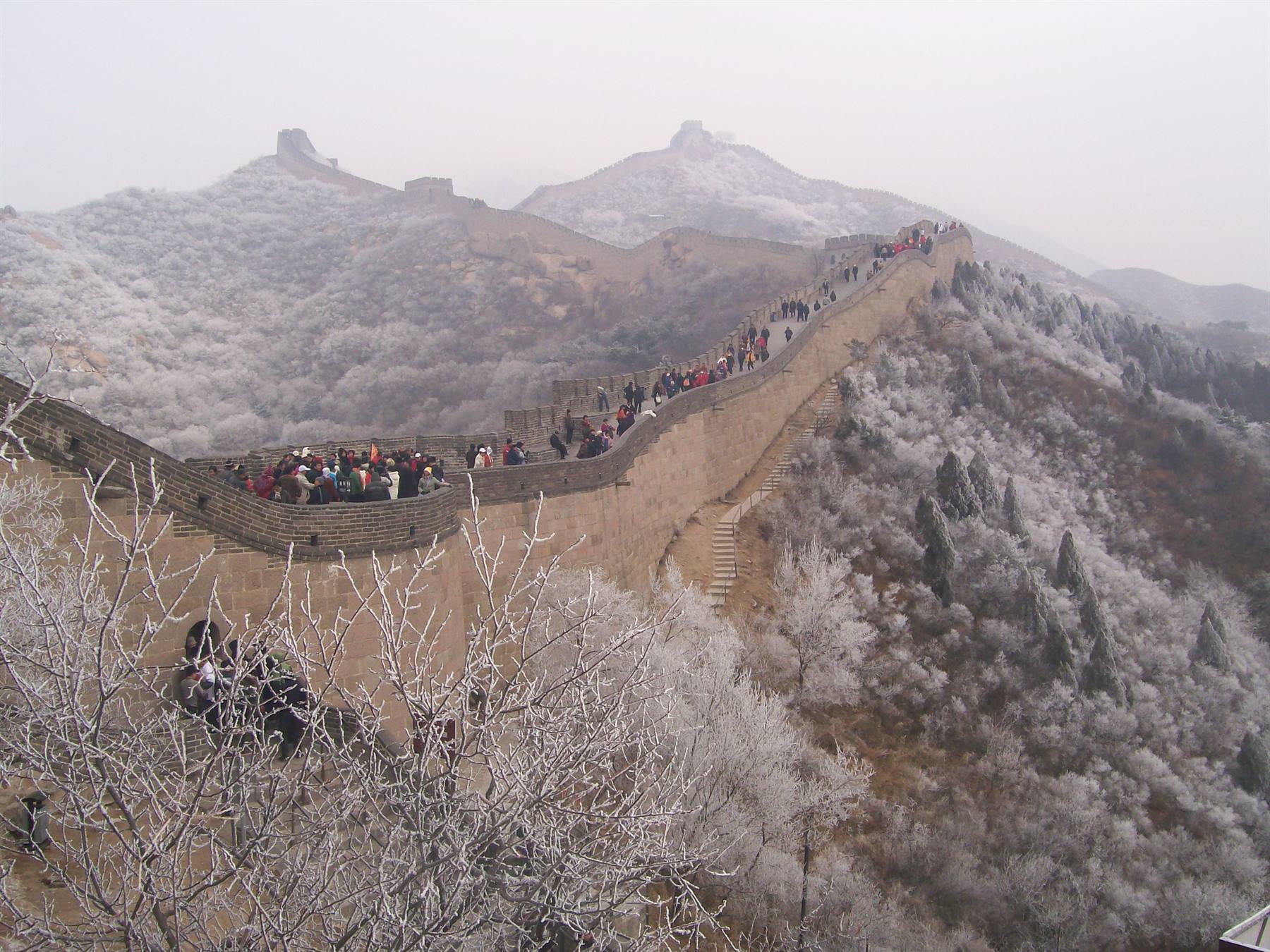
For someone like me who is not interested in making purchases, they are nonetheless interesting because they offer the possibility of following the production cycle of the various artefacts. In this first factory, dedicated to jade, I observe how a skilful craftsman manages to work one sphere inside another, a painstaking task requiring great manual skill and experience. The prices are not prohibitive, but I have come here to see, not to buy, so I resist every temptation. Finally we reach the Great Wall; this enormous construction measures more than 6000 km, but we will limit ourselves to walking a few hundred metres that climb a hill, from which the view ranges along the long wall that follows the profile of the hills with an up-and-down that resembles a roller coaster.
Here the Great Wall is besieged by tourists who, despite the low season, are very numerous, and precisely for this reason it is heavily restored. One walks easily along the walkway once reserved for sentry soldiers, stopping from time to time to observe the panorama, unfortunately clouded by fog. With the sun we would have enjoyed this wonder more, but even with the mists the wall has its charm. On the road back to Beijing we stop for lunch in the canteen of another state-owned factory. The environment is spartan, but we are granted a private little room with its own large round table and revolving glass top. We are getting used to this kind of table; we have learned to rotate the dishes clockwise so that we can all serve ourselves without disturbing one another. There is never a lack of the ceramic bowl in which to put rice, which here is used as we use bread.
On the table there are always chopsticks, but for us Westerners there are also cutlery. As per the travel programme we can also drink a glass of beer or Coca-Cola, and tea is always present to help ourselves to at will. Obviously they also show us the factory, in this case of cloisonné, metal vases enriched with ceramic inserts then glazed and fired several times. It is very interesting to watch the girls decorate the vase with designs, meticulously glue the small fragments of ceramic onto it and brush them with kaolin. A little further on is the kiln for firing the vases and the display of the finished products. Around Beijing we visit the tombs of the emperors of the Ming dynasty, which resemble temples but have a fair display of royal objects.
In China, as centuries earlier in Egypt, the deceased were buried with objects of daily use and precious trinkets that were supposed to be useful to them upon reincarnation; for this reason, from the few tombs excavated numerous finds have emerged. In the display cases at the Ming tombs one can see precious ceramics, crowns and jewels. The tombs were connected by the Sacred Way, which we walk along a stretch of, reaching it with the minibus. The way is not particularly beautiful, but it has some large statues on the sides depicting real and legendary animals, placed there to protect the imperial tombs. We return to Beijing while it is still daylight, and we take the opportunity to rent some of the very numerous rickshaws and visit a Hutong. With this name of Mongolian origin one identifies the old quarters that once made up the entire urban fabric of the city.
With the advent of communism the Hutongs were razed to the ground to make way first for Stalinesque barracks-blocks, then, in the last 30 years, for modern buildings. The quarter we visit is one of the few survivors; it has narrow alleys overlooked by low houses apparently without windows because they take light from an inner courtyard. The little streets are very busy with rickshaws, bicycles and pedestrians, just as the whole of China must have been until the 1980s. We park the rickshaws on the banks of the little lake that touches the quarter, and after crossing a small marble bridge we walk along a narrow street overlooked by numerous little shops of junk for tourists. Immersed in these old buildings, mindful of a Beijing that no longer exists, we almost forget that a stone's throw from here the city pulses with chaotic traffic and galloping pollution.
We are near the two famous Drum and Bell Towers which once, with their sounds, punctuated the life of the capital. We return to our rickshaws, where the "taxi driver" waits for us to accompany us to a private house that we visit to learn how people live nowadays in the Hutongs. The house is not particularly interesting; between the thick walls marked by time there is a bare and old furniture, the elderly man who receives us is very kind, has Manchu features with very narrow eyes, and he has us sit in a circle in the largest room. When we go out we notice a cage with little birds; it seems to be found in every house and to represent the great passion of the elderly, who in China take their birds for walks in the parks as we do with dogs.
We take the rickshaws again and return to our minibus; tonight dinner awaits us in a luxurious restaurant to eat the speciality of excellence of Chinese culinary art, lacquered duck. In this establishment too a room is reserved for us; the service at the usual large round table is impeccable; after a series of appetisers a young waitress expertly portions the meat and places it in thin wrappers of wheat flour. The dish, very theatrical to serve, is also pleasant on the palate. We return to the Hotel full and satisfied after an intense day of visits.
Great Wall
Day 33 Mar 1983
Pechino
The day has faint sunshine and above all there is no wind. The abundant buffet breakfast at the Hotel ranges from American Breakfast to British Breakfast by way of Continental Breakfast and obviously Chinese Breakfast. In practice there is only the embarrassment of choice among toast, plum cake, muffins, exotic fruit, milk and cereals. Interesting, since we are in China, to taste the local bread, which is steamed and filled, or to drink soy milk. With the minibus at our disposal we reach Tiananmen Square, the centre of Beijing, the fulcrum of ancient and recent Chinese history. The Square, which is the largest in the world, is overlooked by numerous monumental buildings such as the Parliament building and the one housing the mummified body of Mao Zedong, the father of the Nation.
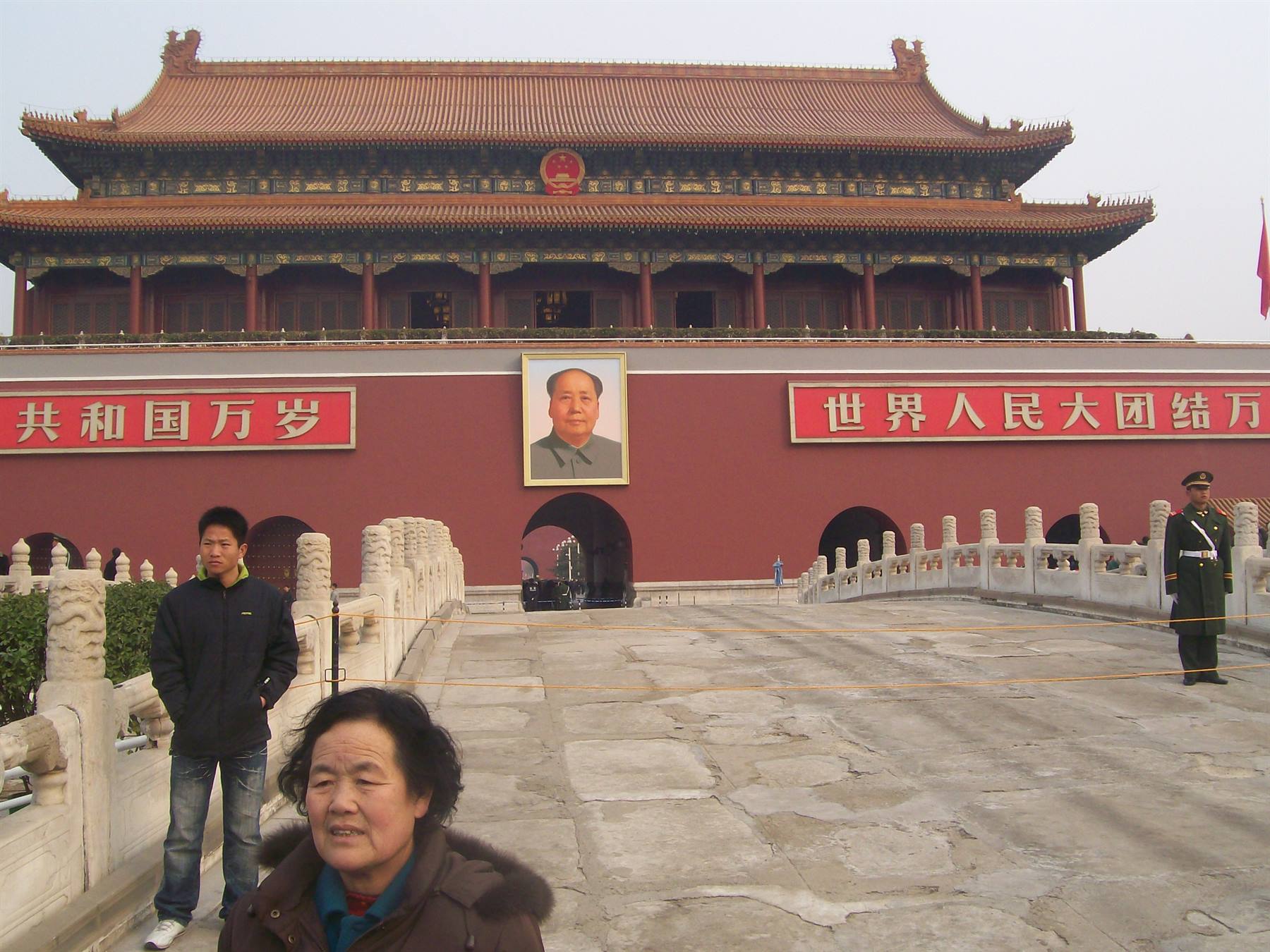
In the centre is the Monument to the Heroes of the Communist Revolution; at the far end of the Square is the entrance to the Forbidden City, on which are placed the famous portrait of Mao and the huge letters wishing long life to the Communist Party. The Party Congress is underway and the presence of police and soldiers throughout the Square is notable. In effect, however, the presence of the State is tangible everywhere in Beijing, and it is probably for this reason that the city is clean and orderly both in the centre and in the outskirts: not a graffiti on the walls, not a piece of paper on the ground, mown lawns, pruned plants—in short, a great civic sense of the people or a strong control by the authorities, or both. The fact remains that you can walk without any fear through an isolated underpass or a dark street because in any case there is someone to protect you.
We enter the famous Forbidden City; it is called so because until the fall of the last emperor, the one in Bertolucci's film, access was permitted only to the royal court. Now the City of the emperors is invaded by tourists who curiously scrutinise the numerous pagoda buildings distributed over a vast area. The emperors had preferred to build themselves a cluster of low buildings rather than a great royal palace as was customary in European monarchies. If the architectural ensemble is pleasant, I wonder how complicated it was for the rulers to move from one building to another rather than from one room to another. Surely the emperor's life was made simpler by eunuchs and concubines; his royal head was protected by an umbrella and transfers from one part of the city to another were made by palanquin.
The structure is almost entirely of wood and fires were frequent, as demonstrated by the numerous rebuildings and the many bronze containers that were used to put out the fire. The interiors are rather bare because much has been stolen; we must not forget that this place suffered foreign incursions, civil wars and the Cultural Revolution in Mao's time, when an attempt was made to ban any pre-communist cultural form. We nonetheless manage to see some furnishings and the emperor's throne. We exit on the opposite side from where we entered; waiting for us is our minibus, which takes us to a restaurant at a pearl-processing enterprise. Needless to say, after the lavish meal we also had to endure the related visit to the enterprise, which nonetheless allowed us to discover how pearls are cultivated inside oysters.
One of us chose a large oyster which, once opened, showed the treasure it held: more than 20 little pearls, which we divided up. It was also explained to us while we were visiting the jewellery display that these are freshwater pearls, decidedly cheaper and less valuable than those cultivated in the sea. At the end of the visit we go to the Summer Palace, the place where the emperors resided during the hot season. Here, exploiting a small watercourse, an artificial lake has been created, complete with a small island connected by a marble bridge with several arches. In the lake are reflected numerous imperial pagodas linked to the memory of the greedy Cixi, the empress mother who manipulated the last sovereigns like puppets.
The Summer Palace, which is in reality a large park, presents among its most interesting things a long wooden corridor richly frescoed with scenes of landscapes and historic battles, while from the top of a hill a great pagoda temple dominates. On the waters of the lake Cixi had a marble boat built, which, rather neglected, still shows itself off—a squandering of money that the empress took from the Chinese fleet. From here we make a broad tour of Beijing, passing through the famous sports area that houses facilities such as the Bird's Nest-shaped Stadium and the swimming pool with walls reminiscent of the sea. We return to the Hotel for dinner, enjoying the numerous specialities of the buffet, then go out again with the minibus for a tour of the capital by night. We stop on a street that hosts a long array of stalls serving regional gastronomic specialities.
From the smoking pots emerge products at times indecipherable; some street vendors display inviting skewers of candied fruit, large dumplings, steamed bread, but also fried grasshoppers, centipedes, snails and even silkworm cocoons!! Nearby we visit the long pedestrian shopping street overlooked by luxurious shops of big fashion brands. This elegant street is contrasted a short distance away by a popular quarter rich in junk shops. One moves with difficulty in this area, much frequented by tourists and locals in search of bargains. In these little markets haggling is obligatory; one generally starts from a request very far from the actual value of the object and ends up buying for a few yuan, the Chinese currency that bears the name of one of the many dynasties that have dominated the Country.
With the minibus we drive along the wide streets of Soho, one of the most modern quarters of the city, where tall skyscrapers show themselves off, among which the very new television one stands out. Returning towards the Hotel, one observes that in the midst of this area of ultramodern buildings, among a tangle of streets, there is still the ancient astronomical observatory, whose instruments are visible from afar. Today too has been an intense day; tomorrow we will leave Beijing.
Great Wall
Day 44 Mar 1983
Pechino-X'Ian
A grey day but at least it is not raining. We get up early to see the Temple of Heaven, which although not very well known internationally is considered the symbol of Beijing. The tall Pagoda where the emperor went to pray to propitiate a good harvest is located within a large public park. From early morning numerous elderly people gather in the park to do Tai Chi, a series of slow exercises derived from the martial arts. Others come here to dance to the notes of a portable stereo, to play badminton or to bounce a rubber ball with multicoloured feathers attached. There are also those who simply stroll among the flowerbeds carrying a little cage with birds. The strangest thing is to see elderly people seriously engaged in gymnastic exercises, managing to use their legs agility as I have not been able to do for years.
Perhaps for this reason one does not see a fat Chinese person around; they are all slender. After observing these sprightly gentlemen of "a certain age" we reach the tall pagoda built by interlocking without the use of nails. It was conceived as a calendar: the 12 inner columns representing the months, the 4 central ones for the seasons and another 12 for the hours, which at the time the Chinese counted two by two. The pagoda is preceded by a wide staircase. It is the last monument we see in Beijing, because the minibus is waiting to take us to the new airport, from where we will take the flight to the ancient capital of Xi'an in the province of Shaanxi. We leave Beijing with its contrasts between old and new, ancient traditions and communist doctrine, bridges and pagodas.


0 reader comments