The story
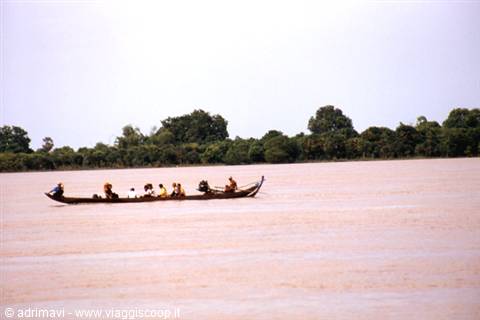
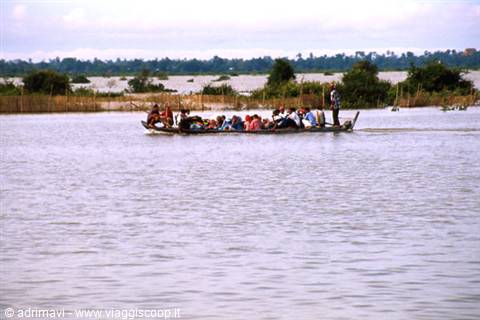
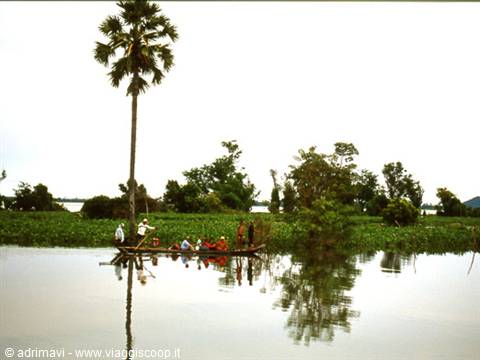
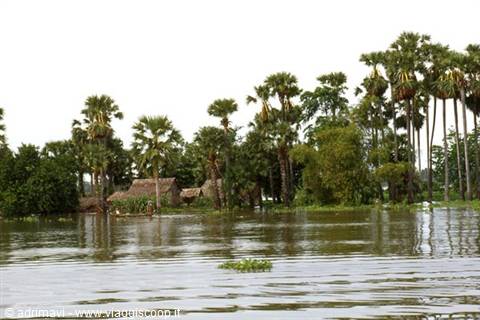
We see a Cambodian flag flying on the left bank of the Mekong — this means we're at the Kaam Samnor border. The crossing was opened recently. Vietnam behind us, Cambodia ahead! The Mekong widens so much that the banks are barely distinguishable. Continuing on we see huts submerged up to their roofs, and we meet boats packed with people, some of whom carry the Red Cross flag... it takes us a while, then finally we understand: the Mekong has flooded. The comings and goings of boats are the rescue parties sent to the flood-stricken population left homeless. Continuing upstream, the river gradually returns within its natural banks. On Cambodian territory the landscape apparently doesn't change: the usual children splashing in the water, women and men at the oars crossing the river from one bank to the other, boats going up and others coming down loaded with people or goods.
But the villages dotting the banks are far more wretched than those seen in Vietnam. In Cambodia one senses greater poverty.
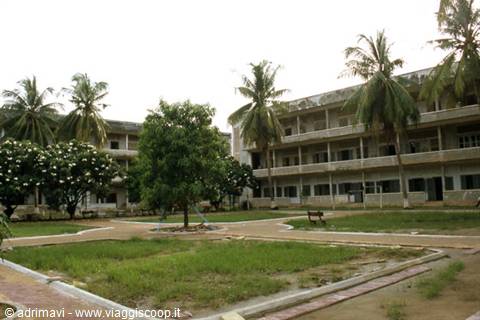
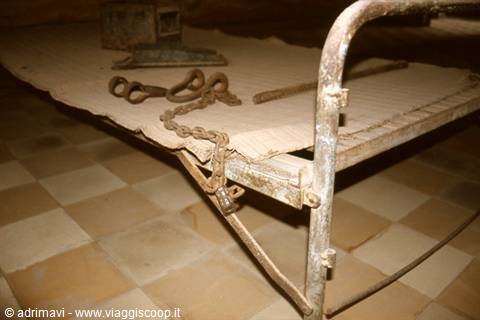
It takes us almost a whole day to reach Phnom Penh. We visit first the Tuol Sleng Museum, the notorious "S-21" prison, in which the Khmer Rouge of the infamous Pol Pot tortured and killed even those merely suspected of anti-government ideas. The prison is horrifying. Chilling echoes come from the corridors and cells. I stare in dismay at the photos of civilians with bodies mangled by cruel torture. I shudder at the sight of the bloodstains still smearing the walls and the instruments used to inflict horrible pain on those poor wretches until they were driven to death. The torments suffered by the prisoners were so inhuman that the inmates preferred to take their own lives by throwing themselves from the windows rather than continue to endure the most insane physical and moral humiliations a human mind can imagine.
Pol Pot, however, thought of this too, and had the corridors, balconies and windows fenced with barbed wire to prevent the suicides. Finally I feel a chill run through my bones as I read the reasons that led to such horror: it was enough to be an intellectual or even simply to wear glasses. Had I been born in Cambodia instead of Italy, wearing glasses I would certainly have been a victim of the regime. The Khmer Rouge of Pol Pot represent one of the saddest episodes in the history of humanity! When in 1979 the Vietnamese army entered the prison it found only 7 people alive. The dead were buried in mass graves in the courtyards. The prison of horrors became, in world public opinion, a grave scandal and today it has become the symbol of Pol Pot's human madness.
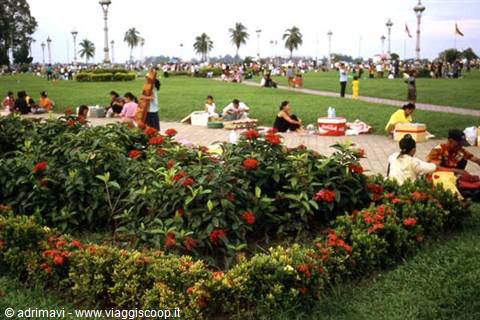
UNESCO, I think, should add the "S-21 prison" to the list of humanity's heritage, as one of those places that bear witness to the many genocides perpetrated by man, so that all humanity, whatever its religion or race, may question the vaunted moral and civil values it has won. The preference given to the "S-21" prison unfortunately costs us the visit to the Silver Pagoda; a shame not to see the 5,000 silver plates it contains. We then immerse ourselves in the animated life of the square in front of the Royal Palace, particularly bustling today as it's a public holiday. People come here to gather — men to argue, women to stroll and children to play. Cambodia seems to be laboriously seeking a dimension of normal life after the crimes of Pol Pot and the Khmer Rouge. Along the way we reach Wat Phnom, made evocative at dusk by the votive candles lit along the path leading to the temple.
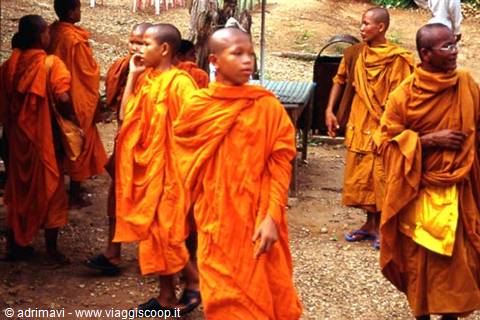
Several monkeys live on the hill; you meet them almost at the entrance door. The temple is empty except for three Buddhist monks, dressed in orange robes with shaved heads. On leaving the temple, but in reality all over Cambodia, beggars — victims of landmines — ask us for alms. In Cambodia a wrong step in the countryside and you risk being crippled for life. People mutilated by landmines are not considered war victims by the government and therefore cannot count on any state subsidy, employment or even the slightest recognition. A dash to the Psar Thmei market, which recalls a Babylonian ziggurat, to go shopping, and then dinner. We have it at the Goldfish River Restaurant. The evening begins idyllically. With the full moon we eat, on a balcony on the banks of the Mekong, every kind of fish, but first the wind, then the rain, spoil the enchantment.
Typhoon, shouts the owner, inviting us inside. Back at the hotel, at the bar two couples catch our attention. They are two elderly, big and fat Western men, together with two young, small and thin Cambodian girls. It's obvious what kind of company it is.
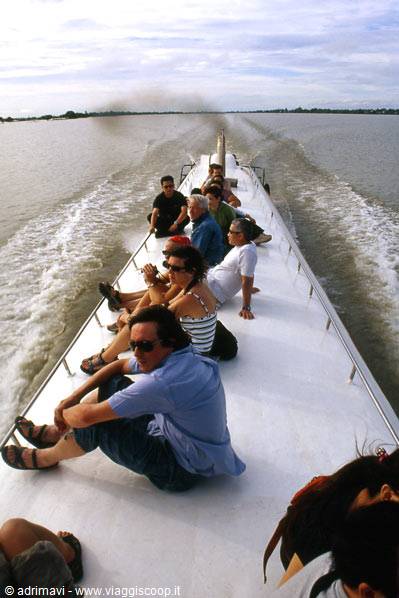
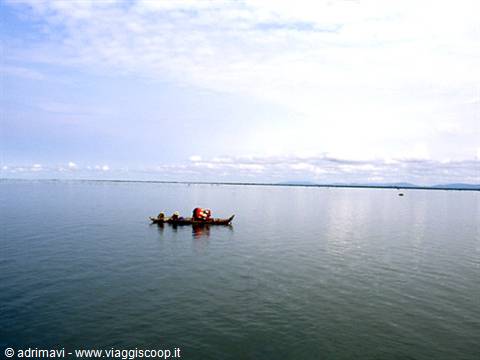
Early in the morning at the port we board the boat bound for Siem Reap. We leave the Mekong for good for the tributary Tonlé Sap and the lake of the same name. The life along the Mekong banks that had accompanied us so far on our journey north now, on the Tonlé Sap, becomes rarer as we go deeper, and the banks more desolate. Near Udong we see the last signs of civilisation. On the horizon, on the mountain ridges, stand very white temples that seem, by their position and grandeur, to hold a considerable sacredness. The river — strange but true — at this time of year, because of the abundance of water, flows backwards towards the lake basin rather than towards the Mekong. As we approach the lake, moreover, the shores recede until they can no longer be seen, and for about an hour it feels as if we're sailing on the open sea.
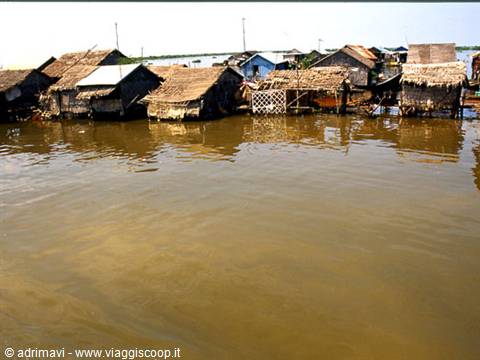
Before disembarking at Phnom Krom our little boat slows considerably to pass through this genuine floating city. Here the children don't play in the street, but in the water. The taxis aren't cars, but canoes. The houses, the school, the little museum, the petrol station are built on boats or stilts.
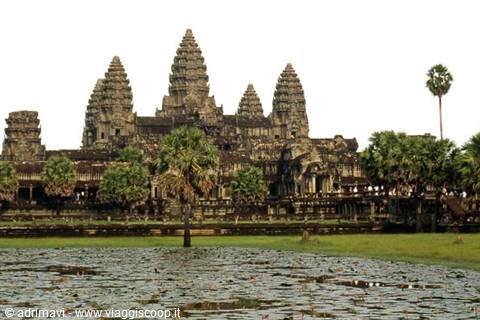
We've reached the final destination of our journey, the temples of Angkor, the ancient capital of the Khmer kingdom, right in the heart of Cambodia. Few places in the world enchant like these ruins, partly overwhelmed by the jungle. Angkor is not merely an archaeological site enclosing hundreds of temples, but a unique place that bewitches and makes you lose your sense of reality. It transmitted different emotions to each of us: it captured, surprised and drew us away from the journey and from civilisation for a whole day. The appointment is at sunrise, at the entrance to Angkor Wat. We reach it by bicycle. The temple is awe-inspiring; you get the impression of crossing into something forbidden, and when Angkor Wat appears it is like a living presence rather than a palace of stones. The enchantment is completed by the harmony of the dawn breeze and the arcane sounds of the forest.
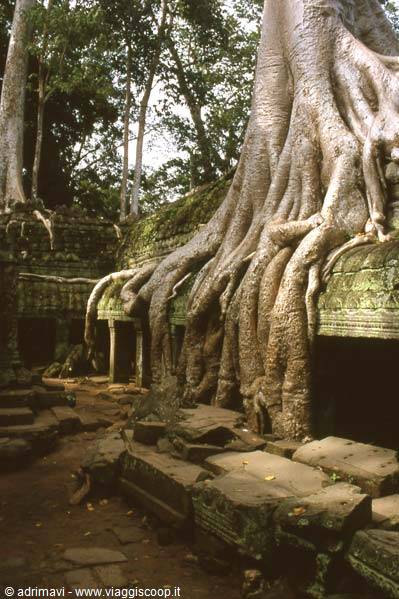
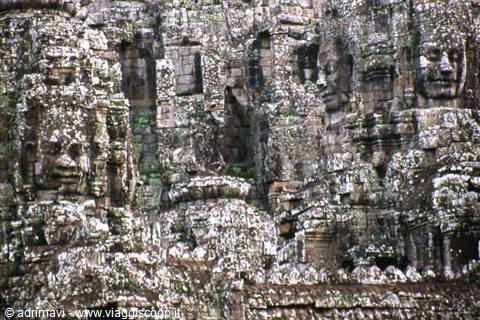
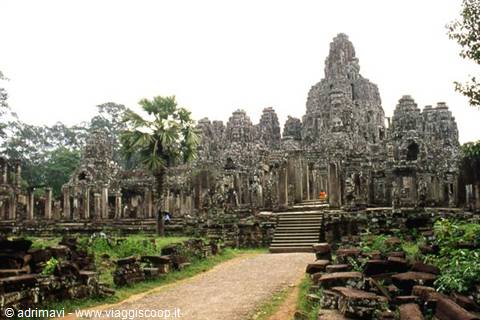
At Angkor Thom, by contrast, you get the impression of entering an archaeological site only just discovered, because of its monuments hidden in the forest. A tomb-like silence hangs in the air, humid and reeking of mould. The monuments emerge with difficulty, but sumptuous, from the roots of the trees. Reaching the Bayon, something mysterious captures us. It's the profiles of the gigantic stone faces that make it up, radiating all around, multiplying over and over as if to symbolise eternity. The sunlight is about to yield the stage to the shadows of evening, and the enormous otherworldly faces seem to whisper among themselves in an ancient language and in a space that seems beyond time. Angkor... The magic is complete!
The journey's photographs
21 photographs · click to open them full screen





0 reader comments