Having arrived in Cambodia in the company of two friends during a long tour in Indochina also including Vietnam and Thailand. Entering Cambodia from the river border on the Mekong aboard a fast boat that had set off from Chau Doc in Vietnam (see Vietnam itinerary).
Day 117 Jan 1994
Phnom Phen
The boat we're traveling on docks on the left bank of the Mekong, where we go ashore to obtain the Cambodian visa. The procedure is short and quick. We set off again by boat toward Phnom Penh, where we arrive in the late morning. At the river port of the capital, we get into a taxi that takes us to the hotel we booked from Italy. After settling into the rooms, we take a tuk tuk to the area near the Royal Palace. It's still early and the Palace is closed for the lunch break. Around 2:30 pm, when the gates open, we're among the first to enter. It's very hot when we begin our visit, joining up with a honeymooning couple and their guide, a retired man from Piedmont who has lived in Cambodia for seventeen years.
We visit the Palace gardens and the Silver Pagoda, which, along with the sacred images typical of Buddhism, also preserves numerous gifts from the faithful, comparable to the ex-votos in our churches. In the park there's also a scale reconstruction of Angkor Wat Temple, which we'll see in the coming days. Within the Palace grounds, you can visit a traditional Khmer house, a strange plant whose flowers bloom and fall to the ground within a single day, and a traditional music group performing. There's also a photo exhibition portraying the multifaceted King Sihanouk, from sovereign to film actor, one of the most politically controversial figures in Cambodian history, also compromised with the brutal Khmer Rouge regime. From here we return by tuk tuk to the hotel, where we book the bus that will take us to Siem Reap the next day.
While I rest in the room, my travel companions visit the nearby covered market. Toward evening, I first go to the aforementioned market, then to a shop selling counterfeit clothing at prices that are still significant, then to the area near the riverfront, where we have dinner at a pizzeria. Nearby is Love Street, with numerous go-go bars packed with young ladies offering their company. It's interesting to observe that these young girls are accompanied to their workplace by their family members and in some cases by their boyfriends. Here, prostitution is a lifeline for families in serious economic difficulty and is therefore widely tolerated. It's not surprising, then, that these sex bars are next to perfectly normal businesses. We return to the hotel by tuk tuk for the night.
Angkor Wat
Day 218 Jan 1994
Tonli Sap and Siem Reap
The next morning we get up and leave, also because breakfast isn't included. A minibus comes to pick us up and takes us to the bus station, and from there we take the scheduled bus bound for Siem Reap. We travel across almost all of Cambodia on country roads that pass through rural villages and dusty towns. The traffic consists mainly of Japanese mopeds overloaded with people and merchandise. A single moped can carry an entire family, newborns included. Everything is loaded onto the saddle: sacks of raffia stacked one on top of another, filled to the impossible, cages with live chickens, etc. Many have adapted their mopeds, turning them into rudimentary sidecars; others tow a cart used for transporting goods or people. There are no taxis here, only tuk tuks or at most private cars, which are decidedly rare anyway. The village houses on stilts pass by the window.
People only go into the house to sleep, because everything else happens underneath, among the poles supporting the dwelling. Here they weave, prepare food, chat, and play. During the transfer, they offer us a snack for breakfast, and later we stop at a roadside restaurant for lunch. On the bus, next to me is a beautiful Cambodian woman with her child. She tells me she lives in Phnom Penh and is going to visit her brother in Siem Reap, while her husband works as a truck driver in Canada. We arrive at the bus station in Siem Reap in the afternoon. As soon as we get off, a young man approaches us offering to use his tuk tuk to reach the city center. We barely have time to check out his vehicle before he quickly grabs one of my friends' suitcases and takes it with him.
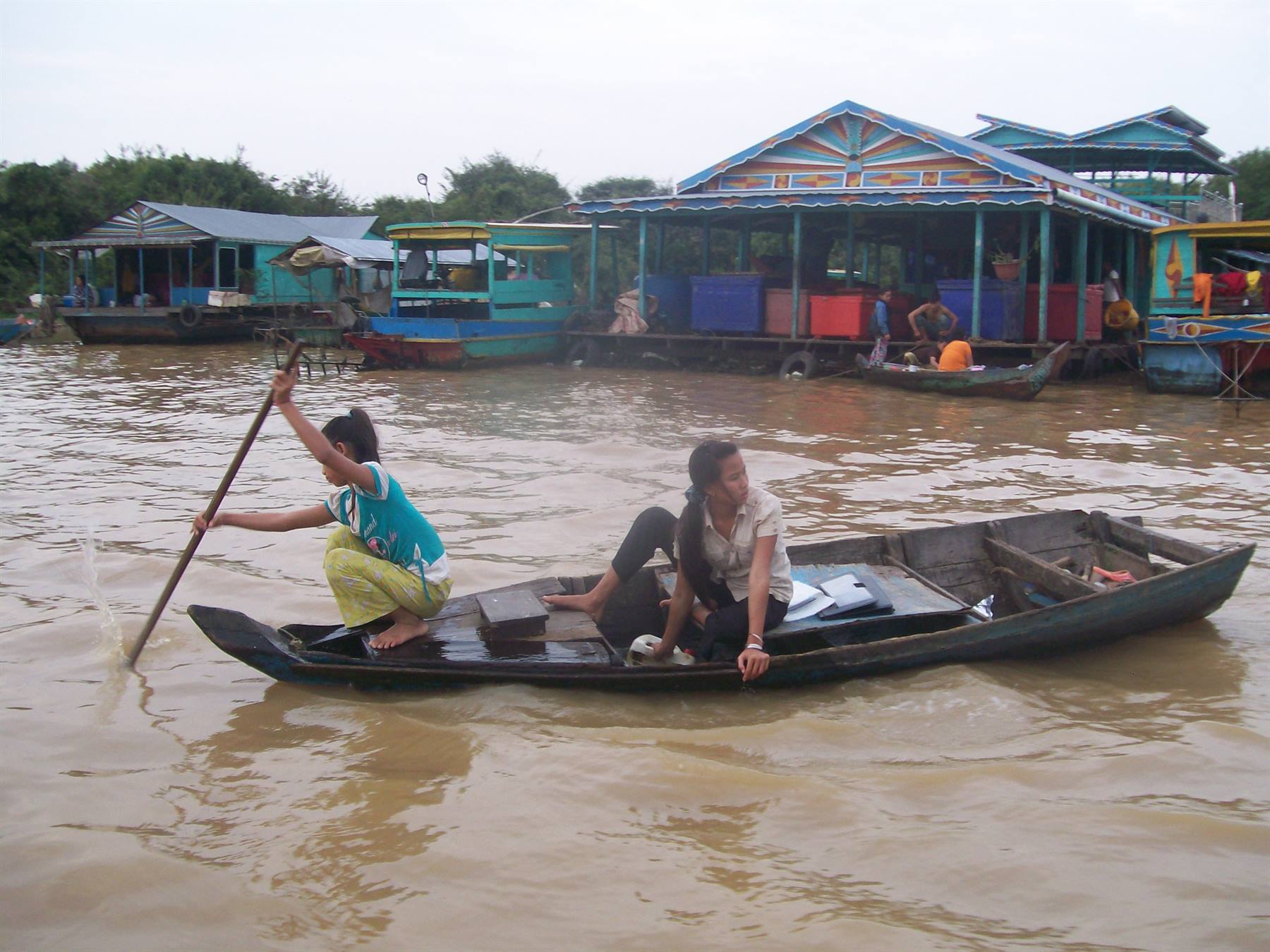
So we're forced to get into his shaky, dilapidated tuk tuk, which he had cunningly hidden from our view behind a larger vehicle. With somewhat aggressive driving, he takes us to our hotel, located in an alley between the Old Market and the nightlife streets; in practice, we're right in the center but haven't realized it yet. The hotel is nice, has a restaurant on the opposite side of the alley, and has a peculiarity: you have to take off your shoes to enter. After settling into the triple room, we take the usual tuk tuk and cover the ten or so kilometers that separate us from Tonle Sap Lake. Upon arriving at the landing stage, we board a motorboat for an excursion to the floating village inhabited by Vietnamese. Here people live by fishing; the fishermen's houses are placed on barges that serve as terraces, and beneath them is the fish farm, accessible through a hatch.
In the village, everything floats: the houses, the gas station, the restaurant, the shops, the school, and the Catholic Church. Between one row of houses and another, dozens of boats ply the Tonle Sap, often steered by people wearing the typical conical hat and sometimes also a mask similar to the ones surgeons use to protect their faces from tanning. Some children play by navigating on plastic buckets and rowing with a small paddle. Every now and then, a boat speeds through the village, raising waves that make everything wobble. We make a brief stop at the restaurant to enjoy a beautiful panoramic view from the first-floor terrace, then we stop at the shop where they try to get us to buy a large sack of rice to donate to the school, but we end up buying a bag of candy. Then we make a stop at the school and the nearby Catholic Church.
We return to the landing stage, where our tuk tuk is waiting, and go back to the hotel in Siem Reap. We have dinner at the restaurant across from the hotel, where I taste Cambodia's culinary specialty: fish cooked in coconut milk, not bad. We then go to the Night Market, a covered market full of stalls selling all kinds of trinkets for tourists, but also beauty salons and massage centers. At one stall I buy some fried bananas sold in bags like our potato chips. In the nearby nightlife streets there's a festive atmosphere; the venues offer live music or booming disco music, the streets are teeming with tourists dancing, and the bars serve rivers of alcohol. There are also touts constantly offering a tuk tuk tour, some drugs, or a girl for the night. For dinner too, there's just too much choice: from Khmer to Japanese restaurants, from Thai to Italian, from Mexican to Belgian to Irish.
Sexual desires are all catered to as well: there are venues for gay clientele, prostitutes, and lady boys. The streets are crowded; we escape this mayhem and return to the hotel.
Angkor Wat
Day 319 Jan 1994
Angkor
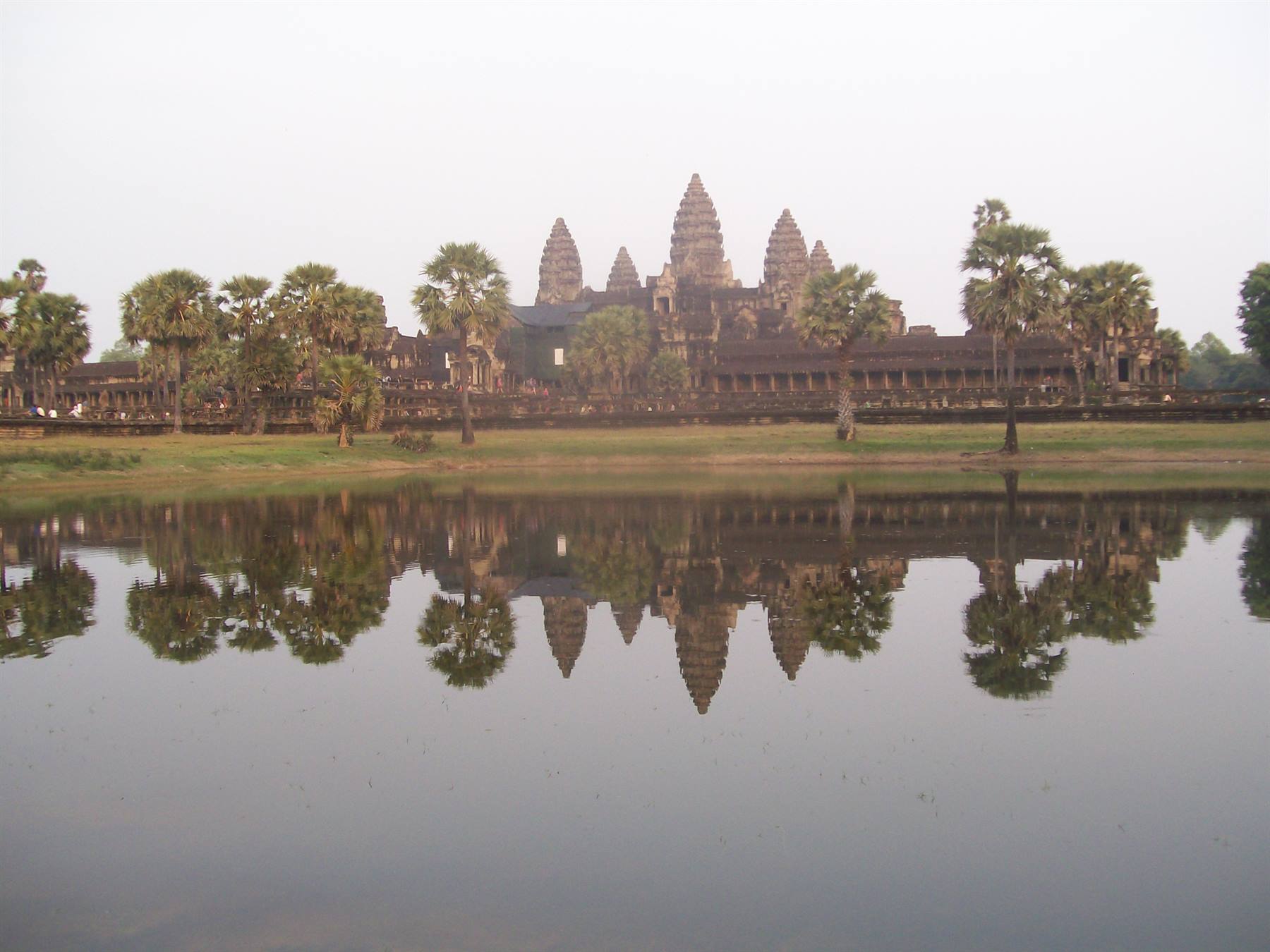
Upon waking, we have breakfast at the restaurant across from the hotel; it's included in the room price but there's hardly anything. The tuk tuk comes to pick us up right on time, and we transfer to the nearby Angkor archaeological park. After paying 20 USD for admission, we continue to the jewel of the Khmer empire, one of the most famous monuments in the world, Angkor Wat. It's so large that it's hard to take it all in with your gaze. The rings of walls are preceded by a moat. There's no point in describing this universally known temple; the feeling is that you've already seen it. However, being amid these historic walls, observing the bas-reliefs in the courtyards, climbing to the top of a tower is nevertheless an unmissable experience. A few kilometers from here, following a road through the forest, you reach Angkor Thom, preceded by a triumphal gate.
Of what must have been this sacred complex, what remains are the terraces with elephant depictions and the Bayon, a spectacular mass of pinnacles carved with human faces. Here too there's no shortage of bas-reliefs on the perimeter walls, though a good part of them have collapsed. By tuk tuk we continue the classic circuit, and after passing another triumphal gate and bypassing another temple, we stop for lunch at a spartan open-air restaurant. Cambodian cuisine has flavors that are too strong for us, so we can only partially eat what they bring us; fortunately, our "taxi driver" gulps down our leftovers like a drain. While we were trying to have lunch, he also found time to repair a wheel on the tuk tuk that was giving eloquent signs of giving way.
We set off again toward the temple wrapped in the large roots of plants; immersed in the tropical forest, it's decidedly less imposing than the previous ones but certainly the most romantic. Over the centuries, vegetation has taken over man's work, causing collapses, tilting structures, and gripping the temples in a fantastic floral vice. For sunset, we return to Angkor Wat to admire the colors changing as evening falls. The Khmer towers are reflected in the ponds. Satisfied, we return to the hotel in Siem Reap. In the evening we walk again through the nightlife, have dinner at a good Mexican restaurant, then head to the Night Market, where I get a foot massage. There are fewer people on the streets than the previous evening, perhaps because it's the start of the week. We return to the hotel for the night.
Tonli Sap
Day 420 Jan 1994
Siem Reap
We've already seen everything we had planned, so today we take it easy. We sleep in, have breakfast at the hotel restaurant, then take the usual tuk tuk (one of the worst around) to have it drive us into the countryside to see a bit of rural life—very little, to be honest. A bit more interesting is the market for locals, which partly unfolds along dusty, busy streets and partly inside a covered structure. They sell everything, including counterfeit US dollars and euros, live and dead animals and fish, sacred images, fried insects, jumping frogs. It's hot and full of mosquitoes. I feel a bit weak, so I prefer to go back to the hotel to rest. In the evening I go out with the others to have dinner at the Mexican restaurant from the previous evening. Tonight the nightlife streets are crowded again. This day of relaxation was just what we needed. We return to the hotel for the night.
Tonli Sap
Day 521 Jan 1994
Departure from Cambodia
After breakfast at the restaurant across from the hotel, we set off in a taxi booked at reception for the airport. It's not actually a real taxi but an ordinary car offering this service. We changed our flight plans—we've had news of unrest in Bangkok—so we'll head to Chiang Mai, though still with a stopover in the Thai capital. With the Air Asia flight Siem Reap-Bangkok, we leave Cambodia.
0 reader comments