The story
Starting point: the thousand-year-old Hotel Les Berberes, dug by hand in the heart of the Matmata mountain. The fuel is topped up and the fresh provisions are loaded into the galley of the field kitchen; off we go. The stretch of tarmac leading to the Pipeline crossroads is very scenic and a few stops for the ritual photos are obligatory. Reaching the crossroads, we quickly cross the new ~60 km stretch of tarmac that has sealed the definitive poetic end of the Ksar Ghilane oasis, now reachable by the masses with any means of transport. We reach the start of the dirt track a little south of the oasis; about 50 km of track, broken up by small sand humps and long stretches of toule ondule, lead us fairly quickly to the Kamur oil centre, where we deal with the paperwork for access to the south.
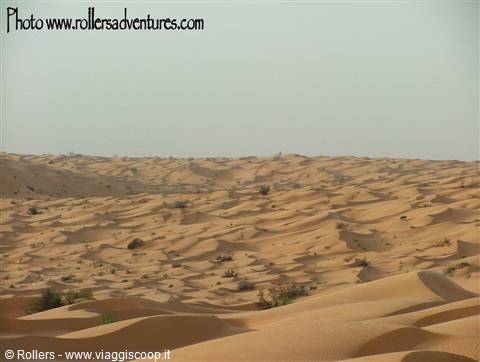
After the check, the battered barrier marking the restricted zone is raised by a very friendly guard, a wave and we set off again. Still many tens of km separate us from a secondary track, which we follow to the foot of a sandy Erg among the hardest to cross in the whole Sahara, "Zemlet El Borma". We are slightly behind schedule; let's not forget the whole thing has to be done in a week and by Friday we'll be back, so we can't afford excessive delays. We decide to head into the Erg, looking straight away for a good spot to camp; first though we gather some wood for the obligatory evening fire, around which we'll exchange our first travel impressions. We set up the first camp, enjoy the sunset and an excellent dinner, simple things that become unforgettable when shared in pleasant company, with silent, gigantic chains of dunes as a backdrop.
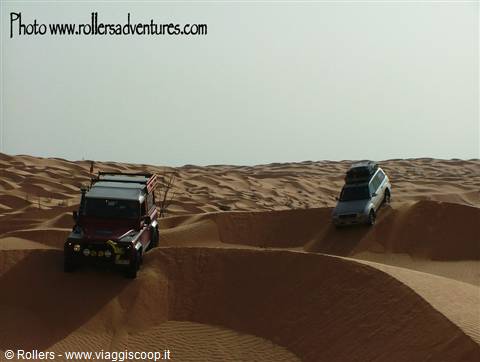
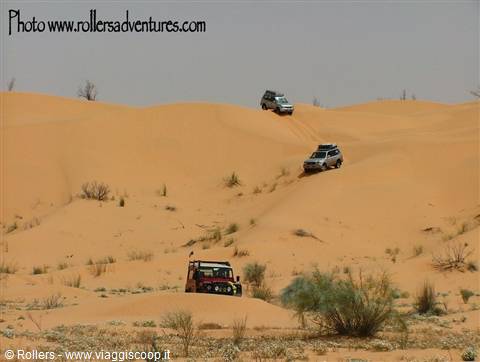
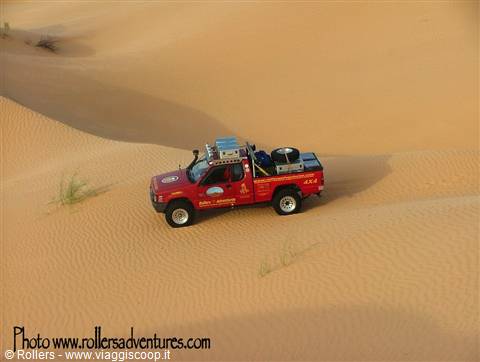
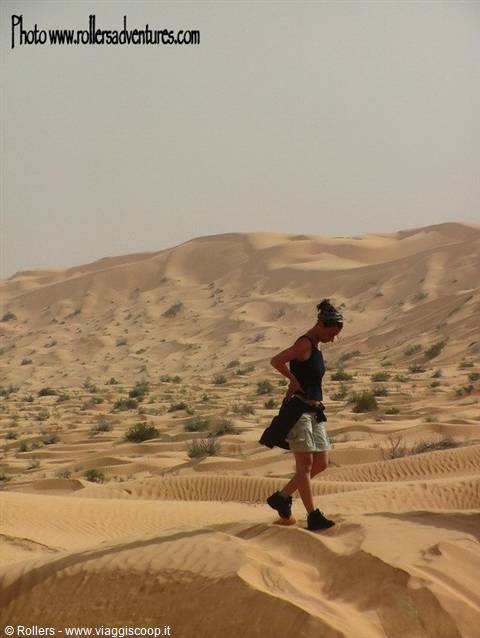
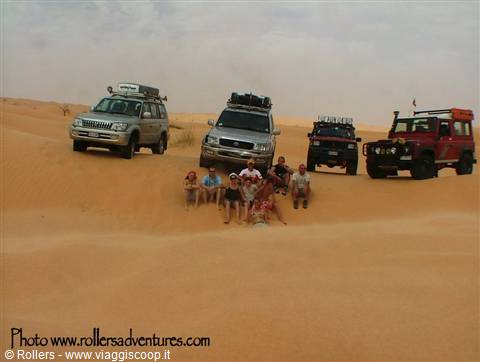
The next morning we set off towards spring number one, "Itnin" (in Arabic); we soon find ourselves amid a veritable tidal wave of sand, where it is very hard to make progress among the narrow dunes typical only of this area. The steep climbs with very short, narrow manoeuvring spaces are set against breathtaking descents that bring us into huge depressions or basins 500/1000 m in diameter, which ease the strain a little, both human and mechanical. All of us, in turn, or all together, get bogged down; it's part of the game. Everyone, even those who had never used a tow strap, by the end of the trip will be experts in the use and correct placement of straps, shackles and whatever else is needed to free the vehicles. We reach yet another crest dividing two basins, but this time the straw-yellow of the sand is broken by the intense green of vegetation, a sign that water is near.
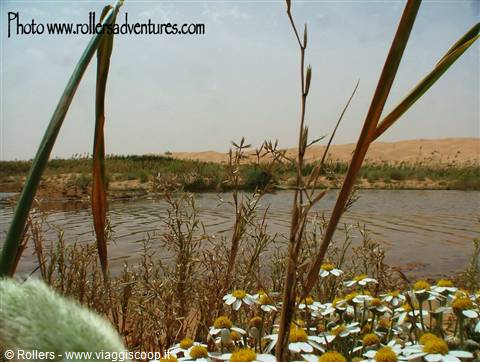
We descend into a remote plain disfigured by the metal remains of old drillings, twisted witnesses of a past when man tried to get rich at any cost seeking hydrocarbons and finding instead something far more precious, which here has been gushing for over twenty years, allowing life to hold out in this hostile environment. Water of no interest at all to the man who found it becomes a salvation amid a sea of sand for many forms of life. Plants and flowers we normally see in everyday life become objects of interest precisely because they are placed in that particular context. Having reached a modest stream, we follow it up to the spring.
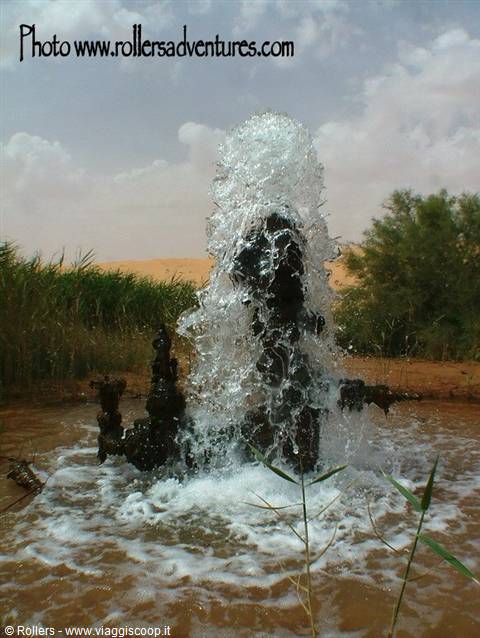
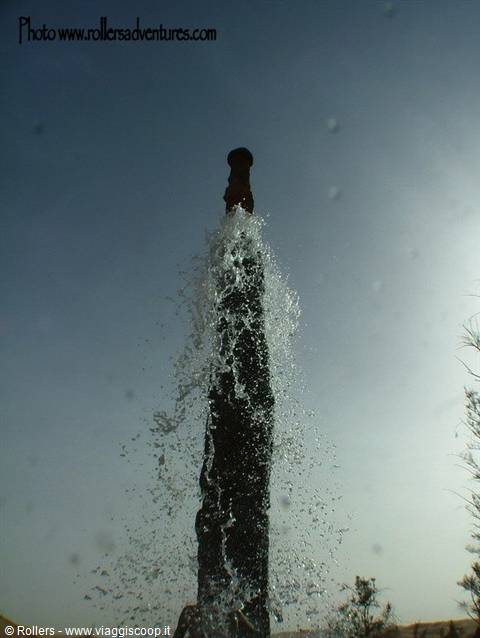
At the exact centre of the basin a pipe about half a metre in diameter rises vertically for some 8 metres; at its end a jet of hot water at about 40 degrees pours out with an impressive flow, and the rain falling in the immediate vicinity hits the ground with such force that you can barely stand under it; the little lake that forms at the base, with its tiny beach, is ideal for staying to enjoy the well-earned rest after the great efforts imposed by the severe dunes of "Zemlet El Borma". The relaxation is such that even though it is not yet evening we decide to stop and set up the second camp. In the morning we strike camp early so as to make the most of the compact sand typical of the first hours of the day; we'll spend the whole morning before reaching the second spring.
Along the way a pleasant encounter with a small clan of the largest nomadic tribe of the Great Eastern Erg, the R'Baya, who in the shade of a small tamarisk carefully watch over some dromedaries of their own, descendants of the warrior tribes that invaded North Africa; the R'Baya are now highly skilled breeders of dromedaries and of desert hunting dogs, a kind of greyhound that can compete in speed even with the swift gazelles. With eloquent gestures they point out the shortest route to the second spring: three chains of dunes towards the sun, two with the sun on the right, there is the water; unique moments of communication that only those who live them can understand the importance of. Spring number two, "Wahad" (in Arabic), is undoubtedly a wonderful place; here there is no sign of the old drillings, so a true paradise.
A circular basin surrounded by very high dunes, in the middle a jet of water of great flow pours out at about 40 degrees from a big vertical pipe about two metres high, feeding a lake of considerable size and giving life to a vast expanse of plants and flowers. These images leave you astonished; these images are certainly worth all the efforts faced and all those that separate us from the fast track that will lead us much further north. The delay on schedule has grown; we decide to get as close as possible to the track before setting up the third camp on sand. We cover about 5 km and a plain much smaller than the others, protected by insurmountable chains of dunes, offers itself as the ideal place to stop. We go along with it, also because going on is impossible given the height and steepness of the dunes around us.
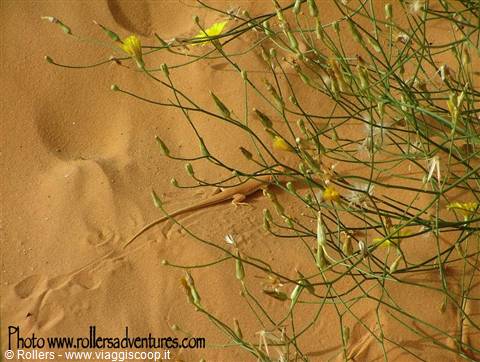
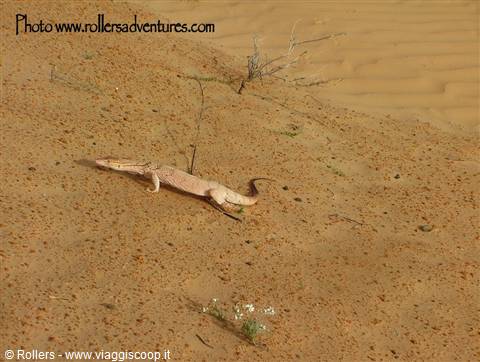
We wait for the group that has fallen behind in getting over a particularly difficult passage; a good half hour passes, the engine has long been off, the silence is total, and to our extreme astonishment we see an animal rarely glimpsed advancing towards us, the grey monitor lizard of the sands. The specimen, which is of substantial size, approaches the vehicle quite curiously. The grey monitor is the largest living reptile in the Saharan environment; a great hunter, it is very skilled at slipping away as it senses the approach of strangers well in advance. We must photograph it without scaring it; we manage to frame it just for the time of the shot, which moreover comes out perfectly, and the reptile speeds away.
Meanwhile the vehicles that have conquered the last dunes catch up with us; we therefore prepare the third camp, have dinner and, truly tired but certainly satisfied, throw ourselves into the tents. The next day we will double back about a km, skirting those insurmountable chains and reaching a lowering of the crests, in jargon a "gate", which lets us quickly reach the connecting track of the El Borma oil extraction base and will lead us north, towards the spring of the Ksar Ghilane oasis, about 200 km away, all of it hard track. So in the late afternoon we head towards Douz, where we will visit and do the usual shopping in the characteristic Souk. In the evening a quick tidy-up of the vehicles is in order, and at dawn they will take us to Tunis, where, as usual now for over ten years, we'll board the ferry for Italy already with our thoughts turned to a new adventure in Africa...
The journey's photographs
20 photographs · click to open them full screen








0 reader comments