The story
29/01-from Nairobi in 5 hours we transfer by private bus to Arusha via Namanga: the road is beautiful, it passes through spectacular scenery of the Rift Valley! In the afternoon we visit the coffee plantations that surround the city, and we end the day with a visit to the Tribal Market, touristy, but very colourful. 30/12-the Arusha NP is 25Km from Arusha and offers a great variety of landscapes: from the jungle where the beautiful Angola Colobus monkeys live, to the mountain grasslands of Longil lake, from the volcanic crater of Ngurdoto to the 7 Momella lakes and their colonies of flamingos. Lots of animals.
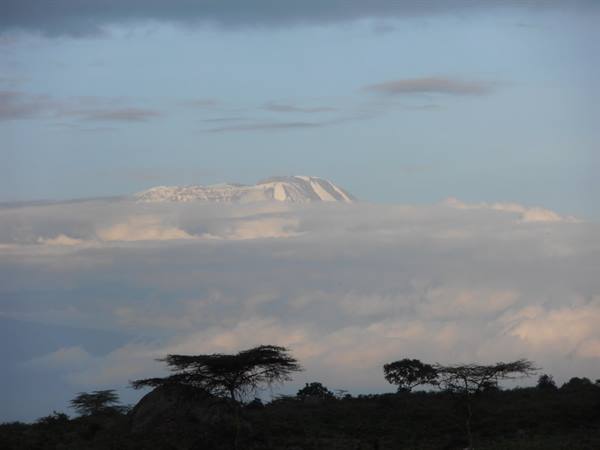
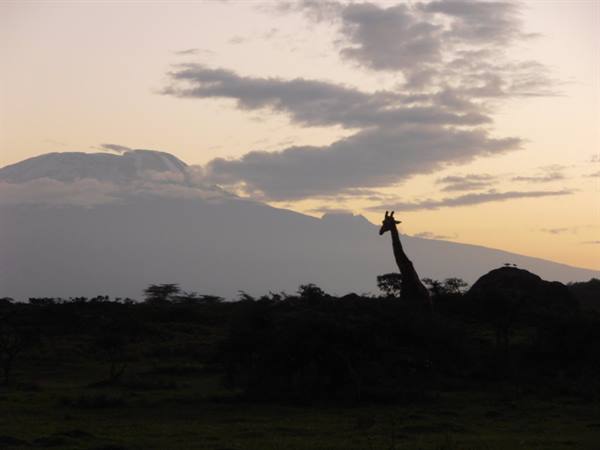
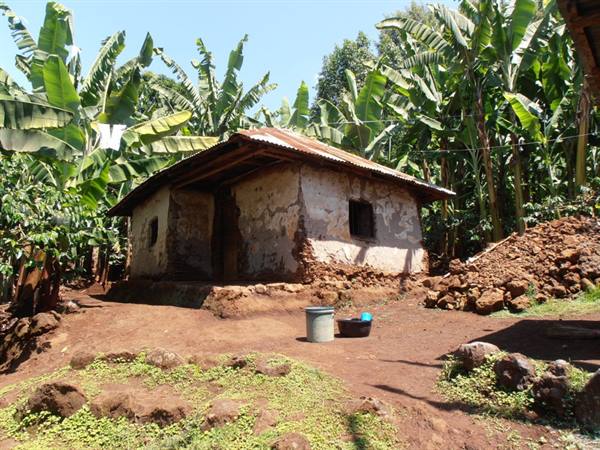
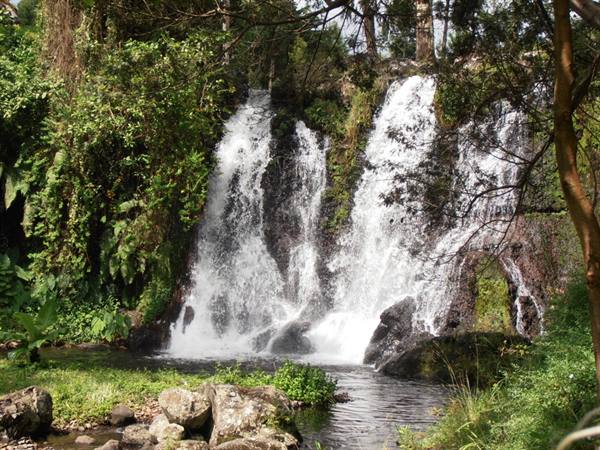
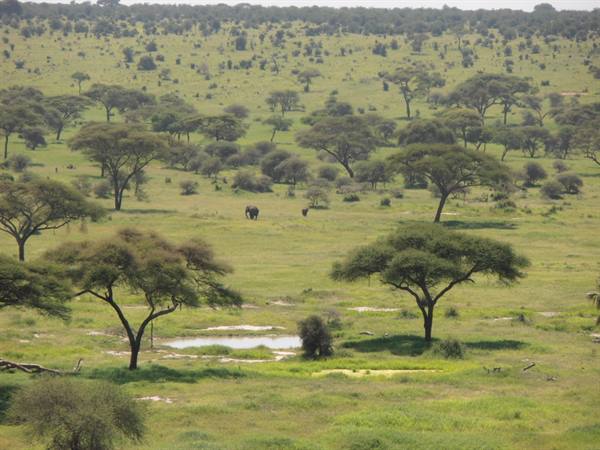
In the evening we sleep inside the park, in the wonderful Momella Wildlife Lodge: it is full of flowers, dominated by the bulk of Meru and that of Kilimanjaro, which this evening is free of clouds and lets itself be admired, 31/12 -In 2 hours we reach Moshi with its flame trees in full bloom; we arrive in Marangu where we visit the region of the Chagga ethnic group: the villages are very poor, completely hidden among the banana groves; then we visit the Kinukamori waterfalls: the water falls directly from Kilimanjaro, the place has lush vegetation, mud huts, many children and we hand out the pencils and pens we brought 01/01 After 2 hours of tarmac road we arrive at the Tarangire NP. It is the park of the 1000 baobabs and of the elephants and here we have confirmation that January is the month of births: lots of cubs of every species.
The southern part of the park is rich in very tall palms and still large herds of elephants that pass in front of our jeep. Towards evening we leave the park and 4km on we arrive at the extraordinary Osupuko Tarangire Lodge: it is a brand new lodge where we are the only guests, it looks directly onto the park and the elephants come to graze below the pool. 02/01 At dawn with the young Masai we go trekking in the bush. It is a unique experience: we see giraffes coming to drink at the river, herds of elephants and tall termite mounds.
We arrive at Lake Manyara NP: we enter a forest full of streams, then we emerge in an area full of acacias where we have the encounter we hoped for: two lions sleeping peacefully astride the branches of an acacia 4 metres off the ground; they had told us that here the lions have this habit but that it is very difficult to see them: evidently we were very lucky. On the lake shore there are many giraffes silhouetted against the blue of the Manyara lake. We arrive at the hippo pool, but it is very disappointing: the hippos are far away and are seen with great difficulty.
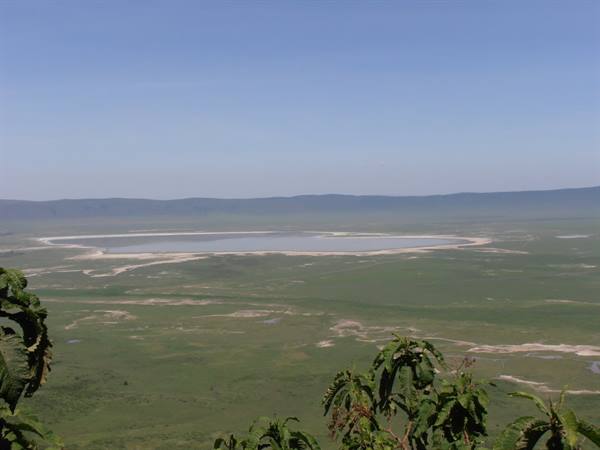
We leave the park and sleep at the Wildlife Manyara Tented Lodge: from the little terrace you enjoy a priceless view over the lake; unfortunately with the evening come millions of midges and insects that made our dinner difficult, but never mind, this is Africa! 03/01 We enter the plateau of the craters and stop at Karatu with its red earth for a little trip to the market. We climb to 2400m up to the viewpoint of the Ngorongoro crater: it is a unique spectacle, but we have to go, we will stop at Ngorongoro on the way back: from now on we can forget about tarmac for 1500km. We descend from the mountains into a magnificent panorama: flocks, Masai in red clothes, very green valleys and bomas scattered here and there. The drivers suggest we visit a Masai boma, but we realise it is a fake visit, too touristy, and we refuse.
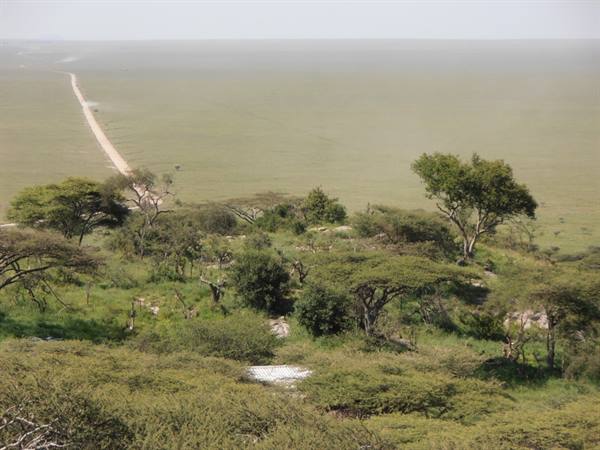
We enter the Serengeti: in the Ndutu area a million and a half wildebeest are arriving, gathering before migrating towards Kenya. It is an incredible spectacle: wildebeest at 360 degrees, from 2 metres from the jeeps to the horizon, they cross the track in their hundreds: we are left speechless! We arrive in the Seronera area: here the panorama is a sea of green grass as far as the eye can see. We have an encounter with 2 cheetahs in the grass and then leopards, lions, jackals, warthogs, trees full of marabou, storks, bustards, egrets and fish eagles.
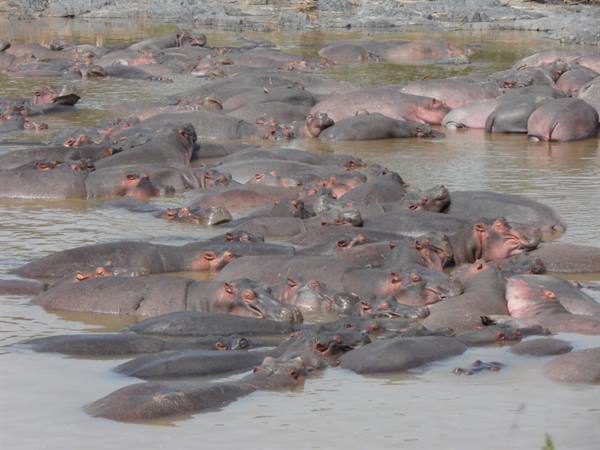
We climb further north for 3 hours and arrive at the Wildlife Lobo Lodge: it is very well camouflaged among rocks and trees in this more mountainous part of the Serengeti 04/01 Today we do two game drives in this area that is famous for its lions: unfortunately with the early migration of the wildebeest, the lions have moved away and unfortunately we won't meet any. We do however see many herds of impala, waterbuck, klipspringer antelope, dik-dik, ostriches, snake eagles, vultures, giraffes etc… and hills as far as the eye can see dotted with green acacias. 05/01 In a bend of the Grumeti we meet more than 150 hippos bathing; an incredible spectacle! We cross the Seronera region again and near kopjes we meet several families of lions and lionesses.
In a small pond we also see 2 crocodiles: but in any case in the Seronera the most fascinating spectacle is the vastness of the prairies surmounted by immense skies. We make a small detour to the Olduvai gorge: from above you see a spectacular canyon with imposing rock towers, but what fascinates us about this place is thinking that right here Mary Leakey found the skull of the most ancient hominid in history, thus demonstrating that we were born and all come from Africa! We slowly climb the mountains up to the edge of the crater, where the Wildlife Ngorongoro Lodge stands: it is an eco-monster, but with an absolutely unmissable view over the crater. 06/02 At dawn we descend the steep track that takes us to the bottom of the crater: here thousands of animals of every species live; we meet lions, buffaloes, gazelles, antelopes, rhinos, wildebeest and zebras.
We arrive at the centre of the crater where there is Lake Magadi with its shores full of flamingos. And here we witness a scene we will not forget: the hunt of 3 lionesses and a lion that after stalking and chasing manage to bring down and tear apart a zebra cub: the scene is terrible, but it is part of the law of survival. After touring this incredible place for more hours, we leave Ngorongoro and descend to Karatu and from there to the Endoro Lodge. It feels like being in an earthly garden: flowers and plants of every kind and luxuriant nature; the bungalows are beautiful: a large room with a little sitting room and fireplace and even an outdoor shower.
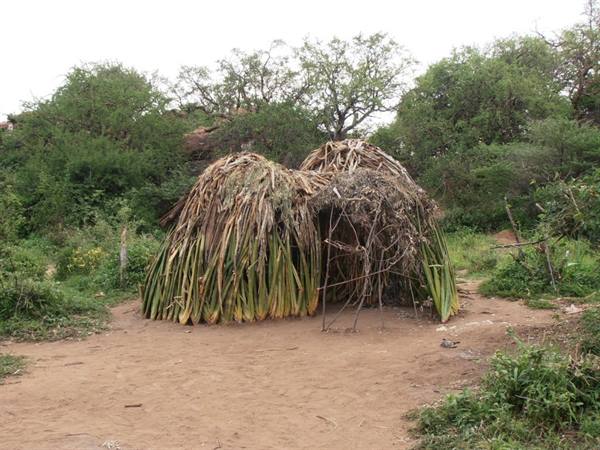
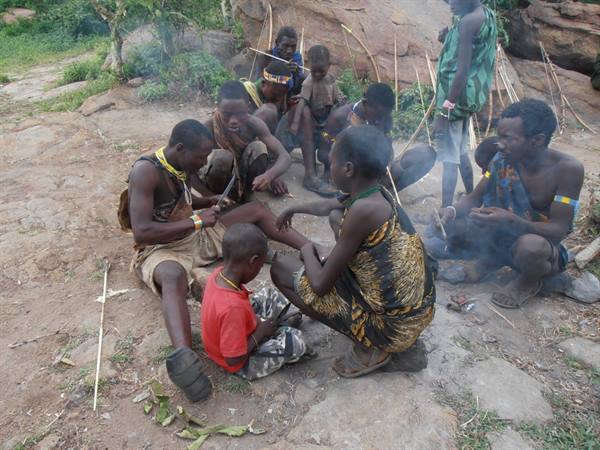
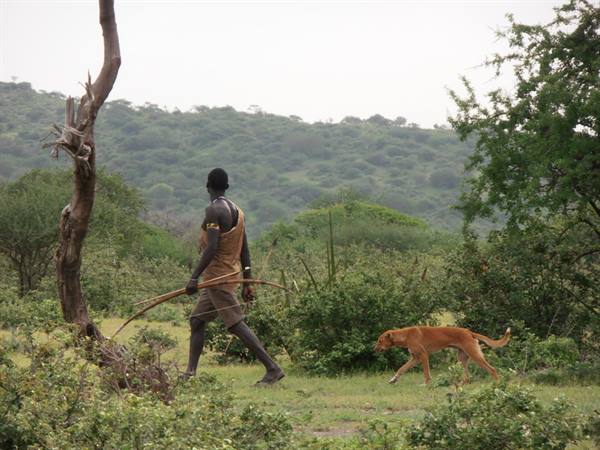
We visit the surroundings: red-earth lanes, flowering bushes, mud huts with makuti roofs in the middle of lush nature: the clouds arrive and a tropical downpour breaks out that sends us back to the lodge soaked! 07/01 In the dead of night we set off for an extraordinary excursion: after 2 hours of track we arrive near Lake Eyasi: from here we take another track that looks like a dried-up torrent, so rough is it, and after an hour we reach the Hadzabe tribe: they are the last bushmen of East Africa: they are hunter-gatherers, they have improvised camps that they move according to the game: they let us get to know their habits, how they make arrows and bows, they accompany us into the bush to hunt: they collect honey from the beehives in the trees, they show us the caves where they live when it rains and they sing us their songs.
With them we spend the most unforgettable day of our whole trip.. we also visit a Datoga tribe, but a less engaging encounter. We reach the shores of Lake Eyasi which are very white with salt and we see flocks of flamingos flying, unfortunately very far away. 08/01 In the morning we visit the lodge's crops: trees full of fruit, avocados, papaya, passion fruit, mangoes, vegetables, flowers and all around thousands of butterflies of every colour, in a stupendous natural setting. After lunch we return to Arusha and from there to Nairobi. At night we leave Africa with the promise of returning one day in the future to this land where nature manifests itself with a force and a power that l
The journey's photographs
11 photographs · click to open them full screen
0 reader comments