Which is the most beautiful city in the world? There are many nominations, often predictable. Sydney, New York, Paris, Rome, Rio....certainly a tough contest. But after seeing Cape Town, I feel I can rightly include the Pearl of Africa in this particular ranking too. Even its geographical position is intriguing, poised as it is on the extreme tip of the African continent, separated from Antarctica only by the ocean; it almost feels like being at the edge of the world. But in particular Cape Town offers everything you could ask of a city: history, monuments, folklore, entertainment, natural beauty, sea, mountains, fauna, flora.
History, though relatively recent, is fascinating, starting with the first Portuguese explorers including Diaz and Vasco de Gama toward the end of the 1400s, continuing with the Dutch and the East India Company in the 1600s, the first to trade with the local tribes, then with the French Huguenots and the English colonization of the 1800s, which influenced the culture and the different architectural styles of the city, and ending with the most dramatic affair of Apartheid, with Mandela's imprisonment at Robben Island prison, off the coast of the city.
The climate is delightful, Mediterranean in type, with summers (our winter), when temperatures normally don't exceed 28 degrees, and mild winters with averages around 15. Christmas is normally celebrated with a barbecue lunch on the beach. Moreover, a powerful wind often rises from the ocean, which besides cleaning the smog from a city already spared from heavy pollution, often gives an intense blue sky that enhances its colors.
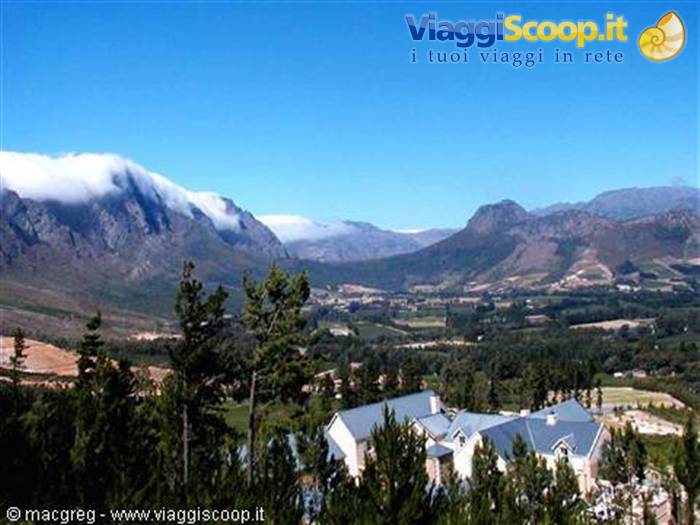
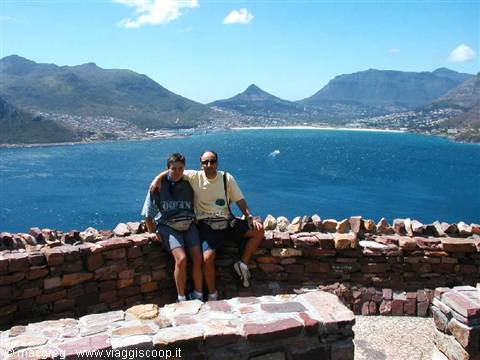
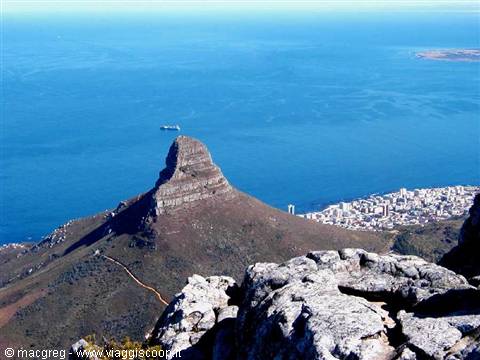
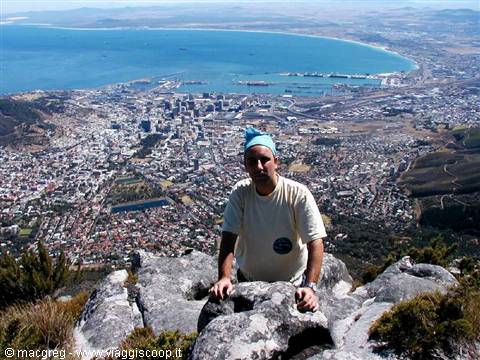
Its natural setting seems almost artificially sculpted, it's so spectacular: situated between ocean and mountains, the symbol of the city is represented by Table Mountain, a kind of enormous monolith over 1,000 meters high, whose shape vaguely recalls our Dolomites. From the center, a modern revolving cable car (rand 110 / €14, closed when it's too windy) allows you to reach the summit, continuously offering 360-degree views: the panorama you can observe from the top is unequaled: you can make out the whole city, the coast, the surrounding mountains, and it allows pleasant walks in what has been turned into a natural park.
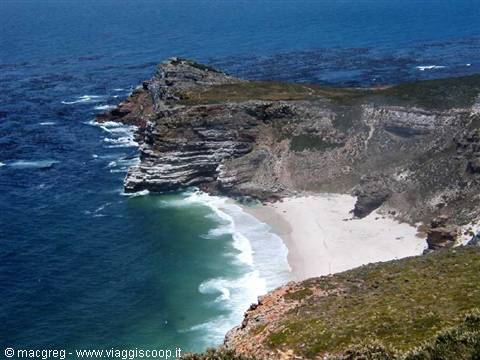
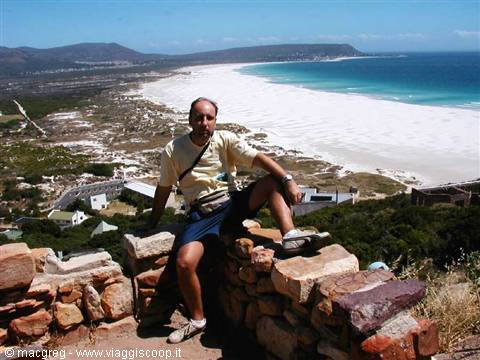
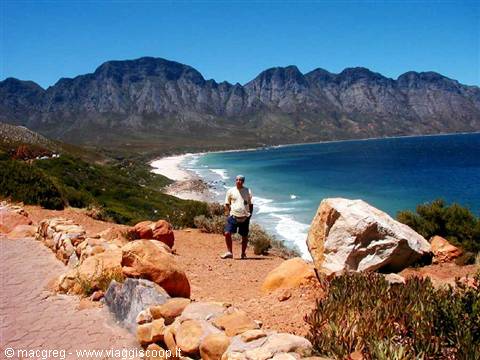
But from the high mountain, in just five minutes by car from the center, you can reach one of the beaches described as among the most beautiful in the world for its particular conformation: it's Camps Bay, where a very long white beach lined with palms lies at the foot of the Twelve Apostles, a decidedly spectacular mountain formation of rocky peaks and very green slopes. If the image that meets the eye is fascinating, the same can't be said for swimming in it: along the Atlantic coast, in fact, the water temperature in summer hardly exceeds 15 degrees. This isn't the only beach available to the inhabitants of Cape Town: there are also numerous beaches facing False Bay, whose waters are decidedly warmer and allow pleasant swimming, while continuing southward, the ones on the Atlantic coast are very fascinating, dazzling white and deserted.
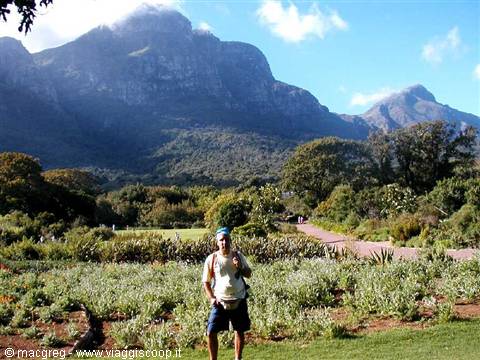
The flora and fauna that characterize the area are also entirely exceptional: already in the center you can stroll among squirrels in a pleasant park, the Company's Garden, created in the 1600s to grow crops and supply the ships arriving at the Cape; now it presents itself as a relaxing area surrounded by tropical plants and small lakes, a few steps from the pedestrian streets of the center (the city's main museums are also found here). But the great variety of South African flora, and not only that, can be admired in an incredible botanical garden a few km from the center, created on the slopes of a mountain in a breathtaking position: this is Kirstenbosch Garden (r25 / €3), with themed paths even in Braille and a garden of floral sculptures. Here you can also admire the Protea, the symbolic flower of South Africa, present in countless species, forms and different colors.
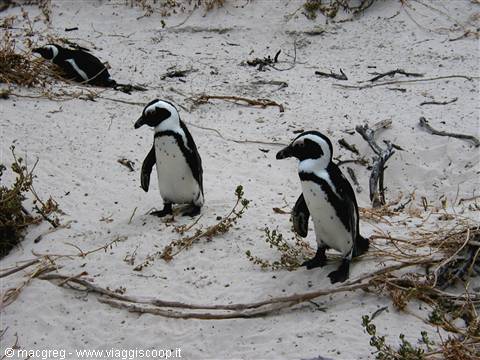
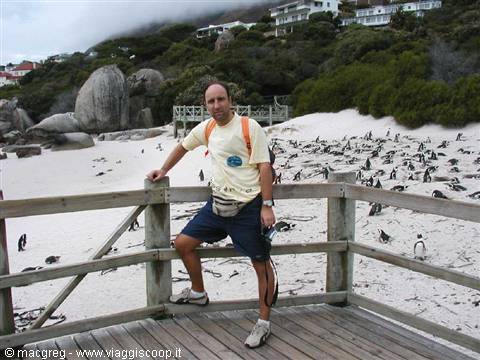
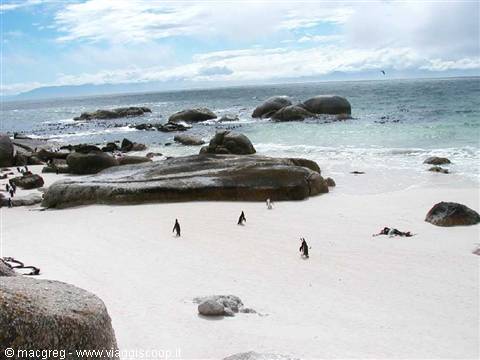
As for the fauna, a few km from the center, in the direction of the Cape of Good Hope, the main attraction is undoubtedly Boulders, where you can observe a colony of penguins in their natural state that occupies all year round a white beach characterized by enormous boulders in the blue sea. An open-air spectacle. And again, continuing along the peninsula, it's impossible not to come across mountain zebras, antelopes, baboons, ostriches. And in the right season, from June to November, scanning the sea you can glimpse and admire the acrobatics of whales and dolphins (the latter all year round), visible directly from the coast without necessarily having to use a boat.
In the center, we move on to visiting its monuments and main attractions; briefly: - The Castle of Good Hope, the oldest structure in South Africa, erected to defend the city in the 16th century, and never attacked. - Greenmarket Square, the very central square surrounded by historic buildings that hosts a characteristic craft market and numerous flower sellers - Old Town House, the old town hall - St.
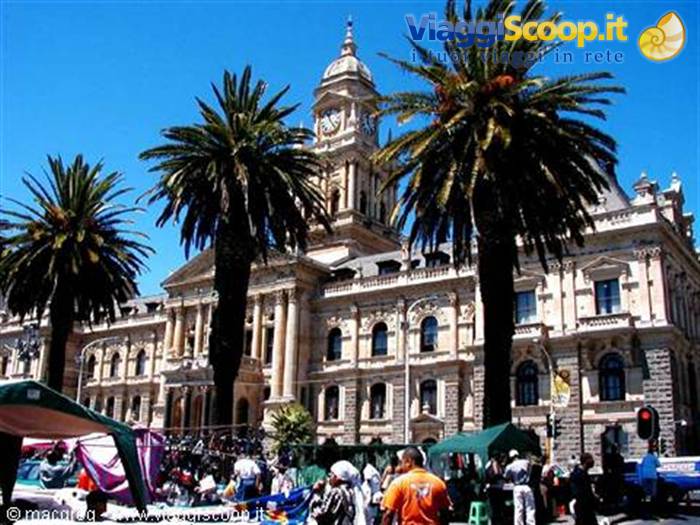
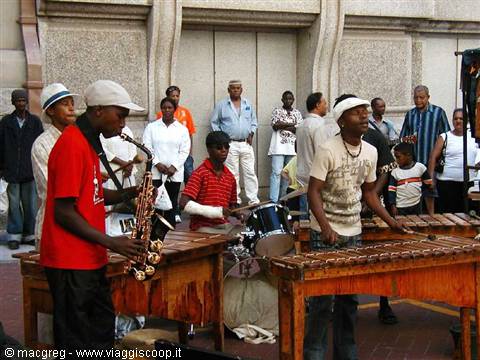
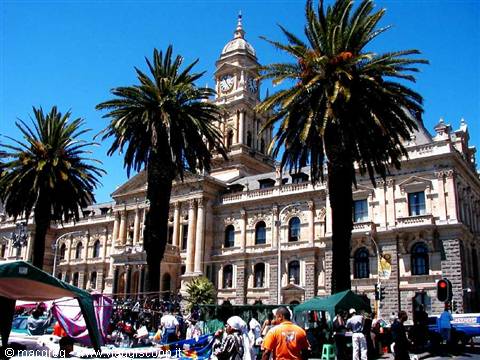
George's Mall, the most charming pedestrian street, with shops and street artists - Groote Kerk, the oldest church in South Africa - Grand Parade, the largest square in the city, dominated by the City Hall, the great Town Hall, and where every Wednesday and Saturday a lively market is held - St George's Cathedral, the city's Anglican Cathedral - Heritage Square and Long Street, with typical Dutch and Victorian-style buildings - Signal Hill, a characteristic hill behind the port and a scenic viewpoint of the city, especially at sunset - Bokaap, a typical Muslim neighborhood, inhabited by the descendants of slaves originally from the Indian subcontinent, now called Cape Malays, with steep streets and numerous mosques.
The Waterfront deserves a separate discussion: it's an old abandoned port that was later redeveloped, and has now become the most frequented area of the city: it maintains the appearance of a port, flanked by countless attractions, restaurants, shops, museums, an aquarium and shopping centers, all in a pedestrian area, a paradise for tourists and inhabitants. Seals swim peacefully in the sea. Here you can dine outdoors in the many ethnic restaurants (a full fish menu in an average restaurant doesn't exceed 15-20 euro and many restaurants allow you to bring your own bottle of wine bought elsewhere), or stroll in complete tranquility and safety among shops, venues and open-air performances. From the piers, boats depart for Robben Island, where you can visit the prison that housed Mandela for several years and many other political prisoners.
Don't miss a sunset cruise in the bay (R70 / €9), to admire the city and Table Mountain in a particular light.
A special note on the cuisine: you can find restaurants of all the world's cuisines: don't miss at least once the typical Cape Malay cuisine, very spicy, which doesn't allow beef or alcoholic beverages, and in particular a dinner at Africa Café: in this place you can taste all the specialties of the African Continent, with the possibility of easily going back for seconds on the most appetizing dishes (specialties from Mozambique, Egypt, Ethiopia, Malawi, South African tribes, etc.). Don't worry, fried termites and other dishes that are inedible for us are not on the menu...
For accommodation I recommend a B&B: the Brenwin, an oasis of peace a 10-minute walk from the port, right in the center, with a pool surrounded by a tropical garden, a breakfast that seems like a lunch, double room (or triple), at 680 rand, about 85 euro per night.




0 reader comments