The trip: It is not exactly a fully independent, organised trip. We relied on Argonauti Explorer: not a traditional tour operator, but an association of travellers that offers outline itineraries and the support of correspondents on the ground; the details of the trip are defined by the group leader (who is none other than a member proposing that particular trip) and by the group taking part. The choice, even in hindsight, is a positive one; the more "traditional" part of Namibia (Etosha - Skeleton Coast - Damaraland - Swakopmund - Sossusvlei) could in the end be tackled easily on one's own. The visit to Kaokoland, and in particular the stretch along the Kunene, and the Marienfluss and Hartmann valleys, on the other hand, needs the support of experienced guides.
If need be, in Swakopmund you can find quite a few agencies, which can be contacted either on the spot or via the internet, able to provide support for visiting those territories. Besides, Swakopmund is a town that, unlike Windhoek, guarantees a peaceful stay and, during the preparations for organising the trip into Kaokoland, offers plenty of possibilities for excursions in the surrounding area. The guides who accompanied us, Dirk and Guss, can be contacted at: Namibia Explorers PO Box 3190 Swakopmund, Namibia Tel: 0926464404230 Cell: 0811224651 e-mail: namexp@iway.na. The site is: The roads are decent, even though most are not tarmacked; the surface is almost always good and even cars without four-wheel drive can drive them easily.
The only real drawback is the high risk of punctures (always 2 spare wheels on board!) and the tyres of off-road vehicles are more resistant (our 3 jeeps altogether had "only" 5 or 6 punctures). A lot of attention must be paid to refuelling, because petrol stations are very rare.
Day 13 Aug 2003
2-3 August M i l a n - Z u r i c h Swissair Z u r i c h - D u b a i Emirates A. D u b a i - J' b u r g Emirates A. J' b u r g - W i n d h o e k Namibian A. The journey is long and boring, but Emirates, the airline with which we did the two longest legs, offers decent comfort (even in Economy); Dubai airport is also an interesting stop both for the atmosphere and for shopping (especially electronics).
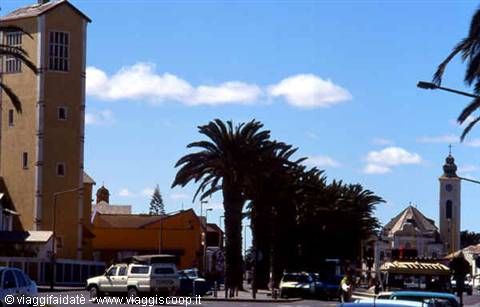
In Windhoek, we meet our guides at the airport, Dirk and Guss, with the three SUVs onto which we load our luggage and reach, by now almost at sunset, the lodge not far from the capital, where we spend the first night in Namibia! A little curiosity: at the airport I changed about €1000.00 (contribution to the common kitty for 4 people) and...I emptied the safe! The next morning, therefore, besides a stop for a minimum of groceries at a supermarket, we'll waste some time in the city because the other members of the group don't have even one Namibian Dollar. At a superficial glance the city looks fairly anonymous and shows a fair degree of prosperity; the electrified barbed-wire fences around the houses are puzzling.
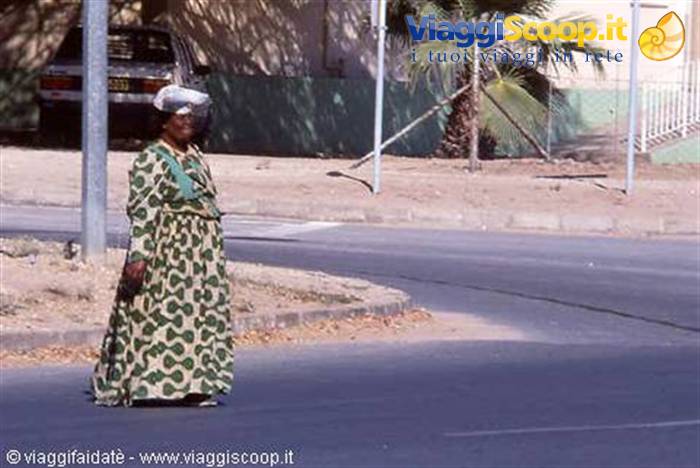
Woman in spotted green dress crossing the asphalt road near palm trees
Day 24 Aug 2003
4 August
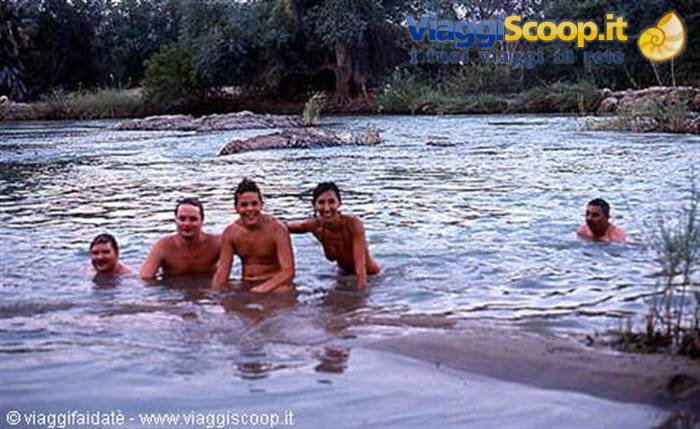
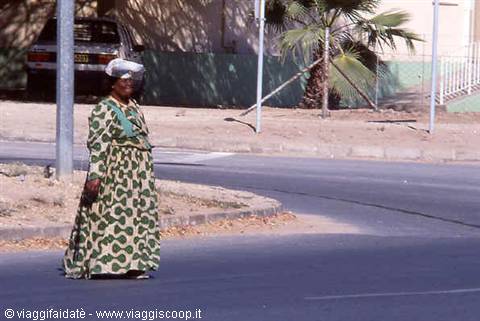
W i n d h o e k - O k a h a n d i a - O u t j o - O k a u k u e j o ( B u n g a l o w ) The road, entirely paved and straight, doesn't cross any particular landscapes, even if the novelty means you don't get bored; just outside Windhoek we notice a craft market. In Outjo we meet a Herero woman in her traditional dress: I photograph her from a distance because they don't like posing. The road runs alongside an irrigation canal where groups of kids are bathing and they inevitably greet us. Okaukuejo welcomes us with its spartan bungalows, its excellent buffet restaurant and the most incredible waterhole where the animals come to drink from sunset onwards: it's hard to tear yourself away from such a spectacle to go to sleep!
5 August
O k a u k u e j o - H a l a l i - v a r i o u s w a t e r h o l e s - N a m u t o n i ( C a m p ) Along the dusty roads of Etosha, from one waterhole to the next, the spectacle is continuous. Only the Namutoni waterhole disappoints, where strangely we witness a scenic sunset, but without animals. We sleep in a tent; the campsite is decent, the facilities good, the restaurant — again a buffet — excellent.
6 August
N a m u t o n i - v a r i o u s w a t e r h o l e s - N a m u t o n i ( C a m p ) The day is entirely dedicated to visiting the park; the only animal we don't see, despite Dirk's efforts in searching, is the leopard. Namutoni's pool, freezing cold, is nevertheless welcome after a day immersed in Etosha's very fine dust.
7 August
N a m u t o n i - O s h a k a t i - R u a c a n a ( G u e s t h o u s e ) We stop in Oshakati at a supermarket to stock up for the period we'll spend free camping in the Kaokoland. There's also a bank with an ATM, but the withdrawal limit is really low, so we join the long queue at the counter to change our euros. The supermarket, on the other hand, is interesting: imported products are sold at more or less similar prices to ours, while equivalent local or South African ones cost less than half. Dirk and Guss's shopping is curious to say the least: an unspecified number of bottles of cognac and Coca-Cola!
Group of friends in swimwear bathing in a river among rocks and greenery
Day 38 Aug 2003
8 August
R u a c a n a - H i p p o ' s p o o l - C u n e n e R i v e r L o d g e - ( C a m p ) At Ruacana there used to be waterfalls on the Cunene (Ruacana falls); the construction of a dam for electricity production and for irrigating the fields has left only the memory. It's a curious place anyway: the BP gas station is the last one for hundreds of km and sells everything, even antibiotics! After dinner and the night spent in the Guest House, we fill the tanks and reserve jerrycans with petrol and a considerable number of jerrycans of purified water. We don't know if we'll manage to find more before 5 or 6 days. Those we'll spend along the Kunene. The first stop of the day is at a bend in the Cunene called Hippos pool, but there's no trace of hippos. They too left after the dam was built.
The road runs along the river, unpaved but with a good surface, and we arrive at the Cunene River Lodge campsite in the early afternoon. The campsite, with a bar terrace on the river, has lush tropical vegetation and grants us an afternoon of genuine relaxation. At sunset we take part in a rafting descent along the Cunene; the title of the excursion is "Booze trip - cruise with unlimited alcohol"!?! We'll only understand its meaning during the rafting; even as we got onto the rafts we were divided into two groups: whisky and gin! And at that moment we began to suspect... but the discovery of the large fridges packed with bottles definitively clarified the nature of the excursion! The sunset over the Cunene nevertheless remains a pleasant memory of that evening. The return to the Lodge by SUV makes us begin to sense what the road will be like from there on.
It's right after the Camp that you come to the junction called Swartbooi's Drift, where the beaten track turns south; from there, continuing west along the Cunene in the direction of Epupa Falls, it's essential to have a guide. Even Dirk and Guss, who go through it every year, navigate with a GPS, because after the rainy season the track undergoes continuous changes and in many stretches is unrecognisable. Barbecue at the campsite (everywhere in Namibia there's a barbecue available) and then off to bed in the tents in absolute darkness. I wake in the middle of the night and go out of the tent to take a couple of steps and......the starry sky at Cunene River Lodge is an indescribable and unforgettable spectacle! We'll see others like it in the coming days, but the first is almost a shock.
9 August
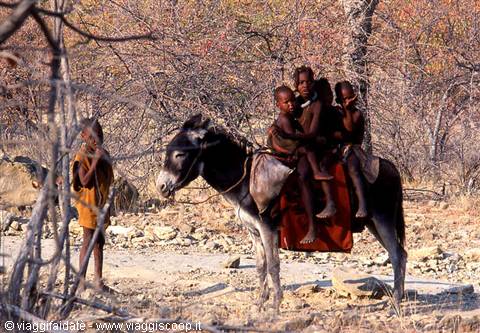
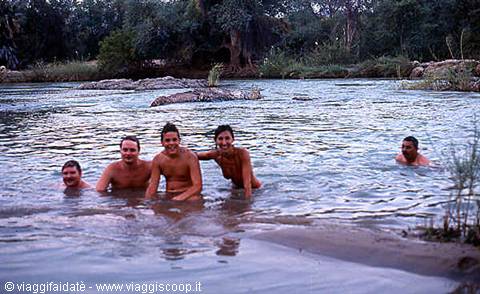
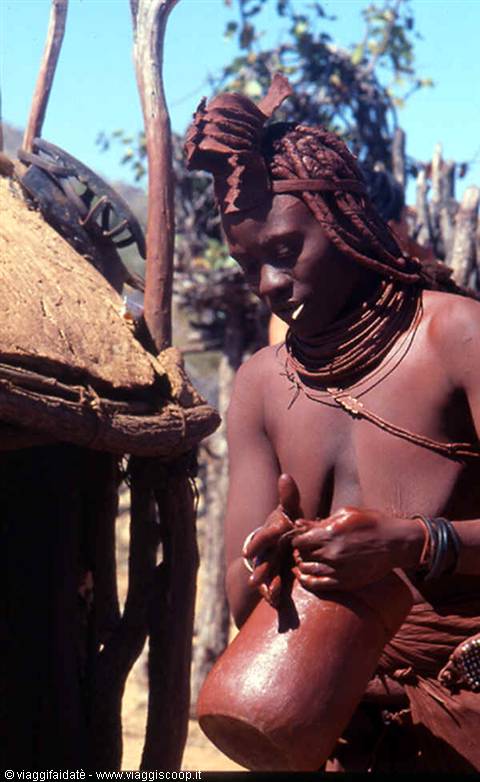
C u n e n e R i v e r L o d g e - H i m b a v i l l a g e s - O r o n d i t i ( F r e e c a m p i n g ) We set off early, the track is at the limit of passability; in many places we get out of the cars and walk. We meet the first Himba, who still live the life of nomadic herders. There are also small kraals abandoned from one year to the next. The villages we encounter consist of a single family unit, or at most two. They're kind, they willingly let themselves be photographed, the head of the family welcomes us armed with a big knife, which he puts down after accepting the small gifts we bring (tobacco, flour, salt...). Free camping on the riverbank where we bathe: Dirk and Guss assure us that where there's a current there are no crocodiles......they bathe first, so we're relaxed. During the day we met only one SUV, belonging to a French couple.
10 August
O r o n d i t i - V i l l a g g i H i m b a - E p u p a f a l l s - O k a n g w a t i - E t e n g w a ( F r e e c a m p i n g ) More encounters with small groups of Himba; by now we sense their approach from the rancid smell of the mixture of red earth and butter that the women smear all over themselves: on the skin, in the hair, on the little goat skirts. We stop at Epupa Falls, where you can bathe (a kind of violent whirlpool). The falls are impressive, and we're in the dry season. Epupa can be reached not only from the track along the Kunene (east-west) but also via a good unpaved road (south-north); there's a nice campsite under the palm grove on the riverbank, and the Himba you meet are "civilised". In fact the women sell small objects and ask for payment for photos, the men are drunk.
This is the impact of civilisation on a people like the Himba! And they say the town of Opuwo is worse. At Epupa there are plans to build a dam in a joint venture with Angola: the project risks causing the disappearance of a scenically very interesting place, but above all, by flooding the lands where the Himba live their existence as nomadic herders, it jeopardises their very existence, condemning them to the effects of a forced "civilisation" for which they aren't ready and with which they don't know what to do. At the campsite we run into our French friends, who are in difficulty because they've punctured both spare tyres. Dirk and Guss, with a few makeshift tools, remove them from the rims and repair them. We set off again and, after a few hours, camp in the sandy bed of a dried-up river, surrounded by a forest of mopane.
The barbecue is fuelled with wood from a dry mopane collected by Dirk after a careful search; apparently it's the best firewood. Indeed, in the morning there are still embers for coffee.
11 August
E t e n g w a - V a n Z y l P a s s - M a r i e n f l u s s ( C a m p ) The track becomes rougher and rougher as we approach the Van Zyl Pass; this pass can only be driven from east to west. In practice you reach the pass from the plateau and from there descend into the Marienfluss valley. On the contrary, going uphill, it's unthinkable to tackle it even with an SUV. We all do the descent on foot, except Alessio, who stays in the car with Guss getting jostled about: the gradients are like a roller coaster and the surface is as bad as you can imagine; in fact we "pedestrians" reach the bottom of the descent before the cars. The view of the Marienfluss from the pass is a spectacle that will renew itself kilometre after kilometre across the whole plain, all the way to the campsite on the Kunene where we'll spend the night.
The word campsite means a group of acacias at the foot of each of which there's a tap of non-drinking water and the inevitable space for the fire. The toilets and showers are set up in a screen of reeds without a door......The Camp is reached by another south-north track, drivable with a good SUV even without guides; in fact, in the pitch next to ours we find a group from Avventure nel Mondo.
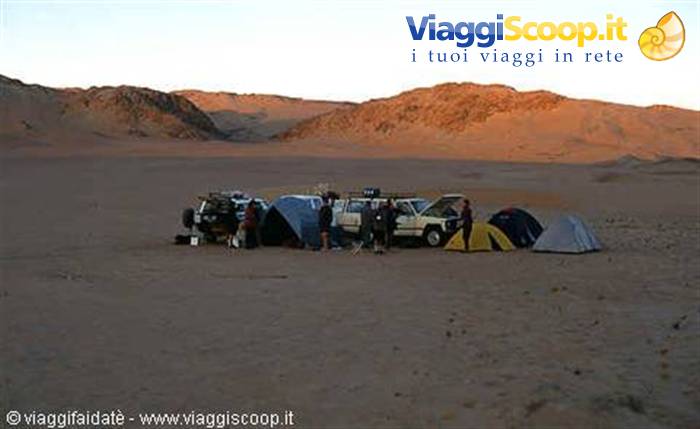
Camp with tents and off-road vehicles among sandy dunes at dawn
Day 412 Aug 2003
12 August
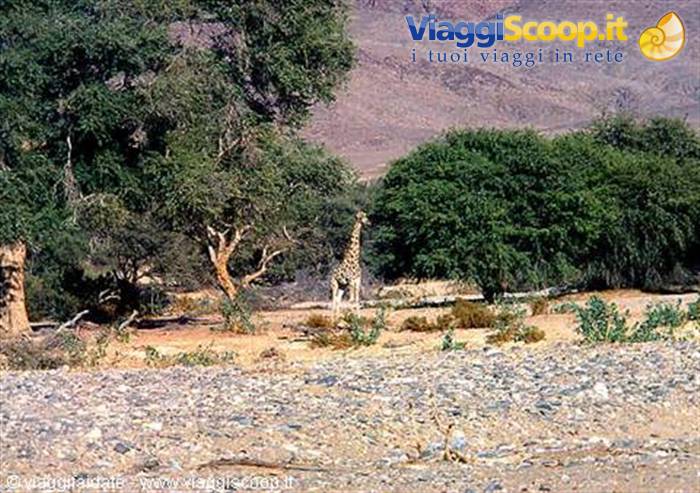
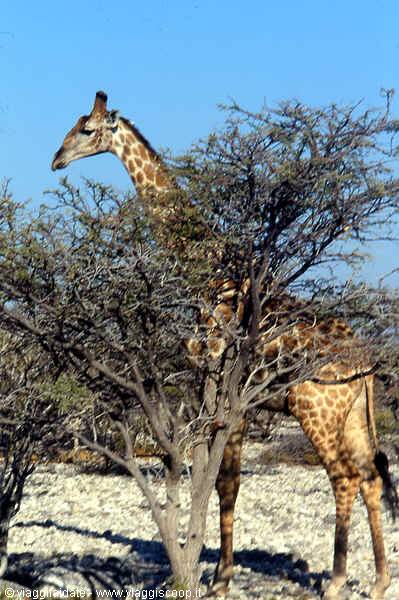
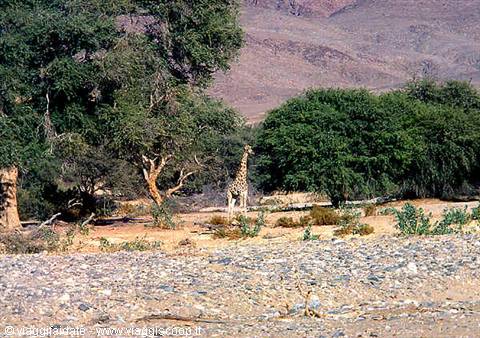
M a r i e n f l u s s - K u n e n e p o o l s - R e d D r u m - H a r t m a n n V a l l e y ( F r e e c a m p i n g ) We cross the Marienfluss again from north to south with its boundless landscapes; we encounter springboks, giraffes, ostriches and the splendid oryx, until the junction called Red Drum (so named because of the presence of an oil drum painted red); at that point we turn west towards the Hartmann Valley, which runs parallel to the Marienfluss and also ends on the Kunene. The Hartmann Valley is a territory owned by an agency from Swakopmund which brings tourists here for photographic safaris. To enter you need a permit, which Dirk obtained for us. The valley, as splendid as the Marienfluss, ends in a fantastic desert of dunes that slope abruptly down to the river. On the other side of the river, arid and mountainous, you can make out Angola.
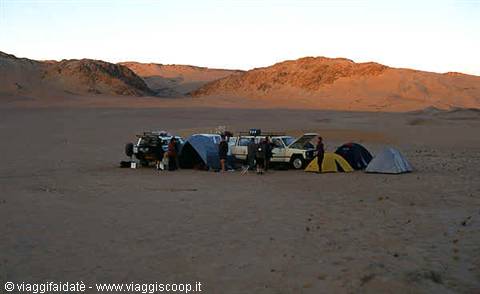
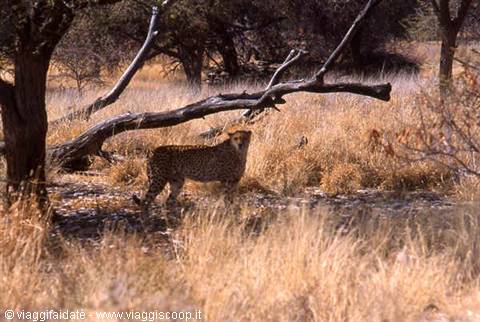
We spend the night camped on the first dunes in the most absolute solitude. Some tracks that Dirk swears are a cheetah's persuade us to pitch the tents one right up against the other; Dirk seems to be laughing under his breath, but...In the morning, a walk on the dunes down to the river; in the cool of dawn walking is a pleasure, the return by now at midday is a real slog. The drinking water is warm and bad after several days in the jerrycans. Our food supplies are also running low and we eat a few tins and freeze-dried pasta.
13 August
H a r t m a n n V a l l e y - D u n e - K u n e n e - H a r t m a n n V a l l e y - O r u p e m b e ( C a m p ) In the afternoon we drive back through the whole valley and stop at a well to fill the jerrycans with fresh water (to be purified). We meet the last Himba, from whom we buy a few crafts (bracelets, baskets, and a dreadful little bucket coated with the usual rancid-butter mixture, which we tie outside the car — I think Dirk wouldn't have let us get in with what he calls the "Himba smell"!). The campsite is as spartan as you can imagine; better the nights free camping.
14 August
O r u p e m b e - P u r r o s - e l e p h a n t s a f a r i ( H o a r u s i b r i v e r ) ( C a m p ) A short transfer to the Purros campsite: a truly luxurious campground with showers and toilets with running water and doors! The sign warning of the possible passage of elephants between the tents is a bit unsettling... In fact this is one of the two areas outside the parks where you can see free-roaming elephants; and we spend the afternoon along the almost completely dry bed of the Uarusib looking for elephants, with absolutely disappointing results. We follow more or less recent tracks of the passage of even sizeable groups of these animals, but we don't see a single elephant. Dirk promises to take us in the coming days to the Ugab river, where we'll have a second chance.
15 August
P u r r o s - S e s f o n t e i n - T w y f e l f o n t e i n ( C a m p ) We gradually return towards more populated areas; Sesfontein is an old German fort transformed into a lodge with a petrol pump and a few shops. The area recalls a Saharan oasis, but for anyone arriving, like us, after 8 days of "nothing" it seems like a metropolis: there's a bar where you can drink a cold soda and a mini-market where you can buy basic necessities. The landscape (we're entering the Damaraland), although very dusty, is always interesting and characterised by very peculiar rock formations.
16 August
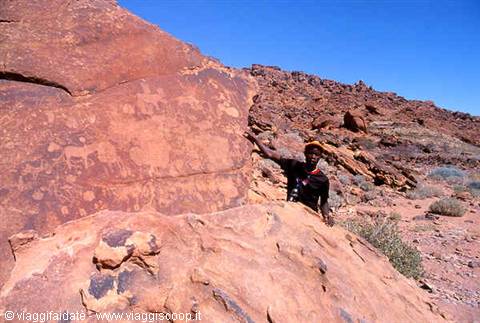
T w y f e l f o n t e i n - P e t r i f i e d f o r e s t - B u r n t m o u n t a i n - O r g a n p i p e s - R o c k p a i n t i n g s - B r a n d b e r g ( C a m p ) We visit the petrified forest, the burnt mountain and the organ pipes, which are the main tourist attractions of the Damaraland, and we climb up to visit the prehistoric rock paintings accompanied by a friendly Damara guide, who besides letting us admire the works painted by the San people about 6000 years ago, gives us a sample of the Damara language, made up of tongue clicks which certainly make it hard to learn, but definitely interesting to listen to. The last two campsites are now equipped with comforts such as showers with hot water, toilets with running water and pitches with barbecue.
17 August
B r a n d b e r g - e l e p h a n t s a f a r i ( U g a b R i v e r ) - C a p e c r o s s (f u r s e a l c o l o n y) - H e n t i e s B a y - S w a k o p m u n d ( B u n g a l o w) In the morning we first drive the jeeps along the almost dry bed of the Ugab following the elephant tracks, and when Dirk becomes convinced he's close, we walk into the bush on foot. It's hard to express the emotion (and also a bit of fear!) of an encounter with a group of enormous elephants, very close, and above all without the fragile but reassuring protection of the car bodywork as at Etosha. Let's say it's because of the emotion that I wasn't able to change the film in time and I don't even have one photo of these animals...
We try to reach the coast following the bed of the Ugab River, but the water rises and we get stuck to the point of having to retrace our steps and reach Cape Cross after a wide detour. On the coast there's fog and it's cold; the seal colony is impressive, and so is the smell. Henties Bay is a holiday town without many attractions from our point of view: the local sport is angling. Swakopmund, on the other hand, is very interesting with its German-style houses on the edge of the desert. Even on the main streets you meet people dressed in pure Bavarian style. Our bungalows, rather spartan, in a village protected by barbed wire, after ten days of tenting seem to us like a 5-star hotel. Not to mention the excellent buffet restaurant at the old railway station where, after our visit, I think they may have had to rethink the fixed-price formula!
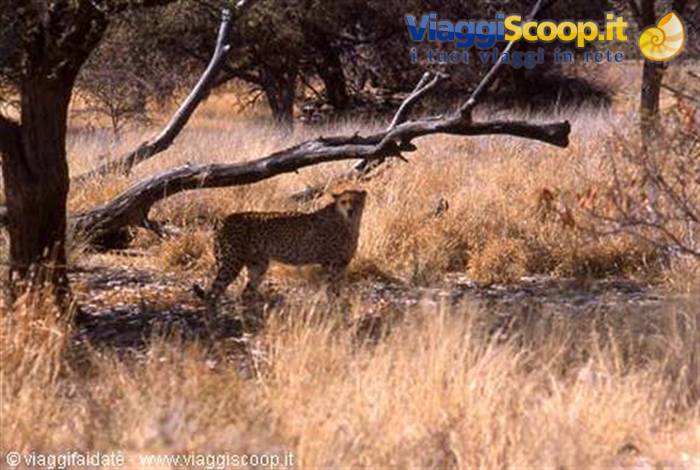
Cheetah walking through dry grass and fallen trees in Etosha savanna
Day 518 Aug 2003
18 August
S w a k o p m u n d - M o o n l a n d s c a p e - W e l v i s c h i a d r i v e - S p i t z k o p p e ( s u n s e t ) - S w a k o p m u n d ( B u n g a l o w ) A day trip around Swakopmund; the highlight, I'd say, is without a shadow of a doubt also the least publicised: the Spitzkoppe. The sunset walk among the red granites of the Spitzkoppe has an almost magical dimension. Even the sight of the mountain rising in the middle of the dusty plain of the Damaraland, more than the Matterhorn, as some guides suggest, brings to mind Ayers Rock.
But when you park the cars, walk in among the enormous granite boulders, mostly rounded, when you climb on rocks that have a particular resonance, almost as if they were hollow, when you sit on the warm granite, in absolute silence, admiring the sunset against the backdrop of the boundless bush, then the similarities with the magical stone of the Australian Aborigines become more evident.
On the way back, thanks to yet another puncture, we have an encounter that adds food for thought to a day already made special by the visit to the Spitzkoppe; as often happens in Africa, a boy appears out of nowhere: about 12 or 13 years old, well dressed, speaks good English because he studies it at school, has a homemade wire toy car that has something ingenious about it (shock absorbers and steering perfectly functional!) and after a bit of chatting we give him 4 or 5 tins of corned-beef-style meat (bought in Sesfontein where there was nothing else), which my kids by now refuse to eat. This very small gift must mean something we can't even imagine because at first he can hardly believe they're for him and then, convinced of it, he runs off overjoyed, vanishing into the nothingness he came from.
His last words: I'm going home to eat them with my porridge! It's a shame not to have a photo of him to remember him better.
19 August
S w a k o p m u n d - d a y o f f - S w a k o p m u n d ( B u n g a l o w ) Swakopmund is a pleasant little town: nice shops, cheerful cafés, a seafront with palms, little markets of handicrafts, and then the day of rest was needed. From Swakopmund small tourist planes take you to see the Sesriem dunes and the Skeleton Coast, but the excursion isn't for me. Dinner is at Dirk's house, where we're all invited for a classic barbecue.
20 August
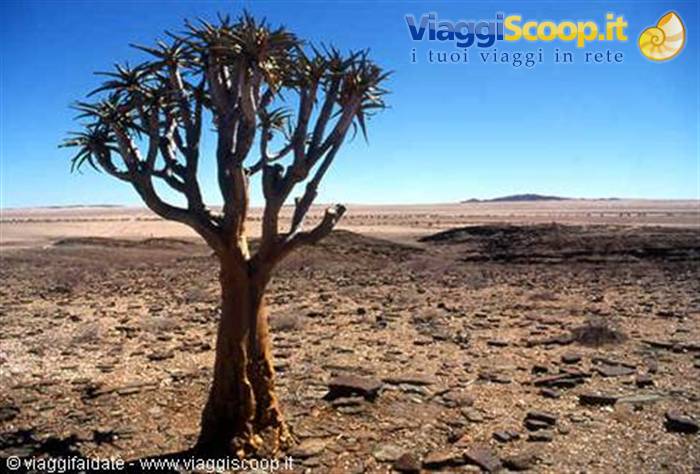
S w a k o p m u n d - W a l v i s b a y ( f l a m i n g o e s) - D u n e 7 - V o g e l f e d e r b e r g - S o l i t a i r e - S e s r i e m ( C a m p ) We set off again early in the morning; the first stop is Walvis Bay, a cross between a port city and a holiday resort; in the lagoon you can admire a large colony of flamingos. Dune 7 is a bit of a taste of what the Namib desert will be like at Sesriem. Along the way we stop to see the quiver trees (kokerboom), characteristic aloes that grow in the Namib desert, which add to the botanical peculiarities we've encountered so far: the prehistoric welwitschias, the majestic baobabs, the omnipresent mopanis, the typical acacias of the savannah. A suggestive stop is Solitaire: a service station with an attached bar-restaurant-bungalows with a particular atmosphere.
You can't pass through here without tasting Solitaire's apfelstrudel! The Sesriem campsite is strategic for visiting the Sossusvlei dune park, because only by starting from here can you see the sun rise from dune 45 (45 means that from the park entrance there are 45 km of paved road but full of potholes). The night in the tent is very cold anyway and I'd think twice before doing the experience again. A bungalow is certainly preferable.
Giraffe among green trees in a gravelly dry riverbed, arid mountains behind
Day 621 Aug 2003
21 August
S e s r i e m - d a w n a t d u n e 4 5 - N a r a V l e i - S o s s u s v l e i - D e a d v l e i - H i d d e n v l e i - s u n s e t - S e s r i e m ( C a m p ) The dawn at dune 45 is certainly a suggestive spectacle, even if partly spoilt by the freezing wind. The visit to the Vlei (depressions among the dunes) climbing from one dune to another marks another unforgettable day of this trip. You need an SUV because the last car park for ordinary cars is very far from the most interesting areas. Even so, the walk on the sand is long and tiring. Towards evening we return to dune 45 for sunset photos.
22 August
S e s r i e m - S e s r i e m C a n y o n - S o l i t a i r e - N a u c h a s ( L o d g e ) The stop at Nauchas, at a farm stay, offers a glimpse of life on an authentic Namibian farm: the electric current, coming from a generator, is cut off at 11 p.m.; hot water comes from wood-fired boilers. The burner is fed practically continuously and this is guaranteed by a girl who shuttles back and forth from the woodpile to the boiler, from what we can see, practically all day; dinner and breakfast take place in the farm's dining room in a very Afrikaans atmosphere. The surroundings of the house are also very suggestive: you can take numerous walks in the bush; the paths are well marked, but within minutes you find yourself alone, immersed in nature.
23 August
N a u c h a s - M e l r o s e f a r m ( c h e e t a h s ) - W i n d h o e k The visit to Melrose Farm allows you to see and photograph a group of semi-free cheetahs; the animals are beautiful, they really have a lot of space (you can't see the end of the enclosure), but it's still an enclosure; the zoo effect leaves a hint of melancholy, or perhaps it's the end of the trip? I'm sure the same visit 20 days ago would have aroused a different enthusiasm......Around Windhoek we find the paved road again. The airport is about 40 km outside the city.
23-24 August
W i n d h o e k - J ' b u r g Namibian A. J ' b u r g - D u b a i Emirates A. D u b a i - F r a n k f u r t Emirates A. F r a n k f u r t - M i l a n Alitalia
lone quiver tree standing on stony desert ground under deep blue sky



0 reader comments