The story
I arrived in Morocco on a scheduled coach from Viareggio bound for Marrakech. Together with Dorina we reached Tangier crossing the Strait of Gibraltar from the Spanish town of Algeciras. From there, on the same bus, to Marrakech, where we visited the beautiful walled city, rich in mosques with bell-tower minarets, madrasas and ancient imperial palaces. The heart of Marrakech, however, lies between the central square, where jugglers, fire-eaters and storytellers perform, and the colourful souk, teeming with people and full of goods and exotic smells. After spending the night in a hotel with an inner courtyard and a terrace overlooking the main square, the following morning, on an organised minibus excursion, we crossed the High Atlas with its majestic landscapes.
Coming down from the mountains we visited Ait Benadou, a distinctive village of ochre-coloured mud-brick houses clinging to a bare hill reachable only on the back of a mule that crosses a river. Continuing the tour we had lunch at Ouarzazate in front of its reddish-earth kasbah and a short distance from the African Hollywood studios. In the afternoon, heading up the Dades valley, we slept in a kind of mountain chalet near the gorge of the same name, reached by a road that climbs between villages surrounded by palms and strange limestone formations. The next morning we went to the more interesting Todra gorge, a narrow canyon where we had lunch. We then continued with our fellow excursionists of various nationalities, crossing increasingly deserted areas broken only by the odd sparse village set in green oases.
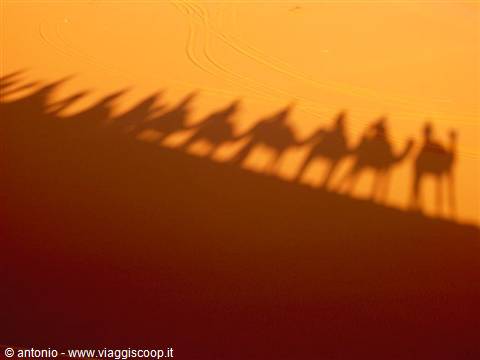
In the evening we reached Erg Chebbi, that is, the desert as you imagine it from childhood: tall dunes of golden sand, nomadic camps of tents and camels. Having parked the minibus in a sort of base camp, we climbed onto camels that led us to a Berber camp. The "blue men" offered us the products of their cuisine, sang a few refrains and had us sleep in their uncomfortable tents. It was beautiful to see the sunset in the desert, the starry night and, on returning to base camp the following morning, the sunrise. From the base camp we set off again by minibus towards Marrakech. On the way back we stopped at Tinehir to watch carpet-making and to visit the plantations of this oasis. Back in Marrakech for the night, the next day we took the train to Rabat.
The station is in the modern city, but you only have to reach the kasbah and the souk to discover that even the capital of Morocco has an ancient soul. After admiring the ocean from the top of the fortress walls we went down to the riverbank to take a small boat bound for the city opposite, Salè, the ancient pirates' haunt. Back in Rabat to visit the souk, we spent the night there. The next day, again by train, since in Morocco it is a clean and efficient means of transport, to Fes. Among the imperial cities this is the most beautiful; it has an enormous souk occupying a whole hill, among madrasas, mosques and ancient fountains. Having made this trip during Ramadan, we respected their dietary rules, but here at sunset there is a great celebration: music, merry-go-rounds and feasting.
The next day it was the turn of Meknes, which among the imperial cities is the most orderly; it has fine palaces, ancient gates opening in the walls, and green gardens we observed from a horse-drawn carriage. But you only have to leave the walls and enter the souk to find the truest Morocco again. Still having found no bus to return home, we went to Kenitra, where a Moroccan we had met on the bus from Viareggio lives, a man who works in Garfagnana. We phoned him from the station and he came to pick us up. We spent three days in Kenitra sleeping in a hotel and eating with him and his family. We thus had the chance to come into contact with the most authentic Morocco. We lazed between the beaches, the city centre, the outskirts and the fishermen's port. From Kenitra we took a bus back to Italy, a direct service to Genoa.
The journey's photographs
2 photographs · click to open them full screen

0 reader comments