The story
The asphalt of the road, long and straight, and the heat of the air create mirages in the distance. Deceived, the eye sees everything blurred. It feels as if you are close to the flames of a fire. But no... we are travelling the road that leads from Errachidia to Ouarzazate, the famous "road of the kasbahs". The name comes from the fact that in this part of Morocco the greatest number of these fantasmagorical and magical buildings is concentrated. The whole route will be marked by sunny days. We cross an arid, semi-desert territory, and there are numerous stops along the roadside, now in the shade of some rare palm, more often inside or in front of a drinks shop. The asphalt road, permanently flanked by a wide strip of packed earth reserved for carts and people on foot, is often interrupted by humps that end in fords with a bed of dried, hard mud.
Here and there, small groups of women, men and children. Little traffic, but when we meet another vehicle we prudently give way, swerving onto the dirt track running alongside, that is, pulling completely aside. It's advisable...
The fate of the kasbahs, like that of the ksour (plural of Ksar), until a few years ago seemed sealed. Having lost their reason to exist, many ksour had emptied, others had collapsed. Every rain or sandstorm weakened or submerged the kasbahs a little more... Erosion and the desert carried on tirelessly with their work of destruction until, in the early 1990s, the Moroccan government decided to intervene with a programme of restoration and preservation work on these true monuments of the national heritage.
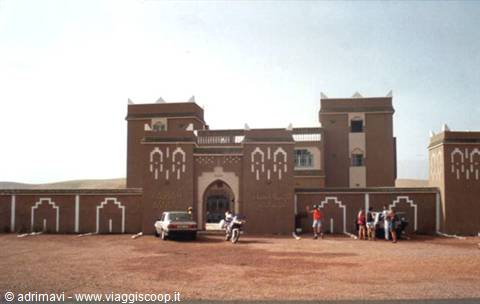
What is a Kasbah and what is a Ksour? A parallel with the Western world is a simplification, but a useful one: the ksour are the equivalent of our fortified towns of the medieval period, while the kasbahs correspond to castles, that is, the dwellings of kings and princes, the local ones. Every kasbah, like every self-respecting castle, has a story to tell and a past rich in memories. You still see many, from those almost completely destroyed to those well preserved. Some seem apparently empty, but in reality they are inhabited by those reluctant to abandon the last testimony of a genuine civilisation called, precisely, that of the kasbahs. If you are not in a hurry and take the opportunity to talk to them, it is precisely with these people that you have the chance to discover a culture founded not on the god of money, but on affection.
For them a fond memory kept and preserved in the heart is still worth more than a few thousand dirham. This is the most characteristic aspect of the "road", the civilisation that still resists there, while the rest of Morocco, including parts of the desert and the south, seems to move exclusively for money.
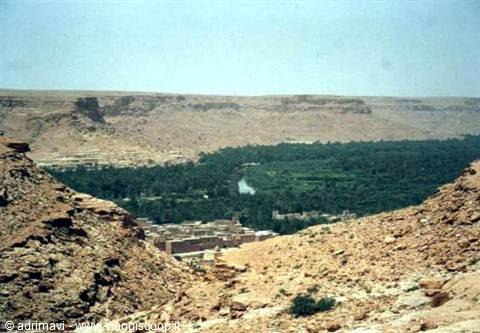
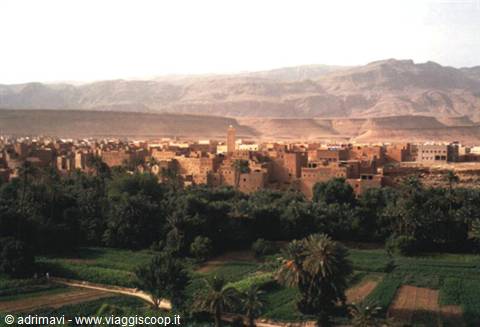
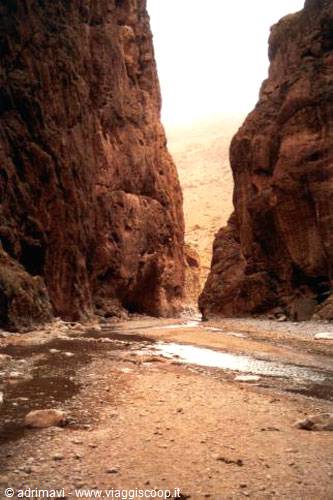
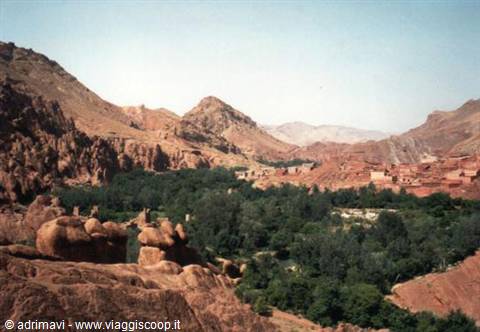
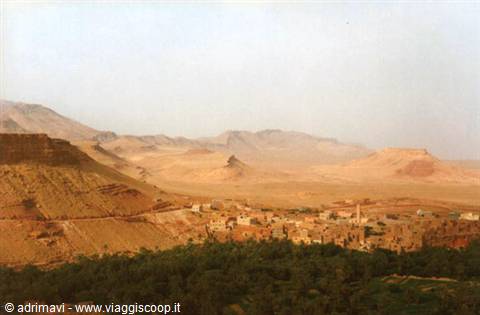
The first one we meet along our route is that of Ifri, near Errachidia. We see it emerge suddenly, since until the last moment it remains hidden by tall palms. It is one of the best preserved and among the most famous. Like this one, you will come across the most beautiful ones without looking for them, but I advise you not to neglect the more dilapidated ones, perhaps harder to reach, scattered everywhere in the landscape and visible as now a tower, now a stretch of wall rises up. The road takes us to Tineghir! The village, seen from the top of the turning that leads to the Todra gorges, looks like a huge ksour, from another age, incredibly intact in the meantime, whereas it is a real village. The buildings, all sand-coloured, blend with the browns, dark browns, beiges and fiery yellows of the surrounding mountains. From Tineghir onwards it is truly a succession of kasbahs and ksour.
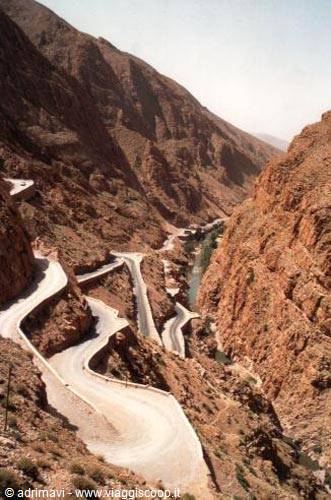
You will find an endless number; it is up to you to choose which to stop at according to your mood and the emotions of the moment. The most famous are not always the most characteristic. Of some you don't know the name or even the exact location; you simply come across them along the way, while others are reached with short detours from the main road. Every visit can turn out to be a waste of time or an unforgettable experience. You will feel as if you have plunged into the age of Saladin, and it is on these occasions that you will stop and appreciate the inexplicable atmosphere of these buildings. In the Dades gorges, along a narrow, steep road full of hairpin bends (in the Moroccan High Atlas it feels like being on certain Alpine passes), you meet splendid ones such as that of Ait Arbi right at the entrance to the gorges and that of Imassine a little further on.
Along the route the impatient curiosity with which each of us awaits the enchantment of a new kasbah, or ksour, taking shape is broken, from time to time, by meeting a group of children or elderly people. Thanks to the hospitality of the people, to the desire to observe with the eyes is added that of the heart, the wish to enrich ourselves through getting to know the Moroccan world around us. The "road of the kasbahs" is not only buildings, but also people, the Morocco of the villages. Absolutely not to be missed, continuing along the road to Ouarzazate, is the kasbah of Amerhidil, in the Skoura oasis, an astonishing fairytale building. Here the click of the cameras is more repetitive than usual.
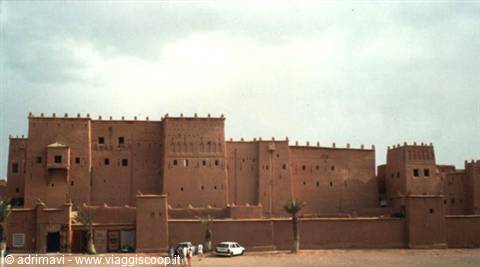
I wonder whether the slides will all be the same, but these subjects, unique of their kind, invite you to immortalise them almost as if photographing the innocent face of a child or a beautiful girl. The kasbah of Taourirt, in Ouarzazate, right in the centre of the town, is a true work of art, but the atmosphere is no longer the magical one of those encountered along the road. I travel to see the works and monuments of man, to get to know peoples and realities different from mine. Well, before reaching Ouarzazate, during the stops between one kasbah and another, between one oasis and another, I often felt I could perceive the signs of the ancient civilisation of the kasbahs, if not dying out, then certainly transforming.
I take comfort from having observed that this small slice of "Arab" Africa remains authentic, where the people try to preserve their traditions, where genuine and friendly encounters are possible. Although sharing the same geographical reality as those encountered along the road, the people of Ouarzazate do not share the same values and the same life.
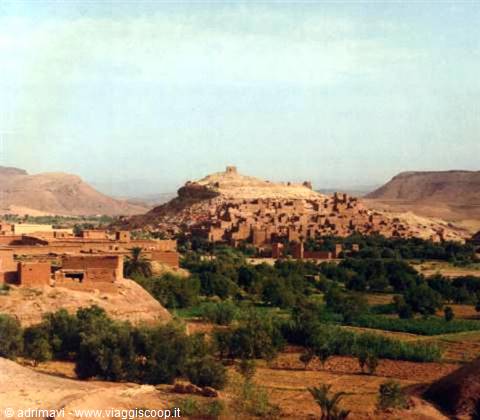
Having left indifferent Ouarzazate for a bumpy but passable road, a few kilometres are nevertheless enough to plunge back into the fairytale of the authentic world of the ksar. That of Aït Benhaddou, with its kasbahs, appears from a distance extraordinarily intact. It looks like a dream vision, a mirage. The walls tremble from the refraction of the air caused by the great heat, and only when we have crossed the largely dried-up river do we realise the deception. The marks of time, climate and men reveal themselves with pitiless clarity. The perimeter wall is severely damaged, of some houses only the walls remain, the kasbahs are battered by a whole series of wounds. And yet Aït Benhaddou is worth the visit. Not for nothing, because of its scenic appearance, has it been chosen as a backdrop for many films. Aït Benhaddou is not a ghost town.
There are still people living there, few to tell the truth, like an old man alone with his donkey, all wrapped up in his long dark-brown woollen burnus, bent with advanced age. Women aside, one of the few men I saw dressed according to Islamic custom.
The journey's photographs
10 photographs · click to open them full screen

0 reader comments