The story
We can't find the junction, and the easy 90 km that separate us from Nema become a hell of mud, water and soft sand. We've ended up on the track of the flooded plain. With difficulty we reach the asphalt at Nema after four hours of travel: we're shattered!! As there are no campsites we find hospitality in the courtyard of a hotel. Nema is a typical border town and lets us stock up on diesel, supplies and, even though it's Sunday, change some money at the bank!! We set off again, resting the tyres and the drivers on a soft and velvety asphalt that leads us to Kiffa through green meadows and lakes where the herds graze. But the efforts aren't over yet: we want to try to return to Tidjikja through the Nega pass!! What better goal for the day of Ferragosto? Up to the village of Boumdeit (N 17° 26.480' W 011° 21.086') the track crosses a very green savannah rich in livestock.
We meet several nomads, some invite us into their tents, another gives Layla a ring, others go out of their way to point us the best route. We spend the night on a dune, near a barrage, surrounded by the prairies: a paradise!! Wake up as usual at six, it's Ferragosto! The Nega pass awaits us. The sky is black with clouds and after a few kilometres we're forced to stop, a sandstorm bars our way. At 10:00 we arrive at Boumdeit, a village forgotten by the world, trapped on one side by high mountains of black rock and deep canyons, on the other sides by chains of dunes up to the Nega pass.
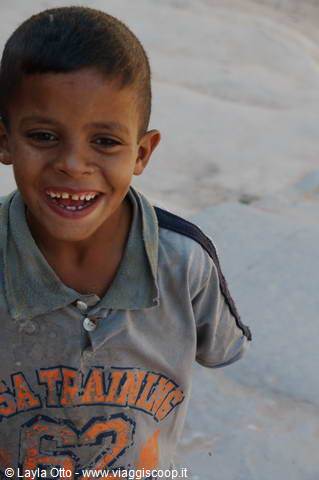
Here the whole village comes out to meet us, men, women and children ask us for cadeaux; a pity we have nothing left to distribute! They need medicines and clothing; there's also a school …! Unfortunately few tourists travel this itinerary and the Paris-Dakar doesn't pass every year, mainly because of strong sandstorms. We set off again "in search" of the Nega pass crossing imposing dunes and getting stuck disastrously!! The way out, according to the instruments, is just a few kilometres away, but they turn out to be the hardest!!! Luckily the sky is hazy, the temperature is mild and the dunes are hardened by the morning rain.
We attempt numerous crossings, we walk on foot climbing the crests looking for the passage… but around us … a sea of very high dunes!! And yet the Nega Pass is there, somewhere… 1.8 km from us!! We arrive with our vehicles and with great effort up to the precipice, on the edge of the canyon. We confer, the GPSs signal the pass always 1.8 km ahead of us, what to do? We decide to send a vehicle on reconnaissance, down into the canyon, the descent is long and steep but the sand is hard, we try. Davide and Katiuscia go down, but after a few moments the CB crackles: "you can't get through here … the canyon closes with very high mountains … our passage is up high, on the edge of the canyon, beyond the dunes…"!! It's now 16:00 and we've been wandering on the dunes for hours without success. We retrace our steps and try to follow the profile of the canyon.
And we're on foot on the dunes again scanning the horizon!! Finally so much tenacity is rewarded… from a dune we glimpse the passage … just two chains of dunes from the vehicles! We try the route on foot to look for the hardest ground and then, one by one, the vehicles pass with cameras and video cameras pointed at the hardest passages!! We made it!! The sun is setting and we set up camp among the dunes on the edge of the canyon. We celebrate with chilled sparkling wine and cakes, it's Ferragosto!! It rains all night and it's cold.
But on waking… surprise, it's completely clear and a waterfall of water cascades down into the canyon, a fairy tale!! We set off again, we cross the stony Nega pass and continue on rocky ground up to the village of El Gheddiya where, in the little lake, Davide spots one of the famous crocodiles!! A nerve-wracking track of stones and boulders accompanies us up to Tidjikja. Several iguanas scan our passing and some white gazelles cut across our path very fast. We spend the night at the new campsite of Tidjikja at the entrance to the village where we enjoy an excellent couscous. We discover from the campsite owner that in Tidjikja there's been no diesel for 12 days now, and even the black-market supply has run out.
The town is on its knees, the generator runs on reduced hours, taxi drivers beg a few litres of diesel from tourists to be able to reach a service station about 130 km further south! We were far-sighted, the vehicles have full tanks and 60 litres of reserve diesel in jerrycans. The track to Atar awaits us, about 400 km, we can make it, if we don't take the wrong route too many times, if we don't have to cross imposing dunes, if… if…, if…!! We try to buy at least 80 litres of diesel on the black market, to have a bigger safety margin. Nothing doing, the man in charge correctly informs us that he's found only a few litres of cut diesel… but … everyone tells us that the supply truck left the capital the day before yesterday …!! It's 17 August, the diesel hasn't arrived, we set off towards Atar, a little worried.
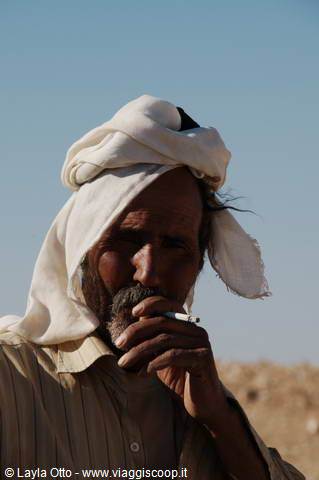
The track is nice and smooth, we pass through the sandy bed of an oued, we photograph car wrecks abandoned by the Dakar and arrive at the pretty village of Rachid. (N 18° 47' 38" W 011° 41'164") At the little market we buy supplies and a few souvenirs. A man dressed in traditional clothes comes towards us. He's recognised us, he's the policeman who checked our documents at the entrance to Nouadhibou. He's on holiday and has returned to his family. We ask him if we can buy some diesel, but we discover that they're stuck here too. We ask him if it's possible to buy some seed oil which, duly diluted with the diesel, could give us a minimum of extra autonomy. So we find a little shop where we can buy seed oil in 5-litre cans.
We decide to buy two cans per crew and mix it with the diesel and… inchallah!! The tanks are almost full, Davide volunteers for the experiment and tops up with the first can. We cover about 30 km, Davide's vehicle gives no problems, doesn't smoke … we all top up!! Having left the village of Rachid and the sand, we travel across immense plateaus scattered with an infinite quantity of stones of all sizes, we proceed at 10/15 km per hour! All eyes are fixed on the fuel gauges, we try once again to refuel by adding the second can of seed oil! To save kilometres we decide to divert directly to Chinguetti. We cross some high dunes until we reach a smooth sandy track that leads us through the oued bed to our destination. It's 18 August and, at sunset, we make our triumphant entrance into Chinguetti … and we're not even on reserve!!! Our first concern is refuelling.
We find it, on the black market in the village square!! We meet groups of Italian, French and Peugeot-driving tourists. Have we returned to so-called "civilisation"? We spend the night at the campsite, there's a full moon and we eat couscous on a terrace. The next day we visit the Library of Chinguetti, well organised, clean, all the books are catalogued and well kept in cabinets. The oldest are kept in glass display cases and can't be photographed....to be continued...
The journey's photographs
3 photographs · click to open them full screen
0 reader comments