Acacus, Erg Uan Kaza, Erg Ubari, Tripoli, Sabratha, Leptis Magna
When
27 Dec 2008 – 5 Jan 2009 10 days · trip of 2008
Who
Cip Civectitis Civetta · @tizimari · Sâo Tomé
How
Travel diary
The story · 1 days
One part of the trip winds along the Mediterranean coast with visits to the Punic-Roman cities of Tripolitania, through the places of classical Libya that bear witness to our own cultural heritage. The other part is a genuine plunge into the heart of Fezzan, the Libyan Sahara, where nature has concentrated a set of natural and artistic features of remarkable interest: from the lakes set among the dunes of the Ubari erg to that veritable open-air museum of rock art that is the Wadi Mathendous, from the majestic setting of the Acacus to the splendid prehistoric paintings hidden among its rocks.
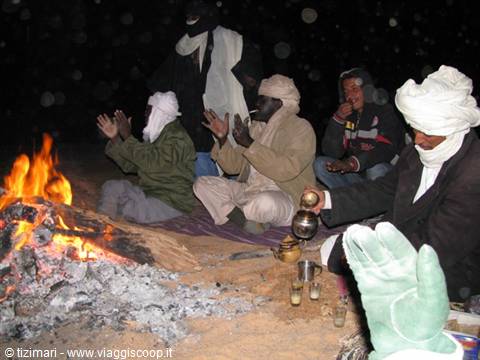
The images of this trip: the immensity of the landscapes, the dunes and eroded rocks, the paintings and rock engravings, the tea and dates, Balek and Chadku. Top five: the Ubari erg and its salt lakes, the Acacus, the rock sites of Mathendous, the Uan Kaza erg, Leptis Magna,
The trip was made with Kel 12, which relies on the Italo-Libyan agency Dar Sahara. Minimum temperatures 6 degrees, maximum 24 degrees Exchange rate 1 euro = 1.78 dinars
27-12-2008 (Saturday): Milan-Tripoli-Sebha-Germa
We set off from Milan Malpensa. At check-in begins the series of endless queues that will accompany us all day long before reaching the much-desired desert. It seems everyone decided to go to Libya this year. At the airport various groups from Avventure nel Mondo, motorcyclists and other small groups from various agencies. Despite arriving at check-in more than two hours early we manage to get through just in time for boarding. Departure is on time at 12.45. We arrive in Tripoli after two and a half hours of flight, a kilometres-long queue at the police checks. To sort everyone into the room the policemen arrange us in various lines that converge on the same checkpoint; the negotiations begin, the infiltrations and the checks with elbows, so as not to lose the position gained. Anyway we get through, but it's only the first part since we have to continue to Sebha.
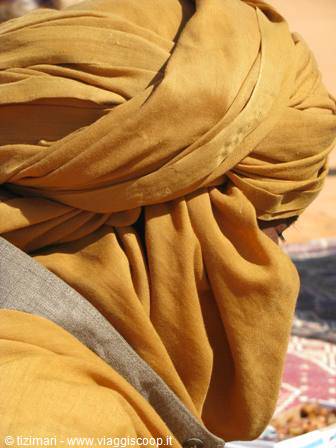
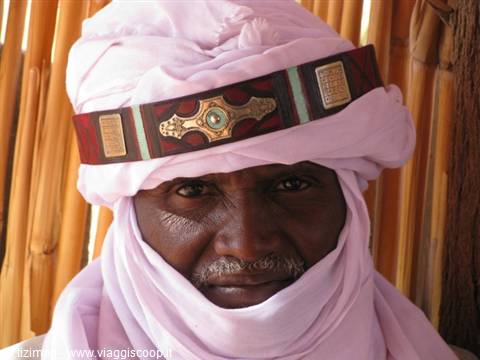
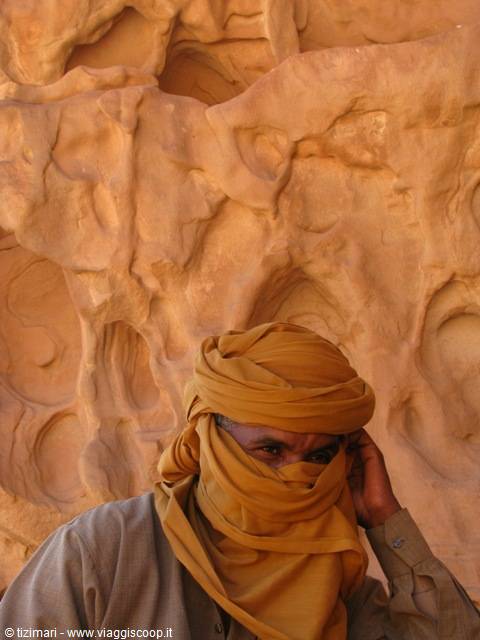
Tripoli airport is not yet organised to receive a large flow of passengers and it seems that today really many have arrived. We leave our luggage with the policemen who will accompany us throughout the itinerary and treat ourselves to a dinner at the airport restaurant. A little game of cards to kill the wait and the two-hour delay of the flight to Sebha. Again in line for the document and hand-luggage check in the usual anarchic-Arab queue. Half an hour standing at the boarding gate because the twenty or so chairs are already largely occupied, and finally, after going down onto the runway for luggage identification, around 23.00 we settle into the plane for Sebha. Welcoming us is Sidi with his indigo chech. We settle onto the buses and off for 2 hours of road to reach Germa. It is almost 3 when we lie down at the Dar Germa Hotel.
28-12-2008 (Sunday): Germa-Uan Kaza-Acacus
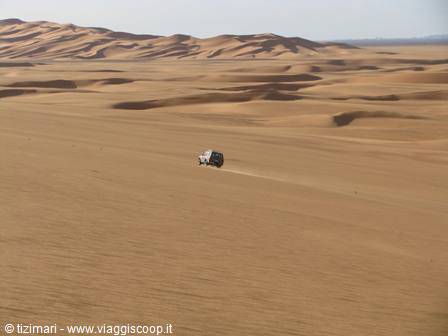
In the morning we meet Balek and Chadku and their "mature" Toyota Land Cruisers. They will be our drivers for the next seven days in the desert of Uan Kaza, of Ubari and on the plateaus of Messak Settafet and the Acacus. Clearly also present is Ahmed, the inseparable policeman with his Colombo-style raincoat, who escorted us throughout the trip. Transfer on paved road for about 200 km heading west and then south towards the dunes of Uan Kaza: sandy corridors, beds of ancient lake basins, sharp ridges. Picnic on the first dunes of Uan Kaza. Brief stop at the village of Al Awaynat. Arrival at the fixed camp of Auis, located at the foothills of the northern Acacus, in a semicircle of eroded sandstone cliffs and protected by a barrier of dunes.
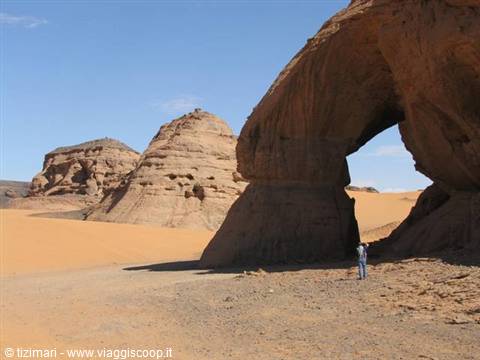
The accommodation at the tented camp is certainly comfortable, but too far from the southern part of the Acacus, which therefore cannot be visited while based at this camp. So we won't manage to reach the famous arch of Fozzigiaren. Dinner and overnight at the camp. 29-12-2008 the reliefs of the Central Acacus We set off early in the morning for a visit to the central area of the Acacus (about 200 km). After water disappeared from the surface of the Sahara, the wind has been and still is the sole and only maker of the shaping and erosion of the morphology of the Tadrart Acacus.
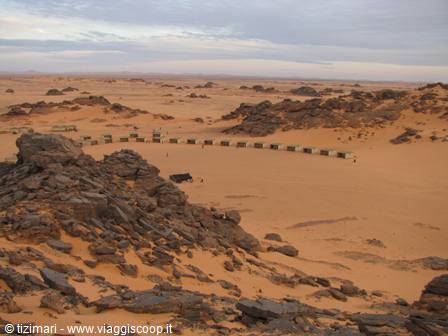
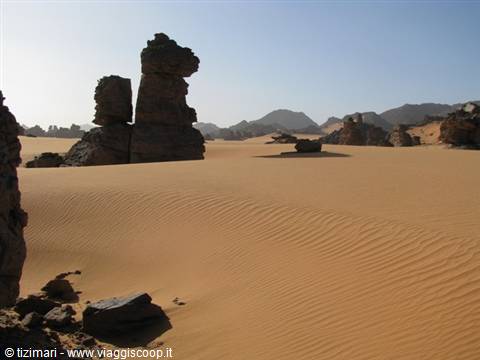
It is the last of the plateaus that from the centre of the Sahara slope down towards the west, losing themselves in the sands of the edeyn of Murzuq: sedimentary rocks intersected by deep wadis (rivers), small chaotic interlaced dunes, sparse vegetation, blackish plains, rock walls eroded into the most bizarre shapes, petrified arches, jagged ridges, isolated towers emerging from the sand. Some shelters and natural cavities were chosen by prehistoric artists who handed down to us paintings and engravings attributable to various phases that illustrate the changes that occurred over the millennia. We visit the rock paintings of Sindhar, the graffiti of Tina Newen and the erotic ones of Tina Lalen, the great arch of Tin Lubo (tea stop). The places chosen by Balek and Chadku for the tea and lunch stops are simply fantastic. Picnic at Sindhar.
Dinner and overnight at the tented camp of Dar Auis.
30-12-2008 the reliefs of the Acacus
We set off at 9.00, after half an hour we reach the plain of Taiwen; the landscape is fantastic with great stones emerging from the sandy plain, and we treat ourselves to a walk on foot among these spectacular rocks. We visit the rock paintings of Tin Taborak, of Tin Hadoun. Picnic at Tin Hidin and then a walk on foot on the surrounding rock walls. Visit to the site of Tin Salhutin. Before returning to the camp, a stop at the enormous dune of Auis. The sun preparing to set gives us a spectacle of colours and plays of shadows on the crests of the dunes, truly spectacular. Dinner and overnight at the camp.
31-12-2008 Dar Auis – Uan Kaza - Germa We leave the tented camp of Dar Auis and, crossing the dunes of the northern part of the desert of Uan Kaza, we reach the strip of asphalt that will take us back to Germa. Quick It is New Year's Eve and at the Dar Germa Hotel they have organised in the lobby a sad little show with local music; luckily in the afternoon we organised with Balek a camel excursion in the desert with some of his relatives. Drawing the wrath of the policeman for this unscheduled outing, we slip away, and at midnight we are around a fire, near the oasis of Ubari, with a group of Tuareg and their camels. The toast this time is based on tea, since it is impossible to find alcoholic drinks. Camel ride in the night under a sky incredibly full of stars. Brief visit to Balek's family and return to Germa.
01-01-2009 Germa – Germa: the imaginary universe of the hunters of Messak Settafet Departing from Germa, a day excursion to the rock sites of Mathendous and In Galghien, which feature some of the most prestigious rock bas-reliefs of the era of the hunters: rhinoceroses, giraffes advancing towards traps, large elephants, crocodiles, hippopotamuses, men wearing masks, pastoral scenes, etc. The route to reach the sites develops in the corridor between the plateau of Messak Settafet and the Murzuq desert, whose dunes can be glimpsed in the distance. An enormous flat and somewhat monotonous expanse until reaching the wall that runs along the wadi. At the site of Mathendous the rock engravings are magnificent, but they are literally crumbling following the landslides and rock breaks caused by the high temperature range.
The symbol of the site are the spectacular "gatti mammoni" (baboon-cats), which dominate the valley, carved into one of the highest rocks. Picnic at In Galghien in an unforgettable setting. Return to Germa. Dinner and overnight
Day 12 Jan 2009
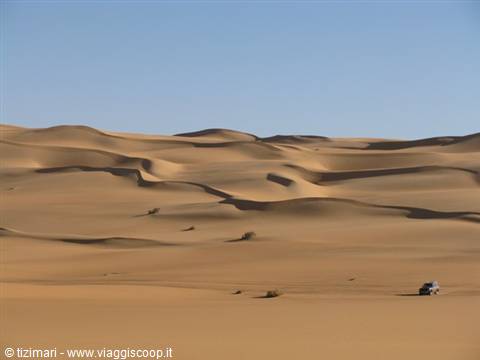
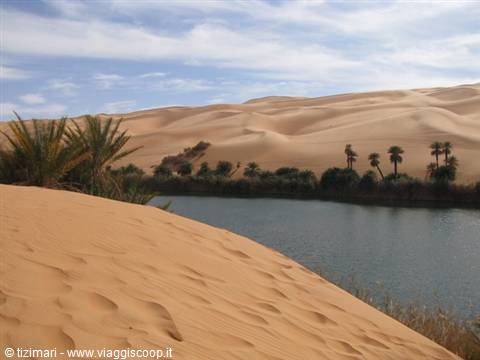
02-01-2009 the lakes among the dunes: the "ramla" of the Dauada This morning the air is biting. We quickly visit Garama about 2 km from the new Germa, the ancient capital of the mysterious Garamantes people. Even the Romans gave up settling in this area, too far from the coast and too difficult to defend against the warlike Garamantes. North of the Ajal valley, you enter the Ubari erg and, after crossing a sea of dunes that seems endless, you suddenly discover a series of lakes surrounded by vegetation and palm groves. They were once inhabited by the Dauada, who for centuries lived sheltered in this environment, feeding on dates and on small larvae that bred on the surface of the waters. Mandara, Umm-el-maa (the mother of waters) and Gabr'aun are our stops.
At Gabr'aun you can still see the ruins of the abandoned village: it is the largest lake bordered by reeds and palms with a large dune close behind, but a bit too crowded and busy for our tastes, much better the small lake a few kilometers before, located between Umm al maa and Gabraun. Picnic at Gabraun. We then continue over the dunes of the Ubari desert until they slowly flatten out, now at the gates of Sebha where the plane for Tripoli awaits us. In the last light of day, a close encounter with a fennec that is desperately trying to reach its den near which we have stopped. Dinner in a local little restaurant and then flight to Tripoli where we settle into the Hotel Corinthia Bab Africa, an enormous 5-star positioned right up against the Turkish walls of the medina and which in one of its towers also houses the American embassy.
03-01-2009 Tripoli-Sabratha-Tripoli
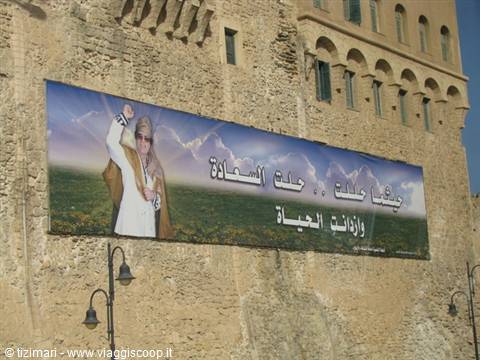
Visit to the Red Castle museum which houses many statues and some splendid mosaics from the coastal villas, a mausoleum from Ghirza and an ethnographic and historical section where we also find, still covered in cellophane, the desk on which Berlusconi and Gaddafi signed the recent agreements between Italy and Libya. For the Libyans, Silvio is already a museum piece, if only they'd put him in one in Italy too!! Brief stop in the colonial quarter where we meet some spry old men who speak perfect Italian. After lunch in a restaurant by the sea, visit to the site of Sabratha, a Phoenician trading settlement that was part of the Carthaginian empire.
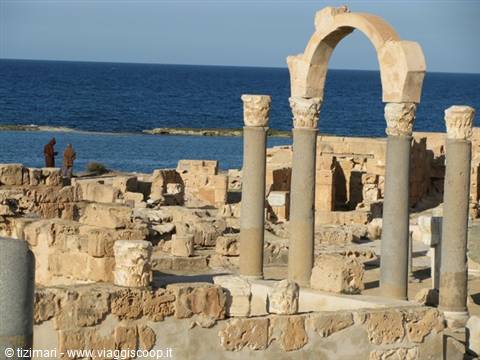
Having become a Roman city in 46 BC with the creation of the province of Africa, Sabratha owes its fortune to the sea: a precarious landing point during the long Mediterranean voyages and terminal point of land routes, arrival place of caravans coming from black Africa that sought contact with the seafaring merchants eager to get their hands on the riches coming from lands that no one had ever seen. From the cardo you cross the residential quarters, the forum, the temple of Liber Pater, the seaside baths, to reach, spectacular in its grandeur, the theater: the backdrop is the sea and the stage – on three levels – stands out against the sky: 108 columns of marble and granite, capitals of different workmanship, two large marble dolphins at the sides of the stage, delicate bas-reliefs in the semicircles of the pulpitum.
Return to Tripoli, nighttime visit to the medina where we find the local madman who literally latches onto my arm. Despite various attempts by some locals to dissuade him, nothing doing, he keeps following us undeterred. I'm forced to reach a nearby police station with the poor fellow who won't let go of my arm. Despite being chased by a couple of policemen, he won't loosen his grip and I'm forced to intervene with the old method of twisting the finger to free myself from the one who had chosen me as his savior. The local policemen hold him back "gently" for a few moments to let us slip away and reach the restaurant "Al Athar" (the arch), built practically next to the ruins of the arch of Marcus Aurelius. Local specialty: a type of tagine served in terracotta amphorae that are opened at the moment before serving. Not bad, cost about 15 euros per person.
A tea at the Ancient Zumit Hotel, located right on the other side of the Arch of Marcus Aurelius. This hotel could be an interesting alternative for staying in the heart of the medina. Overnight at the Corinthia.
04-01-09 Tripoli-Leptis Magna-Tripoli
After the abundant buffet breakfast at the Corinthia, visit to the arch of Marcus Aurelius and then departure for Leptis Magna. On the east coast stands Leptis Magna: originally a Phoenician trading post, it later became a Punic settlement linked to Carthage and then a wealthy Roman city, which experienced several phases of development until at the end of the 2nd century AD Septimius Severus wanted his hometown great and imposing: it is one of the most grandiose archaeological sites of Roman Africa. During the visit you can follow the progressive expansion of the urban settlement, from the old forum to the theater and market quarter, to that of the baths of Hadrian, up to the imposing Severan complex with the colonnaded street that connects the city to the port with its docking quays, the warehouses and the lighthouse.
To the southeast are the grandiose remains of the amphitheater-circus complex, one of the most significant in the entire Roman world. Lunch in a local little restaurant in Leptis Magna. Return to Tripoli and visit to the Gurgi mosque and the medina. For dinner we head to the fish market by taxi (5 dinars). Here, in practice, you choose the fish you want to eat from the stalls, which are then cooked in the adjacent little restaurants. We had a real feast of calamari, prawns, octopus, sea bream and red mullet. All for less than 15 euros per person. A truly unmissable experience. Overnight at the Corinthia.
05-01-09: Tripoli-Italy
Awake at dawn and transfer to the airport to prevent any overbooking problems on the flight to Rome. We are the first at check-in, three hours ahead of the flight time, which then departs almost two hours late.







0 reader comments