The story
Libya, Akakus and the Lakes...
The account of this trip begins at the Libyan border, reached after crossing part of beautiful and ever-welcoming Tunisia on tarmac. The Libyan customs formalities are rather complicated, but as always we manage to enter Libyan territory in half the time compared with other groups, thanks to the customs assistance given to us by our Libyan partners. Once on the road we reach Zouara; there the hostel offers a floor and a roof, enough to rest. In the morning a lovely sun gives us hope; we are rested, some not-well-prepared crews show a little tiredness, but we have to set off. Today's stage will be rather long; passing through Tripoli we will reach Ghadames, one of the most important oases of the Sahara. The tarmac runs for hundreds of kilometres amid stunning landscapes with incredible rocky mountains alternating with flat expanses stretching as far as the eye can see.
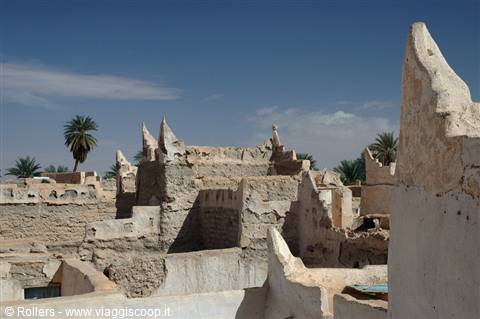
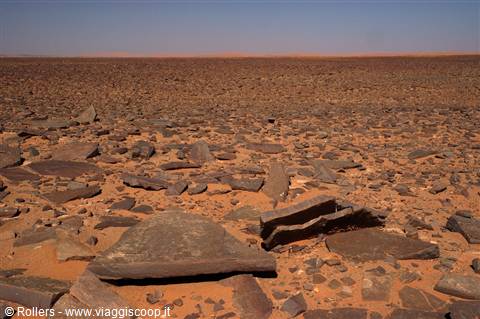
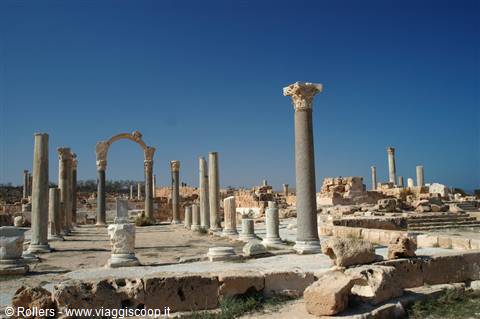
We reach Ghadames at night. The following morning we treat ourselves to a visit to the city. Ghadames was founded by the Romans and quickly became one of the most important Saharan caravan hubs and a centre of important trade. Stunning is the old town, built below street level so as to create ample shaded areas to defend against the heat of the desert. We set off in the early afternoon; we have refuelled with diesel, water and fresh provisions. At last we will leave the tarmac just outside the built-up area; the compass needles turn decisively south towards the oasis of Ghat, about 700 km away, which we will cover in complete self-sufficiency. We cover about forty km across the hammada, a very hard, stony, flat desert; looking around 360 degrees you see no borders, no boundaries at all, as on the open sea.
A puncture in one of the vehicles forces us to make a short stop and we take the chance to stretch our legs a bit. Ahead of us, very far away, we see something strange: a human figure running towards us, waving his arms. When he reaches us we understand that he is a reckless traveller who had ventured with his 4x4, with wife and children, into the Hammada, and in the morning had the bitter surprise of a flat battery; they had been stuck since the previous day. We immediately get them going again, top up their water tanks by drawing on our support vehicles, check on their state of health and point them onto the right track to return to Ghadames. Thanks and tears, of course, are plentiful. We continue our journey amid stunning landscapes hard to describe; a photo or a story cannot convey the emotions the desert transmits.
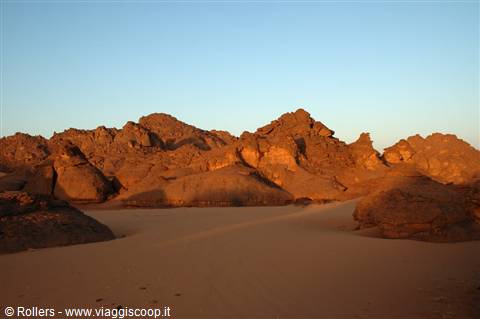
There nature is mistress and powerful; there you can only go along with it and only be a spectator. In the late afternoon, when the sun colours the rocks and sand superbly, very tired but fulfilled we set up camp, have an excellent dinner, a quick consultation of the maps to show everyone the point reached in the desert, and then well-earned sleep. In the morning, after tidying the camp, it's time to start the engines and off we go, but one vehicle stalls after a few metres; the driver realises almost at once that he has a problem with the diesel feed. An hour of intense work is in prospect for the organisation's mechanics who, after emptying and cleaning the whole system, get the car going again.
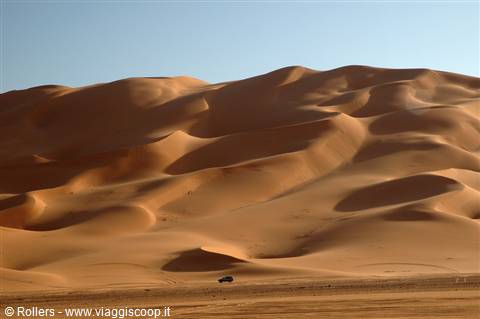
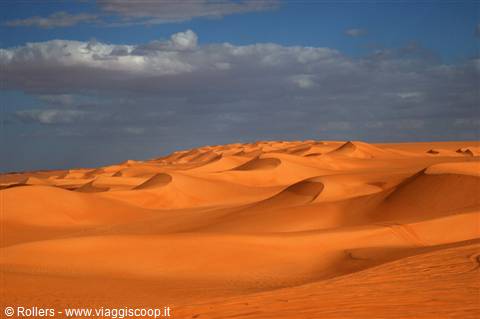
Ahead of us, stretches of Serir incredibly vast; the hours pass and in the distance the imposing dunes of the Erg of Awbari begin to appear, growing ever larger and incredibly beautiful as the hours go by. A little technical and theoretical preparation is due for the novice crews; the tyres are deflated to increase the buoyancy of the 4x4s, and then we're off through splendid landscapes where you almost try to tread on tiptoe, almost afraid of ruining those works of art shaped by the wind. Two intense days in which the pushing crew is called on several times to deal with some rather determined sand-sticking by the less experienced. We reach Al Awainat where we will camp; the next day we will enter what is rightly called the largest open-air art museum in the world.
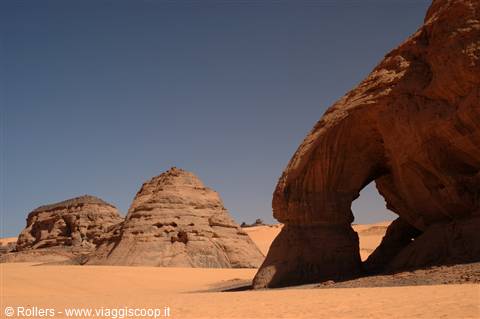
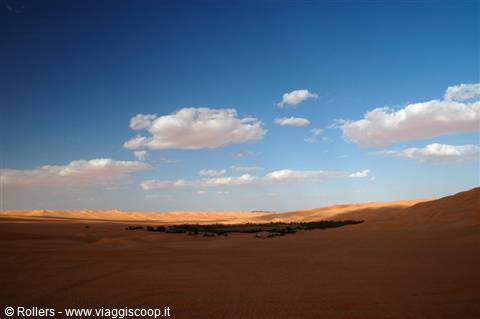
The Akakus is a wonder of nature: gigantic rock arches and incredible rocky mountains emerging from sand of a strong red colour; on the walls eroded by time, as a testimony to a now remote past, splendid graffiti and rock paintings depict hunting scenes with animals of every species. The Akakus represents, more than any other place, the sublime exaltation of sand and rock. After two unforgettable days we leave the Akakus behind to cross the Mathen Doush, a prehistoric river on whose walls hunting scenes and animals of every species are depicted. Our compasses are pointing north-east; soon we will in fact re-enter the sandy desert of Awbari, this time in the area of the lakes that emerge from the age-old sands, with imposing dunes as a backdrop to landscapes that seem to have come out of old master paintings.
Here too the going becomes more demanding and again the less experienced need some help. Advancing slowly among the dunes you discover ever-new, shifting landscapes, until we notice that the dunes begin to drop in height and difficulty, until a sandy plain brings us quickly to the oasis of Sabha. There we take to the tarmac again reluctantly; it will take us back to Tunisia. During the journey there are already those planning another, because like us they are already showing the symptoms of 'Africa sickness'.........
Coletta Claudio and Margherita Fenelli
The journey's photographs
18 photographs · click to open them full screen










0 reader comments