Tripoli, Sabratha, Ghadames, Ghat, Acacus, Leptis Magna
When
26 Dec 2005 – 9 Jan 2006 15 days · trip of 2005
Who
Bruno Visca · @Bruno · Germagnano (TO)
How
Travel diary
The story · 15 days
Text and photos by Bruno Visca
The journey is a door through which one leaves known reality and enters another unexplored reality, which resembles a dream. Guy de Maupassant
It's always with great emotion that one returns to the desert! A magical place in itself which, to us Westerners, who live every day in a chaotic world, appears as an infinite universe outside reality. The beauty of the landscapes, the colours of the dunes that change continually as the hours pass, take on reflections at sunset and dawn with shadings that are hard to describe. The intense blue sky during the day and the sky overflowing with stars at night instil a sense of serenity in the traveller and lead them to appreciate the beauties of nature all the more. The desert is a space where not only the body but also the spirit travels at a slow pace: a watch is entirely superfluous. The desert has always fascinated people. As the Tuareg say: “God created the world to give man a home, and the desert so that there he might find his soul”.
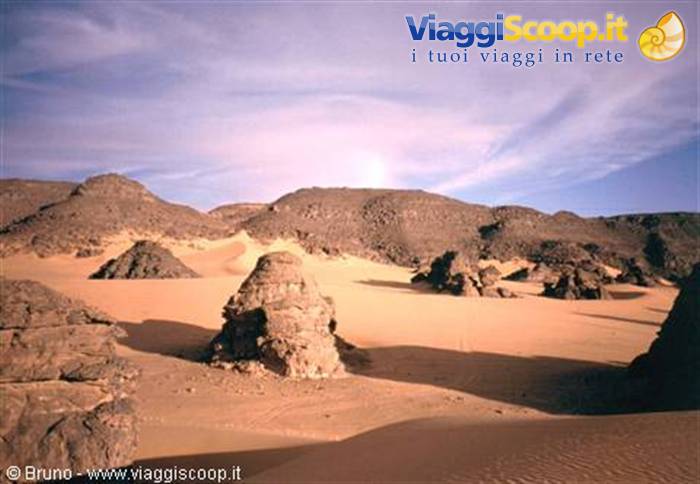
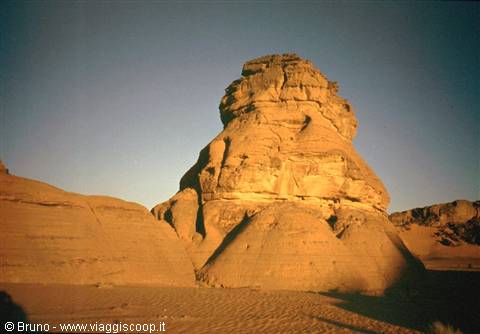
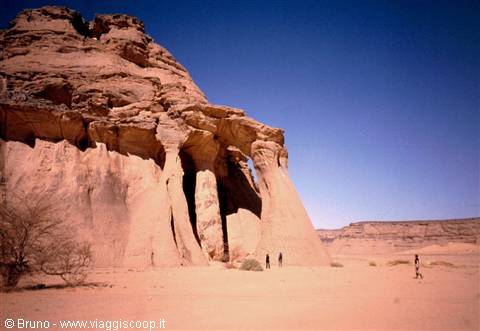
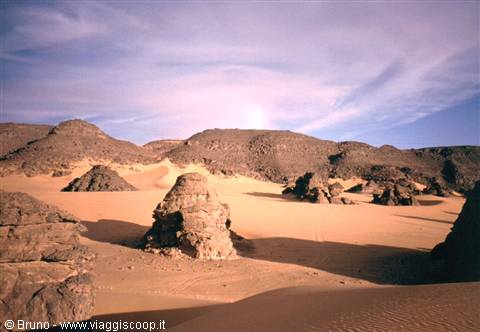
About 1,200 km south of the Mediterranean coast of Tripolitania, in Libya, stretches one of the most fascinating Saharan regions: the Acacus massif, a sandstone plateau with a surface, from north to south, of about a hundred kilometres, broken up by sand dunes and extraordinary rock formations shaped by the wind, a veritable open-air museum. The Acacus covers an area of 7,500 sq km and is a park without custodians, but to enter it you must be accompanied by a guide and hold a permit to show at the checkpoints. The beauty of this place is absolute, but what makes the whole area an invaluable heritage is above all the rock paintings and engravings, evidence of the ancient presence of humans in this region.
On the rocks and in the crevices protected from erosion by the weather are depicted hunting scenes and moments of daily life; the depictions of elephants, giraffes and other animals of the African savannah testify that this region was once not desert but had an ecosystem similar to that of present-day Central Africa. It was in fact around the 3rd millennium BC that the desert began to advance inexorably, reducing the fauna and vegetation and forcing the herders to abandon the region in search of new pastures near the major river basins. The presence of natural shelters in the sandstone massif has also allowed the preservation of magnificent rock paintings.
The first reports of the presence of these paintings date back to the end of the 19th century, but no precise location was given; it was only in the 20th century that the first archaeological explorations were carried out, which made it possible to discover this extraordinary open-air museum, where nature and human skill have merged to create an unforgettable spectacle. It is in this region that, after a quick visit to the ruins of the ancient Roman city of Sabratha, most of our journey takes place.
Day 126 Dec 2005
Milan, Turin, Rome – Tripoli (Plane)
I and the other travel companions who left from Turin, at the Rome airport we meet up with the other members of the group, 20 people in all. We board for Tripoli together with 11 boxes of food supplies plus another with the kitchen crate containing pots, pans, colander and whatever else is needed for cooking. The plane leaves with about 2 hours of delay and at 16.45 we land at Tripoli airport. We change 200 euros each, 150 for the common fund and 50 for personal expenses (1 euro = 1.607 DL). At the exit we find a representative of the agency who has come to pick us up. We transfer our luggage onto the two vehicles waiting for us, a bus with 17+4 seats plus a minivan with 6 seats and in ½ hour we reach the hotel. The flight delay has taken away our time for visiting the city.
In the evening we meet the local correspondent in charge of providing us with the off-road vehicles, the drivers and the guide. It's not just a courtesy visit, he has to collect the agreed sum for all the services! After the greetings and the ritual pleasantries I intend to hand over the money collected previously from all the participants. Not on your life!! In the lobby of the hotel there are too many indiscreet eyes, it's not prudent to count the banknotes in everyone's presence. So he leads me to his car, in the hotel parking lot, in a dark and secluded place. While we are counting the money, an operation that requires a bit of time, I see the lights of some torches approaching. It's some companions who, having seen me heading towards the parking lot in the company of the Libyan correspondent, were starting to worry about me and were coming to look for me!
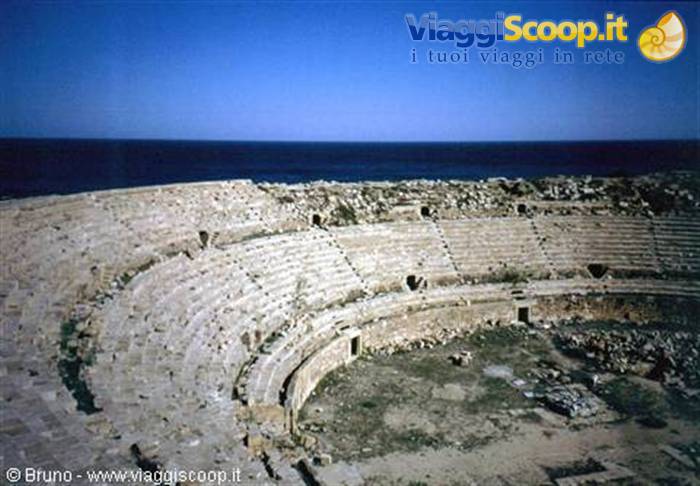
Despite the alarm at 6, we can't manage to leave before 8. We immediately discover that you have to adapt to the slow rhythms of the place, not be in a hurry and not look at the clock. Having paid for the rooms and collected the passports we meet the policeman-guide who will accompany us throughout the trip. In about an hour we reach the archaeological site of Sabratha, we don't take the guide as it's not available in Italian. To visit the site takes about 2 hours. The old Roman city is very beautiful, built on the seashore in the 1st century AD and is one of the obligatory stops for anyone visiting Libya. The origins of the city's name are lost in time, but it is believed to derive from a Libyan-Berber word meaning "grain market". Don't miss the visit of the museum.
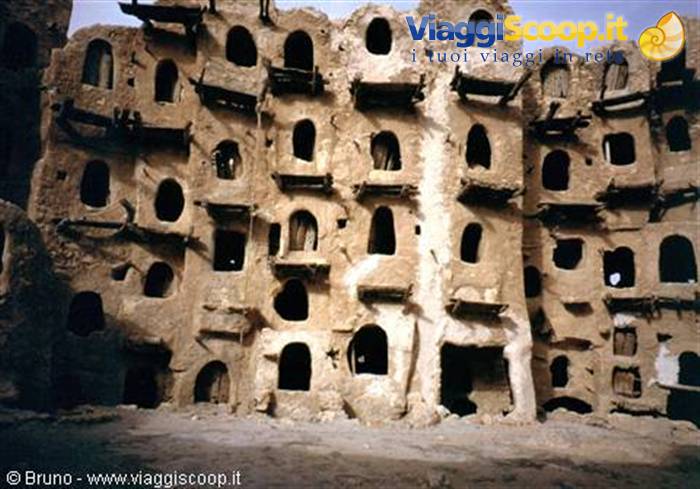
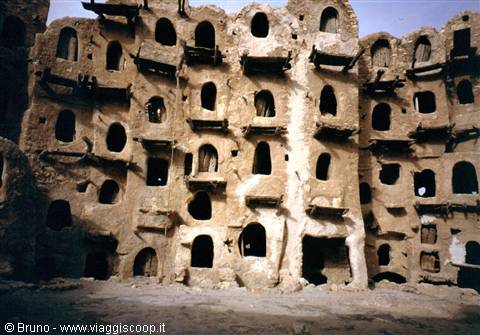
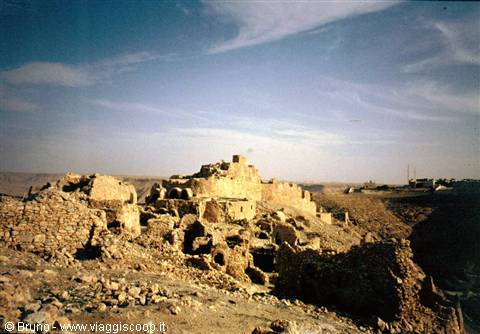
Making a 9 km detour we visit the Berber city of Kabaw with its characteristic qasr (fortified granary) where cereals and skins for oil and olives were collected and stored. The qasr, very interesting, is more than 700 years old and retains an incredible medieval charm. The granary, currently no longer in use, is placed in an impregnable position, on top of a hill and highlights how the protection of cereals was almost as important as the safeguarding of water. Returned to the main road we reach the semi-destroyed and abandoned village of Nalut, also this one with a characteristic qasr, once the pride of the old city but today almost entirely surrounded by the uninhabited ruins of the village. We arrive in Ghadames at 22 and, after settling into the hotel, we have dinner in a restaurant near the hotel.
What you notice most during the transfer journey are the piles of garbage found on the sides of the road, especially near Tripoli.
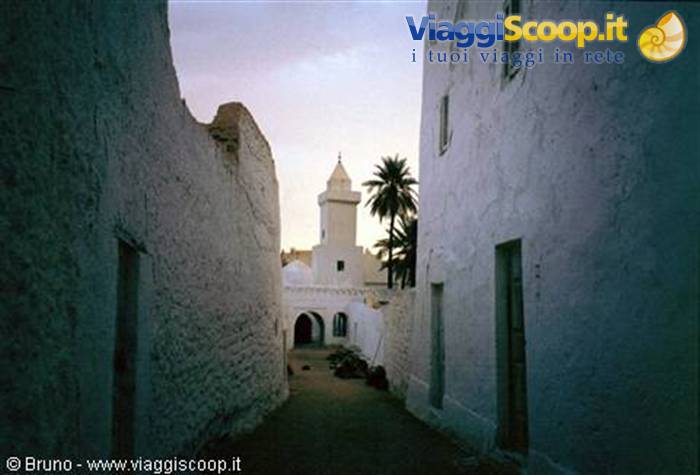
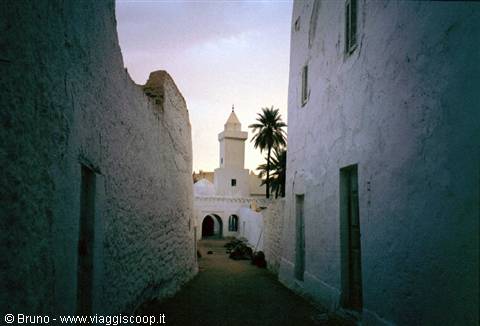
Mosque of the Ghadames Medina
Day 328 Dec 2005
Ghadames – Medina Visit - Hammada al Hamra (Jeep – 100 Km – 3.5 h)
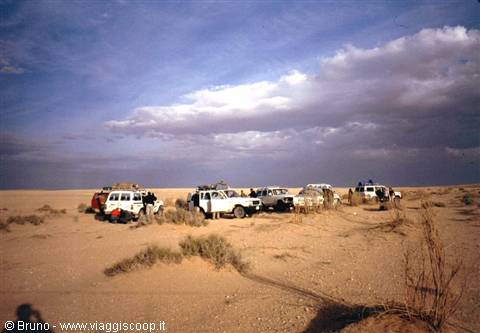
After breakfast we get to know the 6 Libyan drivers who will lead us into the desert together with the policeman-guide. At 8 the luggage is loaded onto the jeeps then, accompanied by a friendly guide who speaks good Italian, we visit the medina, a real maze of covered alleys provided with skylights declared a UNESCO World Heritage Site. After buying fruit, vegetables, eggs, bread, water, 2 basins, 3 plastic mats to sit on during meals and a regulator for the gas cylinder, at 13.30 we finally set off for the desert. Immediately the asphalt road ends and we enter the Hammada al Hamra. The landscape is rather monotonous, an immense stony plain. During the journey the first of the numerous breakdowns of the jeeps occurs, the breaking of the accelerator cable. Fortunately the drivers are also excellent mechanics and in 45 minutes they repair the vehicle.
Even the punctures will be almost daily. The only criticism that can be made is the age of the vehicles. At 17 we reach the area where to set up camp, a place on the edge of the track with a bit of sand. The place is decent, not very beautiful. I decide not to pitch the tent but to sleep under the stars sheltered by my sleeping bag, something I will also do in all the other camps. During the night, on several occasions, a light drizzle falls. It seems strange but even in the desert sometimes it rains.
The first dunes
Day 429 Dec 2005
Hammada al Hamra – Erg Hubari (Jeep – 290 Km – 8.5 h)
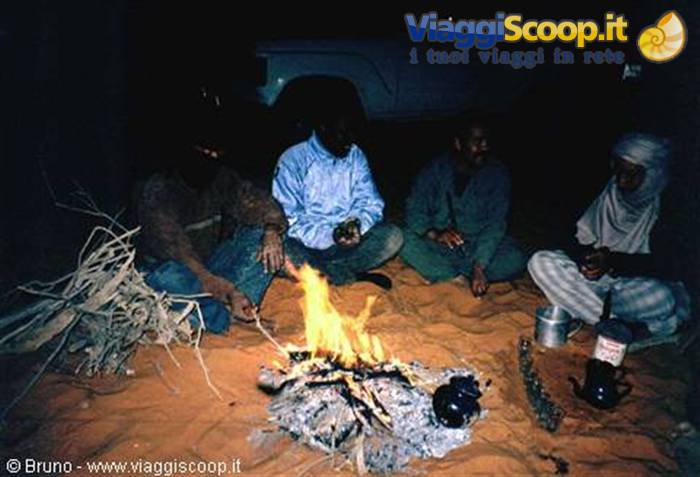
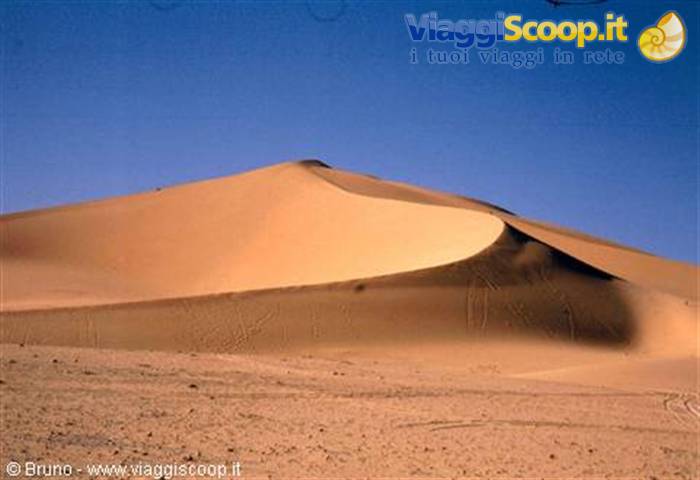
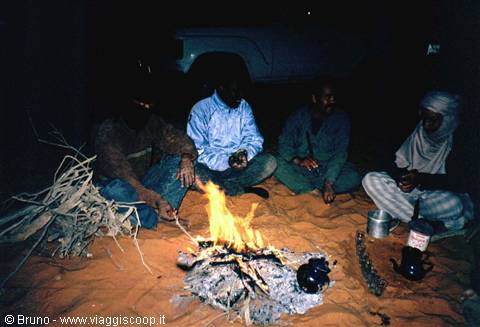
Wake-up at 7.30, as it will be for all the following mornings in the desert. At 9.30 second breakdown: a shock absorber of a jeep has given way. According to the drivers it's not an indispensable element, so it is simply removed!!! In a locality called Liba, 5 km from the Algerian border, we refuel with wood by gathering the dry bushes of the area. The journey continues in a monotonous environment, an immense plain of earth and stones with rare shrubs. An endless horizon at 360º. At 15 we stop at a panoramic point from where, in the distance, the first dunes can be glimpsed. At 17.45 we arrive at the place suitable for setting up camp. Finally among the dunes, in a very beautiful area with carrot-coloured sand. After dinner, around the fire, a pleasant evening in the company of the drivers and the guide.
Evening around the fire
Day 530 Dec 2005
Erg Hubari – Diwana Dunes (Jeep – 190 Km – 9 h)
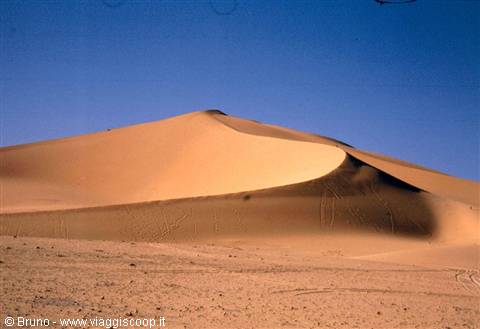
All night long there was a strong wind; fortunately the tents held up. The first part of the stage is very beautiful, all among light orange dunes. Before setting off, the jeeps' tyres are deflated to move better on the sand. Unfortunately the sky is hazy, there is no sun. Once the dunes are over, before tackling a rocky stretch, the tyres are re-inflated. The second part of the stage is again on hard ground covered with stones. The scenery is also less attractive; the landscape appears uniform and lacking in variety. We reach the campsite at 18:00. The area is decent, with sand, a tree and many bushes.
Dunes in the Acacus
Day 631 Dec 2005
Diwana Dunes – Ghat (Jeep – 220 Km – 10 h)
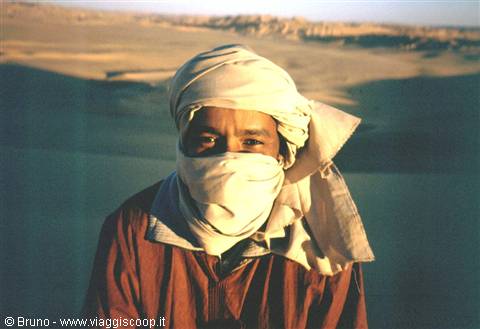
Tonight there was heavy humidity; all the tents are wet. As usual we set off at 9 for a stage that will prove particularly eventful. After many bogged-down incidents, a jeep stops due to a clutch failure. It cannot be repaired on the spot, so it has to be towed, with great difficulty given the rugged, sandy nature of the terrain. After about 50 km of towing with many bogged-down incidents, we come across the asphalt road leading to Ghat. The jeep is left at a village workshop and we reach Ghat with one car fewer. The incident causes a lot of lost time, so instead of arriving at 13:00 as planned, we arrive at 19:00. On 29, 30 and 31 December in Ghat, to celebrate the new year, the Tuareg festival is held. It is an event to which the famous and fascinating "blue men" flock from every part of the desert.
Dances, songs, displays of their crafts, a hymn to their extraordinary culture, whose traditions they jealously preserve. So, after pitching the tents at the Les Dunes campsite and having dinner, we go to watch the show, which goes on until late at night. We celebrate the new year in an unusual way.
The broken-down jeep cannot be repaired in a short time, so to get a replacement I phone the correspondent in Tripoli who, proving extremely efficient, manages to have it replaced within a few hours. In the morning, while the rest of the group visits the medina, accompanied by the police guide I go to an agency to confirm the flights for the return journey. After buying water, vegetables, fruit and bread, at 13:30 we set off for the Acacus. Fortunately the sun is shining, having taken the place of the clouds and the haze that veiled the landscape in recent days. The first part of the track winds over rocky terrain; the scenery reflects what we have already seen in previous days: flat ground with an endless 360º horizon. As we approach the park the landscape changes; beautiful deep-yellow dunes and unusual rock formations begin to appear.
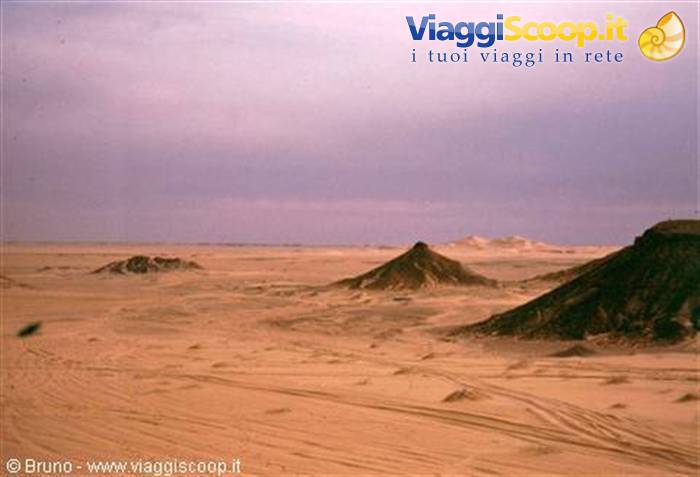
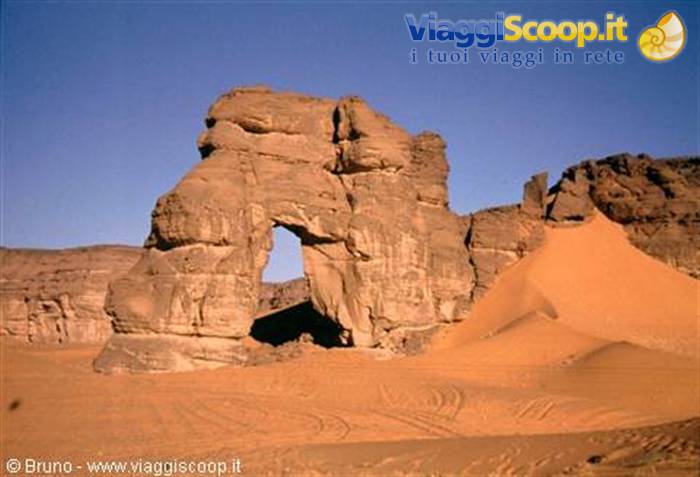
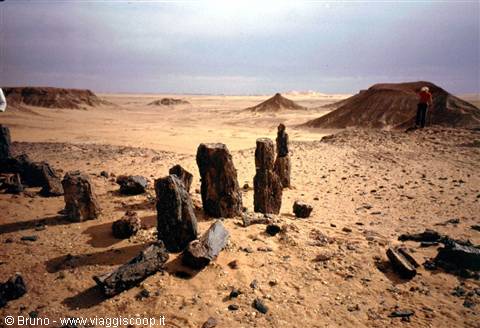
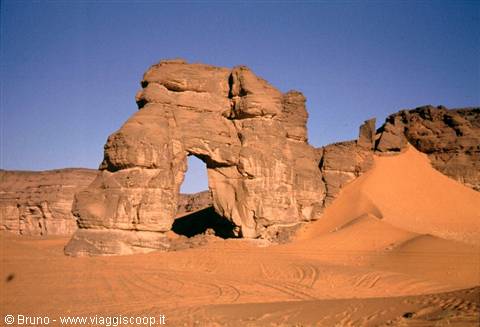
Once we cross the park's boundaries the scenery is breathtaking: very tall pinnacles jut out of the sand and alternate with the dunes. The Acacus alone is worth the whole trip! At 18:00 we arrive in the surroundings of the Fozzigiaren Arch, where the camp is set up. It's a shame the arch isn't visible; never mind, tomorrow we'll be able to see it up close. This is certainly the best time to admire the landscape, when the sunset light brings out the depth of the dunes and enhances their colours.
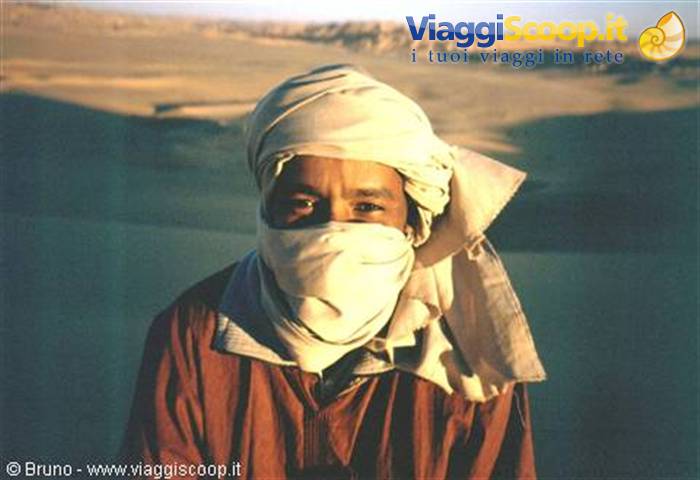
The usual departure at 9 in the morning. Suddenly the Fozzigiaren arch appears majestically in an open space where the branches of various wadis have created a sort of inner basin. Today is a short stage, about 80 km, with small movements in the heart of the Acacus and many stops to observe the famous rock paintings. The oldest paintings date back 10,000 years and depict the animals that now populate only the African savannahs. At 12:00 we make a stop at a large reservoir to replenish our water. The landscapes are always spectacular, with massive pinnacles emerging from the sand. The route continues among wadis, dunes, natural arches and spires that alternate continuously. In the afternoon we stop at the hut of Amrhar, an old Tuareg who was the guide of the Italian archaeologist Fabrizio Mori.
He shows us his photo in the company of the archaeologist and, to be photographed, demands 5 DL. From a relative of his we also buy a kid goat, which will then be cooked by our drivers.
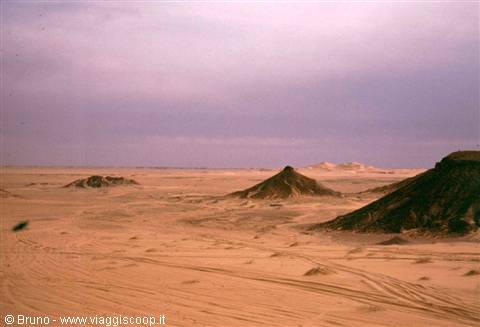
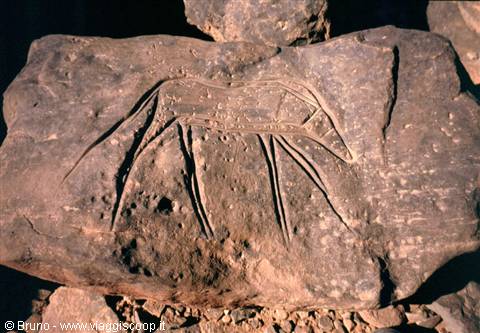
Today, reluctantly, we leave the Acacus. Before leaving the park we come across another beautiful natural arch. We then come out into an endless plain surrounded by high dunes which, little by little, give way to mountains of earth and stones. The journey continues across the plain all morning through landscapes that change continually. At 12:30 a lunch stop in a sandy area; but the sand doesn't last long, and rocky terrain begins again, always the same and flat to the horizon. The boredom is broken by a stop in the wadi Kassa, where there seems to have been a prehistoric settlement, to admire some engravings carved on large stones. The landscape around us is lunar, all rocks in an immense plain with a few small hills, also made of stones.
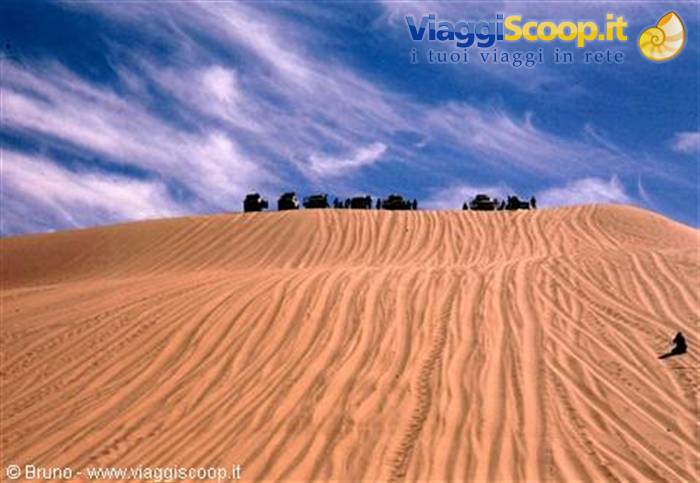
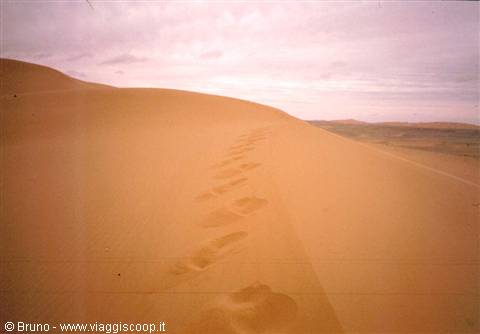
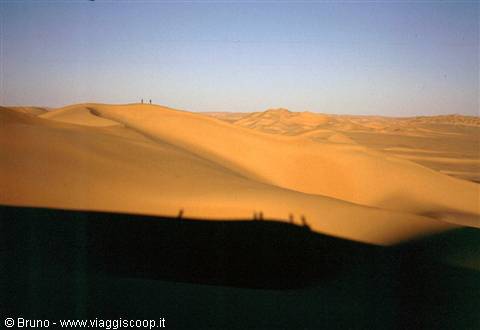
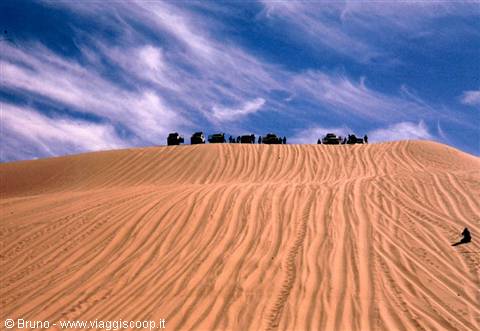
Shortly before arriving in the campsite area we find the dunes again; the scenery changes drastically and the place where the camp is set up is stunning. An imposing dune towers over it and many of us reach its top. The altimeter, at the summit, reads 935 metres while the camp is at 780 metres. In total 155 metres of elevation gain which, covered on sand, made themselves felt. We have left the Acacus behind to venture into the Erg Murzuq, an expanse of rolling dunes as far as the eye can see, mountains of sand up to 200 metres high that form veritable chains with harmonious lines.
Acacus - The Gatti Mammoni
Day 104 Jan 2006
Erg Murzuq – Wadi Baju (Jeep – 150 Km – 9 h)
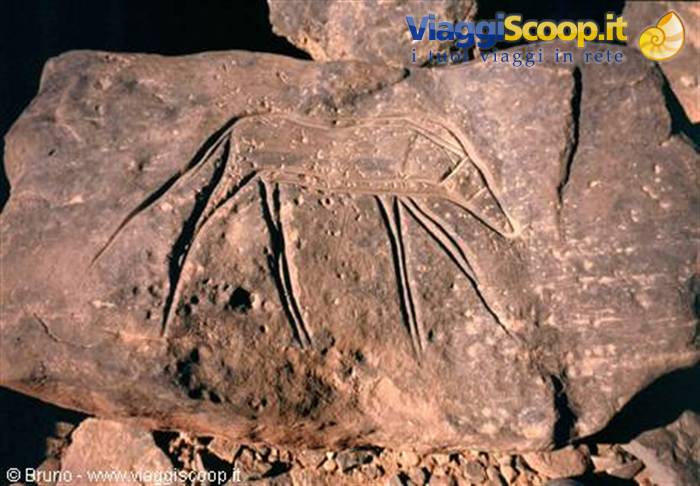
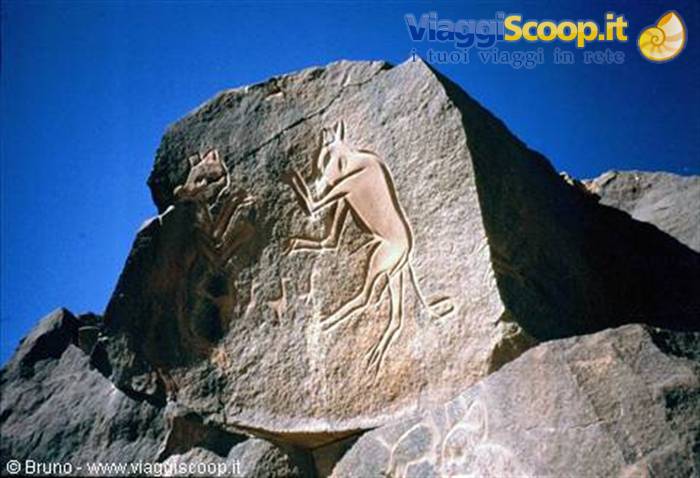
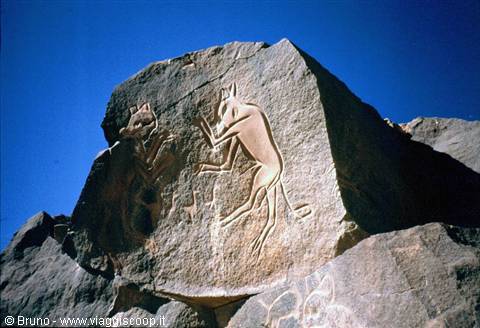
Tonight it was cold. Wake-up, as usual, at 7:30. It is still dark and we are all freezing. We warm ourselves around the fire and with a cup of boiling coffee. At 8:30 the sun arrives and immediately the temperature rises. Shortly after setting off we leave the dunes again and enter an endless, flat plain which, after about an hour, gives way to the stone ocean, an expanse of rocks as far as the eye can see. We cross it and, shortly before 11:00, reach the wadi Methkandoush, one of the largest concentrations of rock engravings in the world. In ancient times it was a watercourse along which there were many human settlements. Its length is about 12 km. On foot, in about 3 hours, we cover 8 km of it to admire the engravings depicting giraffes, crocodiles, elephants and other animals that populated this area before desertification.
The walk is pleasant, not at all tiring; the jeeps wait for us at the end of the wadi. We have lunch and, after visiting the two most important engravings, the Gatti Mammoni and the Coccodrillo, we cross the stone ocean again, which then gives way to a flat area that we cover at 80 km/h. At 18:15 we find the dunes again and stop to set up camp. The sun is setting, a freezing wind is blowing and it is cold.
Acacus - Tuareg guide
Day 115 Jan 2006
Wadi Baju – Erg Oubari (Jeep – 160 Km – 7 h)
During the night the temperature dropped noticeably. It probably even fell below zero because the tents are covered with a thin layer of ice. In the sleeping bag, in the open air, I felt the temperature drop only at dawn. After two hours, with the last stretch on asphalt, we reach Germa, ancient Garama, capital of the warlike Garamantes mentioned by Latin authors and the southernmost point of Roman penetration into the African continent. We visit the medina and the museum. Shower and packed lunch at a campsite where there is the possibility of changing money, although the operation turns out to be rather long because the campsite manager has to go to his own home to get the money. We thought we could call Italy but the phones don't work and the only petrol station is out of fuel.
The stage is shortened because the jeeps, after dropping us off in the campsite area, return to Germa to wait for the fuel, which is due to arrive in the evening. We are once again in a stunning place, surrounded by high dunes. We climb the highest one to wait for the sunset. As soon as the sun goes down the shadows of the dunes lengthen. It is an indescribable landscape, of such beauty that the many photos taken will certainly not be able to do it due justice. The only negative point is the temperature, which drops rapidly as the sun sets. The usual evening around the fire: tonight we stay up late, until 23:30, with the pleasant company of our drivers and the guide.
Ubari Lakes - Lake Mavo
Day 126 Jan 2006
Erg Oubari – Germa – Fjeaj (Jeep – 75 Km – 6 h)
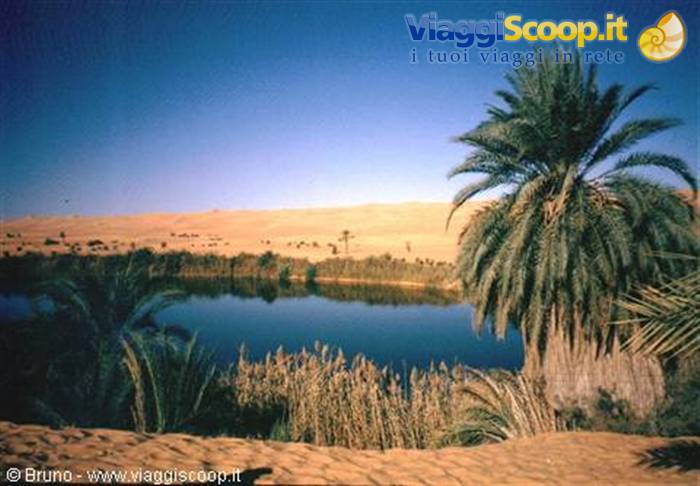
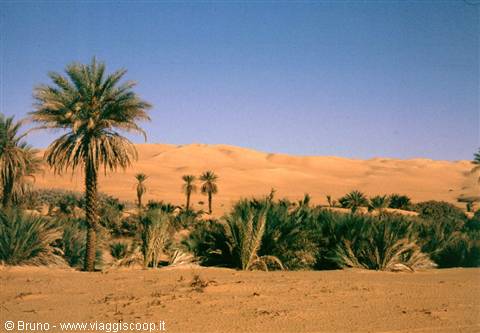
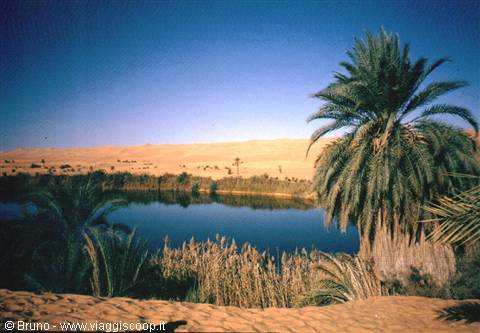
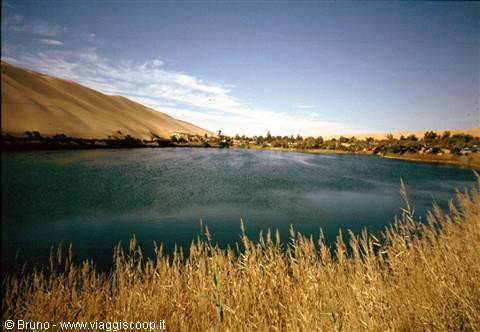
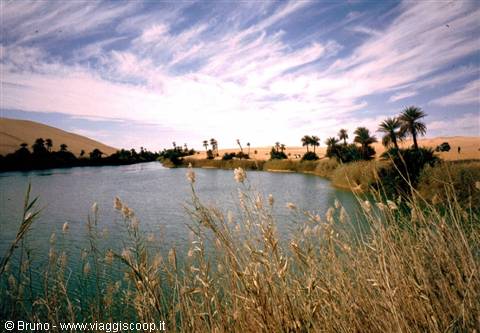
Tonight it was less cold than the previous one. Unfortunately it is the last day in the desert; the camp is taken down with regret, knowing that the tents will never be pitched again. It had been proposed to sleep one more night in tents in the dunes near Fjeaj rather than in a freezing, anonymous hostel, but the next day, given that a very long stage was planned to reach the coast, we would have had to take down the camp again in the dark. Today we visit one of the places of greatest interest in the Libyan Sahara, the lakes of Oubari. They are three characteristic small lakes with a high salt content, located in as many oases and surrounded by date palms. If the outside temperature allows, I highly recommend taking a dip; letting yourself float in their waters surrounded by the dunes is certainly a lovely experience.
In this season it is rather cold but, spurred on by our guide who dived in, I wanted to try immersing myself too. The water is lukewarm; a swim was certainly pleasant; the only problem came when getting out: without the towel, which was closed up in the jeep's luggage, and with the cold breeze that was blowing, it was not very pleasant! The usual departure at 9. After many ups and downs over the dunes we arrive, in about 1 hour and 30 minutes, at the first lake, the small and picturesque Mavo, surrounded by reeds and date palms. A short stop and, in about 30 minutes, we reach the largest lake, Gebraoun, surrounded by very high dunes. A stop of about 1 hour and we set off again for the third lake, Umm-el-Maa, undoubtedly the most beautiful and the most picturesque. Here, tempted by the guide, I take a swim, taking advantage of the long lunch stop.
A 20-minute drive from the third lake there was a fourth small lake, now dried up, Mandara. We visit it hastily, almost without stopping. Another hour or so of thrilling ups and downs over the dunes, then, unfortunately, we reach the asphalt road; after 10 km we are at the Fjeaj hostel. We say goodbye to our drivers, to whom we hand over what is left of the food supplies and a tip of 50 DL each. Tomorrow we will reach the coast by bus.
Towards Lake Umm el Ma
Day 137 Jan 2006
Fjeaj – Al Khoms (Bus – 1100 Km – 14 h)
Departure at 8 with a single 18+4 seat bus (on the way out we also had a 6-seat minibus). In 13 hours, with a few stops, we cover the 1100 km that separate us from Al Khoms. Dinner on our own, not from the common kitty because many participants didn't eat but went straight to bed.
Leptis Magna - Circus Maximus
Day 148 Jan 2006
Al Khoms – Leptis Magna – Tripoli (Bus – 120 Km – 2h)
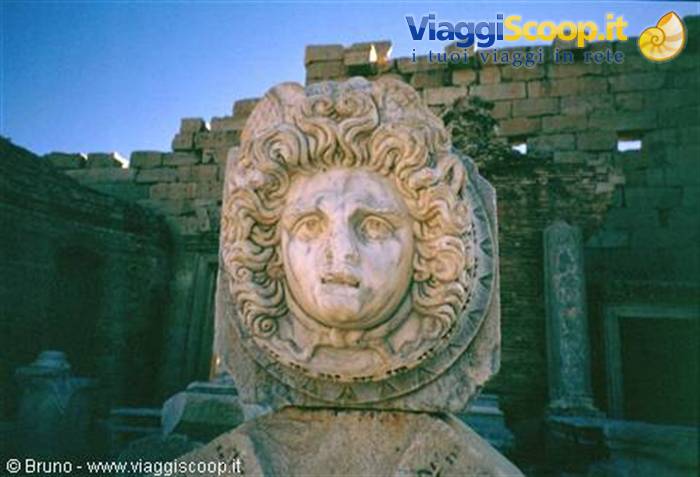
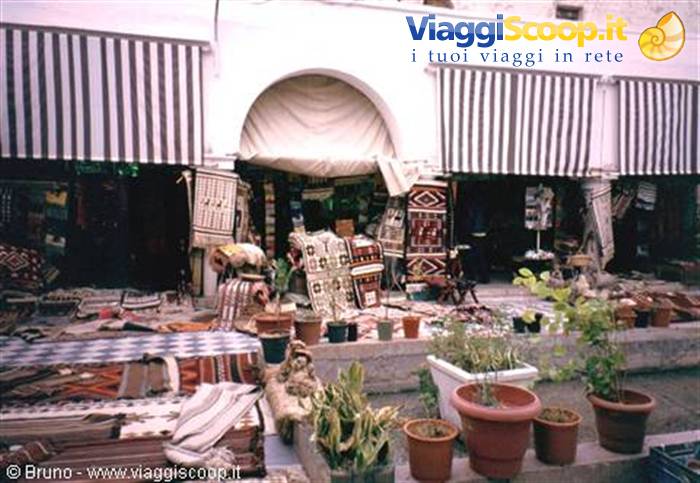
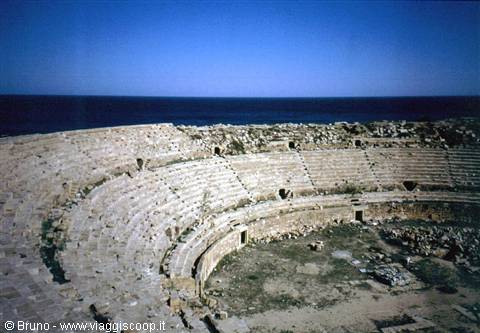
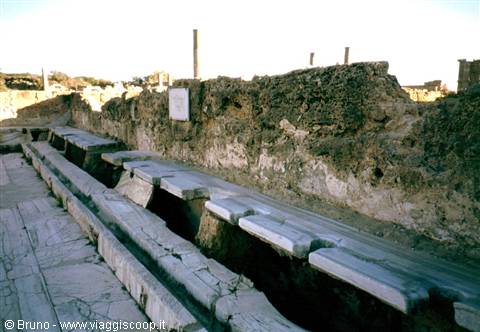
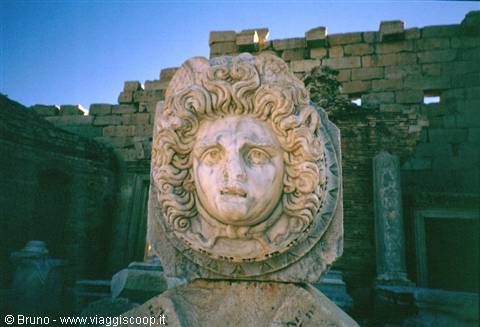
At 8:30 we are at the entrance to Leptis Magna, which is only 2 km from Al Khoms. We immediately look for an Italian-speaking guide for the visit. The ruins are stunning, thanks to Septimius Severus who wanted his hometown to be as great as Rome. The visit lasts 3 hours; we decide not to linger at the museum but to go straight on to visit the Circus Maximus and Villa Silin, still with the same guide. In the early afternoon we set off for Tripoli, which we reach after about 1 hour. We settle into the hotel and book the dinner planned for 20:00 at a restaurant; free afternoon with a visit to the suq.
Leptis Magna
Day 159 Jan 2006
Tripoli – Rome, Milan, Turin (Plane)
Departure at 6 for the airport. At check-in we discover that 5 out of 20 participants did not have a confirmed flight even though in Ghat we had relied on a local agency for confirmation. Fortunately the problem was solved, also thanks to the intervention of the correspondent who, alerted immediately by phone, even though he was still asleep, reached us at the airport in less than 1/2 hour. We say goodbye to our police guide and board the flight to Rome, where we part ways, saying goodbye with a shared promise to see each other again soon. Conclusions This is certainly one of those trips that many of us would like to repeat. Even the people who, never having been to the desert, had decided with some apprehension to undertake this experience.
There was good chemistry among the participants, as well as with our drivers and the guide, who were also excellent travelling companions in every respect; this allowed us to live in harmony even through the various, inevitable hardships.


1 reader comments
foto grandiose e splendida desrcizione, come sempre!