A photographic safari among the most beautiful parks of Kenya
Day 12 Aug 2004
Arberdare treetops
We arrive in Nairobi and our guide is waiting for us. His name is George and at first impression he reminds me of the guide in Tanzania: friendly, likable and capable of putting you at ease right away. We get on the minivan, super-equipped for safaris, and begin to make friends with Matteo and Jessica, two young people from Modena who are doing the same trip as us. They, however, will continue their journey in the parks of Tanzania when we will be heading home. Unfortunately, the mishaps of the trip meant that two other people belonging to our group have already arrived and are waiting for us at the Lodge of the first park. We leave Nairobi and clearly the visual impact is devastating. If you compare it with our cities you risk taking a leap into the past.
So many people on the streets (chaotic and without rules), endless markets of fruit, vegetables, clothing displayed on wooden tables or cloths laid on the ground. Huts made of sheet metal and wood are most of the houses. Around noon we arrive at Aberdare, near Mount Kenya (5100 m), where we leave our suitcases, take what we need for the night, have a quick lunch and head to Treetop. Truly unique and beautiful. A lodge built in the trees where the water pools around it attract animals to drink, especially during the night. It is here that we meet and get to know the two girls who are part of our group, Silvia (nicknamed later The Queen) and Barbara from Arezzo. At dinner we chat a bit and then go to sleep because the day has been tiring, but during the night we got up a couple of times to see the rhinos and hyenas that came to drink.
In the room we have a buzzer and when there are interesting animals to see the guard sounds it so as to wake you up. The temperature is quite cold, even though we are on the equator, but we are also at 2200 m of altitude.
Cheetah in Maasai Mara
Day 23 Aug 2004
Samburu
We return to the previous day's Lodge to pick up our luggage and head towards the Samburu nature reserve, north of Mount Kenya. Before entering the park we visit a Samburu village. They are a population similar to the famous Maasai with slightly different customs and traditions. The village is fenced with a series of thorny brambles that serve as protection, and the huts are made of straw, animal dung and mud. The living conditions are truly prehistoric. They have no water, there is no electricity, there is no sanitation. The Samburu women welcome us with a welcome dance and then show us their huts. We arrive at the park in the early afternoon. The lodge is very beautiful but above all it is in keeping with the savannah theme. Straw roof, wooden interiors and immersed in the vegetation and just a few metres from the river.
The water is red (due to the soil) and the crocodiles seem to swim well. Claudio and I look at each other but say nothing. Surely if they built it in this spot it's because there are no problems. The fact remains that seeing a crocodile just a few metres away is a thrilling experience. We have a quick lunch because right afterwards we set off for the first real safari. We are pumped with adrenaline. Meanwhile George has opened the roof of the van so we can stick our heads out with our various cameras and video cameras. Ready and off—right in front of our vehicle, about 1 metre away, a leopard crosses the road with complete calm, making us understand that this is its home. Incredible, it's a feline that's hard to see since it lives alone in the trees. What fur, what a coat. Extraordinary. Following the dirt roads we approach the river and a family of elephants is bathing.
There are about 10 adults and 4/5 calves. A male elephant can weigh up to 3000 kg. We continue along the riverbank and encounter some reticulated giraffes, a species that lives only in this park, zebras, impalas and then, as if by magic, ahead of us, three lionesses in a line coming towards us. My experience with lions gave me a fair amount of confidence but the emotion is such that goosebumps appear on my arms. We stop the van so as not to frighten them and they treat us to a fine parade just a few metres away. Evening falls and with great satisfaction we return to the lodge for a shower (there's plenty of dust) and to grab a bite to eat. During the evening we exchanged our opinions and I discover with great pleasure that Africa is winning over the other companions too.
Cheetah in Maasai Mara
Day 35 Aug 2004
Lake Nakuru
The roads are a disaster, small patches of potholed asphalt alternate with dusty dirt tracks. We are heading towards Lake Nakuru, kingdom of the pink flamingos. We stop for a break and to get fuel, and at the roadside about ten children appear and ask us if we have anything to give them. I open my suitcase and take out a pack of coloured pens, some notebooks and fill a backpack with T-shirts I had collected in Italy before leaving. I thought I had brought enough material but the reality is that the effort of a single individual in those places is nothing but a drop of water in the universe. I go closer and I see in the children's eyes excitement at its peak. They don't give me time to open the backpack because I am mobbed and they snatch things from my hands. The stronger ones grab and run, the little ones look at you and my heart breaks.
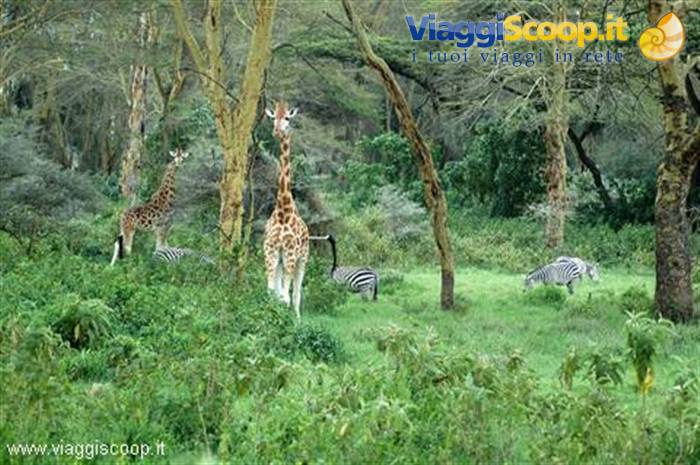
What do I do? Do I take the rest or save it for other children I'll meet along the roads? They are touching scenes, in fact for about an hour I stayed apart with my thoughts. We arrive at Nakuru and immediately an invasion of baboons blocks the van's passage. The environment is very green and the scene that presents itself is fabulous. Giraffes, zebras, buffaloes, impalas, elephants and finally I manage to see the rhino very close up. The lake is a short distance away and its colour tends towards pink. An invasion of flamingos lives in the lake and nearby a colony of pelicans with some marabous are eating. As it is a salt lake, along the entire shore the colour is the white of the deposited salt. Towards evening the sky always clouds over a little but it doesn't rain because this is a dry period.
Usually, in Africa, there are two rainy periods: November–December (short rains season) and April–May (long rains season). Our lodge is, of course, immersed in the savannah and during the night you can hear the male lion marking its territory with its roar.
Cheetah in Maasai Mara
Day 46 Aug 2004
Maasai Mara
As the days go by, the relationship with the other travel companions becomes ever stronger and, with pleasure, talking with Claudio, I can now say with certainty that we were very lucky to meet people who made this trip even more beautiful than we had anticipated. I have always considered the "quality" of the company not essential but important for the success of a trip. The guide George also turned out to be really likeable and professional. With us, in two other vans, are some Italians (nicknamed "The princess with her court") and the rest are Spaniards. George teaches us a very famous local song, Jambo, so during the transfers we spend a bit of time belting it out. Here we are at the entrance of the Maasai Mara, the most famous park in Kenya. This park is the northern continuation of the Serengeti (Tanzania) and is divided by the Mara River.
In this park a phenomenon unique in the world takes place, called the migration. In fact, every year around mid-July about 1,600,000 wildebeest, 600,000 zebras, 400,000 gazelles, giraffes and elephants move from the Serengeti to come to the Maasai Mara. They follow the monsoons and therefore the rains to reach places where they are sure to find grass and water in abundance. Unfortunately along the way they must cross the river, habitat of large crocodiles and felines that await them with impatience. These immense herds remain in Kenya until mid-October and then return, finding the dry plain of the Serengeti that is turning green under the effect of the rains. To say that there are hills and prairies full of animals still doesn't say enough. The landscape is completely different from the other parks; here it is steppe with grass tending towards yellow.
The plants are found along the watercourses and the environment is hilly and very vast. The contrast between the blue of the sky, the yellow of the grass, the green of the plants is huge, and if we add the colours of the animals (giraffes, zebras, gazelles, etc.) it becomes a beautiful palette of colours.
Paradise in Lake Nakuru
Day 57 Aug 2004
Maasai Mara
A full day of safari in the Maasai Mara. After having breakfast and taking the food bag for lunch we go to visit a Maasai village. They differ from the Samburu in culture and customs but are similar in many things. The village chief invites us into his Manyatta (hut). Inside it is dark and there is a lot of smoke because they have lit the fire. At night the temperature drops a lot and so the cold is felt, unlike the day when it can reach 35°. These huts too are built with mud, dung and reeds. They dance and sing for us, they show us their customs and their products. In my opinion, the Maasai are, physically, truly beautiful people. We begin the safari and it is a magnificent day because finally I experience it fully among "my lions", above all Simba, the king of the forest. There are males that reach 300 kg and are enormous. When our gazes meet I have the feeling of being shot dead.
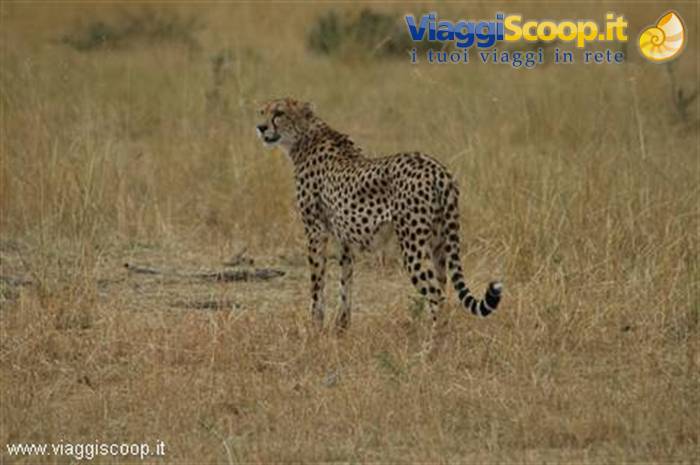
The females are with the cubs and there are an unbelievable number of them. Another stroke of luck was seeing the cheetah (2 metres away) with four cubs. Marvellous. In this park there are all species of wild animals and by and large we have seen them. Obviously along the river there are also hippos and crocodiles.
Paradise in Lake Nakuru
Day 68 Aug 2004
Nairobi
We return to Nairobi and unfortunately our safaris are over. We begin to say goodbye to the girls from Arezzo; they are doing a beach extension near Mombasa and we spend the afternoon shopping for last purchases. We don't go far into the city because it is dangerous and ill-advised. I begin to realise that for a while I won't see the lions anymore and a small feeling of sadness comes over me. Chaotic city, an incredible mess. Everyone shouting, honking, revving their cars and buses. You can't breathe. Visit to the house of the writer Blixen, author of Out of Africa.
Paradise in Lake Nakuru
Day 710 Aug 2004
Return
For more information, itineraries, photographs, maps of my other trips visit

0 reader comments