Addis Ababa, Langano, Awasa, Yabelo, El Sod, Konso, Jinka, Turmi, Arba Minch, Omorate · Adis Abeba,Oromia,Nazioni Nazionalità e Popoli del Sud
When
30 Apr 1991 – 14 May 1991 15 days · trip of 1991
Who
antonio · @antonio ·
How
Travel diary
The story · 13 days
An incredible adventure in a primordial place among the tribes of the Omo Valley in southern Ethiopia. Departure from Rome Fiumicino on a Turkish flight for Istanbul in Turkey. Then a flight with the same airline from Istanbul to Addis Ababa, where we arrive after midnight. The trip was made with five travel companions, one of whom I met at Rome airport and the others in Istanbul. On the way back from Addis Ababa we fly again with the same airline, so a stopover in Istanbul from where, after a long wait, we set off for Rome, where we land in the early afternoon.
Day 15 Jan 1991
Arrival at Addis Ababa airport around 00.00, purchase of the visa and transfer by minibus to the MN Hotel where we stay overnight. The following morning after breakfast we set off on the Tour with two Land Cruisers and their drivers. First stop at the Tiya monolith field then at Lake Ziway where numerous birds are observed including ibis and marabou. Children swim in the waters. We continue to Lake Langano, one of the many in the Rift Valley, where we take lodging at the Wendy Lodge in a characteristic hut. With a guide we walk in the riparian forest where baboons, birds and colobus monkeys that leap from tree to tree live. We then reach the shore where we meet children. Dinner is in the characteristic restaurant of the Lodge under a large gazebo enriched with elements of Ethiopian tradition.
I and the friend from Naples met at Fiumicino airport sleep in our hut at the edge of the forest, there's no electricity and the only noises are those of nature. Among other things, while we're comfortably lying down we see two warthogs passing near the lodging.
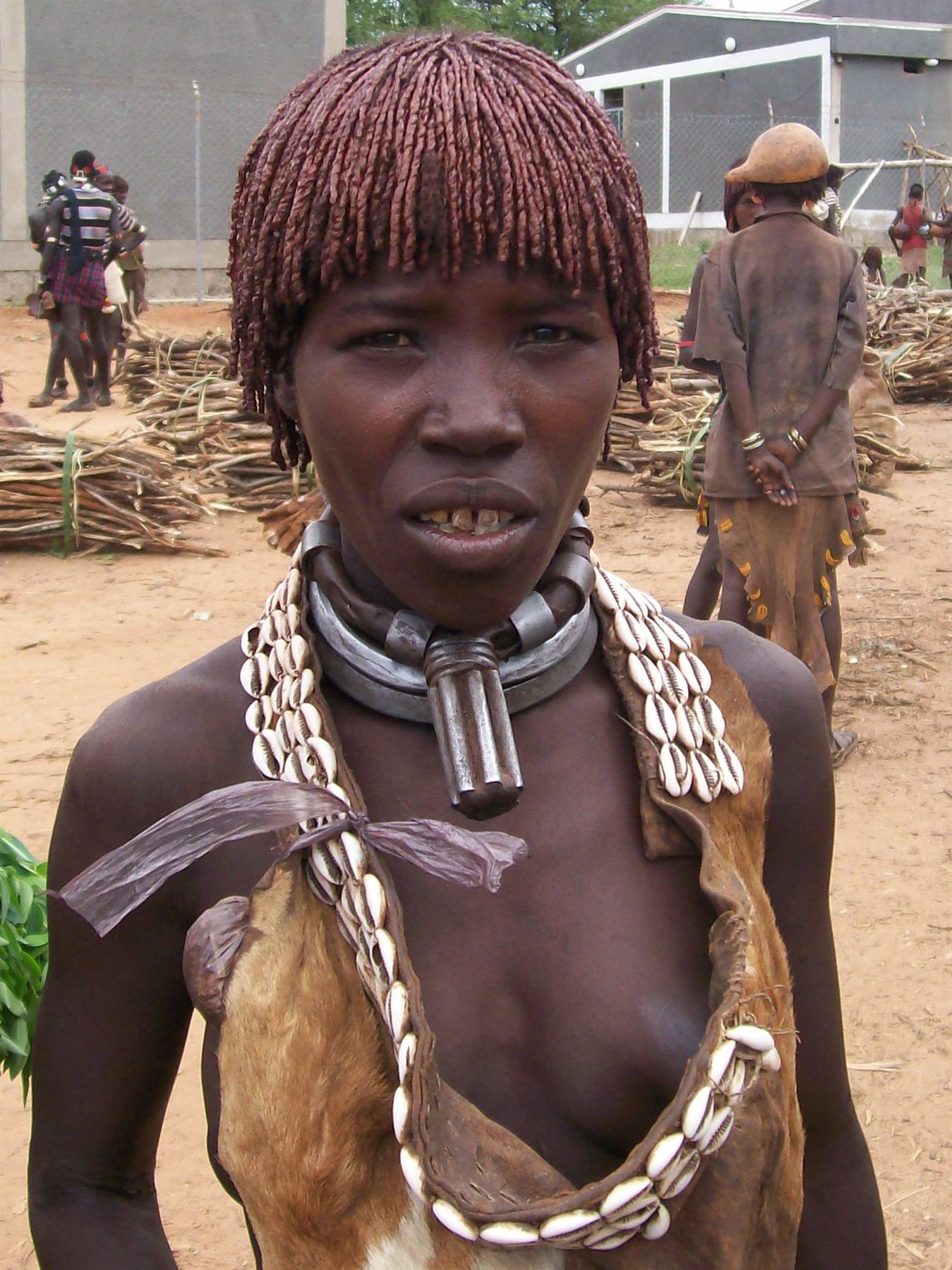
Dimeka-Hamer woman
Day 22 May 1991
From Lake Langano to Yabelo
It rained tonight, after breakfast we set off for a long transfer of about 400 km southward. We pass through Shashemele, the capital of the Rastafarians who in the 1930s moved here from Jamaica with the concession of the Negus whom they identified as the Messiah. We stop at the fish market of Awasa on the shores of the lake of the same name. There are a series of little boats lined up and the fishermen are preparing their nets while pelicans splash in the water. Nearby a boulevard of "cobblestones" is under construction and numerous workers of both sexes are meticulously fitting them together one with another. Continuing on we stop a couple of times along the road to photograph clusters of huts whose surrounding land is furrowed by rudimentary wooden ploughs pulled by horses like those seen on the bas-reliefs of ancient Egypt.
We also stop at Totu Fella to see some strange long, thin steles. More than the archaeological site, the dirt road we have to take to reach it is interesting as it skirts characteristic villages. In the evening we arrive near Yabelo where we stay at the Residence of the same name, a structure similar to an American Motel with the rooms all lined up facing a central courtyard. The Restaurant is also frequented by locals. After dinner we retire for the night.
Dimeka-Hamer woman
Day 33 May 1991
After breakfast we take the road south that leads us to El Sod. We are in Borana land, but not everyone wears the colourful clothes that distinguish this tribe. Many wear second-hand T-shirts and shorts, often torn and always dirty. The interest of El Sod lies in its volcano called "House of Salt" in whose crater lies a muddy and gloomy black little lake where for centuries a salt rich in iodine has been extracted. We park at the edges of the crater and go down the 250-metre wall to the lake. On the steep path there's a continuous up and down of men and mules loaded with a couple of sacks of salt. On the shores of the little lake we see two boys who immerse themselves in the dense dark water to extract the precious goods. The climb back up the crater is very hard and halfway I prefer to hire a local so that for 100 birr (really little) he'll let me ride up on his mule.
It's not easy to stay on the back of this slender but powerful animal which, urged on by its master's blows, climbs up the rocky path. Not rarely we skim the precipice, but I'm too tired and focused on gripping the rope that encircles the mule's neck to perceive the risk of falling into it. Once at the top with my companions we move a few km to see the "singing wells". Basically they are large wells dug for about 30 metres used to supply water to the herds. We're in the season of the small rains and there isn't this need but some boys give us a demonstration of how the water is brought to the surface through the hand-over-hand, a long and hard job done while singing. We can only imagine what the atmosphere and the work are on days of drought when these wells operate at full pace.
Returning to the Hotel in Yabelo we stop to photograph a group of dromedaries feeding in a field where among other things a female is nursing her young. When we arrive at the Motel it starts raining steadily and given the gloomy day we lie down in the room. After the nap we go to the run-down centre of Yabelo where we navigate in an internet point with a slow connection. In the evening we have dinner at the Motel with injera and zighinì, a typical Ethiopian dish consisting of a large and soft crepe of a grain called tef on which is placed a very spicy tomato stew, really disgusting!! At the end of a rainy and cool day (I had to put on my jacket) we go to sleep.
Dimeka-Hamer woman
Day 44 May 1991
Konso
Last night I dared too much and the zighinì did its damage. During the night I tossed and turned continuously in bed, my lips feel swollen and my right eye burns. At breakfast I limit myself to tea which strangely is very good and flavoured with cloves. Despite this during the transfer to Konso I begin to feel weaker and weaker and lose my appetite. Passing through the run-down town of Konso we go to visit a nearby village of the ethnicity of the same name which is located on a hill. The village is surrounded by stone walls within which there are further divisions into sectors formed by fences of woven branches. In these enclosures there are various circular huts with conical thatched roofs and walls of wooden slats. The interior of the huts is bare and dark, you enter through a narrow slit.
In the village there's a clearing for ceremonies with the "tree of generations" in the centre and at the sides the rudimentary barely sketched wooden statuettes of the local heroes buried here. There's also a large hut without walls where the men gather to decide on common matters. We also visit the school where the children study in classrooms poorly lit by a few rays of sun filtering through the narrow windows. The luckiest follow the lessons in the garden, under a large tree. At the exit of the School the village fills with cheerful children in uniform. As in much of Africa, it's the women who carry out the heavy tasks, we see them walking with their shoulders heavily loaded, caring for the children, cooking in front of their hut with the pot placed to boil directly over a flame.
The men generally spend their time drinking and getting drunk with the local beer which they gulp down from the hollow of a dried gourd. We move to the nearby village of Gesergio where a strange rock formation roughly recalls the pinnacles of the American Bryce Canyon. Once at the Lodge I go immediately to the bungalow to lie down. I'm extremely weak and confirm with the thermometer more than 38 degrees of temperature. I stay all day and until the following morning in bed filling myself with Tachipirina and fasting.
Dimeka-Hamer woman
Day 55 May 1991
Key Afar and Jinka
The fever has passed and after breakfast at the Lodge restaurant we visit the market in the center of Konso, though it is still partially being set up. In this part of the world, markets have their peak moment in the late morning, when the various tribes come down from the surrounding villages for the weekly gathering where they display to one another the products of the land and handicrafts for sale or barter.We begin the long transfer to Jinka. The main roads, even the unpaved ones, are wide and well packed, there are no potholes, and we often come across construction sites busy improving them. We stop at Key Afar, where one of the most important markets of the Lower Omo Valley takes place.
The large grassy field where the goods are displayed is crowded; members of various tribes have come here on foot, some traveling as far as 30 kilometers; to do so they set off on foot early in the morning, although there is no shortage of a few lucky ones who found a ride in the back of a truck. They all wear their colorful tribal clothes and show off distinctive hairstyles. It is a spectacle: feathers, beads, sequins, bracelets are proudly displayed. The girls have fanciful hairstyles, their strands of hair mixed with ochre and resin, sometimes polished with urine. The men are armed with knives and machetes, the women carry a Kalashnikov slung across their shoulders. To be photographed they demand 2 Birr; they begin the approach by haughtily scolding you for having framed them, but once they receive the small payment, they greet you with a smile.
The children know the business too, and holding out a hand they insistently invite you to photograph them. Some craftier ones take you by the hand and won't let go until you give them 1 Birr. In the courtyard of what by local standards should be a bar but where back home you wouldn't even keep an animal, a group of women is sipping beer from improbable cups made of gourd and tin; we are invited to join them but politely decline. A group of boys from a nearby village invites us to their initiation ceremony the next day, which we could attend for a fee. After the satisfying immersion in the market, we have lunch in a dive not very different from the aforementioned bar and continue on to Jinka. Once in town we take possession of our rooms in a hotel. The location is central but the rooms are cramped, there is no electricity, and there is no hot water.
The town is a jumble of dilapidated houses and sheet-metal huts; the central square is a wide dirt lot, dusty, with a squalid circular reinforced-concrete fountain in the middle, naturally without water. Along the streets there is a permanent market frequented by dirty people dressed in poor rags. In Ethiopia tribal clothing has its charm, but when people try to westernize by aping Westerners they look like what they probably really are, a mass of dispossessed people. We also find a madman who rails against us and Italy; we drive him off with the help of a policeman made not very authoritative by his dusty uniform. We go into the only internet point, which has a very slow connection that is in fact unusable.
Back in our small, ugly room we wait for dinner, which we eat in what is supposed to be the best restaurant in the area but which in reality is a squalid place like the rest of the town. Apart from the vegetable soup, the rest is inedible. We return to the hotel to spend the night.
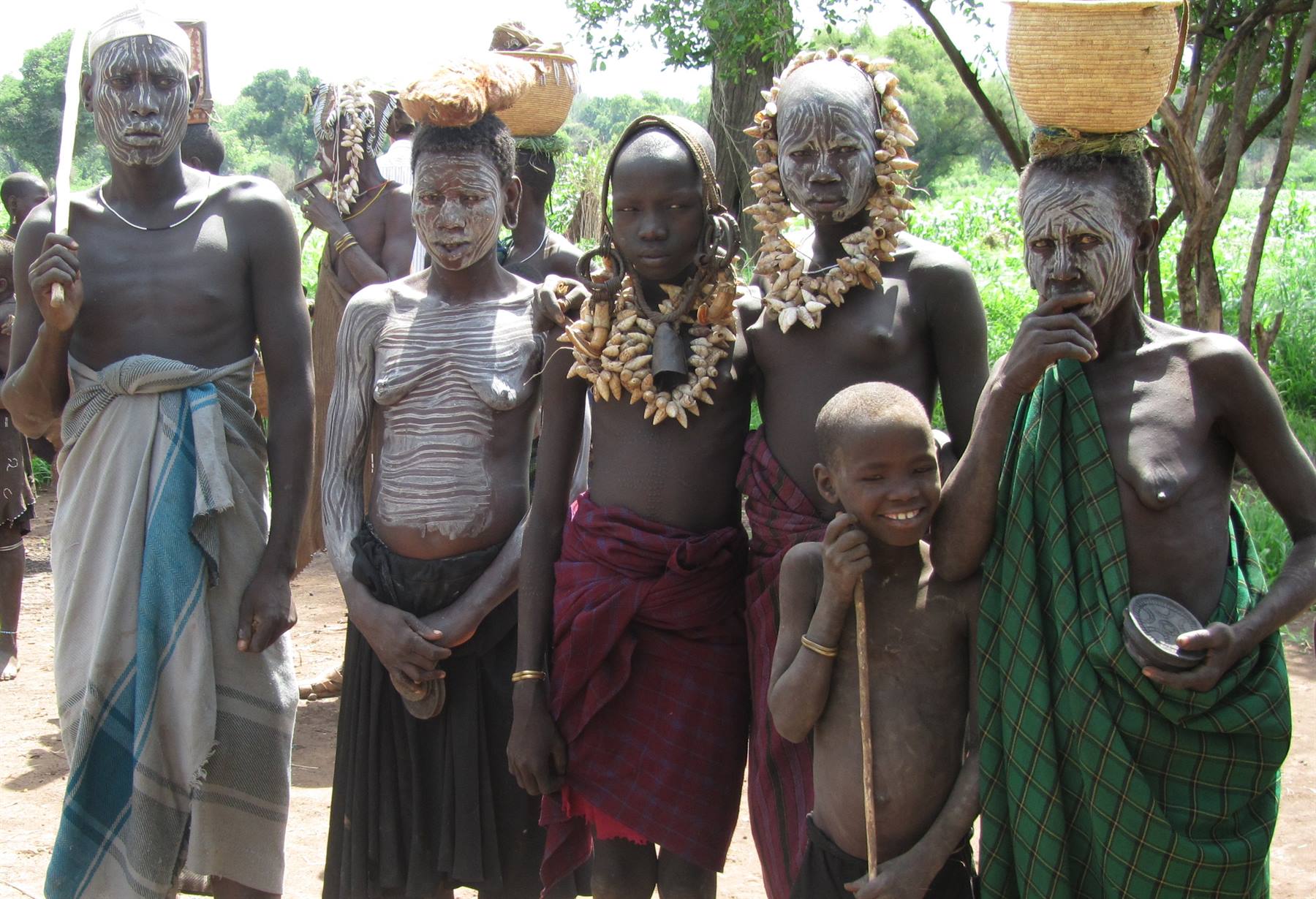
Murzi
Day 66 May 1991
Murzi, Banna and the Bull Jumping
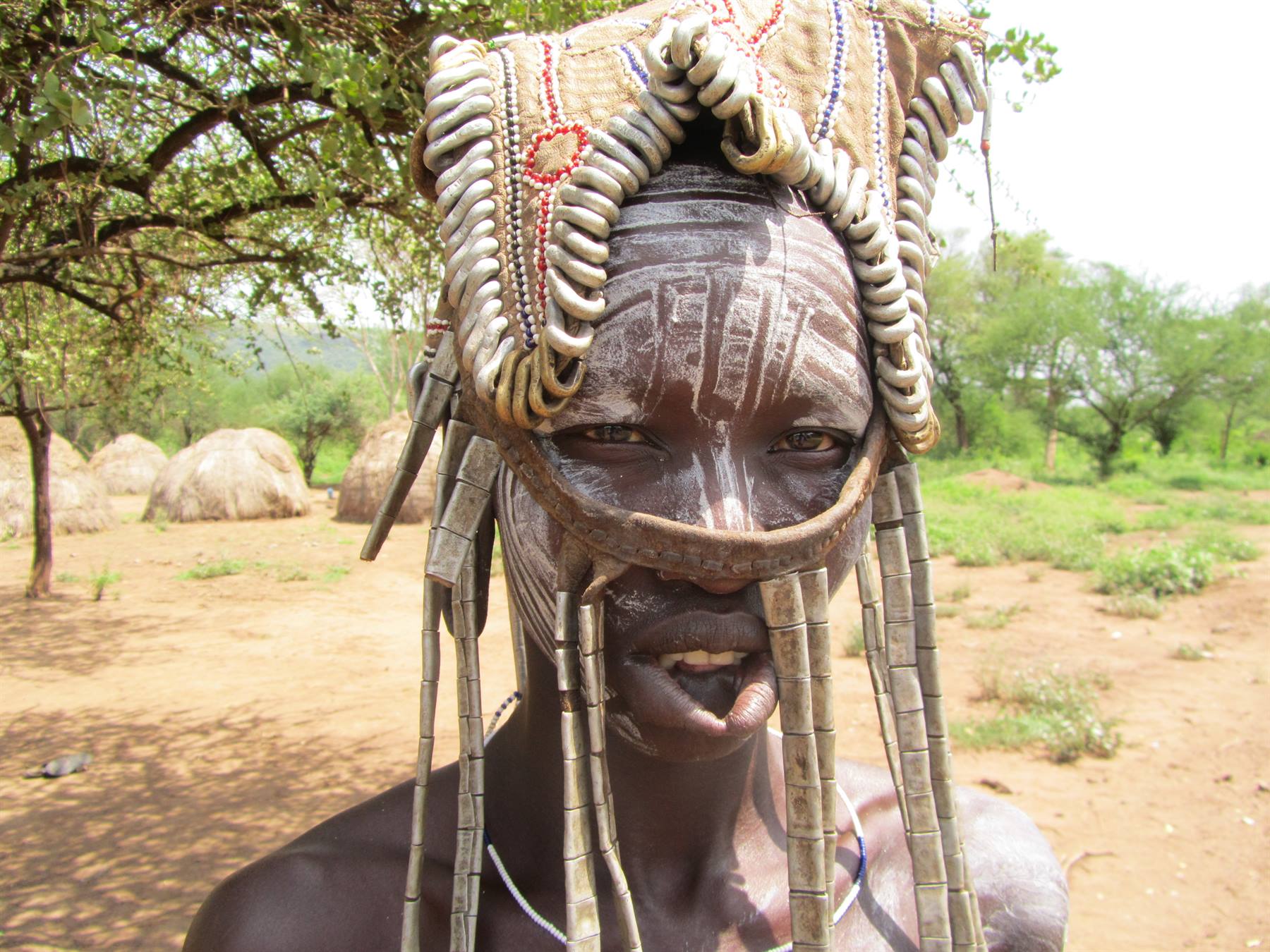
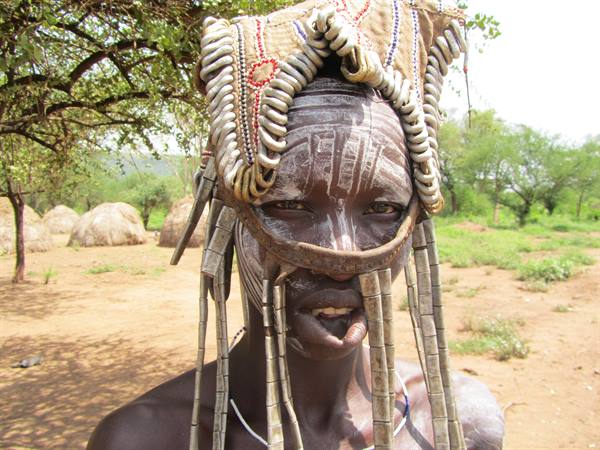
As usual we get up early, load the luggage onto the off-road vehicles and move to the restaurant for breakfast. We don't know exactly how the day will unfold because we can't get confirmation of the ceremony we were invited to yesterday at Key Afar. We go to Mago National Park, famous less for its scarce animals, which are difficult to spot, than for the presence of one of the most famous African tribes: the Mursi. In fact, the park consists of hills covered in thick bush, so it is clear that we will only be able to see the animals that cross the dirt road. In practice, along the way we see a kudu, a few baboons, a small group of Thomson's gazelles, a bounding Grant's gazelle and numerous dik-diks. After crossing the bridge over the Mago River, one enters Mursi territory. This tribe is famous throughout the world for the lip plates worn by the women.
Their whole way of life has remained more or less as it was when they were discovered by European explorers, the only exceptions being a few T-shirts given by passing tourists and the pressing demand for birr to be photographed. Their clothes and their hairstyles elaborated with traditional objects are striking. Those who are not temporarily wearing the disc show the shocking mutilation of the lower lip completely detached from the rest of the face. We photograph the women in front of their cramped igloo-like huts irregularly scattered through the bush. We stop in two villages, then, after crossing the bridge over the Mago again, we return to the park, where surprisingly we spot a lioness, an extraordinary event in Ethiopia. We stop at the Rangers' headquarters to have lunch in the shade of a gazebo with sandwiches prepared by the restaurant in Jinka.
Just as we are about to return to town, when we had lost all hope, the phone call arrives confirming the tribal ceremony we cared so much about. Passing through Jinka, we quickly transfer to Key Afar, where the local guide is waiting for us. From here we take a newly cut secondary track over the hills. We pass through a village that we assume is our destination, but instead we keep going straight for several more kilometers on an up-and-down track that is difficult to identify and that abruptly ends in front of the high bank of a completely dry river. From here we continue on foot along a path that goes deep into the hills covered with scrub. After fording a stream where the women collect water, we begin to hear singing in the distance coming from a hilltop. We climb, meeting more and more people along our way decked out in tribal clothes, until we reach the village.
The celebration involves all the locals. We are among the Banna; the women have bob-style hair made of tapering braids sprinkled with red ochre, some have half a dried gourd on their heads and a Kalashnikov slung across their shoulders. They wear strips of leather on which many small Red Sea shells are placed, and they casually expose their ample breasts. The men generally wear a headband of multicolored beads on their foreheads; some have their hair partly covered with colored clay, to which mosaic tiles are applied. The Banna are very beautiful, their facial features refined and well proportioned, their skin a bronzed black, and all have conspicuous scars on their bodies like scales. These deliberate wounds are called scarifications and are made by cutting the skin to cause a controlled infection; ash is placed on the laceration so that the scar becomes permanent.
Men and women draw an alcoholic substance from large terracotta jugs, and with wooden stirrers they fill containers made from hollowed-out gourds. There is also a large tin pot on the fire cooking an indecipherable dark beverage. We go to offer our respectful greeting to the village chief, a tall, slender little man who strangely wears a cotton T-shirt with horizontal stripes that has nothing to do with Banna tradition and who allows us to photograph freely. The chief would like to seal the agreement by offering us the mysterious liquid cooking in the pot, but reluctantly we politely refuse. The women sing, jumping and marching on the hill; the men drink together under a low hut without walls and with a floor of leaves. Several times the women form a circle and in turn one of them begs one of the men to whip her.
The man takes a long leather thong and strikes her violently, causing deep welts; the woman thanks him with a leap forward, then goes to another man to be whipped again. Some undergo the "pleasant" ordeal while playing a small horn, and none lets any grimace of pain show. Young and old happily undergo the same treatment, while nursing mothers are excluded and watch the scene apart with their babies. The grim spectacle moves us; we feel as if we are inside a documentary, suddenly thrown almost back into prehistory. We passively witness this celebration, incomprehensible by our standards but fascinating. Songs and whippings alternate; many are by now in the grip of alcohol, but everyone is intent on watching the hero of the day, young Maza, little more than a child. Maza is under a tree embracing his mother and surrounded by many people.
He performs ancestral rites such as dropping metal rings into a wooden wedge, then they sprinkle him with milk and lead him onto the clearing where a dozen stamping bulls have been lined up. The animals are restless; one tries to break ranks but is put back in line by being yanked by the horns, another escapes from the enclosure. Two calves serve as a stool for Maza, who takes a running start and, as the sun sets, walks on the animals' hides three times, performing the archaic leap with which, by right, despite his young age, he enters the world of adults. We leave Shaba, that being the name of the village, retracing the path backward with uncertain steps in the darkness lit by the faint light of our flashlights. The firmament above us is clear, favored by the total absence of air pollution. Only the sounds of nature can be heard.
Once we reach the off-road vehicles, we return to Jinka for dinner at the restaurant and the night at the hotel. We are tired but fulfilled at having witnessed an event we will remember forever. We think of Shaba and imagine that the celebration is now continuing in a collective orgy where primal instinct prevails over every form of restraint and conditioning.
Murzi
Day 77 May 1991
Dimeka
After a day like yesterday's, so exciting and unrepeatable, we are aware that the journey cannot offer us anything more sensational. We wake early, have breakfast at the usual little restaurant, then leave Jinka heading for Turmi. We could have stopped at the weekly market in Jinka, but we prefer to stop along the road at the one in Dimeka. Here we first visit the section reserved for the sale of livestock, truth be told disappointing, then, in the center of town, we go to the actual market. It is a parade of traditional clothing of the Hamer and Banna tribes, which are, moreover, very similar. The Hamer are distinguished by darker skin, an intense black. Married women have a collar with a phallic symbol protruding from it. It is not surprising to see them worn even by 12-year-old girls, because here marriages are arranged by families and people marry at a tender age.
In these tribes where polygamy prevails, however, only the first wife has the right to wear the collar. Almost all of them, on the other hand, show their breasts, and the rest of the body too is vaguely covered by triangles of leather decorated with beads and Red Sea shells. I have certainly seen more breasts today than I might happen to see in a lifetime. The men are less traditionalist; they still sprinkle their hair with earth, sometimes placing a bird feather in it. Some shave part of their hair, placing a colored band on their forehead, but they do not disdain second-hand T-shirts. On the main road near the market there are hundreds of Hamer crouched under the trees to shelter from the sun. Many, however, roam in the heat of the market, where on improvised mats of jute or canvas the products of the countryside are sold.
Toward tourists there is the usual aggressiveness while waiting to receive 2 Birr for a photo. Between one walk and another at the market, we have lunch with sandwiches prepared by the little restaurant in Jinka, in the only hotel in the place, a dilapidated and dirty environment where we find a bit of shade. Wherever we move, the Hamer present themselves with their merchandise, the purchase of which requires exhausting negotiations. Having set off again from Dimeka, we arrive in Turmi in the late afternoon. Here we take our places in an Eco-Lodge, the Evengadi, in a spacious and clean bungalow. We take a very short walk around the area and are immediately surrounded by a group of Hamer children looking for Birr in exchange for photos or a useless handicraft item. Back inside, we have dinner; the meal is good and abundant, the best of the trip.
We return early to the bungalow because tomorrow a tiring day awaits us.
Murzi
Day 88 May 1991
Omorate
This morning we wake earlier than usual; a difficult stage on a rough dirt road awaits us. After breakfast at the Lodge we tackle a bumpy route that leads into a desert area with no vegetation. As we head south, the environment becomes more inhospitable and the heat becomes unbearable. Every so often a local appears along the road, a sign that the area is inhabited all the same. After about seventy kilometers in the middle of nowhere, we arrive at Omorate, a jumble of mud buildings eroded by the heat that here they dare to call a town. The only modern thing is the police post, where registration is mandatory and where we are assigned an armed soldier who gets into one of our off-road vehicles.
In the center of Omorate, which is really nothing but a dusty open space, there is the tourist hotel, consisting of a courtyard onto which low buildings face that in appearance look much more like a chicken coop than lodgings. While waiting for permission from the authorities to continue, we go to see the bank of the Omo River, with its broad, muddy bed. From above we notice some fishermen with their canoes carved from tree trunks with irregular shapes. With a group of local children we improvise a short soccer match on the riverbank using their ball made of rolled-up rags. For the record, the Ethiopians win 3-0, since for us controlling this improbable ball, which doesn't bounce and unravels as you use it, is impossible. It is also difficult to make out the goals marked by a pair of plastic flip-flops.
We have nevertheless provided a diversion for these boys excited by the victory, generally used to playing by rolling bicycle rims and employed in hard work from an early age. Finally we set off on a newly cut track that cuts through a desert of stones and sand where the sun beats down hard. At a certain point the road ends in front of the embankment of a wide flood-prone area, though today it is completely dry. A local off-road vehicle traveling in the opposite direction has gotten stuck, and we help it get back up onto the track by towing it with a rope. We get out of our off-road vehicles to allow the two skillful drivers to get through this difficult sandy stretch easily while we continue on foot.
Once back up, we go deeper into a no-man's-land interrupted after a few kilometers by a settlement of low dome huts covered with sheet metal and leaves, where the Dasanech live with their herds. We are practically set upon by these people, who insistently ask to be photographed for a couple of Birr. Their faces are sun-baked; the women show their breasts, sometimes ample, sometimes sagging. Having left the settlement, there is a barrier marking the border with Kenya, which we cross (see the relevant itinerary). Returning from Kenya a couple of hours later, we drive back along the outward track. At Omorate, where we leave the soldier, we stop at the dilapidated and horrible hotel to drink a Coca-Cola amid clouds of flies.
The only beautiful girl seen in "town," and well dressed at that, is sitting in front of the miserable lodgings, probably a prostitute waiting for the rare clients who pass through these parts. We continue on to Turmi, where we arrive tired at the Lodge. After a good dinner we retire to our room.
Murzi
Day 99 May 1991
THE KARO AND THE TURMI MARKET
Yesterday's oppressive heat really wore us out, but a decent dinner after days of nothing and a night's sleep have put us back in shape to tackle a new day exploring this area. We climb up the hairpin bends that lead us onto a plateau covered in bush. The track is rough and after a couple of hours through nothingness we stop near the village of Kolcho, where the small Karo tribe lives. The settlement is preceded by the only concrete building, which houses the primary school attended by a few pupils of different ages. The teacher explains to us that parents prefer to put their children to work rather than send them to school. The classrooms are bleak, with old empty desks, and a few listless pupils greet us. Those who should be in class prefer to come towards us with painted faces asking us for a few Birr.
The village of huts, just a little further on, is located in a splendid position a stone's throw from the high banks of the Omo River, which here flows majestically forming a wide meander. The Karo love to paint their faces with natural colours obtained from the earth, wear tall feathered headdresses and stick a nail under their lower lip. But what fascinates me most about the place is the river flowing below the village. An "urbanised" Ethiopian from the city has come all the way here to explain to the tribal notables how to fill in the receipts to be issued to visiting tourists. The apparently elementary explanation turns out to be incomprehensible to these people, who have little familiarity with money and receipts.
Still, it's a step forward towards modernity if compared with the attitude of a couple of days ago of the girls in the village where we witnessed the "Bull Jumping", so enraptured at seeing themselves reproduced on the monitor of my small camera. We return to our Lodge in Turmi for a frugal lunch, then visit the weekly market, less crowded than the previous ones but attended by the Hamer from the surrounding area with their wares. At last we can make phone calls because the Telephone Exchange, closed over the weekend, has reopened. You have to book your call and wait a long time for your turn. The Telephone Office building, which is this vast area's only contact with the rest of the World, is a structure of straw and mud with no floor, poorly lit inside by the sun. Towards evening we go to a nearby village to watch a dance show of poor quality, put on especially for tourists.
A group of young people of both sexes dance listlessly around a fire. Having witnessed the "Bull Jumping" in its most authentic form, we judge this show absolutely ridiculous, a lure to extract a few euros from tourists. Disappointed, we return to the Lodge for dinner and our last overnight stay in Turmi.
Donna Murzi
Day 1010 May 1991
ARBORE, DORZE AND ARBA MINCH
After three consecutive nights we leave the Evengadi Lodge in Turmi with a long transfer towards the city of Arba Minch. Along the way we make a brief stop at Arbore, a village not far from Lake Stefanie (which we don't see), where the tribe of the same name lives along with a huge number of mosquitoes. For fear of contracting malaria we stop just long enough to take a few photographs, then continue on the road to Konso, part of which we had already travelled on the way there. In Konso we stop to sip a cold drink in a bar, then, after covering more kilometres, we make a further stop to eat the lunch prepared for us by the people at the Turmi Lodge. At last, after days, we get a phone signal again, and this makes us feel a little less isolated. We bypass Arba Minch to climb up into the surrounding mountains, where we visit the market of Chencha.
Here live the Dorze, who although they no longer wear traditional clothing have kept the particular construction techniques of their dwellings. The market spreads out over slightly sloping ground, and the surrounding environment has the characteristics of high mountains that wouldn't look out of place in Switzerland. As a whole, the market resembles an Andean village. The children greet tourists with a dance in which they rhythmically move their buttocks and, unlike their counterparts in other tribes, they don't insist on being photographed in exchange for money. Further down in the village of Dorze (it's named after the tribe) we are received by a young rasta who shows us the characteristic elephant-head-shaped huts where family and animals live together.
Compared to the dwellings of other tribes, there is no central supporting pole because the tall structure is supported by a solid skeleton of bamboo canes covered with enset leaves. Enset is a plant similar to the banana but it doesn't bear fruit; the Dorze use it not only as a building material but also for baking. The pulp of the bark is fermented inside pits lined with leaves of the same plant, then used as dough to make a kind of flatbread which we taste spread with honey. We are then shown cotton carding and their traditional weaving. The Dorze are the most organised tribe among those we visited; they don't pester tourists, and for this reason they have prepared guided tours and run a small Lodge of traditional huts equipped, however, with Western comforts.
Towards Arba Minch we witness one of the most classic African scenes: hundreds of people crowd the main road, men returning with thousands of head of livestock, women and children carrying impossibly large loads of bundles of wood and plastic jerrycans, bringing home the essentials for subsistence. At the sides of the road, students from the local University relax. The children and their mothers walk for kilometres to the nearest well to fetch water. Where there is no well, they draw from the streams a reddish water mixed with earth that must be filtered. A hard task that men avoid because here the main workforce is female. Tribal societies generally assign males the role of hunters and warriors. Poor women of Africa, so far from our Western stereotype, humiliated, whipped till they bleed and with a polygamous husband who forces them into exhausting labour.
But the African women in this situation don't seem to worry about it, because they probably don't know any other World. Descending from the mountains, between one hairpin bend and another, we catch glimpses of the two lakes that bathe Arba Minch, Abaya and Chamo. In the city we stay in what is perhaps the best Lodge, the Swayne's. We are assigned bungalows where, after dinner at the complex's restaurant, we retire for the night.
Donna Murzi
Day 1111 May 1991
ARBA MINCH AND SURROUNDINGS
Despite the rather high standard of the Lodge, the usual problems that afflict tourists in this Country were not lacking: food, water and power. In fact, despite the comfortable accommodation and refined furnishings, there was a long power outage, hot water was supplied intermittently and the dishes served by the restaurant were not very appetising. After breakfast we set off for Nechisar National Park, where we spot few animals compared to other great African Parks, but the experience is interesting nonetheless. It rained incessantly during the night and much of Nechisar is flooded, in particular the track to follow has turned into a torrent on which our vehicles, struggling through the mud, manage to make their way. The scarce wildlife is compensated by the green landscape and the panoramic views over the lakes below, Abaya and Chamo.
The route runs along the so-called "Bridge of God", a narrow strip of land that separates the two lakes discovered by the famous expedition led by Bottego. The Italian explorer gave Abaya the name Margherita, dedicating it to the Queen of Italy. The lake has a pinkish colour due to particular sediments and is the second largest in the Country after Tana, which is located to the north. Between one panoramic view of the lakes and another, we spot a herd of zebras, which we approach with a short walk in the prairie. On the way back we encounter a few friendly baboons, some dik-diks and a Grant's gazelle. We have lunch at our Lodge in Arba Minch, then set off again for the shores of Lake Chamo, where we board a small motorboat. After about half an hour of navigation we approach a bend rich in animals, on whose banks dozens of crocodiles reign unchallenged.
We watch them; they are motionless as statues, some have their mouths wide open but seem petrified. Marabou storks and pelicans pass by their side undisturbed and without fear. Every now and then a crocodile deigns to move, diving into the water near our boat, which in the meantime has approached the shore to see these big animals better. We are surrounded, crocodiles on one side and big hippos on the other; the two species seem to ignore each other and fortunately we too arouse no interest in them. We head back out into open water, where huge numbers of pelicans float on the water; now and then one takes flight, alone or in company, and circles above us. Unexpectedly, an osprey arrives in a flash and, a stone's throw from our boat, snatches a fish in flight with its talons and carries it off, circling above us as in a nature documentary.
As we leave this impromptu spectacle and return to the pier from which we set off, nature offers us another splendid picture: two hippos exchange amorous caresses, bringing their big gaping jaws close together. Satisfied with the mini-cruise, we moor at the shore, then, after a stop at a bar for a drink and at the internet point, we return to the Lodge for dinner and the night.
Donna Murzi
Day 1212 May 1991
THE GURAGE AND ADDIS ABABA
This morning, a long transfer to Addis Ababa. Fortunately, after the first 80 kilometres of bad road alternating potholed asphalt with dirt track, the route becomes acceptable. As we climb northwards, the huts decrease, giving way to houses of mud and straw but also to brick dwellings. The restaurant where we have lunch is more than respectable and wouldn't look out of place in Europe. We are back on the Ethiopian plateau, where there isn't the oppressive heat we found in the south. Along the road to the Capital we make a brief stop in a small village of round huts inhabited by the Gurage tribe, friendly people who proudly show us their dwellings without asking anything in return. The huts are clean and tidy, mats are laid on the ground and the animals live separately from the people. Arriving in Addis Ababa, we settle into the MN Hotel, where we had already stayed on the way there.
My travel companions go to dinner at the city's best restaurant, "Castelli", Italian-owned and located in the former "Casa del Fascio". I stay at the Hotel because my stomach is rumbling and I don't want to make things worse. I also take the opportunity to sleep, since from tomorrow morning a real "tour de force" begins.
Donna Murzi
Day 1313 May 1991
ADDIS ABABA
Today I feel better and this allows me, after breakfast, to take a quick tour of Addis Ababa with my travel companions. We hand in our room keys but keep one shared key to leave our luggage and take a shower this evening before heading to the Airport. We said goodbye to our drivers yesterday, and today the Ethiopian Agency has provided us with a Bus with which we climb up the hill of Entoto that overlooks the city. Here stands the Church of Entoto Maryam, where Emperor Menelik was crowned, and we limit ourselves to seeing it from the outside. We go back down into the city, passing the small city Parks that separate the two main avenues of the centre.
Along this route are the most interesting things in Addis Ababa, such as Africa Hall, headquarters of the African Union, the Yekatit Monument commemorating a massacre carried out in reprisal by the Italian Viceroy Graziani, the Monument to the Lion of Judah, which the Duce transferred to Rome as a war trophy after the conquest of Abyssinia, the Monument to the Derg commemorating the sad period of the communist dictatorship, as well as Museums and Churches. We visit the small National Museum spread over several floors, attracted by the presence of the fossilised remains of the very famous Lucy, the most ancient ancestor of our species. Since we're there, we also take a fleeting look at the rest of the displays, among which stands out the large carved wooden throne of Emperor Haile Selassie. We then go to visit the Holy Trinity Cathedral, which houses the tombs of Selassie and his consort.
Ethiopian Churches are sober and silent; as in mosques, it is obligatory to enter barefoot. We then go to St George's Cathedral, built by Emperor Menelik to commemorate the Abyssinian victory over the Italians at Adwa. The building is circular and inside, for a few birr, a guide explains to us the meaning of the frescoes painted by the Country's best-known artist, one Afewerk Tekle. The Church's dedication to St George is no accident: the Saint defeated the dragon, just as Menelik and his army got the better of those Italians eager to expand their colony in the Horn of Africa. It was the year 1896, and it was the first time a colonial power had been defeated by an African army. After all, Ethiopia was among the Countries of this Continent that was least affected by the European colonisation process.
Its long history and culture have always kept it united against invaders, making it proudly independent, except for the brief fascist interlude. It is no coincidence that many Africans, through the Rasta movement, recognise Ethiopia as the Promised Land; it is no coincidence that Addis Ababa is the moral Capital of the entire Continent, being the seat of the African Union. All this despite the city presenting itself largely as a jumble of disorganised shacks, like the great Merkato, which we don't even dare enter. My roommate did not take part in the outing; he preferred to stay with the young Ethiopian woman he has been sponsoring from a distance for a few years. In the afternoon we are invited to this girl's lodgings, which we reach by taxi.
Here we can see for ourselves the reality of today's Ethiopia: the young woman lives in rented accommodation in a small room with no sanitation, floors or wall coverings. The space is so cramped that it's hard to move around and the bed takes up almost the entire space. As guests we are offered one of the Country's main products, coffee, through a long ritual involving roasting the beans, grinding them by hand in a mortar and serving. For such a solemn procedure, the room is also scented with etan and the surface of the room is strewn with grass. We are all welcome guests because we are friends of her benefactor; thanks to the Euros my travel companion sends her monthly (100 or a little more), she can pay for her studies at the University of the Capital and the rent of this humble dwelling. When she says goodbye to us, she bursts into tears.
Back at the Hotel we take a shower, collect our luggage and reach by bus an ethnic restaurant where, along with a dinner based on injera, which I avoid eating, we are offered a show of songs and dances. We then reach the Airport, from which after a couple of hours we depart for home.

0 reader comments