The story
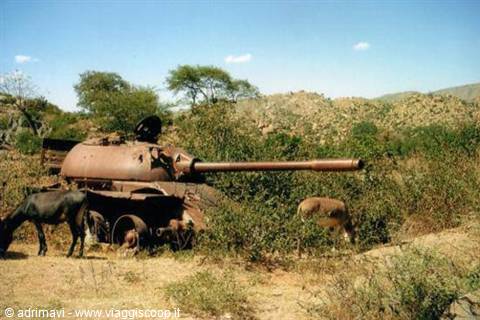
In Eritrea, the first thing that catches the eye are the signs of war. On the Keren - Massawa road you see tanks and cannons abandoned in the fields. The countryside and the mountains still hide mines and unexploded munitions today, despite the commitments made by the government to clear the territory. The "Road of the Italians" of 1936 is a masterpiece of civil engineering, as is the railway that still today runs, in several places, parallel to the road. It climbs from the 1,220 metres of Keren to the 2,356 of Asmara and then descends, in just 115 km, to the port city of Massawa. The slogan launched by the Eritrean tourist board, "three seasons in two hours", is more apt than ever. The journey from the central plateau to the Red Sea is capable of stirring enchanting emotions in those who, like us, are looking for human and natural landscapes off the most beaten tourist routes.
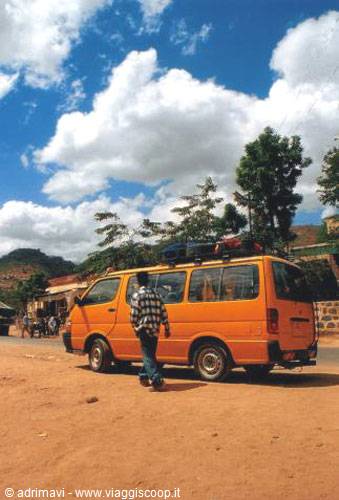
The town of Keren, as dingy and poor as it is, with its scattered settlement clinging to the flanks of the mountain, offers itself to those able to appreciate a still authentic slice of Africa. There is nothing to see, not even the market is worth a visit. We don't see the women of the Bilene ethnic group, the real reason we came all this way, and yet its reserved, nostalgic atmosphere makes it fascinating. Before leaving, we pay homage to the war cemetery where Italian soldiers and ascari (the Eritrean natives who fought alongside our troops) are buried. Wandering around the graveyard, our hearts fill with pride, we feel more Italian than ever. To go to Asmara we hire a taxi. The journey will turn out to be much longer than expected because of the many unforeseen stops.
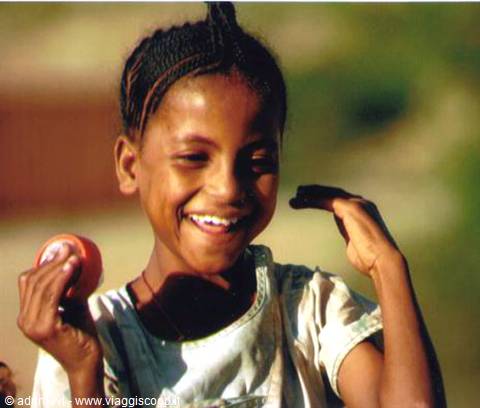
The first just outside the village, when our driver is forced to brake hard against a rope suddenly raised by soldiers guarding a checkpoint. No one is hurt, but the incident fuels a heated argument between the taxi driver and the guards. Having paid a toll for no reason, we set off again, but we are soon stopped once more by a puncture which, luckily, happens near a village. Immediately crowds of barefoot, poorly dressed children run around the car to greet us. It is moving to watch their amazed expression as they see images of themselves reproduced on the monitor of Mavi's video camera. The village huts (called hidmo) have earth roofs supported by wooden poles. The pace towards Asmara is always very slow; we stop constantly by the roadside, now to photograph the carcass of a tank, now to admire a beautiful landscape and visit a characteristic market.
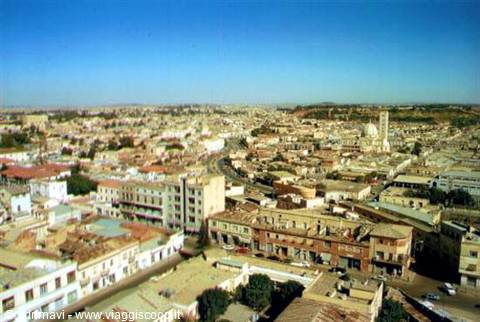
The capital of Eritrea very much recalls an Italian city of the 1930s because all the buildings and works have remained exactly as they were when the Italians left. Visiting Asmara is a journey back in time, into a past that is partly ours too because it belongs to our parents' memories, because we studied it in history books and saw it again and again in television documentaries. Asmara is not appreciated for its architectural works, nor even for its (admittedly characteristic) market, but by strolling up and down Liberation Avenue and getting to know the locals, mostly elderly since they speak perfect Italian. Among them, a shoe merchant who expresses himself in correct Neapolitan dialect - with no wish to offend anyone, the scene is hilarious - welcomes us obsequiously because he considers us compatriots and not foreigners.
He laments the colonial era when Italy brought the country many positive things such as development, progress, well-being. In those days, the nation was one of the leading African states. Then Mussolini also brought Apartheid. He still follows our country's politics today, says he is happy about the return of the Savoy to Italy and criticises our governments, all of them, for having abandoned their settlers, unlike nations such as England and France which, by contrast, still protect their former colonies today. While walking it is impossible not to see the typical greeting of ex-combatants, which consists of shaking hands while giving three simultaneous shoulder bumps with the right shoulder. At the telephone office an old lady recognises our nationality and comes up eager to exchange a few words in Italian.
In ten minutes she tells us everything about herself, having been raised from the age of two at a mission run by Italian nuns. That explains why she speaks our language so well. An engineer, seeing us walking along the avenue with backpacks on our shoulders, pulls over his car and invites us to leave our luggage in his office. We accept and once in the car we thank him for his kindness. "I do it because you are Italians," he replies. We are surprised that in this small corner of the Horn of Africa Italians are still so loved. Is it nostalgia for a past youth, or really did Italy - despite having brought apartheid - do a lot for these people?
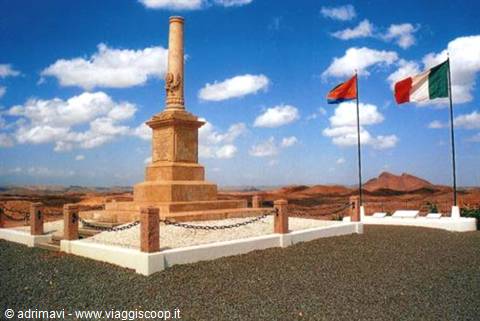
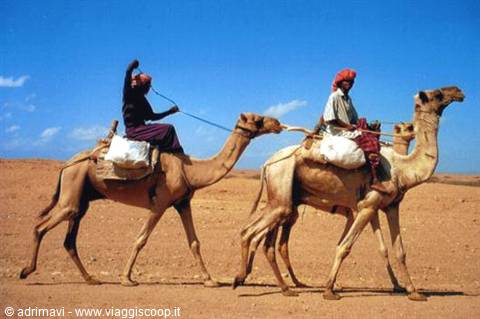
The road from Asmara to Massawa is - by any measure - an Alpine road, complete with impossible gradients and countless hairpin bends. One would easily be mistaken were it not for the caravans of camels and dromedaries met along the way and the countless succulent plants, cacti and prickly pears that cover the mountain slopes. At Dangolio, a plaque commemorates the Italian soldiers "who sacrificed themselves for the homeland" in the battle of 28 January 1886. Immediately afterwards we cross the famous bridge, known to us Italians and even more to us Piedmontese, as it bears the inscription, the only phrase in Piedmontese dialect present in all of Africa. Finally Massawa, which welcomes us with truly unbearable weather! On Massawa Island, the heart of the city, we wander among alleys and secluded corners to come into contact with the locals, truly hospitable and well disposed to chat.
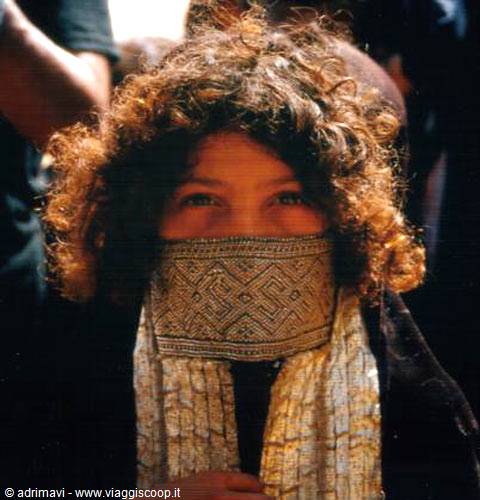
So we meet a group of women busy cooking a kind of "farinata" in makeshift ovens, oil drums in which wood is burned and which are closed at the top by a lid onto which the batter is poured. They invite us to drink a kind of home-made beer, the "sura". Not wishing to be rude we accept, but we gulp the drink down with the utmost effort, hoping at the same time in the efficacy of our vaccinations. On a small square girls offer us more beer, the Asmara beer, without doubt another drink. Everything takes place outdoors, in the open air: people talk, play, sleep, eat, listen to music, etc., etc. The next day we make a trip to the immediate surroundings of Massawa, in the direction of Gurgusum, to visit a village of the Rashaida ethnic group. We meet one at the edge of the road.
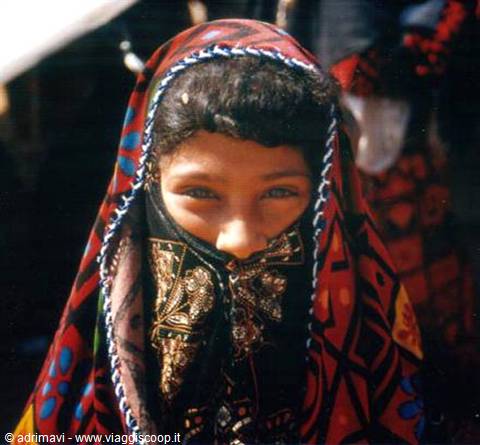
As this is a Muslim population, adult women wear the veil which - unlike in other places - stands out for being finely embroidered. Back in the city, at our hotel's bar, we strike up a pleasant conversation with Mohammed (78 years old). He remembers when the train passed continuously to load the goods from the ships, how prosperous Eritrea was under the Empire. Speaking of Italians he distinguishes monarchists from fascists: good the first, bad the second! He still remembers apartheid very well, when, for example, he could not enter bars or sit on buses.
The journey's photographs
12 photographs · click to open them full screen




0 reader comments