Tripscoop›Africa›CONGO, THE DEMOCRATIC REPUBLIC OF THE›Among the Mai Mai Guerrillas: An Army of Children
CONGO, THE DEMOCRATIC REPUBLIC OF THE · Africa
The story
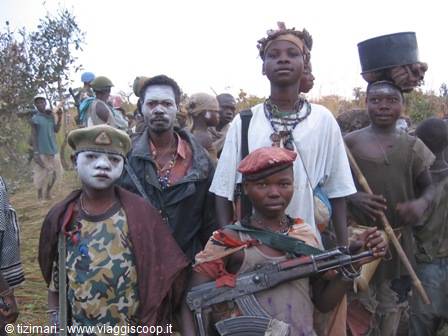
An army of children. Among the Mai-Mai guerrillas Katanga province is one of the 11 provinces of the DRC. It lies in the south-east of the Democratic Republic of the Congo and borders to the north with the provinces of Maniema and South Kivu, to the north-west with the two Kasai, to the east with Tanzania, to the south-east with Zambia and to the south-west with Angola. It is a province extremely rich in natural resources, diamonds, gold, uranium, copper and more, and perhaps for this very reason it has found itself in an almost continuous war for decades now. In the centre of Katanga, between Dubie, Malemba Nkulu and Manono, lies the so-called "triangle of death", where since the middle of 2005 there has been a resurgence of military operations pitting government forces (FARDC) against the Mai-Mai militias led by "Gedeon".
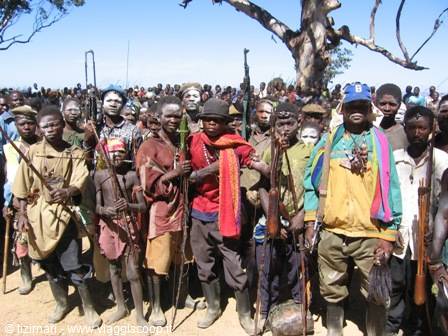
Very many villages have been destroyed and set on fire by the militias, causing a significant displacement of people. More than 150,000 people are said to have abandoned their homes and villages because of the conflict. Rape, murder, mutilation and acts of cannibalism have become daily practices in this area torn apart by guerrilla warfare. The Mai Mai militias recruit large numbers of children into their ranks, children who are forced to commit the most atrocious violence. On 16 May 2006 the mai mai leader "Gedeon" surrendered with his army and handed himself over to United Nations forces at the Mitwaba camp after about 15 days of negotiations. Work has now begun on the recovery and reintegration of the many child soldiers who made up the ranks of the rebels.
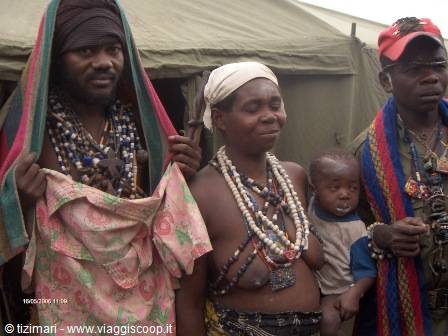
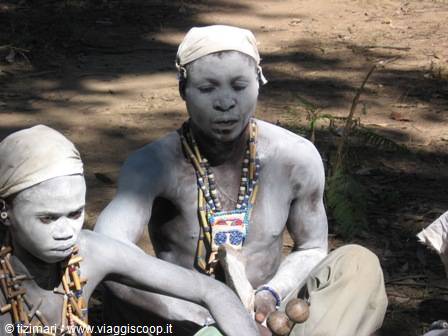
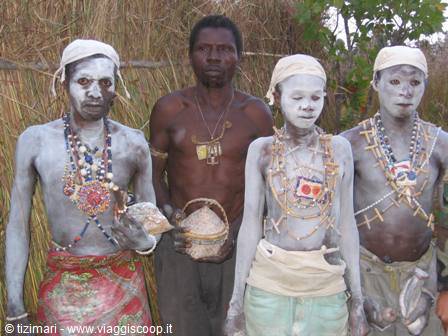
The Mai Mai guerrillas practise animist rites and cannibalism. Their bodies are covered in gri gri (amulets) which, according to their belief, make them invincible and invisible. While at Mitwaba the main Mai Mai leader surrendered to United Nations forces, in other nearby areas other leaders continue to recruit children to strengthen their army.
The Mitwaba area where the images were taken is for the moment reachable only with United Nations flights or with the vehicles of some NGOs operating in the region, and movement is in any case very difficult and almost impossible during the rainy season. Brief notes on the Democratic Republic of the Congo The Democratic Republic of the Congo (DRC), with its capital Kinshasa, is, in relation to its surface area (2.3 million sq km), the third largest African country and, in relation to population, one of the most populous (around 56 million inhabitants, 2004 data). A sub-Saharan state, Congo Kinshasa is located in the centre-south of the continent and shares its borders with nine other countries.
Administratively, the DRC is divided into 11 provinces: Bandundu, Bas-Congo, Equateur, Kasai Occidental, Kasai Oriental, Katanga, Kinshasa (the capital), Orientale and (in the Kivu region): Maniema, North Kivu and South Kivu. Since 2001, after Joseph Kabila assumed the presidency, succeeding his father Laurent-Desire Kabila, the DRC began a gradual policy of international openness. The last ten years have seen the "first African international war" fought on Congolese territory, which is estimated to have caused around 4 million deaths and, according to FAO sources, around 1,200 people continue to die every day because of violence, disease and malnutrition. More than 1.7 million people are displaced, and as many have only recently returned to their communities of origin and are trying to rebuild their homes and their means of subsistence.
The journey's photographs
7 photographs · click to open them full screen


3 reader comments
Complimenti per le foto, deduco che non sei prorio un turista!
Caro tizimari, Mi chiamo Robin Denni; sono redattrice a Oneworld Publications, una piccolo casa editrice in Inghilterra. Giugno prossimo, la mia casa editrice pubblica un libro in inglese di un attivista di Human Rights Watch, Ben Lawrence, chi e andato a Manono nella provincia di Katanga a piedi, a motociclo e in barca, per condividere le storie della pace costruita dalle comunità della RDC. Lungo la via, ha visitato Mitwaba. Durante i suoi viaggi, ha incontrato dei ex bambini soldato Mai Mai e le sue famiglie, di cui condivida le storie in una serie di vignette potenti. Purtroppo, le foto di Mitwaba che Ben ha preso sono smarrite, e quindi le sto scrivendo per chiedere se sarebbe possibile riprodurre una delle sue foto nel libro per dare ai lettori un senso visivo della situazione dei bambini soldato che si sono uniti a Gideon e ai Mai Mai. In particolare, vorremmo usare o la foto ‘Bambini soldato’ o la foto ‘Il gruppo di gedeon a Mitwaba’. Oltre ad attribuire la foto a Lei acanto all’immagine, potremmo mandarle una copia omaggio in riconoscenza per l’uso della foto. Se sarebbe disposto a darci il permesso di usare la foto nel libro, avremmo bisogno di un file foto alta risoluzione, in modo che potessimo publiccarla nel libro. La ringrazio per il disturbo, Distinti saluti, Robin Dennis Email: rdennis [a] oneworld-publications [punto] com P.S. Potrebbe per favore rispondere in inglese?
Mi scusi - Robin Dennis, non Denni!