The story
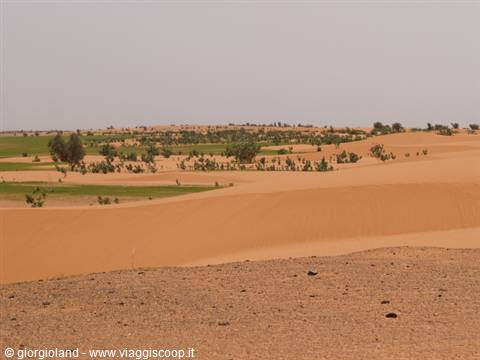
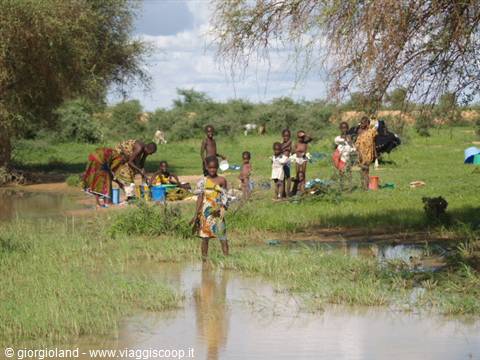
Someone has said that there are three Africas: the one of animals, the one of landscapes and the one of people. If you're interested in the latter, Burkina is fantastic — though it doesn't deny you the chance to see crocodiles, elephants and more, not enclosed in reserves but in complete freedom, and at certain moments the landscapes leave you turned to stone. The population is extremely simple and hospitable, though so poor that at best it can offer you half a glass of dolò (a millet beer that is hard to swallow — NB. the fact that they offer you little of it is a blessing) The thing about the last trip that left me most open-mouthed was the desert covered with a delicious mantle of green grass (it looked like a golf course) and the contrast between the green of the vegetation and the red of the earth (correction: mud).
I have a whole lot of photos, but they're too heavy and I don't know how to make them available. (my IT skills are very modest)
Departure from Turin, boarding in Genoa for Tangier on 12 August 2006, arrival in Tangier in the afternoon of the 14th about 5 hours late.
The journey cost 880 euros for two people for the outward trip alone, in an outside double cabin with service and meals included.
The ship is rather old and the services poor.
At 5 p.m. on the 14th we finally disembark; customs formalities absolutely quick; taking out an insurance contract was unnecessary since Morocco is covered by my Italian policy. (a tip: when you take out insurance at home, ask explicitly for Morocco to be included; it will be a good way to save the first 80 euros)
As we were in a certain hurry following the failure of the first departure (we had been robbed of everything in Marseille and had had to go back home), we headed for Casablanca, where we arrived in the evening.
We stayed overnight at the municipal campsite, quite welcoming, with hot showers, cheap and not too crowded.
Near the campsite is the Mauritanian embassy, where you can apply for visas. It should be said, however, that visas are also issued at the border, and more quickly and at lower cost.
In Casablanca the visas for Mauritania cost 50 euros and you have to wait a day, whereas at the border they issue them immediately and they cost 10 euros.
On the second day (17/8) we wanted to reach a beach ten km before Sidi Ifni, coming from the north, where we knew a lovely little hotel; we did reach the spot, but the hotel was full and we had to fall back on another one next to the first.
Not exactly an uplifting experience: there's no electricity, the bathroom is shared, the place is beautiful, the fish served for dinner excellent, but the price not exactly modest (half board comes to about 30 euros each).
The next morning (18/8) we have to take to the road immediately, even though that beach would have deserved a stop of at least a day.
The hurry prevents us from stopping at the plage blanche, a stretch of coast that you travel along at the water's edge among sole fishermen in an enchanting landscape that we had visited during the trip the year before; near the plage blanche I recommend the hotel ksar Tanidilf, truly fantastic. (see itineraries
We reach Layoune for the night, where we stop at a splendid hotel, the "Parador", in a side street off the main road, price negotiable, with a final agreement at 80 euros.
For dinner there are two equivalent restaurants, one beside the other, considered the best in the city, but they're really not worth much; they are where the main road, towards the end, makes a bend, and one of the two is called "la perla".
A further stop (19/8): reaching Dakla, a pretty little town of which only the pastry bar on the seafront is worth a mention; night at a campsite, only one hotel, expensive, easily recognisable because it's the tallest building in the town.
The next morning early (20/8) we set off early for Nouadhibou; the journey, as in recent days, is deadly boring, the road is always completely straight and the landscape monotonous.
Nouadhibou is a rather pleasant city, though it doesn't escape the characteristic of the whole of Mauritania, which is to be the dirtiest country I have ever visited. The main problem of the Mauritanians is that they are a nomadic people who therefore always left their rubbish wherever they had camped, except that progress and the excessive use of plastic, tin and all sorts of other non-biodegradable materials in place of the once entirely biodegradable waste have turned the country into a veritable open-air rubbish dump.
In Nouadhibou, in any case, the market is worth a visit (in the streets parallel to the main road, not very easy to find); likewise don't miss a dinner at the Monaco restaurant near the airport, where you eat really well and…..they have wine and beer. Things to buy: fabrics — my wife preferred the white cottons, in her words beautiful.
In Nouadhibou we met Thomas, a motorcyclist from Genoa, also heading for Mali, who from that moment would be one of our travelling companions as far as Bamako. We stop in Nouadhibou for two days, both to get the visas for Mali and because tiredness is starting to set in.
The next day we set off for Nouakchott, the capital of Mauritania and a symbolic city — if the symbol, as I am now inclined to believe, is rubbish.
For sleeping, the reference point for all European travellers who get this far is the auberge … but I recommend to those who can afford it the chambre d'hotes Jeloua, belonging to the same owner.
Here we finally meet Mario, a friend with whom we were supposed to set off, if we hadn't been robbed at the start of the trip, who in turn had met two journalists travelling around Africa by motorbike in search of human-interest stories.
At this point the group should have consisted of two Land Rovers and two motorbikes, except that different needs in terms of time available led us to do only some stretches together.
Morning of 23/8, departure towards the interior; the worries begin about temperatures and road conditions. The second problem turns out to be non-existent, at least as far as the border with Mali, while the first turns out immediately real and concrete, with the thermometer reaching 57 degrees!!!
In the evening my wife and I arrive in Kiffa, where we stop again for two days to wait for our travelling companions who had fallen behind; Kiffa didn't seem like much to us, though it remains an obligatory stop for the night.
On this point, note that the local authorities strongly advise against camping in desert areas, because, although they are all always friendly and hospitable, we remain wealthy Europeans in a country where only misery abounds.
On the 25th we reach Gogoui, a village of no interest whatsoever, but where once again we arrive after sunset, having covered about 350 km of track through mud, mud and more mud.
In Gogoui there is a campsite, but anyone, like me, with an air camping won't be able to get in, because in that desolation they thought it a good idea to put a reinforced-concrete beam above the two columns marking the entrance.
We were lucky, or perhaps also a little cheeky, because we managed to get ourselves invited by a wealthy local with a villa to boot, who we later discovered was the former minister of industry, Maritano. The gentleman even invited us to dinner, showing fantastic hospitality. Only downside: we confi
The journey's photographs
11 photographs · click to open them full screen
0 reader comments