The story
Bobo Dioulasso: located in the south-west on the road to Mali, Bobo is the second city of Burkina with about 400,000 inhabitants. Characterised by an extremely quiet atmosphere, far from the chaos and frenzy of Ouaga (everything is relative!!) and by a rich subtropical vegetation, with wide avenues lined with mango and ceiba trees, its real strength lies in its geographical position.
Close to Mali and Ivory Coast, with which it also shares a language (Dioula is a branch of the Bambara language widely spoken in west-central Africa), Bobo has always been an important crossroads and a meeting point of different ethnic groups that make it a very active and lively town culturally (for some time Bobo has hosted the National Culture Week and the Yeleen Festival: two of the most important and interesting artistic events in all of francophone Africa.) The old mosque: Built in 1880, it is an exquisite example of Sudanese mud architecture - it is said that a few years ago the town wanted to demolish it to build a new one but the bulldozers could not scratch the solid banco walls - once inside, the evocative interior is striking, very much resembling a labyrinth and characterised by a low ceiling and extreme simplicity of detail, with mud walls, many columns and no decoration of
any kind - besides, it is an old animist temple converted to Islam. - The old quarters of Kibidwe and Sya: they make up the oldest part of the city. Inside you can admire traditional Dioula and Bobo houses - the latter are two-storey: the woman lives on the upper floor with the children, the man on the ground floor - and the first house built in this town - attributed to the era of Sundiata, the glorious Mandinka emperor who lived, it seems, in the time of Charlemagne. Many blacksmiths, potters, dyers and weavers work here following ancestral methods. Great activity along the dead arm of the Huet river and, in the evening, in the many cafes of the quarter. The streets are made lively by the ceaseless work of the craftsmen whom you can watch at work.
- The Grand Marche: it is one of the finest in West Africa thanks to its size and its Sudanese architecture, which gives it something special. Inside it is a real feverish beehive where you find everything it is possible to buy: in the tall galleries there are beautiful masks, old stools, jewellery, Bobo chests, traditional puzzle games, magic potions......; everywhere you come across small everyday objects - pots, stools, combs.... - handicraft fabrics and printed cottons (batik and bogolan). Unmissable is the covered butchery: truly impressive! BANFORA Transfer by scheduled bus from Bobo Dioulasso to Banfora. It is a large agricultural village with quiet quarters strangely scattered across the territory and with farmland spread here and there (mainly sugar-cane fields, of which the Banfora district is the country's leading producer).
The beauty of this small town, however, is its surroundings, certainly one of the most fascinating areas of Burkina and a true paradise for excursions. Banfora is also known for some of its cabarets where you can listen to traditional music played with the balafon - a sort of xylophone made of wood and gourds of different sizes, one of the oldest African musical instruments - and the bara - an ancient percussion instrument made from a large hollowed gourd covered with goatskin over which a special rubber is stretched, giving it particular sonorities - while tasting the dolo - red millet beer - or the bangui - borassus wine. AROUND BANFORA - Lake Tengrela: it is about 10 km of dirt road from Banfora. On the spot you can watch the fishermen at work (particularly interesting is the moment they pull in the nets from the boat), numerous species of tropical birds, monkeys and hippos.
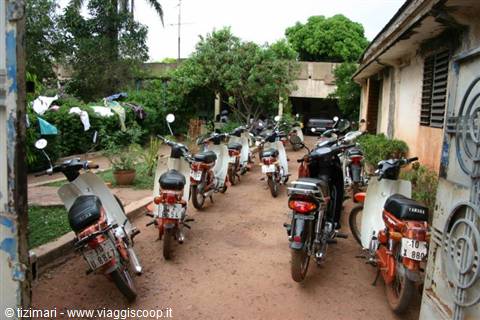
The "trembling dances" that the women of the nearby village come to perform on the shores of the lake are particularly suggestive. - The Comoe waterfalls: they are about 3 km from Lake Tengrela, where the waters of the Koba river plunge in beautiful falls into a large natural pool surrounded by thick vegetation - it is not rare to come across legendary and immense baobabs - and bizarre rock formations. The running, lukewarm water makes it an excellent place to cool off and splash about freely. - The Febedougou heights: reachable after a walk of about 3 km starting from the waterfalls. The rocks of the landscape are very suggestive: some look like huts carved in stone, others look like trees, birds, gourds, masks, faces.... THE VILLAGE OF SINDOU AND THE SACRED PEAKS We rented two mopeds in Banfora and headed towards Sindou.
Sindou is a village located 50 km from Banfora, in the Comoe region. Known above all for its characteristic Sacred Peaks, it is of interest both touristically and culturally and humanly. In 1995 the famous filmmaker Dani Kouyate shot his first feature film "Keita, l'heritage du griot" (Fespaco '95 prize, Junior Cannes '96, Mannheim '96) in the evocative setting of the Sindou peaks. The same Dani would act as a bridge between the village - with its community of old and young - and artists of the Koron Tle and the Siraba association. In recent years the association Young People and Students of Sindou has been founded, whose aim is to promote and enhance the cultural and tourist features of the village - for example, the construction of a reception centre to host passing "friends" has recently been completed.
The interest in including Sindou in our itinerary lies not only in the tourist importance due to the beauty of the place, but also and above all in the friendship that binds us to the village and its people, which will therefore allow the traveller to penetrate the most intimate aspects of everyday life as well as of cultural-artistic-traditional life. THE CLIFFS OF SINDOU In the valley of the Leraba river the rocks of Sindou rise into the sky in long paths sculpted by the wind, twisted, tormented. Anyone looking at these bizarre rock formations will enjoy attributing to the rocks the shapes and likenesses that their imagination suggests. The surrounding landscape offers a splendid view and the chance to meet birds of all colours.
Ouagadougou was founded in the 11th century by the Nyonyonse, who called it Kombemtinga, the "Land of Warriors", and who, tired of suffering attacks from neighbouring peoples, placed themselves under the protection of the Mossi Emperor Zoungrana. Later the city changed its name to its present one, became in 1441 the capital of the Mossi Empire, and in 1919 the capital of colonial Upper Volta. Today it presents itself as a strange city that looks like a grouping of large villages built in the middle of the plain rather than a west-African metropolis in the Abidjan style. Although it is urbanising quickly, Ouaga manages to maintain a certain harmony, as witnessed by the new buildings at most 4-5 storeys high and built with a very elaborate architecture.
The capital of Burkina therefore presents itself as a city with a relaxing atmosphere (though to a markedly lesser degree than Bobo) but which at the same time offers a nightlife among the liveliest in West Africa. A curiosity: in Ouaga in the evening, with the brick dust - which circulates in quantities sometimes reall...
The journey's photographs
4 photographs · click to open them full screen

0 reader comments