O man, what does it matter whether you are hot or cold? It is the law of the desert to be hot by day and cold by night. But you have only to turn your face to the sky to receive the sun and then the stars. And you will be content. Mussa Ag Amastane, Tuareg poet
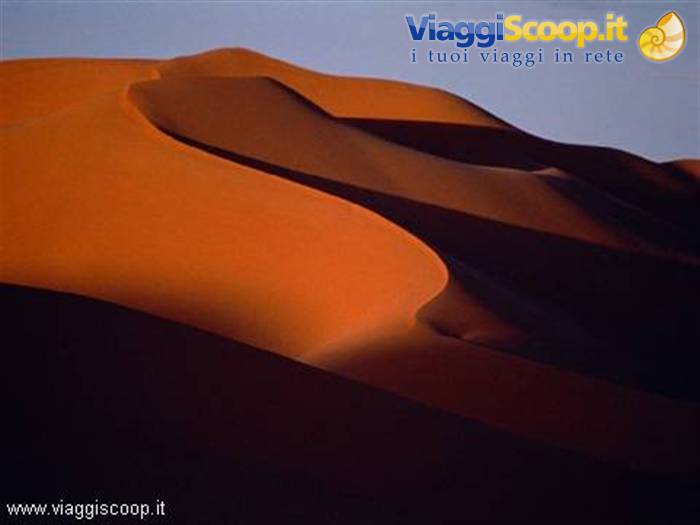
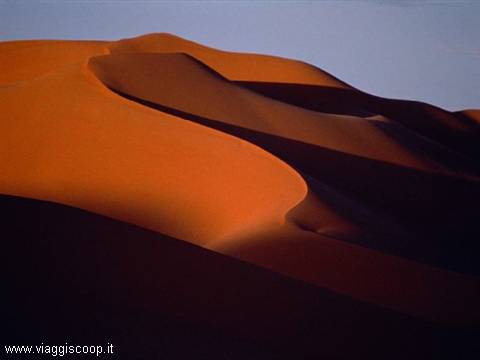
The emotions felt in the desert go far beyond the meteorological sensations of heat and cold. They are feelings of calm, tranquillity and peace in stark contrast to the frantic rhythms we are used to, the ones we live with in this "civilised" society of ours. Total immersion in unspoilt nature, the beauty of the landscapes around us, the colours of the dunes that range from ochre to red with reflections that, at sunset and sunrise, take on tones and shadings that only a painter can express on his canvases, and the sky a deep blue by day and overflowing with stars by night, grant the visitor who knows how to face the small hardships inevitably encountered a sense of gentleness and serenity that make one appreciate all the more the beauty of our "old" world.
This reflection on the desert, where life seems almost absent, may appear contradictory only to the traveller who observes it superficially; in fact, especially in the rocky areas, the desert is rich in life: besides the few large mammals such as dromedaries, gazelles and the fennec (the desert fox), there are countless insects, small reptiles and many birds. What then of the rare thorny shrubs and the few plants that manage to live in such a hostile environment, pushing their roots deep down to capture the little water present underground? Our journey takes place in the south of Algeria, in an area where 90% of the population is of Tuareg ethnicity (Targhi in the singular).
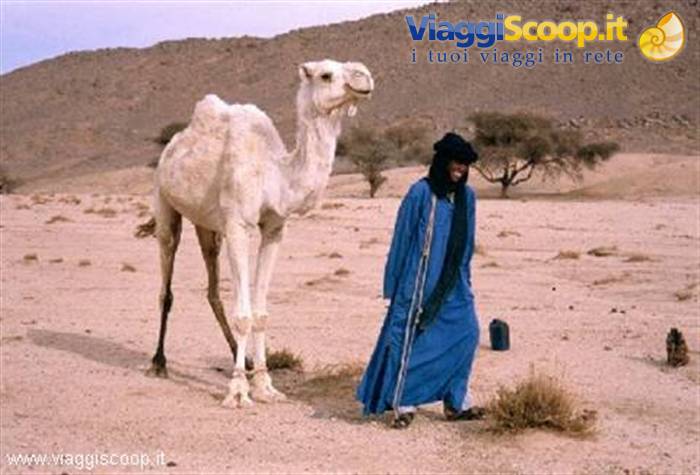
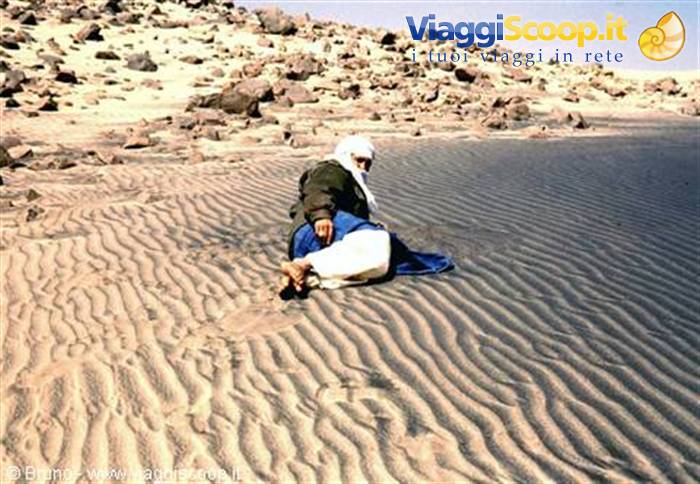
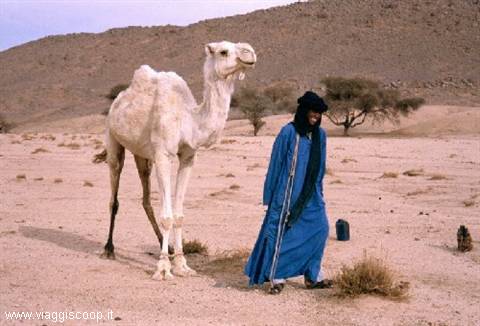
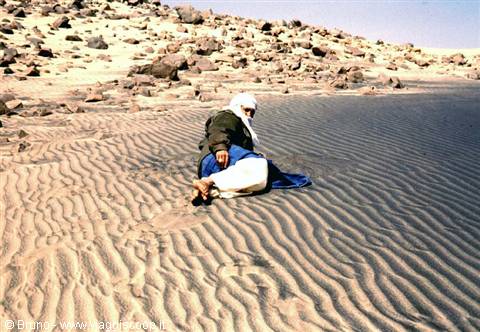
Close relatives of the Berbers, admired for the elegance of their clothes and their truly regal bearing, they managed to settle and develop an extraordinary nomadic civilisation in a territory that may seem uninhabitable. Their name probably derives from the Arabic word targa and denotes a region rich in trees and water, as these territories were in remote times. The Tuareg are very proud of their ethnicity and consider themselves free men, extraordinary horsemen and deep connoisseurs of the desert; their language is Tamashek, derived from Berber, but almost all of them also speak correct French. They are called "blue men" because their shèsh (a long strip of cloth, usually blue, behind which they hide their face), as it dyes the skin, makes their face take on a blue tint.
According to Tuareg tradition, the shèsh also serves to prevent evil spirits from entering the heart through the nose and mouth. Contrary to what happens in the Arab world, the women do not cover their faces and, in this seemingly male-dominated society, it is they who pass on writing, who teach the children and who pitch the tents; they can also leave their husband with the same formula that the Quran provides for men. Unfortunately, today progress has made the old activities of Tuareg men almost useless, which were mainly leatherworking to make saddles and trade carried out with long caravans of dromedaries that travelled the trans-Saharan tracks; despite this cultural disintegration, the Tuareg people have not given up and, with the arrival of the albeit rare visitors, have devoted themselves to tourism-related activities, such as handicrafts and guiding travellers across the desert.
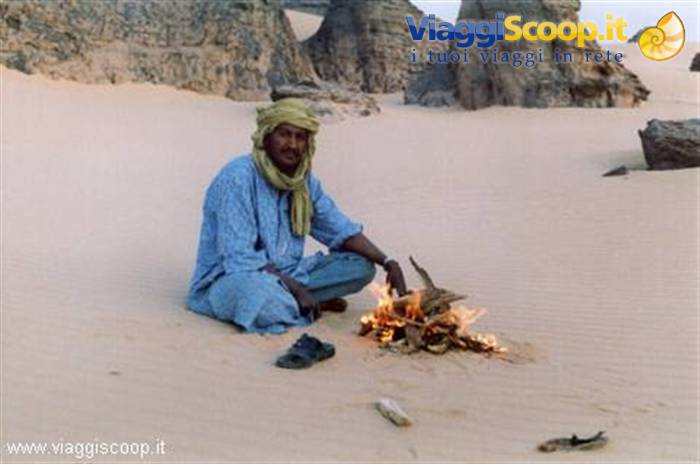
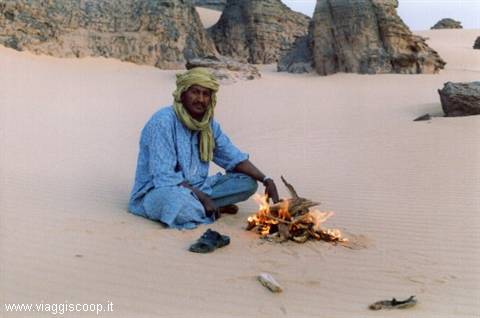
Spending a few days in the desert in the company of the Tuareg can prove a wonderful and unforgettable experience; they are extremely skilled at finding their bearings even when there are no landmarks and the gaze, turned to the horizon, sees nothing but sand and stones. This deep knowledge of the territory instils a sense of security in the traveller who alone certainly would not know where to head. Before starting the crossing, which always takes place calmly and without haste, one gathers the wood needed to light the fire, a true ritual performed three times a day: in the morning as soon as you wake up for breakfast tea, to cook the midday meal and in the evening.
The food of the Targhi, in the desert, consists essentially of "galletta", an unleavened bread made with corn semolina, water and salt; once the fire is lit to obtain the embers, the Targhi kneads everything with a skill worthy of the best Neapolitan pizza maker; once the desired consistency is obtained, the galletta is covered with sand on which the embers are placed; after about 30 minutes the cooking is finished, the galletta is pulled from the sand, cleaned and reduced into tiny pieces that are dressed with vegetables and meat cut into pieces, previously cooked in a stew. After the meal there is always tea which, especially in the evening, is a true ritual.
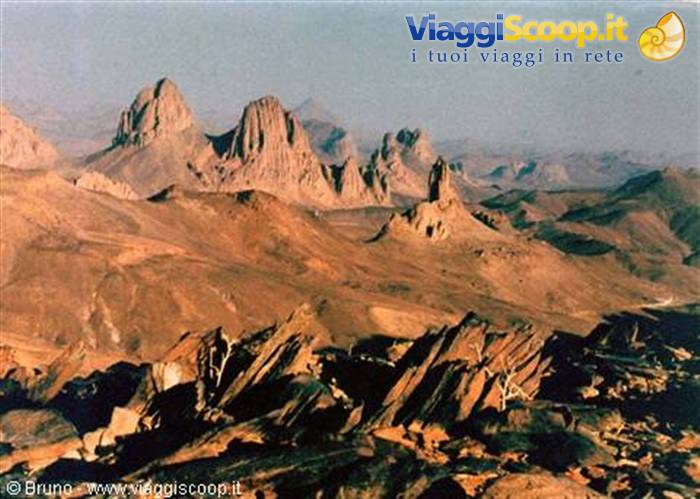
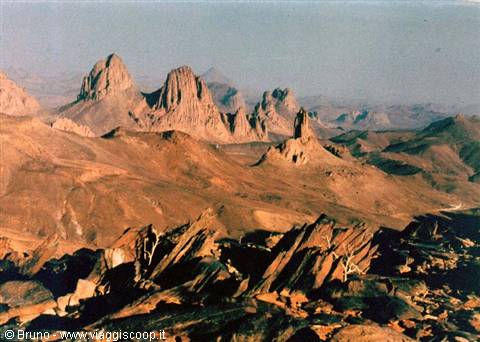
The tea leaves, sometimes accompanied by a few mint leaves, are boiled three times to obtain tea of ever lower concentration; at the end of each boiling, sugar is added and mixed by pouring, with considerable skill, the tea from one teapot to another, several times and keeping the two teapots considerably one lower than the other. All three different teas must be drunk because each has its own meaning: according to Tuareg tradition the first is hard as death, the second is strong as life while the third is sweet as love. The desert is not only sand; in fact only about 20% of the Sahara is sandy. The Hoggar area, which we crossed in the first week, consists mainly of a stepped rocky plateau on which isolated pinnacles rise, remnants of ancient volcanic activity; among them the highest is the Tahat (2,918 metres).
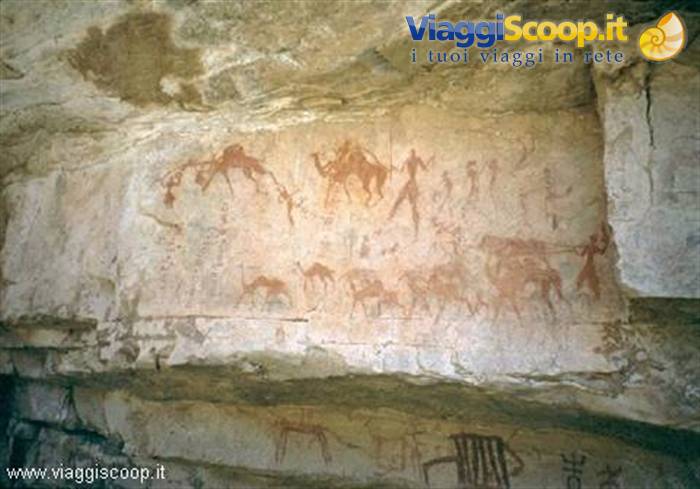
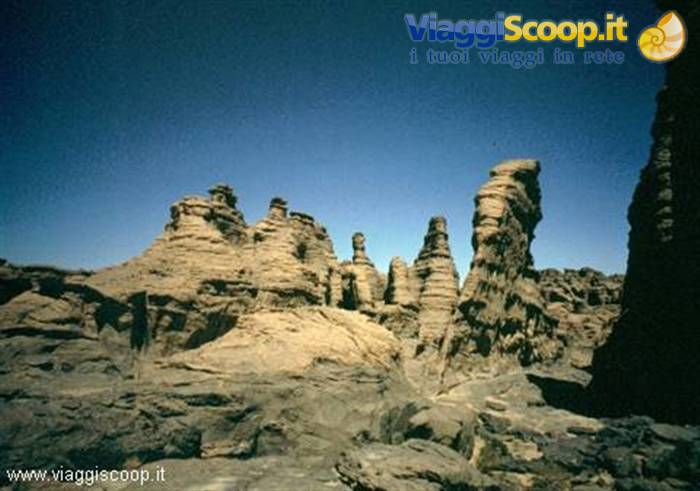
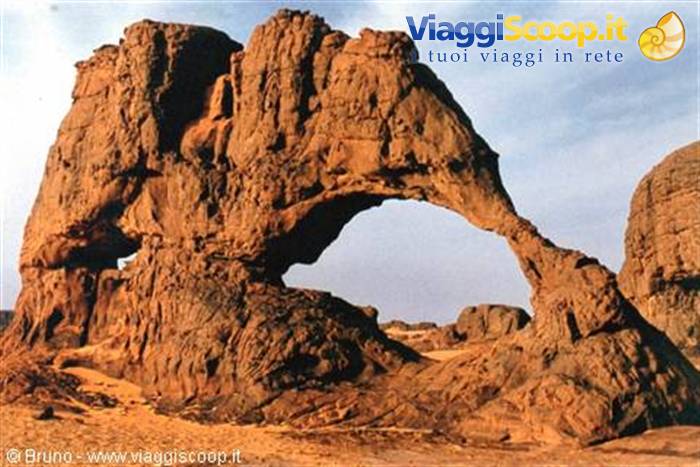
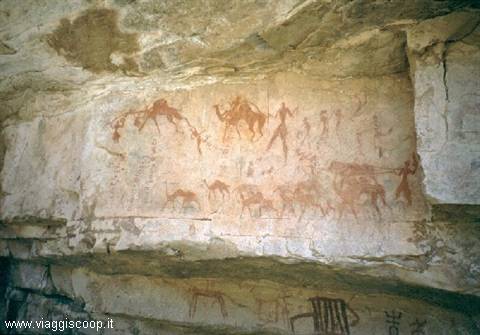
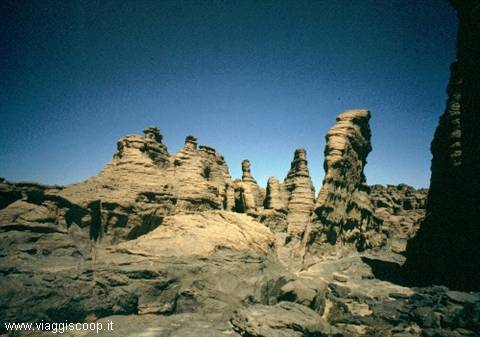
The Tassili n'Ajjer, visited in the second week, is formed by a vast terraced plateau on the edge of the Hoggar massif, with sandstone spires and pinnacles deeply carved by erosion. The Tassili area is one of the major centres of Saharan rock art. In particular, it is famous for the numerous and important wall paintings explored and systematically recorded from the mid-1950s onwards.
Day 12 Mar 2002
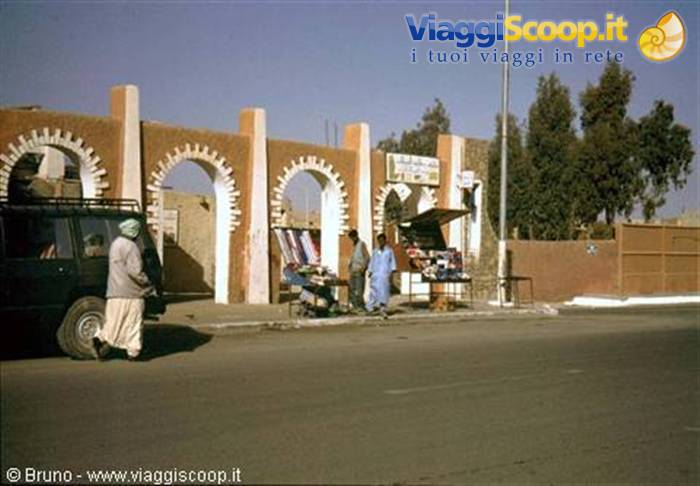
With an Air Algerie flight, whose "punctuality" one appreciates, via Rome-Algiers, we land at 21 at Tamanrasset where we settle in for the night in a camping-hotel. Tamanrasset, at 1400 metres above sea level, once a small village lost in the desert, is now at the centre of a fair amount of tourist traffic and, thanks to the sedentarisation of the Tuareg, has a population of around 40000 inhabitants. It practically offers nothing, but it is one of the great myths of the Sahara.
Dromedary and Tuareg
Day 23 Mar 2002
I get up at 7, in silence so as not to wake my companions, and a surprise immediately greets me: the door of the room won't open. Hearing me fumbling with the key, everyone wakes up and takes turns, each with the greatest effort, trying to open the door, but without succeeding. After about 10 minutes a Targhi, hearing the noise caused by our fruitless attempts, advises us to pass him the key through the gap under the door. From the outside he opens it for us.
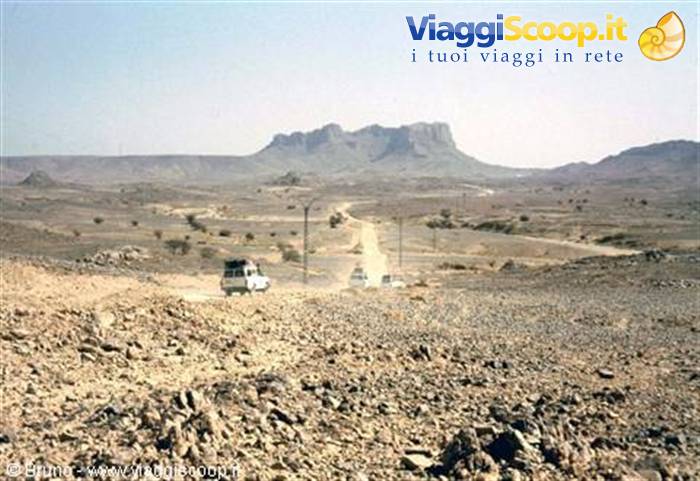
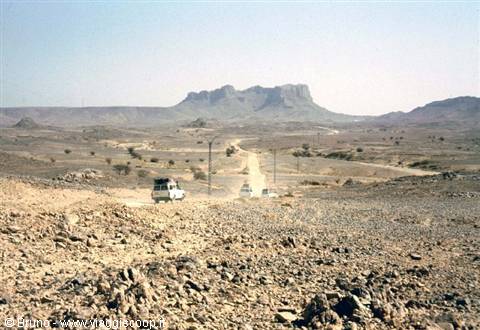
He doesn't seem surprised but seems to consider it all absolutely normal! Perhaps they fear that guests might flee without paying the bill and for this reason they lock them in their rooms? After a brief tour of Tamanrasset to buy what is missing to face the crossing of the desert in the coming days, we set off in a four-wheel drive for an excursion to the Assekrem refuge, located in the Hoggar mountains, where we will spend the night. Thus we make the acquaintance of Badi, our driver. We leave in Tamanrasset the non-essential luggage, which will be collected the following day. Having left the city, we set off along a track in the desert, an area not sandy but totally stony.
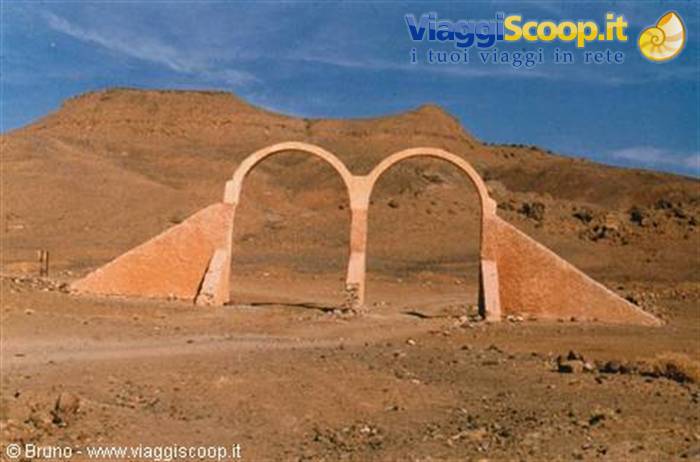
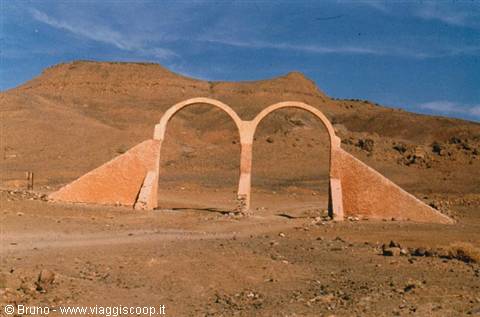
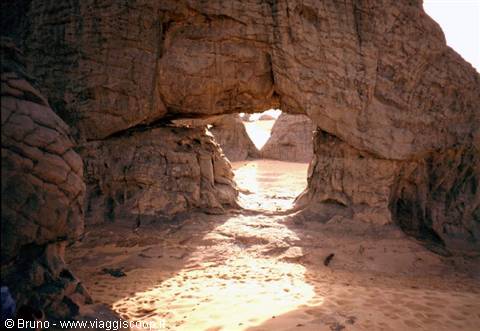
The barren and desolate landscape, but at the same time fascinating, the sense of solitude with one's gaze ranging far and coming to rest in the distance on the heights of the Hoggar, provoke an attraction that is hard to describe and that many do not understand until they experience it. The journey continues with a few stops to take photos and with a detour to visit Afilale; it is a ghelta (a pool of water) on whose banks thick vegetation grows. A real rarity for these places. To reach this spot, a trace branches off from the main route, clearly visible on the ground because, nearby, there is a gate built with two stone arches, a gate that seems to be the entrance to nothing. The journey continues through a lunar landscape. After a continuous up and down, the track begins to climb and towards 15 we reach the refuge located at an altitude of 2600 metres.
Beautiful is the view of the peaks surrounding the south side of the refuge; a veritable amphitheatre of pinnacles and peaks that faintly recalls the Dolomites. We have reached the refuge dirty and covered in dust but with our souls and spirits perfectly in tune with these places, whose clear air we appreciate but above all the enchanting panorama that one admires. At 16, in about a 20-minute walk, we climb to the Hermitage of Charles Foucauld, at 2780 metres, located just above the refuge. We wait for dusk to capture the pinnacles that are tinted red by the rays of the sun, which, as it sets, strikes them at a particular angle. Unfortunately the clouds prevent us from admiring the sunset in all its splendour. We go back down to the refuge around 19, hoping to make up for it at the first light of the following morning. Dinner based on "sciorba" (soup) and couscous.
Dunes at sunset
Day 34 Mar 2002
Still drowsy, we get up at 5:45; at 6:10 we set off to climb back up to the Hermitage and contemplate the sunrise expected at 6:45. We climb in the dark, lighting the path with our headlamps, and once we reach the top we anxiously watch the sky which little by little begins to turn pink, treating us to a beautiful sunrise that makes up for the disappointment of yesterday evening's sunset. At 7:30 we return to the refuge for breakfast and, at 8:30, we set off for Tamanrasset, where we arrive at 12 after retracing the entire track of the outward journey. The landscape and the views over the desert, even though they are not new because we already saw them yesterday, stir the same emotions and sensations as on the way out. Here we get to know Chire, the second driver, and Abdellah, our guide.
After doing some shopping, at 16:00 we set off for the first stage of the crossing towards Djanet; the planned destination is Tamekrest, where we arrive at 18:30. During the journey we also experience the thrill of meeting, in a place called Tounen, a tribe of Tuareg nomads complete with dromedaries used for carrying their belongings during their continual displacements. The poor beasts, so that they don't stray too far from the camp, have their front legs tied together, forcing them to move with difficulty and in small steps. The area of Tamekrest, where we set up camp, lies in the ancient bed of a river that, judging by the high banks, must have had plenty of water before desertification.
Nearby there is still what the Tuareg call a "waterfall"; in reality it is an almost invisible trickle of water formed by a small spring that rises on the heights and feeds an artificial well where the nomads stock up. For dinner, Annamaria and Eros prepare excellent fusilli with tomato and onion sauce, much appreciated by the whole group. This will be the only night spent in a tent; from tomorrow we will sleep under the stars.
The fire in the desert
Day 45 Mar 2002
At 6:30 Eros, Eugenio and I climb a hill behind the camp to admire the sunrise which, as throughout the week, always turns out to be veiled by some cloud. Before setting off for the second stage that will lead us to Yuof Ahakit, we visit the small well and the "waterfall" located nearby. The slender trickle of water does not resemble even remotely the waterfalls you can admire in the Alps but, for the local people, it still represents a treasure. Along the way we come across a village near which there is a well with women drawing water. The entire village is made up of huts built from reeds; inside only a few women can be seen, the men are probably grazing with the livestock. We continue on our way, following, as far as possible, the beds of ancient rivers that are now completely dry.
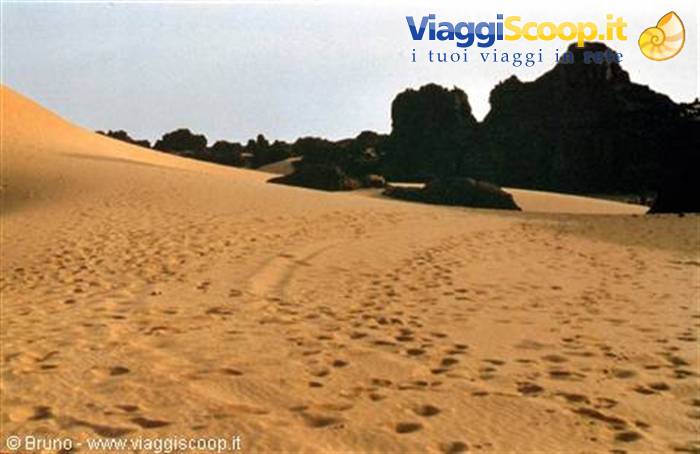
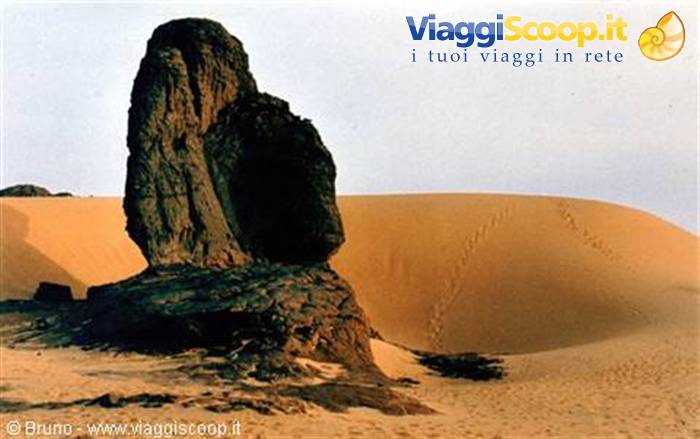
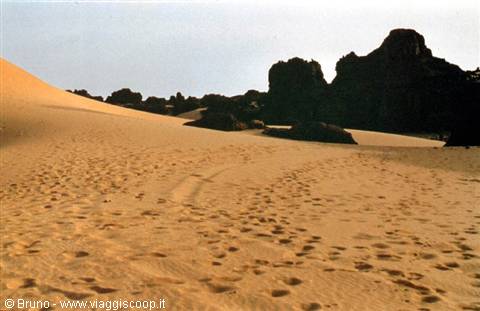
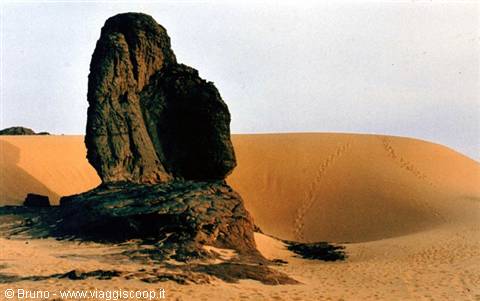
The landscape gradually changes; the desert, from rocky with the presence of a few rare trees, becomes sandy with a total absence of vegetation. Towards 18:00 we reach the place where we will set up camp, a spot that fascinates for the presence of dunes and rock formations rising from the sand, towering vertically for several metres; in the background the horizon closes on a sequence of very jagged pinnacles that seem to delimit and protect a part of the desert, on the whole of such a beauty as to seem unreal! This is certainly the most fascinating place encountered so far.
Rock paintings on the Tassili
Day 56 Mar 2002
At 6 the light of dawn wakes me; I get up and take the opportunity to enjoy a little more of the enchantment of this wonderful nature. Unfortunately this morning we will have to continue with the third stage that will lead us to Honang. We set off at 8:30 and, after 1½ hours, we leave the dunes to enter an area with a prevalence of hard ground and rocks. The completely flat terrain and the heat that accompanies us favour the onset of the mirage phenomenon which, as already happened yesterday, appears before our eyes. In the distance it seems we can make out a wood on the shores of a cheerful little lake. Mirages are in reality optical phenomena due to the refraction of light in the lower layers of the atmosphere when the density of the air has an anomalous distribution.
They can be observed on surfaces intensely heated by the sun because the temperature of the ground and of the layer of air in contact with it is distinctly higher than that of the higher layers; in these cases a distant object may appear as if reflected on a stretch of water. After the usual stop for lunch with the baking of "galletta" by our Tuareg companions, we travel through a region where the terrain changes continually. Bare and monotonous views alternate with spectacular landscapes such as the area of the blue rocks; this is a vast site of rocks emerging from the sand, of an intense blue colour due to the presence of minerals. The spectacle certainly deserves a stop to take photos, even though the images will hardly be able to do justice to a landscape of such beauty; for this reason I try to imprint it permanently in my mind.
Following a detour that follows the course of a dried-up river we enter deep and stunning gorges. The place is once again spectacular and of a beauty so wild that it is rarely seen in our mountains. At 18:15 we reach Honang, the site of the third camp, located in a fairly wide gorge, with a steep wall on one side while on the other the slope is much less pronounced. Like yesterday, again tonight, despite the big black clouds, Eros and I sleep in the open. During the night a few sparse large drops fall; they can't last (at least we hope so), in fact we are in the desert where it only rains every three years! I stick my head inside my sleeping bag and wait. After a few minutes the rain stops, it didn't even have time to soak us.
Tassili N'Ajjer - Tamrit area
Day 67 Mar 2002
Because of the strong wind and with sand getting in everywhere, today's stage will certainly not be monotonous. The usual wake-up at 6.30, and a scouting expedition, in the company of Eugenio and Eros, of the top of the gorge that we climb back up on the side where the wall is less steep, to admire the sunrise from the summit. At 8.15, while our two drivers and the guide are still loading the luggage onto the off-road vehicle, we set off on foot for the fourth stage, which is to take us to Erg Admer, a completely sandy area with great dunes; we want to stretch our legs a bit after three days of crossing spent mostly sitting in the off-road vehicle. The sky is clear and promises fine weather.
Back on the vehicles, in the morning we make a stop near a well to refill our water and to refresh ourselves; despite the heat outside (about 40°), the water, which is found deep down, is very cool and it is a real pleasure to feel it on your skin. The Tuareg drink it, it must be a real delight, cool as it is; we don't trust it, we have to purify it first and consequently we will drink it warm, what a shame! We cross an enormous sandy plateau at an altitude of about 1100 metres. It is completely flat, and only at intervals can you make out some elevation on the horizon; for the most part, though, it is flat and identical on all sides. The Tuareg still manage to find their bearings in a landscape like this, with no points of reference other than the position of the sun in the sky. The wind begins to pick up, and in this place it seems always to be present.
Despite the closed windows, the sand starts to make itself felt and to get in everywhere. Fortunately we are all equipped with shèshes and glasses, which allow us to shield our faces completely. Not even during the lunch stop does the wind show any sign of calming down; on the contrary, it seems to be gathering strength. We take shelter close against a small dune, stretching a cloth between the two off-road vehicles to get a minimum of shade. We are totally wrapped in the whirlwind of this sandstorm, and we soon realise that our "protections" are of little use: the sand gets into every part: our necks, our mouths, our eyes, etc. We carry on with the wind showing no intention of dropping in intensity. We come in sight of the dunes that we have to climb to set up camp.
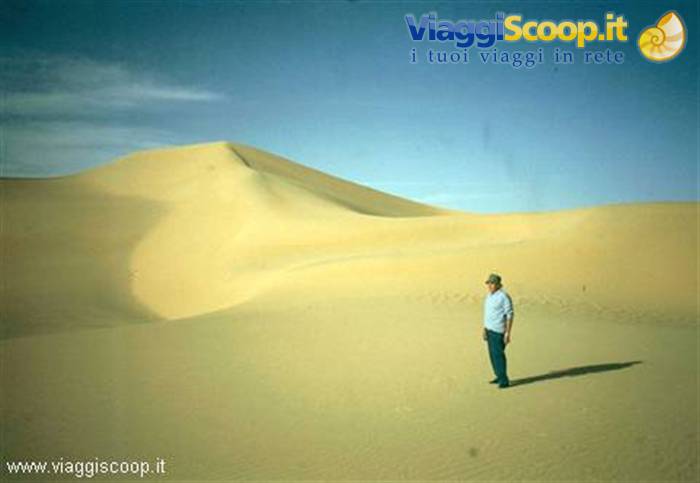
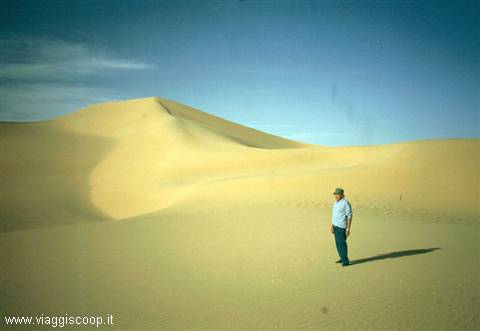
The landscape is spectacular, different from those encountered in previous days: the dunes follow one another as far as the eye can see in all directions, a true sea of sand in a storm, where the dunes are the waves. When we start the climb, despite the low gears, our off-road vehicle struggles to make progress and after several attempts we get out and continue on foot. At the top of the hill the view is breathtaking, the sea of dunes fades into the horizon and seems to have no end; the beauty of the landscape even manages to make us forget the persistence of the wind which, continuing to blow relentlessly, even if at a slightly lower intensity, keeps lifting the sand and driving it in every direction. We arrange the off-road vehicles so as to obtain a shelter where we can camp.
It is not possible to pitch the tents because the wind hinders the work, so tonight we will all sleep in the open. Dinner too is conditioned by the environmental situation; we cannot light a fire, so no hot meal; we have to make do with a cold dinner with abundant sand. Despite the difficulties, which are actually quite bearable, none of us complains; on the contrary, morale is very high and we are all fascinated by the enchanting panorama. The wind has swept the sky, and with the arrival of night it is particularly bright thanks to the effect of millions of stars shining with a most intense light. No obstacle and no glare prevents a 360-degree view of the celestial vault, and we wish our eyes could capture this unique spectacle so as not to forget it and to be able to tell of it on our return.
It is certainly the sky that every astronomer dreams of seeing at least once in their life! Despite the sand also getting inside our sleeping bags, we fall asleep happy because, faced with the natural splendour of these places, every discomfort becomes a trifle.
Dunes near Djanet
Day 78 Mar 2002
I wake up at 6.15. The wind has almost completely stopped, but a thin layer of sand completely covers our sleeping bags. I get up and explore the dunes in the light of the rising sun; as the brightness increases, the colour of the sand takes on every shade of grey, then turns to ochre when the sun has fully risen. We are in such a fascinating place that it is a shame to leave it; one would like to be able to stay at least a few days. Unfortunately we have to set off again for the last stage, which will take us to the oasis of Djanet. We go back down the dunes on the opposite side to the one we climbed. Once at the bottom, where the ground is harder and more compact, we stop to inflate the tyres, which had been partially deflated yesterday before the climb up the dunes so that they would have greater grip on the sand.
The operation is carried out with a pump similar to the one we use at home for bicycle wheels. While our drivers inflate the tyres, we set off on foot to stretch our legs; we find ourselves on an immense plain, completely sandy, surrounded in the distance by dunes. We gladly cover a good stretch until the off-road vehicles catch up; we climb back on board and, at a fast pace (about 60 km/h) allowed by the flat and compact surface, we reach the asphalt road that comes from the north and leads to Djanet. After a few kilometres of asphalt we leave the road again and, with a detour on a dirt track, we arrive in the area of Terarat, famous above all for a Neolithic engraving called "la vache que pleure" (the cow that weeps). The engraving depicts several cows; from the eye of one of them a tear seems to be falling; this detail gave the engraving its name.
The area consists of sandy dunes and large monoliths emerging from them; it is on one of these that the engraving of the cow is found, probably one of the most famous in the whole Algerian Sahara. Once back on our way, we soon reach Djanet, where we settle in at the Hotel Teneré; at last we can savour the pleasure of a shower that washes away all the sand that has accumulated on our skin during the crossing. Tomorrow we will set off to visit the Tassili n'Ajjer, this time not with off-road vehicles but on foot, with the help of donkeys to carry the luggage.
Sunset over the Hoggar mountains
Day 89 Mar 2002
The Tassili n'Ajjer is one of the largest concentrations of prehistoric rock art in the world, with its oldest works dating back 9000 years. The desire to visit it helps us overcome the fatigue of a 5 a.m. wake-up to travel by off-road vehicle to Tafilatet, about 15 kilometres from Djanet, the starting point of our 5-day trek on the Tassili plateau. Here we get to know our new guide, Mohamed, with 6 little donkeys used to carry the luggage and their two young handlers, Mohamed junior and Ibrahim. Initially flat, the path gradually becomes steeper and, after about an hour of walking uphill, we reach Tafetest, a large plateau surrounded by vertical walls. Having crossed the plateau, we enter a canyon; with a climb that is first gentle and then very steep, we reach the Tassili plateau, at about 1700 metres.
Before us opens a rocky tableland that fades into the horizon and seems to be endless. We set off into this lunar landscape, which gradually changes appearance. After an hour of completely flat walking we enter a veritable labyrinth: this is an area of canyons that are not very deep, but from which, without knowing them, it would be difficult to find your way out. Fortunately our guide Mohamed seems to be well acquainted with the area, so at 13.30 we reach Tamrit, the site of our first camp on the Tassili, characterised by beautiful vertical rock spires several dozen metres high. We stop for lunch, and at 15.30, with a 3-hour trek, we can admire some beautiful rock paintings and the valley of the thousand-year-old cypresses, of enormous size.
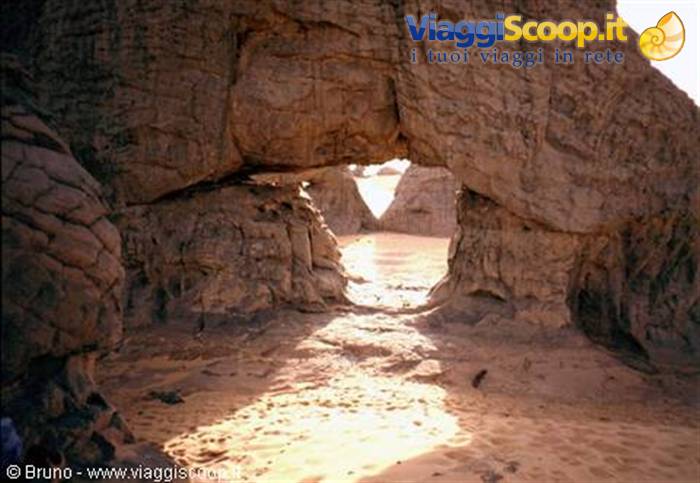
The Tassili plateau is characterised by rocks eroded by the winds, forming numerous hollows in which one can spend the night; so we do not pitch the tents but sleep on the sand beneath these rock shelters.
Algerian Sahara - Youf Ahakit
Day 910 Mar 2002
Today we move to the Sefar area. We set off at 8 and with 4 hours of easy walking, we reach the place where we will pitch camp. During the move we make numerous stops to visit the sites where interesting rock drawings are located, so the stage does not prove tiring. The Sefar area, characterized by rock formations rising from beautiful dunes, is extremely rich in paintings and is divided into Sefar Blanc and Sefar Noir. In the afternoon we visit the dark red site. Another night under the open sky with the air cooling down considerably during the night.
Algerian Sahara - The Elephant
Day 1011 Mar 2002
Without taking down camp we set off at 8 to visit the paintings found in the nearby site of Tin Tazarift. The place, besides its beautiful rock drawings, is worth a visit for the spectacular landscape, as indeed is most of the Tassili. A labyrinth of very tall pinnacles eroded by the weather and lying close against small sandy dunes created by the wind. The day is magnificent; the gleaming ochre colour of the sand blends into one with the reddish colour of the rock of the pinnacles that stand out against the background of an intense blue sky completely free of clouds. At 11:30 we return to camp, which will be taken down to move us, in the afternoon, to the In Etouame area, without neglecting a visit to the Sefar Noir site. After leaving the beautiful Sefar area, rich in pinnacles, we cross, heading west, an immense stony plateau whose end cannot be seen.
The direction of our walk, as we approach the camp area, turns south and the landscape changes once again. We encounter other pinnacles and other spires, not as beautiful as those of Sefar, but equally fascinating. During the walk we visit other sites with rock drawings and finally, at 17:40, we reach the campsite.
Algerian Sahara - Branch on the sand
Day 1112 Mar 2002
After setting off, which happens at 8, the pinnacles regain a charm similar to those of Sefar. We enjoy their beauty for another hour, after which we return to the rocky plateau already visited on the previous days. We cross it and, at 10:45, we reach Tamrit, at the same spot where we pitched camp the first night spent on the Tassili. We stop early for lunch and set off again at 14; we leave the Tamrit area and cross the plateau that seems to be endless for the umpteenth time. We begin the descent following a path different from the one taken during the ascent and, at 17, we reach the Akba area where we set up the last camp. Today's stage turned out to be a transfer stage, not very interesting as far as rock drawings are concerned, but always attractive from a landscape point of view.
We pitch camp in a small round hollow, surrounded by the usual limestone rocks and very well sheltered from the winds. Eugenio, Eros and I do not let the opportunity slip for one last exploratory round on the rocks surrounding the camp.
Hoggar mountains - Gates towards nothingness
Day 1213 Mar 2002
Unfortunately, today we leave the Tassili for good. We set off at 8 to descend to Tafilatet where, at 14, we have an appointment with the off-road vehicles for the return to Djanet. A very hot sun accompanies us all the way down and, at 12, we arrive at the meeting place. Water must not be wasted as it is a precious commodity, especially in these parts; so the purified water left over in our jerrycans is immediately salvaged by our guides and poured into a "jerba" (a goatskin waterskin) that will be left on the spot for future excursions. The scant shade of a tree shelters us from the sun's rays and gives us a bit of relief. The wait for the off-road vehicles drags on beyond the agreed time; we keep moving under the tree to follow the shifting shadow, and soon the water in our canteens runs out.
Our parched mouths and the intense thirst brought on by the heat of this place are stronger than the precautions we have followed so far, and I decide to drink the water drawn from the "jerba"; after all, it contains the water from our jerrycans that had been purified, even if it has probably been mixed with other water. Finally, at around 15:30, we spot the off-road vehicles arriving to pick us up. We will later find out that they had forgotten about our return! Once we arrive at the oasis of Djanet we settle into the central camping-hotel Zeriba. Dinner based on "sciorba" and couscous.
Stop at Tamanrasset
Day 1314 Mar 2002
The term oasis comes from the Egyptian "waha", it means station and is, by definition, a limited area within a desert expanse where, due to the local emergence of an underground water table, vegetation appears and cultivation and human settlement become possible. The oasis of Djanet, located in southern Algeria on the border with Libya, has for decades been called the "pearl of the desert". It is hundreds of kilometres from any other inhabited centre and is at an altitude of about 1000 metres. Almost all the buildings cling to the slope of an escarpment, on the foothills of the Tassili; the plain below, precious because it is fertile, is used almost exclusively for cultivation.
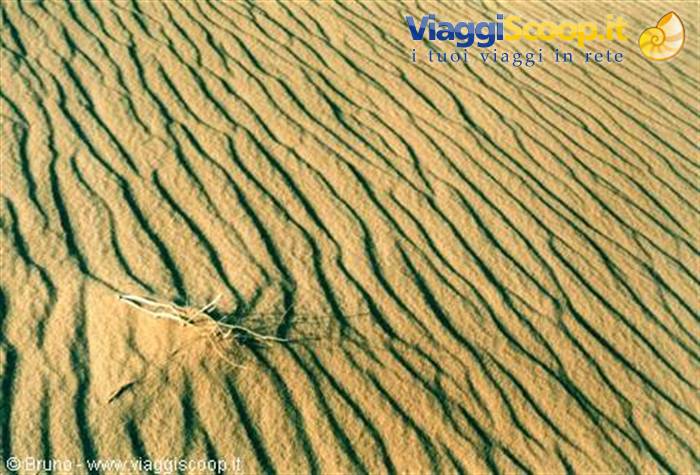
Its origins are lost in the mists of time; its documented history dates back to the end of the 1800s and the colonial wars; its strategic position, right at the entrance to the Tassili range, made it a coveted prize for the French, who occupied it. In the upper part of the town, Fort Chalet is still visible, named after a French commander, which housed soldiers of the Foreign Legion. We spend the morning visiting Djanet and shopping. In the afternoon we return, by off-road vehicle, to the Erg Admer area in the hope of being able to admire the dunes at sunset without the strong wind we had encountered on the evening we camped there. After a stretch of asphalt road, we follow a track that crosses the desert and arrive in the dune area. It is astonishing to notice how the wind shapes these enormous piles of sand into sinuous and sensual forms.
Having parked the off-road vehicle at the base of the dunes, we climb on foot up a ridge and reach the top of a dune. From here the panorama is wonderful. For 360 degrees you see nothing but sand as far as the horizon; the dunes follow one another with gentle undulations and seem to invite you to follow them to discover what hides behind them. Unfortunately time passes quickly and, between one photo and another, sunset arrives and we have to return to Djanet. We spend the last evening in contact with the desert; tomorrow we set off for Algiers. We have dinner with "sciorba", roast dromedary and chips.
Towards the Assekrem refuge
Day 1415 Mar 2002
A final farewell to Djanet before boarding an Air Algerie domestic flight that, with a stopover in Ouargla, is supposed to take us to Algiers. Instead of Ouargla we land at Ghardaia, about 200 km further west. We are informed that a sandstorm is underway that does not allow landing at Ouargla, so we have no choice but to wait for the storm to end. We remain grounded from 10 to 14, after which we set off again and arrive in Algiers at 17:30, about 3 hours late. After settling into the airport hotel, we visit the city by two taxis. Algiers rests on hills that slope down towards the sea and surround a wide gulf open to the Mediterranean. On a spur overlooking the bay is the old Arab city (casbah), while around the port rise the new districts built by the French.
On the hill the "Monument to the Martyrs" dominates the entire city: it is an ugly work of immense proportions, dedicated to those who died during the war of independence from France, inaugurated in 1982 to celebrate its twentieth anniversary. In the city there is no trace of tourists; we are probably the only ones and the inhabitants look at us as true rarities. We end the visit with dinner in a restaurant on the seafront: here too we are the only Europeans and we are treated with great courtesy by the owner; the food is also excellent, though perhaps a little spicy.
Algerian Sahara - On the black dune
Day 1515 Mar 2002
A final farewell to Djanet before boarding an internal Air Algerie flight that, with a stopover in Ouargla, is supposed to take us to Algiers. Instead of landing in Ouargla, we land in Ghardaia, about 200 km further west. We are informed that a sandstorm is under way that prevents landing in Ouargla, so we have no choice but to wait for the storm to end. We stay put from 10 to 2, after which we set off again and reach Algiers at 5:30 p.m., about 3 hours late. After settling into the airport hotel, we visit the city by two taxis. Algiers lies on hills that slope down toward the sea and surround a wide gulf open to the Mediterranean. On a spur overlooking the bay is the old Arab city (casbah), while around the port rise the new districts built by the French.
On the hill the "Monument to the Martyrs" dominates the entire city: it is an ugly work of immense proportions, dedicated to those who died during the war of independence from France, inaugurated in 1982 to celebrate its twentieth anniversary. There is no trace of tourists in the city; we are probably the only ones, and the inhabitants look at us as true rarities. We end the visit with dinner in a restaurant on the seafront: here too we are the only Europeans and we are treated with great courtesy by the owner; the food also turns out to be excellent, though perhaps a little spicy.
Algerian Sahara - Youf Ahakit
Day 1616 Mar 2002
It is the day of our return to Italy. Once in Rome we say goodbye to Annamaria who, having reached her destination, leaves us. We also say goodbye to Eros, who boards for Milan, while Marina, Eugenio and I wait for the plane to Turin.
Conclusions
Having to sum things up to give an assessment of our trip, convinced that I am also expressing my companions' thoughts, I can say that it amply met our expectations. The entire itinerary unfolded according to plan. We were able to appreciate the charm of a wild and untouched nature (by now increasingly difficult to find), as well as total immersion in Tuareg culture, which allowed us to draw close to a world that was, at least for me, unknown. I must admit, however, that the excellent success of the trip was above all thanks to my companions: their great willingness allowed our small group a harmony such as usually occurs only among old friends. In Rome we said goodbye with the intention of meeting again; who knows, perhaps we might manage to organize another trip together, maybe in the desert again.
Travel companions (in alphabetical order)
· Annamaria - Rome
· Bruno - Germagnano (TO) · Eros - Ponte San Pietro (BG) · Eugenio - La Cassa (TO) · Marina - Chieri (TO)




0 reader comments